


May 17, 2018 3:37 PM
Updated Feb 10, 2022 10:31 PM
Frank Fear: Why should Progressives support legal sports betting? One answer is that America should—as much as is feasible—replace illegal marketplaces with legal systems to support activities associated widespread social behavior. Tax revenues—otherwise non-existent—would then be used for the public good.
Earlier this week the Supreme Court paved the way for establishing a legal alternative to the illegal sports betting industry, which experts estimate generates as much as $150 billion dollars in illegal activity each year (although one economist, Ohio State’s Jay L. Zagorsky, doesn’t believe the industry is quite that large).
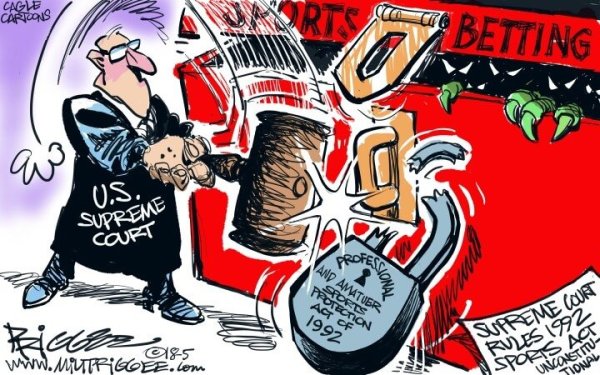
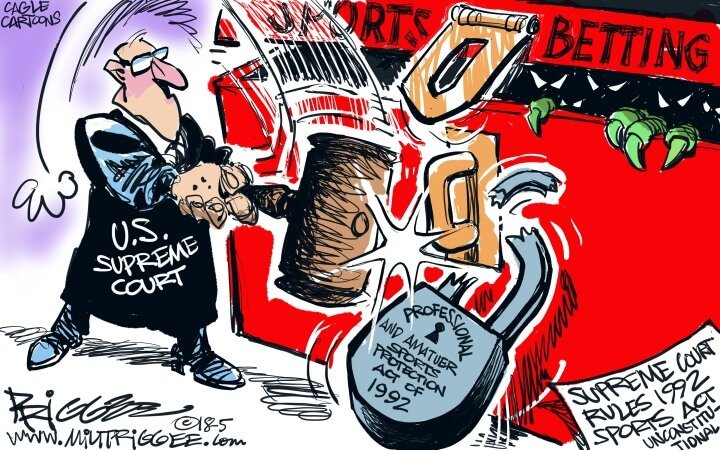
In its ruling, the Court didn’t legalize sports betting; it ruled that authorization resides with the states, according to the US sports betting guide at betting.com. But I take heart in the legal underpinnings of the Court’s decision. Why? The very same provisions could be used in the quest to legalize other domains of national interest, including the recreational use of marijuana.
The majority opinion is based on two planks—The 10th Amendment and The Anti-Commandeering Doctrine.
The 10th Amendment reads:
Related stories
“The powers not delegated to the United States by the Constitution, nor prohibited by it to the States, are reserved to the States respectively, or to the people.”
SCOTUS concluded that the prohibition of sports gambling had not been delegated by the Constitution or sufficiently restricted by Congressional action. Consequently, the Court ruled as unconstitutional The Professional and Amateur Sports Protection Act (PASPA) of 1992. That Act had outlawed sports betting nationwide except in four states—Oregon, Montana, Delaware, and in licensed sports parlors in Nevada.
The Anti-Commandeering Doctrine is based on two prior rulings—New York v. United States (re radioactive waste disposal) and Printz v. United States (re gun distribution and use). It declares that the Federal government can’t impose itself via coercive means on state legislators and/or state-level executives. This doctrine protects states against possible Federal overreach.
Why should Progressives support legal sports betting? One answer is that America should—as much as is feasible—replace illegal marketplaces with legal systems to support activities associated widespread social behavior. Tax revenues—otherwise non-existent—would then be used for the public good.
But in taking it’s “up to the individual states” stance, the Court set in motion what could become a free-for-all with different states enacting different laws. In response, Congress now appears to be motivated (finally!) to enact Federal legislation regarding national gambling oversight.
Why should Progressives support legal sports betting? One answer is that America should—as much as is feasible—replace illegal marketplaces with legal systems to support activities associated widespread social behavior. Tax revenues—otherwise non-existent—would then be used for the public good.
I came to that conclusion quite early in life based on a personal encounter with illegal gambling.
My grandparents ran a neighborhood convenience store, and one day I heard them talk about “the numbers” and something called “The Black Hand.” That conversation made no sense to me, but the look on their faces told me something was up. With age, I realized that my grandparents were active agents of illegal gambling. Local mafia guys, “The Black Hand,” coerced them into selling what we know today as “lottery tickets” (i.e., “the numbers”).
Today, states across the country—not the mafia—run lotteries as legal enterprises. In the national aggregate, state lotteries generated nearly $18 billion for state coffers in 2010. By 2015, that number had grown to about $25 billion. Funds generated are used to support the public good, including public education.
The same type of public benefit is being served by marijuana sales. In Colorado, pot sales in 2017 exceeded $1.5 billion dollars and the state’s cut totaled nearly $250 million in taxes and fees.
The public cut of legal gambling activities could generate similar numbers—even in smaller states, like West Virginia. Industry experts predict that The Mountain State could benefit by as much as $235 million over three years. And in larger states, like California—where it’s estimated that between $20-$40 billion dollars are being wagered illegally each year—the take would be even larger. California State Assemblyman Adam Gray predicts "you could see tax revenue as high as a $100 million or $200 million a year to the state general fund if we authorize sports wagering."
For Progressives, it’s the prospect of public good coming from what’s currently an illegal activity. The problem, of course, is assuring that funds generated actually benefit the public good. And research done on the outcome of state lotteries represents a cautionary tale.
Several years ago the analytic group, FiveThirtyEight, found considerable unevenness across states with respect to how lottery revenues were spent—on prizes vis-à-vis the states’ cut—save for consistency with respect to lottery administrative costs. And, earlier this month, The Brookings Institution reported uneven impacts of lottery revenues on the support of state-funded higher education. “Merit-based aid may be undermined if it comes at the expense of funding for need-based aid,” the Institution found.
The conclusion: the public benefits of legalizing sports betting isn’t a sure thing. But in today’s constrained public fiscal environment, it seems worth the chance. That’s because there is a sure bet: if we don’t legalize sports betting, it will continue as an illegal activity. And those illegal revenues are considerable—equal to the revenues generated last year by The Ford Motor Company.

Frank Fear
Comments

Powered by RoundtableAn AI/DeFi-powered Enterprise Media Operating System. Learn more at Roundtable.io.© Roundtable 2026. By using this site you agree to the Terms of Use and Privacy Policy