
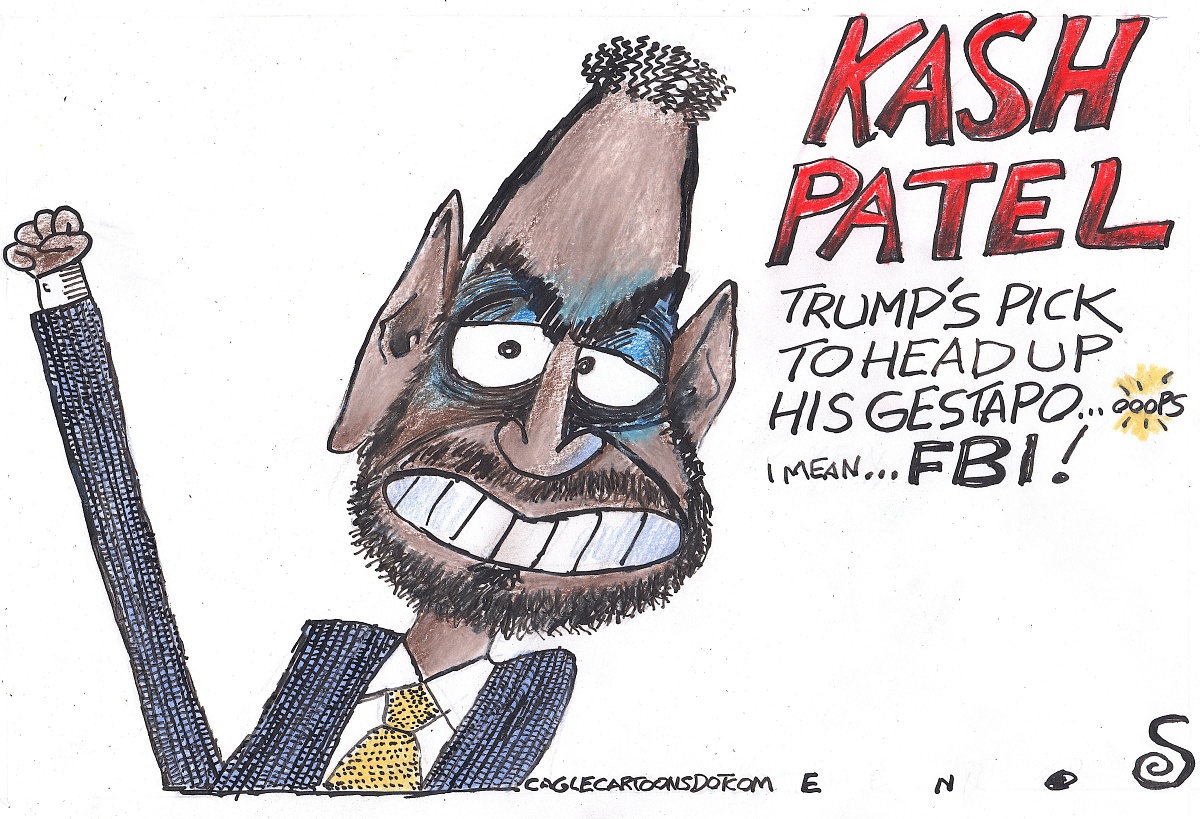
Cagle Cartoons: Randall Enos


Kash Patel
Dec 4, 2024 5:43 PM
Patel’s history reveals a disregard for the rule of law and a propensity to weaponize government functions against perceived enemies.
Kash Patel’s potential appointment as FBI Director would be, by any measure, a shockwave to an already fragile democratic system. As David Corn aptly outlines in Mother Jones, the reasons for his unfitness to helm one of the nation’s most powerful agencies are manifold and alarming. Patel is no stranger to controversy; his career has been marked by a willingness to politicize intelligence and law enforcement, bending institutions to serve partisan agendas rather than the public trust.
Corn notes Patel’s close association with Donald Trump and his critical role in advancing baseless conspiracy theories aimed at undermining faith in the FBI itself. From his involvement in efforts to discredit the Russia investigation to his participation in Trump’s chaotic post-presidency maneuvers, Patel has proven himself a staunch loyalist to a single individual rather than a defender of institutional integrity.
Even more troubling, Patel’s history reveals a disregard for the rule of law and a propensity to weaponize government functions against perceived enemies. His elevation to FBI Director would likely accelerate the erosion of norms and further politicize an agency already under immense strain from external attacks and internal division.
The implications of such an appointment are staggering. It would signal the prioritization of loyalty over competence, vendettas over justice, and power over principle—a stark departure from the FBI’s foundational commitment to impartiality and the rule of law. Corn’s article serves as a warning: appointing Patel would not just be outrageous; it would be catastrophic
Related stories
Patel is a MAGA combatant who has fiercely advocated Trump’s lie that the 2020 election was stolen from Trump and who has championed January 6 rioters as patriots and unfairly persecuted political prisoners. (The still ongoing January 6 case, including scores of prosecutions for assaults on police, is one of the FBI’s largest and most successful criminal investigations ever.) Patel is also a fervent promoter of conspiracy theories. At the end of Trump’s first presidency, when he was a Pentagon official, he spread the bonkers idea that Italian military satellites had been employed to turn Trump votes to Joe Biden votes in the 2020 election. And he has falsely claimed that the Trump-Russia scandal was a hoax cooked up by the FBI and so-called Deep State to sabotage Trump.
Moreover, Patel has been supportive of the most loony conspiracy theory in MAGA land: QAnon.
Corn identifies what is surely the most chilling aspect of Kash Patel’s potential appointment as FBI Director—his fervent alignment with QAnon—a movement steeped in conspiracy, paranoia, and violent fantasies. QAnon’s ideology has fueled attacks on democracy, inspired insurrectionists, and perpetuated some of the most dangerous falsehoods in modern politics. For someone who openly supports such a movement to be considered for leadership of the FBI is not just inappropriate—it is perilous.
As a vocal QAnon sympathizer, Patel has embraced a worldview that sees shadowy, evidence-free cabals of Satan-worshipping pedophiles lurking in the highest echelons of power. This is the same belief system that motivated the violent storming of the Capitol on January 6th, 2021, a day when QAnon adherents sought to overturn the democratic process by force. The idea that someone who aligns with such delusions could lead the very agency responsible for safeguarding the rule of law is beyond alarming—it is a direct threat to the integrity of that institution.
Under Patel’s leadership, the FBI would be at risk of becoming a tool for conspiracy-driven agendas, used not to protect the nation but to pursue the ideological fantasies of QAnon and its followers. This isn’t just a hypothetical danger; it’s a formula for turning the FBI into a weaponized arm of disinformation and authoritarianism, undermining its mission to uphold justice and public trust.
To elevate Patel to this position would be to endorse the most extreme fringes of American political life, giving QAnon’s dangerous fantasies a foothold in the highest levels of law enforcement. It’s a decision that would not only jeopardize the FBI’s credibility but also imperil the very fabric of democracy.
According to Corn:
Patel acknowledged he was courting the QAnon crowd for Truth Social: “We try to incorporate it into our overall messaging scheme to capture audiences because whoever that person is has certainly captured a widespread breath of the MAGA and the America First movement. And so what I try to do is—what I try to do with anything, Q or otherwise, is you can’t ignore that group of people that has such a strong dominant following.” He praised QAnon, saying, “There’s a lot of good to a lot of it,” and he agreed with a host who said Q had “been so right on so many things.” Patel praised Q for starting a “movement.”
Appearing on Grace Time TV in September 2022, Patel said of the QAnon community, “We’re just blown away at the amount of acumen some of these people have.” He added, “If it’s Q or whatever movement that’s getting that information out, I am all for it, every day of the week.”
QAnon, which arose in 2017, has not received much media attention these days but we are making a grave mistake to assume that it no longer is a danger to the republic. QAnon holds that an intelligence operative known only as Q has revealed through cryptic messages that a cabal of global, Satanic, cannibalistic elitists and pedophiles is operating a child sex trafficking operation as it vies for world domination and conspires against Donald Trump. This evil political cartel supposedly includes Democratic politicians, Hollywood celebrities, business tycoons, and other notables. Those who believe this bunk see Trump as a hero who is secretly battling this conspiracy in a titanic, behind-the-scenes struggle. It is pure nuttery. Worse than that, QAnon has sparked multiple acts of violence.
QAnon’s impact on American politics is undeniable. In the solitude and alienation of modern life, it offers a stage for ardent believers to weave a tapestry of lies, each thread an opportunity for virulent expression, each fabrication a spark for passion. Their aim is nothing less than to flood the public square with their fervent beliefs, their unyielding declarations echoing like the cries of prophets in a wilderness of misinformation.
For those ensnared in its orbit, QAnon is less a theory than a creed—a gospel of cryptic messages and coded promises. Its adherents construct an elaborate cathedral of belief, a fragile and dizzying epistemological architecture that stands in stark contrast to the grounded rationality of mainstream thought. And yet, for those thirsting for adventure, for belonging, for purpose, this architecture is irresistible, offering a refuge from the mundanity of fact in favor of the thrilling allure of fiction.
As Julia Carrie Wong so aptly describes it:
“More than just another internet conspiracy theory, QAnon is a movement of people who interpret as a kind of gospel the online messages of an anonymous figure – ‘Q’ – who claims knowledge of a secret cabal of powerful pedophiles and sex traffickers. Within the constructed reality of QAnon, Donald Trump is secretly waging a patriotic crusade against these ‘deep state’ child abusers, and a ‘Great Awakening’ that will reveal the truth is on the horizon.”
In this distorted reality, Donald Trump is a messianic figure, waging a covert war against unseen enemies. The promise of a “Great Awakening” looms just beyond the horizon, a promised utopia that will vindicate their beliefs. But like any house of cards built on whispers, the slightest breeze of scrutiny could bring it all crashing down—though the faithful, lost in the thrall of their narrative, may never notice the collapse. For them, the dream is too intoxicating to abandon.
Many who stand outside the tangled web of QAnon first encountered its bizarre underpinnings through the notorious “Pizzagate” conspiracy. This baseless theory claimed Hillary Clinton was orchestrating a child sex-trafficking ring from the basement of Comet Ping Pong, a cheerful Washington, D.C. pizza restaurant known more for its ping-pong tables and kids' craft rooms than for secret atrocities.
The fantasy burst violently into reality on a Sunday afternoon, December 4, 2016, when Edgar Maddison Welch—a man driven by QAnon’s spectral gospel—stormed through Comet Ping Pong’s front door, armed to the teeth with an AR-15 rifle, a .38 revolver, a shotgun, and a folding knife. Convinced he was on a noble quest to rescue tortured children, Welch fired his rifle. Miraculously, no one was hurt, and the horrifying drama ended with his arrest. The restaurant had no basement, no captive children, no sinister plot. But to QAnon followers, this glaring absence of evidence was immaterial; their faith remained unshaken.
The ease with which such myths take hold is alarming. Consider the Wayfair conspiracy: one Reddit user, musing about the price tags on industrial-grade cabinets—many priced over $10,000 and bearing female names—sparked a theory that the company was trafficking children disguised as furniture. Despite Wayfair’s factual explanation—these were industrial cabinets, and product names were randomly generated—QAnon devotees eagerly dug deeper, linking the company to heinous, imaginary crimes.
Not all QAnon conspiracies dwell on child sex trafficking, but their adaptability to current events ensures their survival. When COVID-19 swept the globe, they heralded the use of industrial bleach, “Miracle Mineral Solution,” as a cure. When wildfires consumed the West Coast in 2020, QAnon amplified a baseless claim from a failed Senate candidate that Antifa had intentionally ignited the infernos.
QAnon’s reach doesn’t stop at U.S. borders. Like a dark tide, its narratives have seeped into international consciousness, adapting to local fears and crises, proving that no conspiracy is too outrageous, no audience too rational, for its seductive lies.
What, then, has captivated the minds of QAnon adherents since it burst upon the political scene? It remains, to no one’s surprise, the grotesque specter of blood-slurping, torture-loving, Satan-worshipping cannibalistic pedophiles—an image so lurid it could have been pulled from the fever dream of a pulp horror novelist. But this carnival of imagined depravity is not enough on its own. QAnon also feeds its followers a darker thrill: the intoxicating fantasy of rebellion, the audacious allure of smashing through the foundations of democracy itself.
For these believers, January 6th was not an aberration but a siren call. They romanticize the storming of the Capitol as a righteous crusade, a heroic uprising against the shadowy forces of betrayal. The rush of beating policemen, breaking barriers, and threatening to hang so-called traitors is, for some, less about politics and more about power—a visceral assertion of their reality over everyone else's. The chaos is their theater, the destruction their manifesto, the noose their punctuation mark.
It is this volatile cocktail of apocalyptic mythology and revolutionary zeal that keeps QAnon’s fires burning. They see themselves not as conspiracy theorists but as soldiers of destiny, protectors of a crumbling nation, determined to burn it all down to save it. It is a grim spectacle, both fascinating and terrifying, as they march further into a labyrinth of their own design, each step dragging the fragile threads of democracy closer to the brink.
Brian Bethune writes that QAnon adherents today are obsessed with the false notion that the election was stolen from Trump:
QAnon – an otherwise heterogeneous mix of unfounded and unrelated conspiracy views – universally regards the former president as the secular Messiah destined to rescue America from a Satan-worshipping cabal of cannibalistic pedophiles centered in Biden’s Democratic party, Hollywood’s elite and the so-called deep state.
That belief constitutes QAnon’s anchor, and it gets worse, since
[e]mbedded within the horrific claims that cabal members prolong their lives by harvesting adrenochrome from the living bodies of children is the ancient and ongoing anti-Semitic belief that Jews drink the blood of Christian children. (Some believers assert the existence of a video of Hillary Clinton, the chief villain in the QAnon narrative, cutting off the face of a young girl to wear as a mask while she consumes the child: a sight so gruesome, so the story goes, that the New York police who discovered the video committed suicide.)
So, how does Q post his messages? What triggers these crazy stories?
Bethune writes:
The first of Q’s postings, known as ‘drops,’ featured the kind of reader-enticing questions and suggestions that became a hallmark of his (her? their?) messaging. Drop 1 was itself reactive, a response to another anonymous poster’s statement that Hillary Clinton would soon be arrested. Q agreed and amplified the claim. Her passport had been flagged, he wrote, ‘in case of cross-border run,’ and the National Guard mobilized to restore order should protest riots ensue: ‘Proof check: Locate an NG member and ask if activated for duty 10/30 across most major cities.’ Q, who went nameless for his first 33 drops, identified himself in Drop 34 as ‘Q clearance patriot,’ a reference to the high-security clearance level he claimed to possess as a government official; a day later, a Canadian user on the same site decided to call him QAnon, the name that stuck.
The remainder of Q’s 4,953 drops, just as inaccurate as the first, came at a raggedly uneven pace up to December 8, 2020 – sometimes 15 to 20 a day, separated by weeks of silence; sometimes just images of the US flag or links to YouTube videos; sometimes hundreds of words of cryptic declarations and rhetorical questions.
Bethune offers a cloak-and-dagger example of one of Q’s drops, Drop 2559, which reads in part:
RUSSIA = THE REAL CONSPIRACY; Define ‘PROJECTION’; What happens when they lose control, and the TRUTH is exposed? What happens when PEOPLE no longer believe or listen to the FAKE NEWS-CONTROLLED MEDIA, CONTROLLED HOLLYWOOD, CONTROLLED BLUE CHECKMARK TWIT SHILLS, ETC ETC???
How was this message by Q received by the cult members? And how do some Q followers profit from Q’s cryptic messages? Bethune explains:
As Rothschild notes in an interview, right-wing Internet personalities were immediately attracted to the way Q’s pro-Trump message was seemingly expressed in logic puzzles, ‘treating the drops as holy writ with hidden information that needed to be teased out in their own tweets or YouTube videos.’ Such movement ‘gurus’ as the Praying Medic and Joe M are as important as Q in the world he spawned, amassing social media followers and, often, lucrative pages on the Patreon paid subscription service. There is opportunity in QAnon, says Rothschild, for ‘grifters to make money from books and Q merch.’ Another practical pillar of the movement can be found in its online trolls, he adds, some involved because ‘they hate Jews or Democrats,’ others simply for entertainment.
When a video was broadcast of a cicada from Brood X, the swarm of insects that had recently emerged from seventeen years underground in Mid-Atlantic American states, landing on Joe Biden’s neck, a chat group of 225,000 QAnon members on the social media platform Telegram, lit up the dark channels of the internet in spectacular fashion because ‘any news referencing the number seventeen (the letter Q’s place in the alphabet) or the word underground (QAnon somehow believes that the deep state keeps captive children in subterranean tunnels), has the potential to be ‘comms’ (communication) from Q.’ Bethune puts this in perspective when he comments: ‘It is a very broad church indeed that can accommodate the concepts that its devil eats living children and its prophet speaks via cicada-comms.’ QAnon members ‘trust the plan’ because it gives them a focus for their retributive desire, which remains laser-focused on destroying Hillary Clinton and her cadres of elite cannibal pedophiles.
Now before you think all of this is just too absurd to consider, please recall that one third of adults believe the 2020 election was stolen.
It should come as no surprise that QAnon grew in prominence during the COVID-19 pandemic when its members threw their support behind furious anti-vaxxers and damn-the-torpedoes, full-speed-ahead mask resisters around the world. The QAnon cult could have cost hundreds and even thousands of lives with its support for a perverted view of freedom that does not take into account the simple fact that not wearing a mask or refusing to get a vaccination puts other people at greater risk of dying from the virus. What a selfish, egocentric view of freedom.
According to forensic psychiatrist Brian Holoyda, conspiracy theorizing could be an adapted evolutionary mechanism. He writes that
Some have hypothesized that conspiracy theorizing may be an evolutionary by-product of adaptive psychological mechanisms including pattern perception, agency detection, and threat management. Indeed, the processes of pattern perception and agency detection are well on display in the interpretation of banal events by QAnon theorists. For example, when Donald Trump was on a trip to Asia, Q posted photographs of islands that conspiracists interpreted as evidence that Q was on Air Force One.
QAnon adherents are willing to challenge almost any position taken up by those whom they consider the liberal elite, as they zealously follow their fellow believers on 4Chan (famous in internet culture for its racist extremism and campaigns of harassment) and 8Chan (a more extreme version of 4Chan) through posts – known as ‘breadcrumbs’ or Qdrops – from a so-called administration insider with high-level government security clearance codenamed ‘Q,’ whose messages are intriguingly cryptic and sometimes appear as puzzles (puzzles make it a lot more fun, doesn’t it?). Because Q posts anonymously, Q uses a ‘trip code’ that allows followers to distinguish his posts from those of other anonymous users (known as ‘anons’). In November 2017, Q decided to switch to 8chan from his usual posting on 4chan. He alarmed the QAnon community when he went silent for several months after 8chan shut down in August 2019. Q eventually re-emerged on a new website established by 8chan’s owner, 8kun. Julia Carrie Wong writes that
For close followers of QAnon, the posts (or ‘drops’) contain ‘crumbs’ of intelligence that they ‘bake’ into ‘proofs.’ For ‘bakers,’ QAnon is both a fun hobby and a deadly serious calling. It’s a kind of participatory internet scavenger hunt with incredibly high stakes and a ready-made community of fellow adherents.
QAnon adherents are “talking about a group of people who are operating our government against our wishes, and they’re molesting and torturing children and destroying our society,’ said Joseph Uscinski, a professor of political science who studies conspiracy theories. ‘It’s an incitement to violence.’
At times, their childish levity, lyrical outrage, cheerful obliviousness and self-indulgent chicanery – to say nothing of their pure and simple dishonesty – seems relatively innocuous until you realize their commentary is engendered by a ferocious desire to bring down the government and replace it with their own members. Or until you recall that the killings, domestic terrorism incidents, child-kidnapping schemes, and an attempt to destroy a coronavirus hospital ship were all carried out in the name of QAnon. According to Brian Hoyolda,
QAnon has been associated with various criminal acts. For example, on June 15, 2018, Matthew Phillip Wright blocked traffic on a bridge over the Hoover Dam with an armored truck containing two assault rifles, two handguns, and 900 rounds of ammunition. He held a sign next to the vehicle that stated, ‘Release the OIG report,’ and claimed that he was on a mission for QAnon to obtain a report on the conduct of Federal Bureau of Investigation (FBI) agents during their investigation of Hillary Clinton’s use of a private e-mail server for official public communications. He later pleaded guilty to charges of making a terrorist threat, aggravated assault, and unlawful flight from a pursuing law enforcement vehicle. On May 30, 2019, the FBI released a report classifying Pizzagate and QAnon as ‘fringe political’ conspiracy theories and noted that they likely motivate domestic extremists to commit violent and other criminal behaviour. It is therefore not surprising that many of those arrested for their participation in the January 6, 2021 insurrection at the United States Capitol building have been found to be loyal QAnon believers. Like any other type of belief, a conspiracy theory can motivate the believer to act, including in ways that are violent or otherwise unlawful. QAnon has managed to invade mainstream political discourse and spread to other nations. Given its wide uptake, general psychiatrists, correctional psychiatrists, and forensic psychiatrists may encounter individuals espousing belief in the conspiracy theory more frequently. It is therefore important for practitioners to understand the underlying tenets of this theory, as well as how QAnon compares to other types of atypical belief systems. Psychiatrists charged with evaluating or treating QAnon theorists should also be aware of how conspiracy theories spread, a process that has become more rapid and virulent with the rise of social media. Finally, forensic examiners require a framework by which to evaluate the role of QAnon and other conspiracy theories in the context of forensic assessment.
One of the more outlandish QAnon pronouncements includes the claim that many in the Democratic cabal have already been secretly captured and replaced by clones, President Biden being the most prominent. Another belief is that John F. Kennedy Jr. is still alive. Bethune notes that ‘Neither of those concepts came directly from Q, the still anonymous imageboard user who began it all on October 28, 2017.’ Some even claim that the younger JFK, who died in a 1999 plane crash, is not merely still alive but also Q himself. Kennedy purportedly functions as a covert political operative and will reveal himself as Trump’s new vice president. Some QAnon adherents believe that John McCain did not actually die of natural causes but was secretly executed for treason. Others maintain that Robert Mueller was a clandestine Trump ally investigating the president as a decoy operation. The QAnon shaman, made famous during the January 6 coup, claims that decorative tiles outside bathrooms in shopping malls ‘were coded signals for secret gangs of Deep State child-trafficking paedophiles to abduct children into a cave network to harvest the chemical adrenochrome from their brains.’ And there exists a subset of QAnon followers who believe in the existence of the ‘frazzledrip tape,’ which, according to Josef Burton, is
a purported video of Hillary Clinton and her assistant Huma Abedin ritually sacrificing and then eating a baby. This chaotic fever dream of demonic imagery is mixed with more prosaic enemies – elitist diplomats, complacent Washington insiders and Trump’s personal enemies list – to make up the shifting cloud of what is called the Deep State, the hidden enemy.
According to Josef Burton, the term “deep state” is used in the United States as ‘a catchall term for status quo power structures or hegemonic institutions.’ But, in Ankara, Turkey, where he worked in the US Embassy, the deep state is real, ‘a shadowy parallel system of power, not the power structure that you can openly see.’ The term describes ‘unauthorized and unknown networks of power operating independently of official political leadership … and includes state-aligned mafia figures as well as industrialists and conservative economic elites….’ Trump administration figures used the term ‘deep state’ ‘initially in much the same way that Barack Obama coined the phrase ‘the blob’ – as shorthand for the Washington establishment consensus.’
But the deep state is far from an establishment consensus. We know, for instance, that the deep state was involved in some serious skulduggery, from COINTELPRO in the 1960s, which consisted of a series of covert and illegal projects conducted by the Federal Bureau of Investigation (FBI) aimed at infiltrating, discrediting, and disrupting domestic American political organizations. The FBI famously monitored radical organizations, from Martin Luther King, Malcolm X and the Young Lords, to MK-ULTRA experiments on Canadian psychiatric patients in Montreal funded by the CIA and the Canadian government. We know that operatives at Fort Bragg’s John F. Kennedy Special Warfare Centre in the 1980s (previously known as the US Army Institute for Military Assistance) took part in ‘American covert efforts to fight communism – the men who ran the Phoenix Project death squads in South Vietnam and trained anti-communist secret police and commandos in Thailand, Iran, Italy, Greece, Guatemala and a dozen other countries, including Turkey.’
But, in the US, the victims of the ‘deep state’ as described by the right-wing extremists are often merely abstractions, not real:
In America, real and specific Deep State agents – celebrities, politicians, institutions – purportedly commit horrific torture on abstract categories of victims (patriots, children, etc.) who can never be specifically named or seen. Nobody has successfully proved voter fraud in the 2020 election. No child survivor of the elite Soros adrenochrome harvest has come forward.
That view of the deep state could be changing. Some ranks of QAnon, according to Burton,
are much less prone to the fantastic and make more concrete (although still totally baseless) claims. The events that they claim happened, the jargon they use to impart verisimilitude to their stories, and frequently the conspiracy theorists themselves are linked to the US military or security services.
Consider this fantastic rumor that was circulating just a month prior to the January 6 coup:
A month before January 6, rumors swirled among the Telegram channels and yet-unbanned Facebook groups where the Capitol rioters mobilized. For example, a specific military unit, the 305th Military Intelligence Battalion, was reported as having raided a secret underground server farm in Frankfurt, Germany. It was there, the story went, that the CIA had secreted away a server farm full of voting data with incontrovertible proof that the 2020 election had been stolen from Donald Trump. There had been casualties, but the raid was a success. The 305th had captured CIA Director Gina Haspel, and she had already been flown to Guantánamo Bay and been executed for high treason. While the real public affairs officer for the actual battalion was busy drafting a statement explaining that no, the Arizona-based unit of analysts was not a secret shock troop tasked with overturning the 2020 election and had not been engaged in a subterranean battle with the CIA in Germany, a retired lieutenant general, Thomas McInerney, was solemnly intoning that the 305th had taken heavy casualties. A month later, while the QAnon Shaman stood shirtless on the Speaker’s rostrum in the House of Representatives chamber in a horned headdress and howled about impending doom for traitors, Larry Rendall Brock stood on the House floor in a tactical plate carrier and helmet, giving instructions to other rioters. A former Air Force lieutenant colonel, Brock had tucked into his vest a bundle of zip ties meant to restrain detainees. (After his arrest, he claimed he actually had no targets for detention in mind but wanted to give the zip ties to the police.)
It appears that QAnon adherents who have some military experience are promulgating conspiracy theories about the deep state that now include mythic heroes, in this case, the 305th Military Intelligence Battalion, who purportedly executed Central Intelligence Agency Director Gina Haspel. But, of course, the military had to respond to this baseless rumor in order to stop its spread. Consider this disturbing statistic:
Seven per cent of Americans are veterans, but almost 20 per cent of the January 6 rioters had served in the military. A midlevel State Department official who covered South American affairs has now been charged with assaulting a police officer during the riot. This strike against the American Deep State on January 6 was therefore demographically closer to any putative Deep State than to the general public. Not all American security institutions are bad in this fantasy world.
But what is most alarming is that ‘conspiracy theories like QAnon and militias like the Oath Keepers that participated in the January 6 insurrection have found fertile recruiting ground within the ranks of law enforcement and the military.’ As Burton notes:
The targets of the real existing Turkish Deep State and the Americans who regard themselves as fighting against a fictional Deep State are the same. They are democracy, minority rights and the left…. As it meanders in translation, Deep State loses useful meaning and becomes the territory of wingnuts and cranks. If this continues to happen, we will lose sight of one last terrifying irony: that with their infiltration of the military and the security services, contempt for democratic processes and willingness to use political violence, the anti-Deep State conspiracists in the United States are well on their way to creating the unauthorized and unknown networks of power that the term Deep State was coined to describe. Years after Ankara, on my way to work at another diplomatic post, I watched January 6 unfold on my phone. The rioters stormed up the steps of the Capitol with the same vigor any US-trained officer might have displayed while overturning a Cold War-era election in some foreign country. America’s support for anti-democratic violence has finally come home…. The boys have indeed done it.
In a broader sense, all this mystery and otherworldliness is crucial to QAnon’s success as a cultish organization – perhaps the key factor in making QAnon exactly what Los Angeles-based conspiracy reporter Mike Rothschild calls it in the subtitle of his new book, The Storm is Upon Us: How QAnon Became a Movement, Cult, and Conspiracy Theory of Everything.
The way QAnon followers impart their experiences to others is generally through protest gatherings. But much of their activity involves online histrionics. Bethune stresses the interactive nature of QAnon, which is an important feature of the cult. But QAnon participants cannot be considered unintelligent. They are not. They are crafty and live in a world where the criterion of what is truthful is very different from the mainstream. They would be very happy living in a postmodernist world where truth is relative. Similarly, they would be happy to have Aleksandr Dugin (Putin’s favorite philosopher) as their philosopher-king, for whom truth is whatever you are prepared to believe. Julia Carrie Wong writes:
Will Partin, a research analyst with Data & Society, and Alice Marwick, a professor of communication at the University of North Carolina, describe QAnon as a ‘dark participatory culture,’ which is to say that it is a community that takes advantage of the infrastructure of social networking sites to bring disparate people together and foster discussion, collaboration, research and community, but directs those energies toward anti-democratic, regressive and even violent ends. ‘Everything about our research suggests that these people are not irrational; they’re hyper-literate, even if they’ve come to beliefs that are empirically inaccurate,’ Partin said. ‘That’s partly because they have a fundamentally different epistemology to judge what is true and false.’
Reddit originally was the source of QAnon followers, but, in 2018, the company banned 18 QAnon subreddits, the largest of which had more than 70,000 members but they are, nevertheless, still embedded in the ‘digital architecture’ of the internet and can be found on YouTube, Twitter, Discord and Facebook. Sometimes Facebook will ban QAnon if it engages in what Wong describes as the
digital astroturf tactics that Russian operatives used to support Trump’s presidential campaign in 2016. Those rules are aimed at operations in which actors make false representations about their identities in order to mislead people – a description that could encompass Q – but Facebook only applies its policy to deceptive behavior that occurs on its platform, not on 8kun.
But how dangerous is QAnon? Wong quotes Will Parton:
There are innate societal and individual harms to convincing people of a version of reality that is simply false, as QAnon does, said Data & Society research analyst Will Partin. ‘When a common sense of what is real and what is correct breaks apart, it becomes nearly impossible to reach a democratic consensus.’ And QAnon followers’ enthusiasm for misinformation is not confined to politics; as the coronavirus pandemic took hold, the groups became a hotbed for medical misinformation – something Facebook has claimed to be working hard to combat. Analyses by Gallagher, the social media researcher, and the New York Times demonstrated how QAnon groups fuelled the viral spread of ‘Plandemic,’ a 26-minute video chock full of dangerously false information about Covid-19 and vaccines.
Consider that the extremist Larry Cook, the administrator of Stop Mandatory Vaccination, one of the largest anti-vaxx Facebook groups, is urging QAnon believers to join his group, as he references the ‘deep state’ and stokes fear of forced vaccination and ‘FEMA camps.’ Read his twisted logic and imagine it being taken up by QAnon followers:
I have discussed the concept many, many, many times that vaccines destroy our connection to God and that we are in a spiritual war with Principalities of Darkness that have a death wish for our children, and humanity at large.’ Oh, and don’t forget to purchase his various products on his subscription-only platform for ‘medical freedom patriots.’
In May 2019, the FBI identified QAnon as a potential domestic terrorism threat in an intelligence bulletin. Despite this, Uscinski ‘consistently finds that QAnon is “one of the least believed things” out there, well below belief in theories about Jeffrey Epstein’s death, anti-vaccine hoaxes, and Holocaust denialism.’ Uscinski’s recommendation is that we not overly exoticize the QAnon narrative, reminding us that ‘most of the component parts of QAnon have been around forever.’ He notes parallels in the Satanic Panic of the 1980s and the plot of Oliver Stone’s JFK. And he’s concerned about the free speech implications of censorship by tech platforms.
Brian Holoyda warns that forensic psychiatrists will be encountering QAnon patients in the future, and it ‘is therefore important that psychiatrists understand the QAnon conspiracy theory, as well as how it is consistent with and different from other conspiracy theories’ and ‘to be able to differentiate QAnon beliefs from other types of beliefs, including delusions and other delusion-like beliefs.’ Belief in QAnon is not delusional, but it is delusion-like. Why? Because, according to Brian Holoyda,
belief in QAnon and other conspiracy theories fails to meet the DSM-5 definition of a delusion because their existence depends on a community or subculture of individuals that share the belief. In addition, there are degrees to which theorists adhere to their beliefs that may change depending on the evidence presented to them. Even those committed to act on behalf of QAnon, such as Edgar Welch (the Pizzagate gunman), may find that their “intel [is not] 100 per cent” or that their belief is shaken by evidence to the contrary. Finally, the fact that conspiracy theories are widely held within the general population indicates that they are not delusions, lest most of the population be considered to have a delusional disorder.
If you really want to understand QAnon believers, and you happen to be a school psychologist, then you could take some professional advice and try to
understand individual belief acquisition and maintenance and the impact of dyads, closed groups, and the internet in such processes… [and understand] … models of the adoption of unconventional beliefs. Relevant examples include the two-deficit model that involves the cognitive misinterpretation of an anomalous experience, and the socio-epistemic model that involves epistemic mistrust (i.e., lack of belief in the authority of traditional institutions), as well as information-processing biases that make an individual vulnerable to misinformation.
That might be too much of a mouthful for most people. But if it’s in your wheelhouse, maybe you wish to read about Carl Wernicke’s concept of overvalued idea. Since the idea of
extreme overvalued belief is meant to assist psychiatrists in distinguishing between delusions, obsessions, and DLBs to which someone may firmly adhere. Differentiating elements of the definition of extreme overvalued belief include that it “is shared by others in a person’s cultural, religious, or subcultural group,” that the “individual has an intense emotional commitment to the belief and may carry out violent behavior in its service,” and that it “is usually associated with an abnormal personality.”
I have no desire to canvas the psychological literature for possible connections with QAnon, but I will say that QAnon does not fit in the official definition of a cult. But it has merged of late with the Sovereign Citizen Movement. Holoyda expands on this particular psychological merger:
Though QAnon and its adherents are not a cult, its conspiracy theories have begun to merge with the pre-existing DLBs [delusion-like behaviors] of the sovereign citizen movement. Sovereign citizen beliefs have morphed since their inception in England in the 19th century, but common tenets include the United States’ rule via admiralty law; the creation of a corporate trust in a child’s name coinciding with the assignment of a social security number; and redemption by freeing oneself from the jurisdiction of the US government. Because of their beliefs, sovereign citizens attempt to combat government interference in their lives by refusing to pay taxes and filing excessive pseudo-legal documents in court. Recently some QAnon supporters used sovereign rhetoric to explain why Donald Trump will be President of the United States again. Specifically, QAnon adherents claimed in January 2021 that Joe Biden was inaugurated President of the corporation of the United States, but that Donald Trump would be inaugurated as President of the original republic on March 4, 2021. This cross-over of sovereign beliefs into QAnon further demonstrates the malleability of the conspiracy theory and the difficulty of distinguishing between different DLBs, including similar types of DLBs.
The QAnon conspiracy theory has a fraught and contentious relationship with reality. It can easily be absorbed into our everyday tribal thinking. It poses a very different danger to the liberalism that every so often re-initiates us into the giddy whirl of bourgeois subjectivity with its aerosol thinking, its jacuzzi reformism, and its lap-dog governance and tilt-a-whirl ethics. In stark contrast, it presents the very danger of supporting the fascist logic of regimes such as Trump and Orbán. Hence, I will shoulder no conciliatory defense here for the rebarbative Manichean worldview that envelopes it. It exhibits cult-like behavior and is focused on death in a way that has captured the heart and minds of millions of its followers. Neither do I have any truck with establishing a dialogic relationship with proponents of one of QAnon’s cousins, the deep state. If we wish to rescue sanity from transmogrification, we need not make a covenant with vexatious interlocutors wearing black suits and Ray-Ban Wayfarer Classics for the sake of a need to chauvinize. Nor do I wish to purge those who claim to work in Area 51 from the sanctuary of good old-fashioned civility.
QAnon adherents are whacky, intellectually disjointed and permanently polarized from the mainstream; they are uncritical proponents of a tendentious doctrine that has them classified as a potential domestic terrorism threat by the FBI, who have linked the group to numerous attempted acts of violence. Yet Trump has praised Marjorie Taylor Greene, a supporter of QAnon, who won the Republican nomination in Georgia’s 14th congressional district, describing her as a ‘future Republican Star.’ When Trump was president, he was asked about QAnon. And he replied, ‘I don’t know much about the movement other than I understand they like me very much, which I appreciate…. I have heard that it is gaining in popularity.’ He also made the following remark: ‘These are people that don’t like seeing what’s going on in places like Portland and places like Chicago and New York and other cities and states. I’ve heard these are people that love our country, and they just don’t like seeing it.’ When a reporter asked Trump a follow-up question, pointing out that QAnon supporters believe Trump is ‘secretly saving the world from this satanic cult of pedophiles and cannibals,’ Trump replied blithely: ‘I haven’t heard that, but is that supposed to be a good thing or a bad thing? ‘If I can help save the world from problems, I’m willing to do it, I’m willing to put myself out there, and we are, actually. We’re saving the world from a radical left philosophy that will destroy this country, and, when this country is gone, the rest of the world will follow.’
When Alabama’s football team presented Trump with a jersey bearing the number 17, which also happens to be the position of the letter Q in the alphabet, the QAnon community saw this as a sign of support for their group. Never mind that Trump himself is estimated to have promoted the conspiracy theory at least 265 times via retweets of QAnon-associated accounts between October 2017 and October 2019.
Notwithstanding their ambiguous nuances, and their self-fashioning as free beings, QAnon believers are determined to marshal their fanatical fantasies that involve glorious revenge scenarios against Satan’s minions in the service of siphoning away Democrats’ political power. They will do anything to ‘own the libs’ in the name of their sham Republican orthodoxy, where everything is weighted by a factor of untruth and where they don’t mind mixing weirdness into their political gruel (JFK is going to appear from the grave and join Trump in destroying the ‘paedo’ Dems). The followers of QAnon are passionate and tenacious, perfect conscripts for the battalion of loonies in Trump’s army of followers. People who feel Trump is part of God’s plan will go to great lengths to see his destiny fulfilled. QAnon is a cult-like organization where raw stupidity has never been equaled in trenchancy, where the unadulterated lie joins in holy matrimony with deific audacity. Its members are less than scrupulous about logic or rational argumentation than most. They seek to create an affective investment in preposterous ideas in order to create the chaos necessary to challenge democracy. What is worse is that they actually believe their own nonsense. QAnon is an apocalyptic religious cult-like organization where information is accepted on faith, where false beliefs give meaning and purpose to their cavalcade of empty lives, where a connection is made with a narrative so all-encompassing that it engulfs and smothers all counter-intuitive attempts to explain it away. If somebody tells you that the government is carrying out disinformation campaigns and that gets your blood boiling, how much more compellingly seductive is the belief that Satan is being worshipped by an elite group of Democrats and Hollywood stars who carry out cannibalistic rituals that include peeling the faces from their victims, and who are going to be punished by Donald Trump, God’s ‘Chosen One.’
There is no QAnon codex; there are no golden tablets or resplendent temples, so there is no need here to transcode complex glyphs into determinate behavior to try to figure out what makes the QAnon cult so bizarre.
We all know that the government, together with large corporations, keeps secrets from the public, such as surveillance programs of citizens. It brings solace to people trapped in siloed communities of modern, digitalized, neo-feudal, post-industrial life to share their fears and feelings of vulnerability with groups who reside outside their normal everyday lives and to realize that others feel the same way you do. In the case of QAnon, the interanimation of ideas and variegated sets of preposterous beliefs remain convoluted, a catharsis of unreason, loosely linked to a warped interpretation of Christianity or its gnostic variants, that can’t be easily refuted as self-evidently wrong but that smell awfully suspicious. As partisans of illiberal thought, their ineluctable vicissitudes and attention-seeking behavior have put QAnon’s epigones and disciples on a path to an alternate, evidence-free reality. Yet they cannot help to antagonize and bastardize the very grounds of rationality that most of us take for granted. Their perversity of reason – inspired by a hatred of liberal democrats and their embeddedness in ‘woke culture’ – plays a salient role in the concrete unreasonableness of daily life in America.
To what extent Patel believes most of the extreme conspiracies promulgated by QAnon can only be inferred at this point. But it is in no way reassuring to learn of his comments promoting his children’s book. Corn writes:
When Patel was promoting a children’s book he wrote—about a King Donald who is persecuted by his political enemies—he offered ten copies in which he signed the books and added a special message: “WWG1WGA!”” That’s the QAnon motto: “Where we go one, we go all.” He hyped this special offer on Truth Social using the hashtag “#WWG1WGA.”
For the majority of Americans who cast their vote for Donald Trump, there was likely some awareness that his appointments would stir controversy. After all, Trump’s political brand has always thrived on disruption, his picks often reflecting his preference for loyalty over competence, and ideology over expertise. But whether this means that a growing number of Americans are sympathetic to conspiracy theories like QAnon is harder to gauge.
What is undeniable, however, is the alarming trajectory of Trump’s administration, marked by the elevation of extremists to positions of power. From individuals openly hostile to the institutions they were appointed to lead to figures tied to fringe ideologies, these selections have fundamentally reshaped the tone and priorities of governance.
The potential appointment of Kash Patel—a vocal QAnon supporter—as FBI Director is emblematic of this trend, signaling not just poor judgment but an embrace of dangerous and divisive beliefs. Such decisions force us to confront a sobering reality: conspiracy theories, once relegated to the fringes, are now creeping into the highest levels of power.
Whether or not the average voter aligns with QAnon, the normalization of its adherents in government is deeply troubling. It is no longer just about individual appointments but about the erosion of democratic norms, the weaponization of misinformation, and the legitimization of movements that thrive on paranoia and distrust. As these extremists rise to positions of authority, it becomes clear that vigilance is not optional—it is imperative.
If, for nothing other than his QAnon history, we have good reason to be wary of Kash Patel. I will let David Corn have the final word:
Seeking retribution, spreading conspiracy theories, backing an attempt to overthrow a presidential election, supporting J6 rioters, echoing Moscow talking points—none of this is what one would see in a responsible choice for FBI director. But Patel’s cozying up to QAnon is especially troubling. Among many vital duties, the FBI director oversees the federal government’s efforts to combat violent crime—an area where QAnon remains a concern. Patel’s relationship with QAnon shows either that he has a severely distorted view of reality or that he will recklessly exploit dangerous, misguided, and false ideas for political benefit. Neither is an approach suitable for the most powerful and important law enforcement agency in the land.
Parts of this article appeared in Pesaagora.
Comments

Powered by RoundtableAn AI/DeFi-powered Enterprise Media Operating System. Learn more at Roundtable.io.© Roundtable 2026. By using this site you agree to the Terms of Use and Privacy Policy