
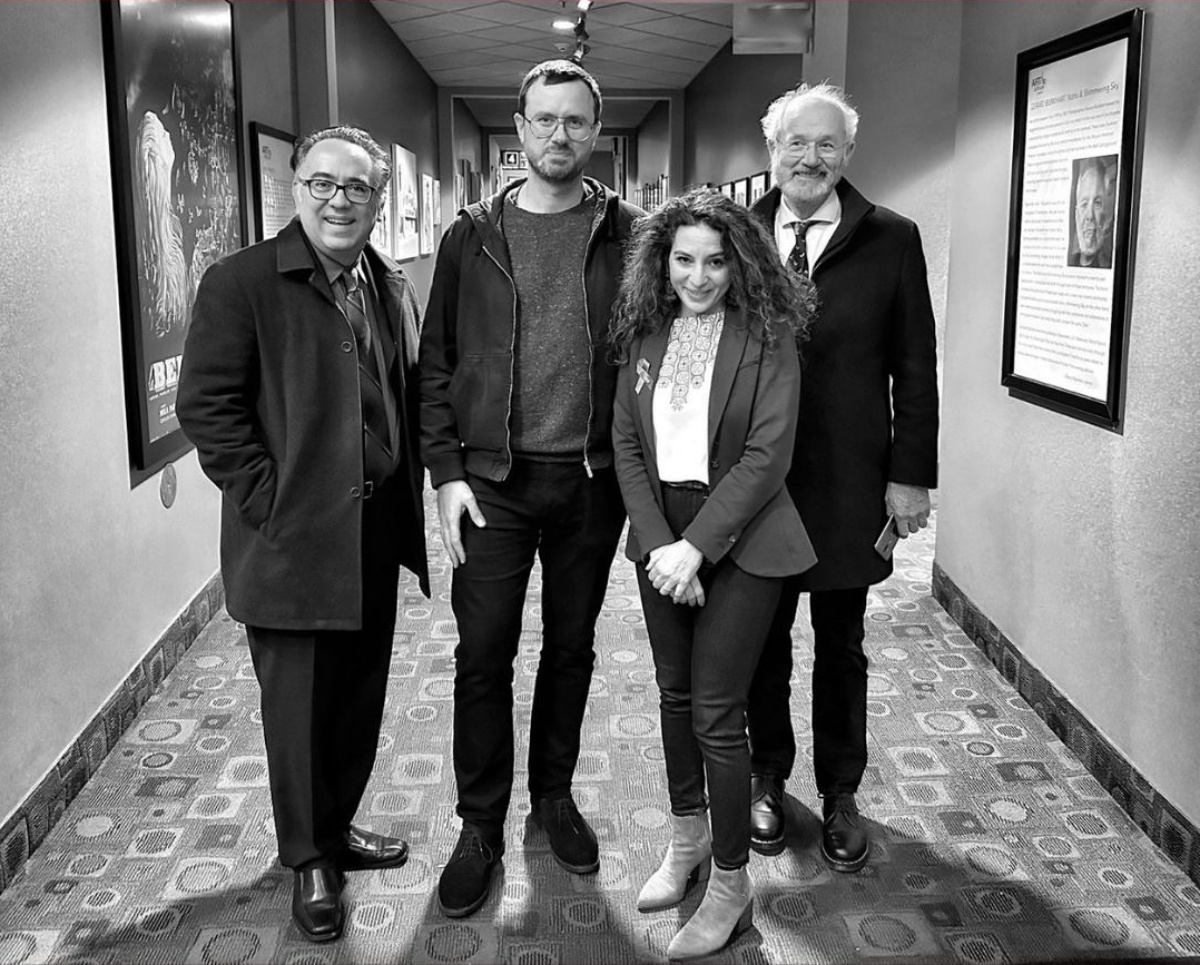
Panelists ACLU SoCal Executive Director Hector Villagra, Ithaka Producer Gabriel Shipton, ACLU SoCal President Rana Sharif, and John Shipton (Photo: Twitter)


Mar 3, 2023 4:57 PM
Their merciless attacks on Assange are not only a warning to American and international journalists, but also an instruction manual to other intelligence agencies and governments.
Arranged by the ACLU of SoCal and shown at the Laemmle Noho 7 one night only, Ithaka follows the indefatigable John Shipton around the world as he tries to rally support for his son, imprisoned WikiLeaks founder Julian Assange. As we follow Shipton, we learn about Assange and his case, and we meet Assange’s wife (and lawyer), Stella Moris, their children, and supporters.
During a brief discussion after the screening with ACLU Executive Director Hector Villagra, ACLU SoCal President Rana Sharif, and Gabriel and John Shipton, John Shipton wondered why the American intelligence community (AIC, as opposed to CIA) and our government were so obsessively and mercilessly hounding his son. In 2010, Assange had released via WikiLeaks immense tranches of classified American intelligence documents when it was the AIC and our government that couldn’t keep them secure. From the audience, I pointed out that he had answered his own question: The AIC and our government can’t keep their classified intelligence documents secure—Daniel Ellsberg, Edward Snowden, and Chelsea Manning are sufficient proof of that—so to intimidate others from doing what Ellsberg et al had done, they were mercilessly and obsessively hounding Julian Assange as an object lesson.
Among the most perverse ironies of Assange’s now 11 years of detention, some of it relatively easy, some of it brutal, is that there is little doubt that foreign governments already had everything WikiLeaks had released and more. The AIC and our government are comfortable having foreign governments know our secrets—it’s okay for governments to know each others’ secrets, and anyway it can’t really be prevented—but what the AIC and our government can’t forgive is that Assange, via WikiLeaks, had revealed those secrets to the American public. It isn’t a question of whether he betrayed the AIC and our government, it’s that he embarrassed them.

A fundamental security flaw is inherent in all computer systems: To be useful, they must be accessible, and accessibility makes them vulnerable to being, well, accessed. “False sense of security” is redundant; every sense of security is false. Add governmental addiction to secrecy and you’ve got problems. There are simply too many classified documents stored on too many servers by too many alphabet agencies too decentralized and too territorial with too many people having clearances and access to too much of it. And perversely, the more complex and baroque that system security measures become, the more potential cracks there are through which things can and will fall; data can and will leak through those cracks.
Related stories
As systems become increasingly complex, eventually there are so many obstacles that it becomes nearly impossible to get any work done. People inevitably take shortcuts, and shortcuts expose even more vulnerabilities. Further add the illegal, offensive, sometimes even monstrous nature of some of the material the AIC and our government tries to hide—lies about collateral damage (Oops, sorry!) and friendly fire deaths of football heroes, bombings of hospitals, videos of drone strikes killing dozens of civilians who happen to be near a high-value target—and analysts that see the material and are disgusted by it sometimes feel an overwhelming need to expose it. (See Daniel Ellsberg, Edward Snowden, and Chelsea Manning).
At one point in the film, the thoughtful and articulate Shipton says that the mark of one’s having done the right thing is that one would do the same thing again. Among the questions I would put to Julian Assange is, “Knowing what you know now, knowing what you have had to go through and put your family and friends through, would you do it again?” Because that’s the exact question the AIC and our government want all of us—not just journalists—to ask ourselves before we press Send.
The details of all the charges against Assange are at best murky, convoluted, and questionable—in a plot only over-imaginative CIA operatives could have conjured, Sweden, of all countries, is involved. But what’s so worrisome and spooky about all this is that, in fact, the charges and their validity don’t actually matter. The AIC and our government have, simply by charging Assange, imprisoned him without trial for 11 years.
Assange’s long detention began in June 2012 when, while free on bail, he was granted asylum in the Ecuadorian Embassy in London. He would remain there, effectively under house arrest, for the next seven years. At the end of that period, the Ecuadorians let in the British police, and he was arrested. Found guilty of violating bail, he’s since been imprisoned in London’s brutal, high-security Belmarsh Prison, much of his time there spent in mentally destructive solitary confinement. The AIC and our government are essentially using the British prison system to house an inmate who hadn’t yet been tried, much less found guilty; it’s Guantanamo, but in English.
An extradition request from the US was denied for health reasons, but in July of 2022 an order came from the British Home Secretary to extradite Assange to the US to face charges of violating the US’s 1917 Espionage Act. That order is under appeal. Subsequently a pardon was sought from the outgoing American president. Trump, who had once publicly thanked WikiLeaks for its revelations about Hillary Clinton’s campaign, denied the request.
The Biden administration was asked to drop the charges, but it declined after furious lobbying from the AIC; Conservatives, some of whom called for Assange’s assassination (Assangination?); Mitch McConnell (who is rumored to have threatened Joe Biden with impeachment should the charges against Assange be dropped); and Hillary Clinton. Clinton blamed her election defeat in part on WikiLeaks’s revelations about her, so she’s not entirely objective. She said Assange’s “disclosures were not just an attack on America’s foreign-policy interests [but] an attack on the international community.”
Part of the murk of intelligence work is successfully having things both ways. During a nearly 15-year PsyOp campaign, the AIC has succeeded in turning Assange into Schrödinger's cat: Both alive and dead at the same time, he exists and doesn’t exist. As part of the PsyOp, the AIC took over operation of the Ecuadorian Embassy’s security system, including its cameras, and was then able to watch Assange and his family. Ithaka contains film clips from the embassy security cameras in which we frequently see Catsky, the embassy cat. As I watched, I wondered, only partly in jest, whether the AIC could have gotten to Catsky. Was it even really Catsky, or a Catsky lookalike? Was it even really a cat? That’s how a PsyOp works: It erodes and corrodes one’s sense of reality.
Another facet of PsyOps is muddling issues, creating cognitive dissonance and providing legal and moral wiggle room. After the September 11 attacks, we began to see the term “extraordinary rendition” (i.e., the kidnapping of and taking people to secret houses outside the US where the kidnappers were free of pesky US law). Also "enemy combatant" was popular with the Bush cohort. This term allowed them to keep alleged members of al-Qaeda and the Taliban in permanent detention at Guantanamo, sometimes on the flimsiest of evidence. (Thirty years after the end of the Gulf War, 32 of those enemies are still there.) In this context, "enemy combatant" actually refers to persons the United States regards as unlawful combatants, a category of those who do not qualify for prisoner-of-war status under the Geneva Conventions. However, unlike unlawful combatants who qualify for some protections under the Fourth Geneva Convention, enemy combatants, were, according to the the Bush administration, not covered by the Geneva Convention. See? Thus categories were deliberately muddled so prisoners could be held indefinitely without trial and legally tortured. Though they have not (yet) named him as such, "enemy combatant" is how the US is treating Julian Assange.
Yet another facet of a PsyOp is distraction. One such distraction is fomenting a false debate about whether Assange is a journalist and thus entitled to First Amendment press freedom protection. Here’s the First Amendment:
Congress shall make no law respecting an establishment of religion, or prohibiting the free exercise thereof; or abridging the freedom of speech, or of the press; or the right of the people peaceably to assemble, and to petition the Government for a redress of grievances.
In this context, whether Assange is a journalist and entitled to “freedom of the press” is a red herring. The Founders wanted both to ensure the free exchange of ideas and to limit the government’s ability to present official views cleansed of unflattering details while at the same time preventing the circulation of contradictory points of view. “Freedom of the press” is meant to insure that the whole truth is made available to the citizenry, but “freedom of the press” is about the content of speech, not how it is packaged. It is about function, not form.
Other Assange-related distractions are whether he disrespected two Swedish girls, whether he conspired with the Trump campaign to defeat Hillary Clinton, or whether he was secretly working with the Russians all the time.
None of this matters. It doesn’t matter whether Julian Assange is good or bad, liberal or conservative, journalist or attention seeker, respectful or disrespectful to Swedish girls. What matters—considering the gravity of the allegations, all that matters—is whether the monstrous behaviors of the American military and American politicians—the war crimes, the dirty tricks—detailed in the WikiLeaks document releases are true. But as any defense attorney will tell you, the best defense is a take-no-prisoners offense: If you lack grounds to defend the defendant, attack the plaintiff and make him defend himself.
Thus the real reasons the AIC and our government are hounding Julian Assange: To distract us from their wrongdoing, to force him to defend himself, and—this is the big one—to intimidate others who might be considering blowing the whistle on AIC and government abuses. Their merciless attacks on Assange are not only a warning to American and international journalists, but also an instruction manual to other intelligence agencies and governments about how to handle future Ellsbergs, Mannings, and Assanges. (See above, Hillary Clinton, “also an attack on the international community.”)
The longer Julian Assange is detained, the worse his health deteriorates, the happier that makes the AIC and our government because what they want is to demonstrate unequivocally to anyone tempted to tell what he or she knows about AIC and US government misbehavior exactly what they face if they proceed.
In fighting extradition, Assange is doing exactly what the AIC and our government want him to do: extending their opportunity to demonstrate their reach and power to wreck lives. The last thing the AIC and our government want is to have this tested in an American court of law in front of an American jury and have a jury find Assange not guilty.
To show the world that America really is back, the Biden administration ought to promise Julian Assange, should he return voluntarily, pre-trial freedom of movement so he can best prepare his defense. It would be the opposite of a show trial; it would be a show of faith trial, a show of faith in our system.
This is why I think Assange and his legal team’s strategy is wrong. Were he to voluntarily waive extradition and come here to face trial, the AIC and our government would suddenly have to answer many questions from many sources:
How can they justify charges of espionage against a non-US citizen (Assange is Australian) who simply released to the public documents given him by someone else?
What is free speech?
Are we in reality who we keep telling ourselves and the world we are?
But would Assange ever come voluntarily? The PsyOp that the AIC and our government have been running on Assange for so long has convinced him and his family and his advisors that when brought here he will again be placed in solitary confinement, this time at the US’s flagship supermax prison in Florence, Colorado. From there he would face a trial where the penalty could be 175 years.
But that would be yet another question the administration would have to answer, only this time to an engaged American press that would see the case as real because it was here on our soil rather than some abstract idea over there in a British gaol doubling as an extraordinary rendition torture house.
The goals of the AIC’s and our government’s Assange efforts are, purely and simplly, intimidation, the quashing of free speech, the neutering of the press. Assange has been effectively imprisoned without trial for 11 years.
Ithaka repeats several times that no journalist has ever been jailed for telling the truth. Exactly. The demonstrations, the adverse publicity, both at home and across the world, would be devastating to the American brand.
Should this come to trial, the government will almost certainly lose, and that’s what the AIC and our government are so afraid of. They can’t keep their secrets safe, and they can’t prosecute whistle-blowers. Holy crap.
But even in the unlikely event that Assange lost in front of a jury of 12 Americans raised on the importance of due process and free speech and freedom of the press and punishments fitting crimes—Wait, what is the crime, again, exactly?—there would be years of appeals. And, honestly, how much worse off would he be than he is now, serving what amounts to indefinite pre-trial imprisonment while the AIC and our government fuck with his head?
I know why Assange and his family, after a decade and a half of involuntary martyrdom—pre-trial imprisonment, solitary confinement, PsyOp mental torture—would want a pardon. They just want it to stop. Yet—and this is easy for me to say, I’m not in prison—a pardon kicks the free speech and press freedom cans down the road. What I think is that Assange should voluntarily give up the extradition fight, come here, and put the AIC and our government on trial while the press and the internet publish a “best of” the documents and videos Wikileaks released.
I am certain that the finest legal minds in America, selected from among the millions of lawyers who believe in what America can and ought to be, will fight each other to represent him. I believe that Americans will rise and rally around him and the things that we—not our government, we—hold dear. So how about it, Joe? Can we get a fair trial?
Comments

Powered by RoundtableAn AI/DeFi-powered Enterprise Media Operating System. Learn more at Roundtable.io.© Roundtable 2026. By using this site you agree to the Terms of Use and Privacy Policy