


Jul 20, 2026 8:44 PM
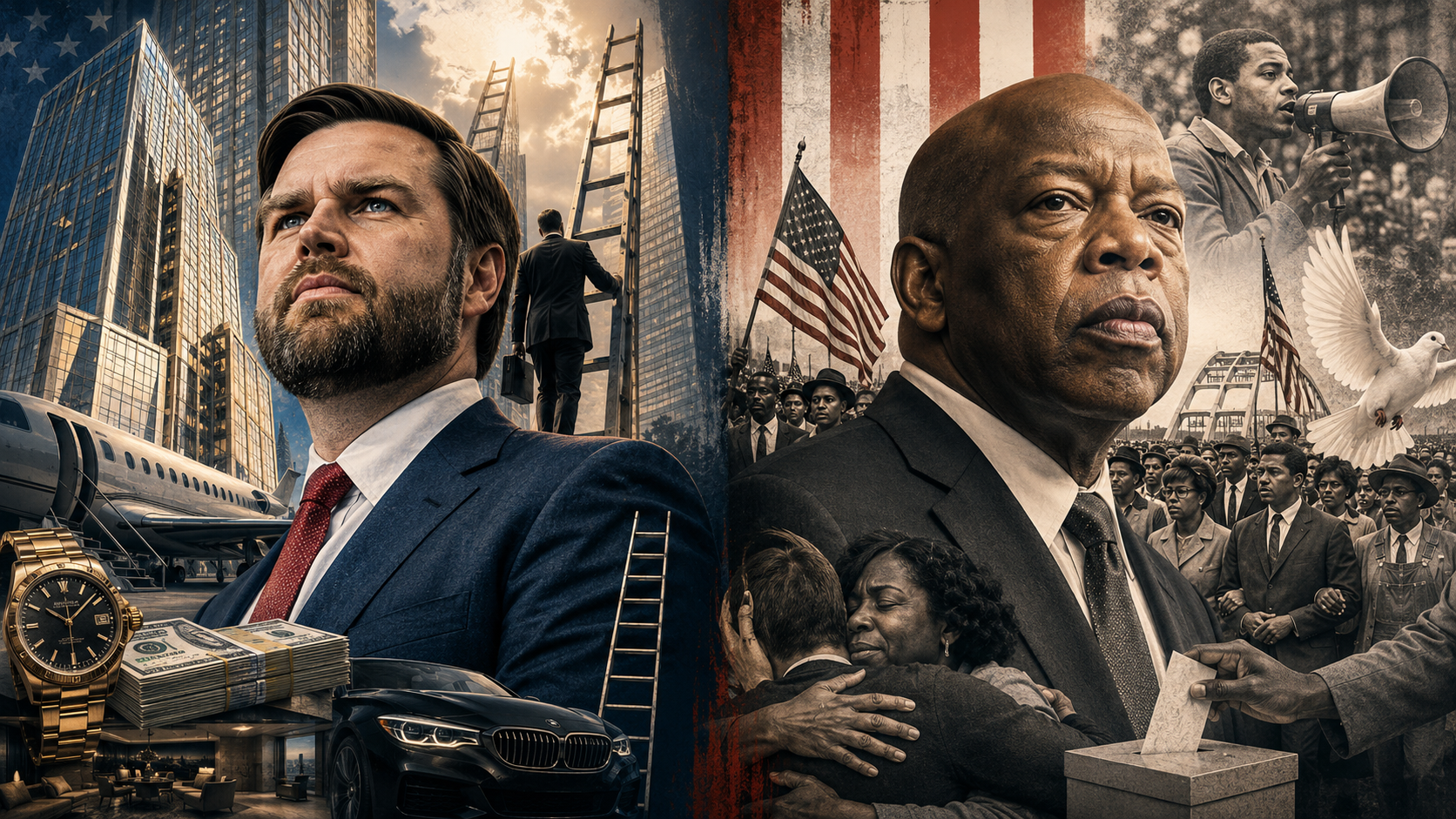
One vision measures success by wealth, status and upward mobility; the other calls America toward equality, dignity, peace and love.
In Vice-President J. D. Vance’s recent autobiographical Communion he writes,”One of the vices that animated me—looking back, probably since the earliest days of my life—was the arrogant desire to rise above others. In college I was obsessed with the question of social mobility. What were the odds that a person born in the bottom fifth of the income distribution would rise to the top fifth, or even to the middle? This question lay at the heart of the American Dream: Do poor kids have a chance of making it in our country? But it was also very personal for me: I was a poor kid, and I was desperate to make it.”
“Desperate to make it.” What did Vance mean by that? The answer is to be found in his earlier words--“I was obsessed with the question of social mobility. What were the odds that a person born in the bottom fifth of the income distribution would rise to the top fifth, or even to the middle?” That question, as he writes, “lay at the heart of the American Dream.”
And to most of our country’s men and women, he is right--the American Dream means we will have the opportunity to increase our standard of living, and our kids will be able to be better off financially than we are. (Although for a variety of reasons, especially our present climate crisis, there is no guarantee that tomorrow’s adults will be better off financially than today’s adults.)
The vision of Vance’s boss, President Donald Trump, was not very different from Vance’s, except that he was not born poor but rich--he grew up in a 23-room house with a chauffeur and a cook and possessed a Cadillac. But for him, society was divided between winners and losers. To his mind, the former were those who were financially successful, and the latter those who weren’t.
Related stories
He subscribed to the Horatio Alger myth--described by historian Christopher Lasch as the late nineteenth-century’s Gilded Age’s “dominant ideology of American politics.” The term implied the rags-to-riches success narratives characteristic of the many popular novels of Horatio Alger (1832-1899). As Lasch adds, “Failure to advance, according to the [Alger] mythology of opportunity, argues moral incapacity on the part of individuals or, in a version even more implausible, on the part of disadvantaged ethnic and racial minorities.”(In 1985 Donald’s father, Fred. was honored as the year’s Horatio Alger Award winner. In 2025, during Trump’s first year of his second presidential term, he and his family made at least $2.2 billion.)
But not all Americans limited the “American Dream” to economic advancement. For many Black and Native Americans their main “dream” had to do with achieving racial equality. Emancipator Frederick Douglass, for example, insisted that “our greatness and grandeur will be found in the faithful application of the principle of perfect civil equality to the people of all races and of all creeds, and to men of no creeds.” But it was not until almost a century later, in the 1960s, that Black and Native Americans came close to achieving such equality--and by many measures have still not achieved it, especially in our present Trumpian times.
Almost 70 years after Douglass’s speech, with racial segregation prominent in the South, Black poet Langston Hughes wrote his “Let America Be America Again.” It contained these lines:
I am the Negro bearing slavery's scars.
I am the red man driven from the land,
I am the immigrant clutching the hope I seek—
And finding only the same old stupid plan
Of dog eat dog, of mighty crush the weak. . . .
.
I say it plain,
America never was America to me,
And yet I swear this oath—
America will be!
And it was not just racial minorities that wished our “dream” to broaden. Besides equality, there were other elements that people wanted included in our dream--elements like more beauty. In 1908, for example, John Muir, sometimes referred to as the "Father of the National Parks," wrote: “For everybody needs beauty as well as bread.” They needed, for example, “our magnificent National parks.” But “they have always been subject to attack, mostly by despoiling gainseekers,--mischief-makers of every degree from Satan to supervisors, lumbermen, cattlemen, farmers, etc., eagerly trying to make everything dollarable.”
Back, however, to the 1960’s, a decade in which Martin Luther King Jr. (MLK) once more spoke of the American Dream. In his famous “I Have a Dream” speech (1963) at Washington D. C.’s Lincoln Memorial, he said, “I still have a dream. It is a dream deeply rooted in the American dream.”
But it was a July 4, 1965 sermon, “The American Dream,” at the Ebenezer Baptist Church in Atlanta, where King more fully detailed his vision of the dream. He began by quoting from the Declaration of Independence: “We hold these truths to be self-evident, that all men are created equal. He also spoke of religious tolerance and inclusiveness: he noted the “amazing universalism” of the phrase “all men,” which includes “humanists and agnostics,” as well as non-Christian believers. Later on in his sermon, King commented favorably on the non-Christian Gandhi’s teachings, which applied Jesus-like love to social interactions. And he stated that he was “more convinced than ever before that nonviolence is the way…. Oh yes, love is the way. Love is the only absolute.”
He also spoke of God intending “us to live together as brothers and to respect the dignity and worth of every man.” He noted that “on the one hand we have proudly professed the great principles of democracy, but on the other hand we have sadly practiced the very opposite of those principles”--e.g., in regard to Native Americans and Black people. And he regretted that since he gave his famous speech on that “sweltering August afternoon in 1963, my dream has often turned into a nightmare; I’ve seen it shattered.”
But MLK thought it was “marvelous and great” that our Founding Fathers left us with a dream “to forever challenge us; to forever give us a sense of urgency; to forever stand in the midst of…. our terrible injustices; to remind us of the ‘oughtness’ of our noble capacity for justice and love and brotherhood.”
In emphasizing that people can’t take from you the “right to pursue Happiness,” King perceived that happiness was more important than two of Vance and Trump’s favorites, money and fame.
After King’s assassination in 1968, some of his followers continued his mission of trying to make the American Dream come true. One of them was John Lewis, who was elected to the House of Representatives in 1986. While working with King, he had been beaten on occasion and arrested at least 40 times.
Already in 2011, Congressman Lewis had put out a press release celebrating the “4th of July and the Power of the American Dream.” He stated that “the American dream is more than living large. The American dream is the power to create one out of many and the goodness that flows from the unity of all human kind.” And in his final letter, right before his death in July 2020, he wrote “let the spirit of peace and the power of everlasting love be your guide.” Whether he realized it or not, he agreed with Holocaust survivor and psychotherapist, Dr. Viktor Frankl, who wrote in Man's Search for Meaning, “love is the ultimate and the highest goal to which man can aspire.”
Finally, in early July 2026, the website of the League of Conservation Voters (LCV) featured an article entitled “America 250: Facing attacks on the American Dream.” Although it didn’t mention “love” and “racial equality,” it did stress our environment and climate, and protecting “communities of color, low-income communities, women, and LGBTQ+ people.” In other words, it realized--as Vance and Trump do not--that the American Dream is about much more than money and fame.
Comments

Powered by RoundtableAn AI/DeFi-powered Enterprise Media Operating System. Learn more at Roundtable.io.© Roundtable 2026. By using this site you agree to the Terms of Use and Privacy Policy