


May 29, 2018 10:33 PM
Updated Feb 10, 2022 10:28 PM
John Peeler: As he envisioned socialism fundamentally as a rigorous equality of income among all, he saw capitalist society as the fundamental cause of the subjection of women.
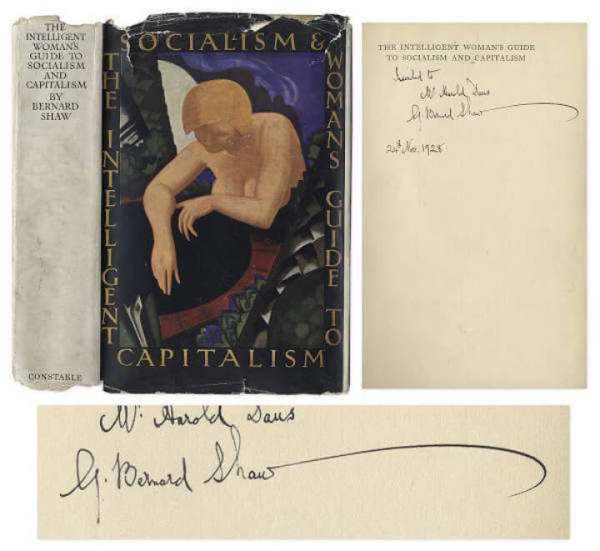
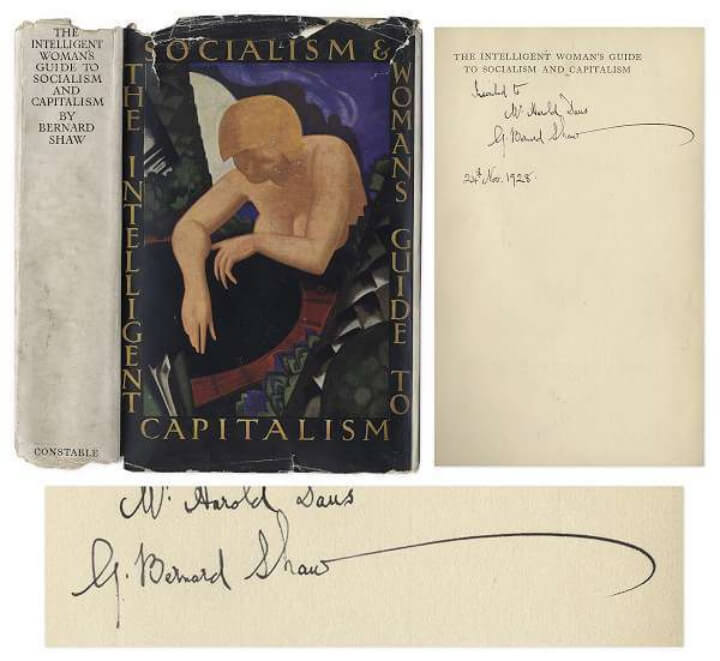
A Blast from the Past: Berhard Shaw's The Intelligent Woman’s Guide to Socialism and Capitalism (1928)
I was delighted to see this book at the local Mondragón Bookstore, and had a great time reading it for the first time (though I had known of it as one of the benefits of my liberal education). Shaw is better known as one of the leading English playwrights of the twentieth century. But even with a subject that has been known to induce comas, his gift for writing will engage the interested reader.
About the title: the modern reader will be put off, will find it patronizing. Indeed, but you have to put yourself back into the 1920s in upper class London; then you will see that Shaw was as much a feminist as his time and place would allow. He displays an acute awareness of the tensions and contradictions that confronted women of his time, and unreservedly pushed for full equality between men and women. But he couldn’t quite get his head around the idea that a woman who married need not become exclusively a homemaker and rearer of children. In his time, of course, that was the norm. But as he envisioned socialism fundamentally as a rigorous equality of income among all, he saw capitalist society as the fundamental cause of the subjection of women:
As he envisioned socialism fundamentally as a rigorous equality of income among all, he saw capitalist society as the fundamental cause of the subjection of women
At present a married woman is a female slave chained to a male one; and a girl is a prisoner in the house and in the hands of her parents. When the personal relations between the parties is affectionate, and their powers not abused, the arrangement works well enough to be bearable by people who have been brought up to regard it as a matter of course. But when the parties are selfish, tyrannical, jealous, cruel, envious, with different and antagonistic tastes and beliefs, incapable of understanding oneanother: in short, antipathetic and incompatible, it produces much untold human unhappiness.
Why is this unhappiness endured when the door is not locked and the victims can walk into the street at any moment? Obviously because starvation awaits them at the other side of the door….but there must be an immense number of cases in which wives and husbands, girls and boys, would walk out of the house, like Nora Helmer in Ibsen’s famous play, if they could do so without losing a single meal…
Related stories
As Socialism would place them in this condition it would infallibly break up unhappy marriages and families. (407-8)
The book is directed to the Intelligent Woman because she is oppressed (and may not know it), and because she is smart enough to follow the argument. That argument is Shaw’s analysis of the political economy of capitalism, and his advocacy for socialism as its necessary replacement. His critique of capitalism, not surprisingly, owes much to Marx:
Such poverty as we have today in all our great cities degrades the poor, and infects with its degradation the whole neighborhood in which they live. And whatever can degrade a neighborhood can degrade a country and a continent and finally the whole civilized world, which is only a large neighborhood. Its bad effects cannot be escaped by the rich. (42)
Because socialism is equality of incomes,
Socialism abhors poverty and would abolish the poor. A hearty dislike and disapproval of poor people as such is the first qualification of a good Equalizer. Under Socialism people would be prosecuted for being poor as they are now for being naked. Socialism loathes almsgiving, not only sentimentally because it fills the paupers with humiliation, the patrons with evil pride, and both with hatred, but because in a country justly and providently managed there could be neither excuse for it on the pauper’s part nor occasion for it on the patron’s. (95-6)
As a good Fabian, Shaw was convinced that socialism could and would be brought about gradually by parliamentary means, had a profound mistrust of revolution, and thought the Russian Revolution had gone seriously astray by treating Marxism as a religion. Yet he is not very positive about the parliamentary democracy that the Fabians relied on.
The naked truth is that democracy, or government by the people through votes for everybody, has never been a complete reality; and to the very limited extent to which it has been a reality it has not been a success. (452)
Capitalism, he thought, is like a runaway car that must somehow be controlled. The key to that is a strong state with robust taxes, but the voters resist that.
Thus our inability to govern ourselves lands us in such a mess that we hand the job over to any person strong enough to undertake it; and then our unwillingness to be governed at all makes us turn against the strong person, the Cromwell or Mussolini, as an intolerable tyrant….At each blind rush from one extreme to the other we empty the baby out with the bath, learning nothing from our experience, and furnishing examples of the abuses of power and the horrors of liberty without ascertaining the limits of either. (318)
Shaw had no better idea than Marx of how to make socialism a reality, but like Marx he surely enjoyed the vivisection of capitalism.

John Peeler
Comments

Powered by RoundtableAn AI/DeFi-powered Enterprise Media Operating System. Learn more at Roundtable.io.© Roundtable 2026. By using this site you agree to the Terms of Use and Privacy Policy