


Mar 2, 2023 10:06 PM
The destruction of democracy and its institutions will result from the increasing attack on ethical standards, the undermining of truth, and a mass consciousness that supports violence as a central weapon for social change.
The future of democracy in the United States will not be determined by the malignant decisions made by a reactionary group of Supreme Court justices who are waging a war on the most fundamental elements of democracy. Nor will it be decided by the existence of voter suppression laws, the ubiquity of the “big lie,” massive structural inequality, or the rise of white nationalism and a politics dominated by white supremacist ideology. Neither will it be decided by the rhetorical accelerant endlessly produced by former President Trump with his frequent allusions to violence and armed revolt. It will not be determined by a Republican Party that wages war on transgender youth, women, and people of color or a Democratic Party wedded to a savagely cruel neoliberal capitalism.
The destruction of democracy and its institutions will result from the increasing attack on ethical standards, the undermining of truth, and a mass consciousness that supports violence as a central weapon for social change. Accelerating this breakdown of democracy is the disabling of memory, the mass production of ignorance, and the weakening of the collective imagination. To the degree that the public can be convinced, as Judith Butler argues, that the “call for democracy is interpreted as sedition [and] the call for freedom is taken to be a call to violence,” democracy will suffer from a legitimation crisis and will disintegrate. Under these conditions, the devastation produced by capitalism will accelerate and become normalized; moreover, state-sponsored punishment will expand and will be used to criminalize more and more social problems; increasingly, fascist politics will gain more legitimacy and potentially prevail in the United States.
Since the brutal attack on the Capitol on January 6, insurrection has become a dominant motif informing politics, social media, and the mainstream press. Recurring images of the attack by a violent mob of Trump followers have solidified into a horrifying epic of lawlessness and deadly assaults, adding a ruthless optic to a long history of white supremacy, American exceptionalism, gangster capitalism, and state violence. All of which was amplified by the House January 6 committee hearings, which provided a civics lesson on a resurgent authoritarianism and white nationalism at work in the United States. While the mainstream media have failed to see the signs, authoritarianism’s historical political, racial, and cultural dynamics have become more visible, taking on a seditious and coarsening reality as they have emerged in boldly rhetorical, increasingly violent, and terrifying forms. Part spectacle, part reality check, the images of violence on January 6 have been appropriated not only by those exposing the dark side of authoritarianism but also by those, such as Rep. Marjorie Taylor Greene, who view the event as a symbol of what they term “our 1776 moment.”
Images associated with the Capitol insurrection included the waving of Confederate flags, “a makeshift wooden gallows, with stairs and a rope erected on the Mall,” “Camp Auschwitz” shirts, a sea of MAGA hats, and a frenzied crowd with some people yelling “Hang Mike Pence!” “Shoot the politicians,” “Fight for Trump,” and “America first!”—a “phrase popularized in 1940 by Nazi sympathizers” in the United States. Videos and TV footage of Capitol and DC police officers being attacked, beaten, and pummeled—over 140 were injured—revealed a vicious mob that believed it was above the law, urged on by Trump at a rally earlier that day, in which he stated, “If you don’t fight like hell, you’re not going to have a country anymore.” These were not innocent words said unintentionally in the heat of the moment. The impact of his incitement has to be measured against a range of comments provoking violence that Trump made in previous speeches and rallies. As Fabiola Cineas reported in Vox:
Related stories
Trump’s messaging on January 6 is precisely in line with how he’s historically addressed violence on the part of hate groups and his supporters: He emboldens it. As far back as 2015, Trump has been connected to documented acts of violence, with perpetrators claiming that he was even their inspiration. In fact, dozens of people enacted violence in Trump’s name in the years before the Capitol attack, according to a 2020 report from ABC News.
Trump’s attack on the foundations of democratic rule received enormous legitimation from his base and political party, and it was deeply rooted in a culture that normalized violence as a political tool while becoming increasingly cruel, frighteningly intolerant, and unabashedly disdainful of democracy. Even more disturbing is how Trump’s lies, racism, and attacks on his enemies attracted a broad swath of individuals of different ages and occupations, living in different parts of the country. Nowhere was the mainstreaming of radical politics more evident than in the fact that right-wing extremist groups such as anti-government militia could recruit both young and older people and create “a network across the US that include[d] former military members, police and border patrol agents.” Some of the individuals who attacked the Capitol police were still serving in the US military.
This dehumanizing reality did not begin with the Trump presidency. His recharging of white supremacist ideology and its merging with the discourse of violence has, as Henry Louis Gates, Jr. observes, “a long tradition and it’s a legacy of the rollback to Reconstruction.” Trump’s success in mobilizing millions to support his lies, racism, and unmitigated disrespect for the law has resuscitated terrifying elements in the social order that were once relegated to its margins. This flourishing reactionary political formation comes not only from the powerful influence of a right-wing propaganda machine and structural anti-democratic features built into the American political system—including the Electoral College, the filibuster, and the role of money in determining electoral outcomes—it is also the result of the Republican Party’s willingness to embrace unabashed white supremacy and a rebranded form of fascism as a gateway to power.
How else to explain Trump’s willingness to publicly make overtly racist comments as part of his broader attempt to expand his political power and gain more adherents to his evidence-free claim about a stolen election. Throughout his presidency and beyond, Trump has stirred racial tensions by mobilizing notions of white grievance. In the aftermath of the Biden election, Trump has done more than falsely claim the other side stole the election, reinforcing a dangerous strain of racism; he has also endorsed “white replacement theory” with his lie about whites being shortchanged by people of color. White replacement theory is a core ideology of white supremacists, who falsely claim that people of color are jeopardizing, if not replacing, the power, privileges, livelihoods, and rights of white people. For instance, at a political rally in Texas, Trump went so far as to claim that he was a victim of racism, as are white people in general. He told a Saturday night rally in Florence, Arizona, in January 2022 that “The left is now rationing lifesaving therapeutics based on race, discriminating against and denigrating … white people to determine who lives and who dies. If you’re white you don’t get the vaccine, or if you’re white, you don’t get therapeutics … In New York State, if you’re white, you have to go to the back of the line to get medical health.” White replacement theory has become code for racial cleansing and racial purity, parading under “frantic appeals to white survivalism.” While white replacement theory has a long history in the United States and Europe, it has taken on a new urgency given its compatibility with a growing fascist politics and militant white nationalism. It has become a central tenet of the modern Republican Party, which argues that white people as an alleged “native population” are being replaced by undocumented immigrants, Muslims, and others considered outside of the acceptable parameters of whiteness. Moreover, it is increasingly supported by prominent Republican officials, pundits, and media celebrities such as Fox News’ Tucker Carlson.
A week after Trump’s poisonous racist lie, close to two dozen white nationalists took Trump’s incendiary racist comments seriously and protested in front of Brigham and Women’s Hospital in Boston, holding a bedsheet with black lettering reading “B and W Hospital Kills Whites.” The line between Trump’s racist rhetoric and his open display of fascism is too direct to be ignored. Trump is not alone on the global stage. “Authoritarians are on the march” once again in Brazil, India, Hungary, Turkey, and Russia, and “in a disturbingly long list of other countries.”
Racism has once again become a central pillar of a political party, becoming a mark of pride, bigotry, and virtue. Democracy has reached a dangerous point and is once again under siege on a global level. As the Economist Intelligence Unit observed at the beginning of 2022, less than half the world is living in a democracy, and only “6.4 percent live in a full democracy.” Freedom House also released a report stating that democracy is in retreat worldwide. What is unique about Freedom in the World 2022 is that it singles out the United States, specifically Trump and the Republican Party, for the suppression of voting rights, attempts to overturn the election, and the ongoing sabotage of American democracy.
Equally disturbing is that the promises and ideals of democracy are being replaced by a fascist politics that trades in deeply authoritarian principles. These include racial discrimination, censorship, widespread disinformation, xenophobic nationalism, suppression of dissent, the threat and use of violence to achieve political ends, the conflation of state and corporate power, the cult of personality, a culture of fear and cruelty, white supremacy, and the absolute veneration of the strongman. The display of overt white supremacy by Republican Trump loyalists in the confirmation hearings of the well-respected Judge Ketanji Brown Jackson was an “object lesson for the entire world on the ongoing dynamics of systemic racism in the United States.” She endured a range of nauseating racist attacks by six right-wing GOP Senators in which she was accused of being soft on sentencing child pornographers, interrogated about her alleged support for the evils of critical race theory, and harangued over the revealing issue of whether she believed interracial marriage should have been left to the states, all of which had “little to do with the actual work of the supreme court.” As Jack Ahern pointed out in Salon, “White supremacy was undergirding each and every one of these senator’s questions, far exceeding the level of mere dog-whistles.” Racism has now become political theater—a performative act of unhinged bigotry and moral degradation. We have seen these trends before in times much darker than the present.
Attacks on democracy via threats of violence are hallmarks of fascist and authoritarian politics. This was clear not only in Mussolini’s use of Blackshirts to intimidate his opponents but also in Hitler’s use of his voluntary paramilitary force, the Brownshirts, which attacked Jews, gays, leftists, and other critics of Nazi ideology. Both groups have their contemporary American counterparts not only in groups such as the Proud Boys, Oath Keepers, and Three Percenters but also in far-right politicians such as Paul Gosar, Marjorie Taylor Greene, Matt Gaetz, and Lauren Boebert and spokespersons including Steve Bannon, Michael Flynn, Roger Stone, and Tucker Carlson. The terror of the unforeseen and unthinkable that runs through history—at work currently in Orbán’s Hungary, Marcos Jr.’s Philippines, Putin’s Russia, and Modi’s India, among other countries—is with us once again, rekindling violence, fear, and bigotry while offering the American public the swindle of fulfillment at work in the emotionally charged, hate-filled, conspiracy laden appeal of a rebranded populist form of neoliberal fascism. The callousness of neoliberalism has found its most powerful form of legitimation in the claim that the only alternative to its own failures is the call to replace the idea of democracy with the promises of an illiberal democracy—twenty-first century code for white nationalism, white supremacy, and unchecked authoritarianism.
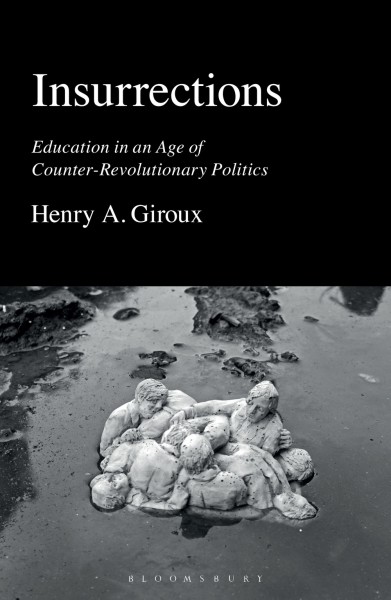
This article is the introduction to Henry Giroux's "Insurrections."
Comments

Powered by RoundtableAn AI/DeFi-powered Enterprise Media Operating System. Learn more at Roundtable.io.© Roundtable 2026. By using this site you agree to the Terms of Use and Privacy Policy