
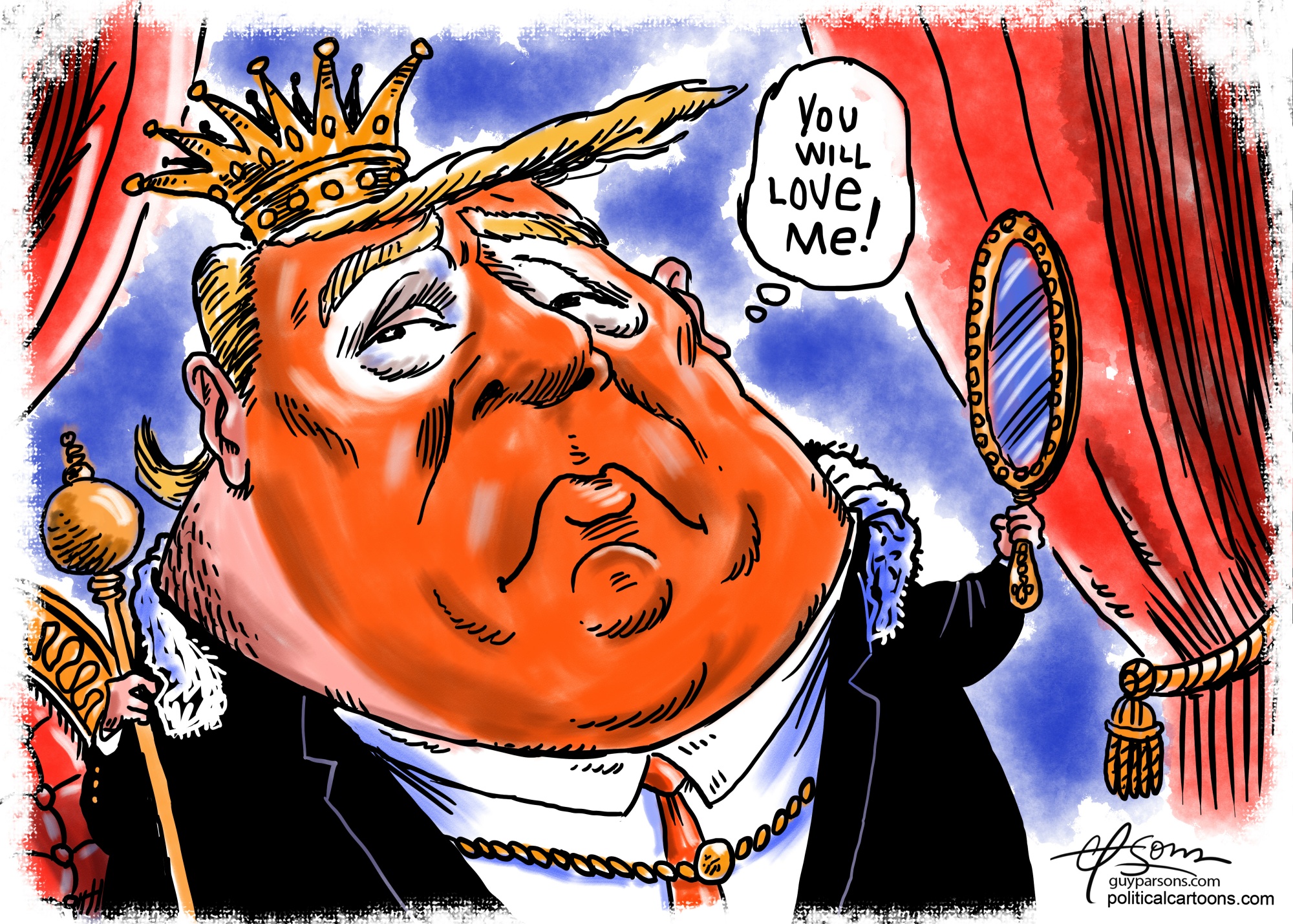
Illustration by Guy Parsons on CagleCartoons.com


No Kings Day is a line in the sand. Let’s honor the republic. Let’s remind each other—and the world—that in this country, power still flows from the people.
Aug 27, 2026 12:43 AM
Updated Aug 27, 2026 7:50 PM
Maggie Haberman and Jonathan Swan chronicle a first year of retribution, executive power, war, political vengeance, and presidential plunder.
This will be the definitive account of the stunning first year of Trump’s second chance Presidency. Haberman and Swan accessed the most secret councils and obscure conflicts to produce a detailed and disturbing picture of the most consequential presidency in the history of our country.
The book has several topical sections that overlap in time. The first is “Whirlwind,” covering the transition, inauguration, and the tumultuous first initiatives. There was the avalanche of first-day executive orders, largely prepared by Stephen Miller, Deputy Chief of Staff for Policy and Homeland Security Adviser. Miller emerges as a Rasputin-like figure in the shadows. There were multiple foreign policy initiatives seeking peace in Ukraine and Gaza, featuring the peculiar roles of Howard Witkoff and Jared Kushner as unpaid master emissaries charged with bypassing the professional diplomats. And who could forget the chaotic reign of Elon Musk’s “Department of Government Efficiency,” or DOGE? And the tariffs decreed by Trump were levied on essentially the whole world.
Part II, “Retribution,” deals with Trump’s enduring obsession with persecuting and prosecuting those he believed had done him wrong. The list was long. And he saw no contradiction in doing what he’d accused Biden of: politicizing the Department of Justice. What he expected of his DOJ was to pursue his enemies, to give them no peace. He didn’t seem to care if DOJ lost in court. Referring to New York Attorney General Leticia James, he said, “I want to make her life miserable.” It was pure meanness.
Trump’s demonization of any who were not with him is covered in Part III, “The Enemy Within.” The authors document Trump’s long fascination with strong military suppression of dissent, as in Tiananmen Square in Peking in 1989. He wanted troops in major cities (mostly led by Democrats). He wanted Homeland Security to aggressively seek out, arrest and deport illegal immigrants. The killing of conservative activist Charlie Kirk galvanized a determination to repress the Left, tarring all with the image of a violent Antifa movement. Stephen Miller took the lead on this, vowing to “identify, disrupt, dismantle and destroy these networks.”
Related stories

“Plunder” is the final part, focussing on the two major military actions of that first year: the seizure of Venezuelan President Maduro and the takeover of the rump of Maduro’s government, and the attack on Iran. Both had elements of Trump’s characteristic greed: he wanted to “take” the oil in both cases. The negotiation of a Board of Peace for Gaza is also included; greed played a role there too. After the UN Security Council finally approved it, Trump appointed himself its chairman, and all he could talk about was making Gaza into a resort like the French Riviera.
The Venezuelan intervention was preceded by weeks of bombings of alleged drug smuggling boats in the Caribbean and Pacific. It was not thought necessary to provide any evidence that those on board were actually drug smugglers, and on the few occasions when people survived the initial bombing, they were killed, not rescued.
The attack on Venezuela went remarkably smoothly: Maduro was captured and taken to a New York prison. His Vice President had previously indicated she would be amenable to continuing in office while taking orders from Washington. Secretary of State Rubio effectively became the Viceroy of Venezuela.
The Iran attack didn’t go so well. It was Prime Minister Netanyahu who pushed the idea of a joint attack, and who provided the key intelligence that the top Iranian leadership would be meeting with the Ayatollah at a known time and place. Calculations of what such an air assault might accomplish focussed on weakening Iran’s military capabilities, but also hoped for decapitation and regime change. Though there were those who worried that the Iranians could continue to pose a danger to US troops and the region, and specifically that they could close the Strait of Hormuz, all deferred to Trump’s dismissal of those concerns and his desire to go ahead. The narrative stops as the operation began.
We now know what didn’t happen. The final outcome is to come.
Comments

Powered by RoundtableAn AI/DeFi-powered Enterprise Media Operating System. Learn more at Roundtable.io.© Roundtable 2026. By using this site you agree to the Terms of Use and Privacy Policy