
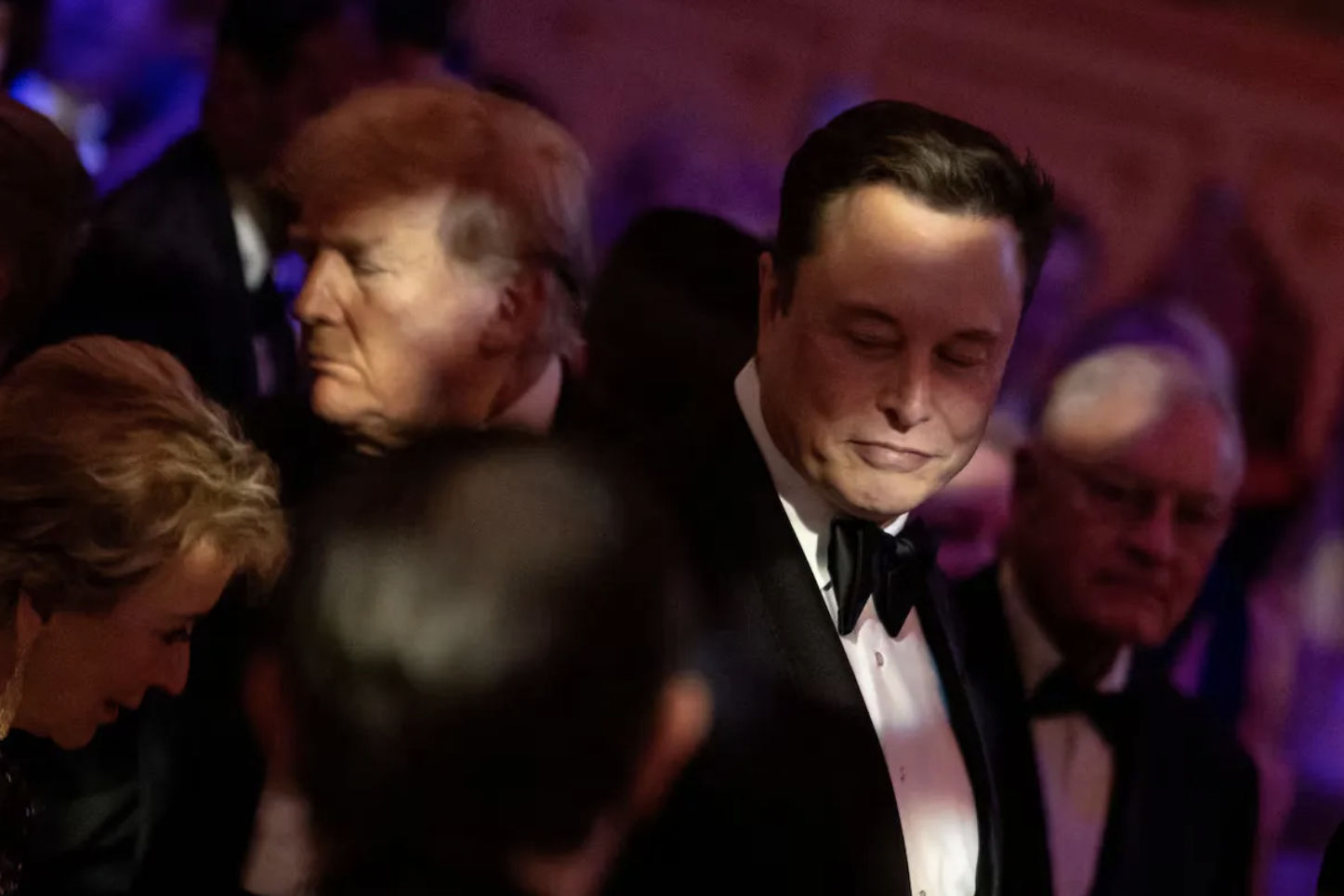


Trump-Musk DOGE Chaos
Mar 13, 2025 5:57 PM
The power of trauma is in the hands of the malignant narcissist Donald Trump, and his sidekick, Elon Musk, who may be even worse.
Anyone paying attention to politics knows that Trump’s second term has been marked by a gleeful cruelty. The blizzard of executive orders, freezing overseas assistance to the world’s poor, firing masses of federal workers and targeting domestic safety nets pick up where his first term left off.
“We want the bureaucrats to be traumatically affected,” boasted Russell Vought, who is now Trump’s Office of Management and Budget director, in speeches before 2024’s election. “We want to put them in trauma.”
As the Atlantic’s magazine’s headline writers warned in 2018, “The Cruelty is the Point: President Trump and his supporters find community by rejoicing in the suffering of those they hate and fear.”
There’s ample evidence of this mob sentiment. As Trump’s State of the Union address showed, his followers are as mesmerized by his taunts and power threats, and many revel in the pain that is being caused.
Related stories
But what stands out as the most powerful element in Trump’s November 2024 presidential victory is that many Trump voters are themselves victims of trauma.
Moreover, MAGA voters’ traumas are leveraged and manipulated via Trump’s own deep-seated emotional damage. His bullying, constant lies, grandiosity and profound feelings of victimhood and grievance are major parts of the glue that binds Trump and his cult-like followers.
We shouldn’t be surprised by all this. But what is surprising is how so many people – Trump voters – welcomed Trump’s chaos and saw it as positive for themselves, somehow a salve for their troubles.
Those who study the trauma saw Trump ‘s perverse mass appeal early on. Gabor Maté, thefamed psychiatrist, author and trauma expert wrote about Trump’s candidacy.
“We need not be perplexed that a Donald Trump can vie for the presidency of the most powerful nation on Earth,” Maté said. “We live in a culture where many people are hurt and, like the leaders they idolize, insulated against reality. Trauma is so commonplace that its manifestations have become the norm.”
“People who are anxious, fearful and aggrieved may be unable to recognize the flaws in those seeking power,” he continued. “They mistake desperate ambition for determination, see grandiosity as authority, paranoia as security, seductiveness as charm, dogmatism as decisiveness, selfishness as economic wisdom, manipulation as political savvy, lack of principles as flexibility.”
Trump gave wounded swathes of the electorate a permission slip to hate immigrants, those transgendered, every diverse Democratic constituency, with special emphasis on educated coastal “elites” and its “lying media.” The irrational hate mobilized against Democrats resulted in many MAGA voters acting like the most crazed sports fans, known for their rigid, sometimes violent, home-team loyalty.
Daniel J. Siegel, a clinical professor of psychiatry at the UCLA School of Medicine, further explains the powerful appeal and draw of leaders who exude hostility and authoritarian impulses.
“People may actually feel excitement that someone in the public eye is expressing aggression, or assertion, the opposite of impotence,” Siegel said. Such traits can feel empowering to those who lack agency and power in their lives, he explained. “It is like a child wanting to be with a parent who will protect them.”
Thus, a perverse cycle of dependency arises. Forensic psychologist Bandy X. Lee, who, after the first Trump victory, curated and edited a book on Trump’s fitness for office – The Dangerous Case of Donald Trump: 27 Psychiatrists and Mental Health Experts Assess a President, told Scientific American that the bond between Trump and his supporters has a name: narcissistic symbiosis.
“Narcissistic symbiosis refers to the developmental wounds that make the leader-follower relationship magnetically attractive,” Lee explained. “The leader, hungry for adulation to compensate for an inner lack of self-worth, projects grandiose omnipotence — while the followers, rendered needy by societal stress or developmental injury, yearn for a parental figure. When such wounded individuals are given positions of power, they arouse similar pathology in the population that creates a ‘lock and key’ relationship.”
These insights help to explain Trump’s appeal. But before we can do anything to counter this toxicity, we need to understand how traumatic events and their lingering pain shapes psyches and actions in many areas of society.
Trauma is Bi-Partisan; It is Everywhere
Trauma is a word that can be used casually, sometimes promiscuously, without much understanding of the underlying psychological meaning. But public discussions about lived traumatic experiences are pretty rare. It’s as if American’s real inner lives are kept under wraps – until they break out.
As a society, Americans are both traumatized and seemingly clueless about understanding psyches, causes and impacts of emotional turmoil. Trump’s malignant narcissism diagnosis, given by many mental health professionals – a marked absence of empathy, demand for constant attention, and gleeful aggressive abuse of others – have origins. Many experts, including Mary Trump, his niece who is a developmental psychologist, think that these dysfunctions stem from a traumatic childhood under a cruel father.
To help with our understanding, the trauma expert Pat Ogden defines trauma as a disruption of the nervous system. She says that trauma occurs when “an event, a series of events, or a set of enduring conditions, overwhelms a person’s capacity to integrate emotional experience and/or is perceived as threatening safety or survival… triggering physical and psychological disruptions that can endure for years.”
(The last section of this article offers some options for dealing with potential trauma from the MAGA assault.)
Traumatic experiences and their lingering impacts are everywhere. Traumas are embedded across the more outwardly observable lines of gender, class, race, and political orientation in tens of millions of people. We can imagine trauma in American society as a Ven diagram with overlapping circles that represent a range of traumas in play.
Think of four overlapping circles: society at large separate from elections (where trauma is widespread); among MAGA voters amidst decades of economic and social decline; among Trump opponents, who were barraged by relentless brutal bullying attacks by Trump during the election; and post-election, with the further traumatizing of opponents, especially government employees — a priority represented by Elon Musk’s contempt for workers and by Vought’s desire to traumatize workers as part of the MAGA vendetta against government itself. Thus, there is red-state trauma, blue-state trauma, and bi-partisan trauma.
In 2020, I wrote about the backdrop of trauma in America noting that much of it originates from adverse childhood experiences — “of family violence, of sexual and physical abuse, of abandonment or divorce, of addiction and mental illness. There are also traumas of racism, and sexual and gender prejudice.”
As Bessel Van Der Kolk points out in his powerful and influential book, “The Body Keeps the Score: Brain, Mind and the Body in the Healing of Trauma,” the Adverse Childhood Experience (ACE) Study showed that 20 percent of Americans were sexually molested as a child; 25 percent were beaten as a child to the point of a mark or bruise on their body; one third of couples engaged in physical violence; A quarter of us grew up with an alcoholic relative, and 1 out of 8 of us witnessed our mother being beaten.”
The ACE study is considered highly reputable and was done with a large sample of primarily middle-class people in San Diego. It is frightening to think about the likely extent of trauma present in society with the U.S. population of roughly 328 million people.
Van Der Kolk adds that fortunately humans “belong to an extremely resilient species and have rebounded from wars, and natural and man-made disasters, along with betrayal and violence in personal lives. But trauma leaves its mark on our cultures and history or close to home on our families with dark secrets being imperceptibly passed down through generations.” Trauma also leaves “traces on our minds and emotions, on our capacity for joy and intimacy, and even on our biology and immune system.”
Other sources of trauma are embedded in a society where guns are plentiful and violence, of all kinds, is widespread. Research and data from the U.S. Centers for Disease Control and Prevention’s National Intimate Partner and Sexual Violence Survey report that 41 percent of women and 26 percent of men experience sexual violence, physical violence, or stalking by an intimate partner during their lifetime. These victims, the CDC reports, suffer lasting impacts.
Another overarching potential trauma is the consequences of more than 1.1 million Americans dying of COVID-19 pandemic, and the ongoing impact on their families and loved ones. The U.S. leads the world in COVID deaths. In 2022, federal researchers estimated that as many as 17 million Americans may have long COVID, which is 6.9 percent of the population.
How people respond to trauma varies, but often temperaments change. Thom Hartman, a journalist and historian, drawing from literature on trauma affects, noted that “surviving a once in a century pandemic can cause hypervigilance, difficulty with trust, cognitive impairment, social isolation and more. The average of a number of studies on the psychological impact of the pandemic found that 26 percent of Americans having diagnosable PTSD [post-traumatic stress disorders] from Covid.”
Then there is war. Today, there are more than 18 million living veterans in the U.S., representing about 6 percent of all adults. As of 2023, roughly three-quarters (78 percent) served during wartime. Post-traumatic stress haunts many people who served in the military, especially those who saw combat.
Financial trauma is more widespread. It results from the stresses tied to wage stagnation, economic insecurity and society’s vast inequalities. As the writer Astra Taylor noted, U.S. capitalism is an “insecurity producing machine.”
These examples are among the most obvious causes of collective trauma. But there are others, such as the unpredictable impacts of climate change events: hurricanes, heat waves, massive fires – such as those seen in Los Angeles.
That trauma causes powerful psychological harms should be self-evident. Observable symptoms include anxiety attacks, substance abuse, self-destructive behaviors, angry outbursts, depression, insomnia, chronic pain, and headaches, domestic and interpersonal violence. And suicide. Trauma can be experienced individually and collectively.
MAGA Trauma
MAGA voters have reasons for their trauma reactions. Often, economic and cultural resentments going back decades have fueled a collective response – a dynamic that mental health professionals call “displacement.”
In the political sphere, that shared reaction can prompt and breed partisan distortions, conspiratorial accusations, and magical thinking. These reactions have been fed, encouraged and leveraged by Trump and opportunists in his MAGA movement.
The power of this MAGA blowback is part of the long-brewing reaction to 50 years of neo-liberal politics and policy, which ballooned inequality to record levels and left millions of working Americans feeling abandoned, profoundly angry, financially insecure, aggrieved, resentful and vindictive.
Displacement is part of a backlash of major proportions against economic and cultural decline. Today, it is felt primarily by white voters, particularly men without college educations, who have slid down or feel they are slipping down economic and cultural ladders. Their feelings of victimization are fed by Trump scapegoating immigrants and assailing successful women. Trauma can leave one feeling helpless, powerless, overwhelmed and alone.
Where do lonely or hurt people turn in their solitude? Often it is the Internet and social media, where like-minded people find some semblance of community, but at the same time cut themselves off from broad perspectives, forming mutually reenforcing silos among like-minded people.
Feelings of displacement were further incited by right-wing opportunists who promoted the so-called “Great Replacement” theory, the lie that Democrats were actively bringing in immigrants to dilute and replace working-class whites. That political narrative has many antecedents – notably in Nazi Germany. But its power and appeal regrettably endure.
Just as mental health professionals see this dynamic clearly, so, too, do cultural analysts and political commentators.
Cultural analysts and political commentators see versions of trauma in play. Former New York Times columnist Anand Giridharadas has written that we live in an era where “emotion has more persuasive power than facts and rationality. As history has shown, that makes us vulnerable to authoritarians who delight in swaying mass sentiment and fanning mobs.”
“It is an age defined by Big Feelings,” Giridharadas said. “By anxiety and fear and future dread and a great confusion among millions of people about who they will be on the far side of head-spinning change. All around us, people are lost, not sure how to make sense of their place in a world of upheaval. In an era, such as this, leaving the politics of emotion, of passion, to aspiring autocrats is a dangerous abdication.”
Trauma is a centerpiece. But not the whole story.
To be clear, personal trauma isn’t the only reason that people joined the MAGA crusade. It seems an essential ingredient, but it is only a part of the election picture. In a presidential campaign there are any number of synergistic elements.
The MAGA coalition includes: anti-abortion zealots; Christian nationalists; believers in patriarchy and misogyny; those who respond to the propaganda exaggerating fear of the “other,” especially immigrants; the emergence of the “broligarchy” – the libertarian, dominating tech moguls who pumped hundreds of millions into the campaign, especially those advocating for Crypto Currency; and the growth of the “bro-culture, led by popular podcaster Joe Rogan, which especially targets women. (Note: I am not including the price of eggs, the classic red herring of our election period.)
It can includes wealthy people who thought Trump’s anti-regulatory crusade would lift their investment portfolios.
Trump’s (and Rogan’s) good friend, Dana White, head of the hugely popular World Wrestling Federation (previously known as violent cage boxing) successfully mobilized millions of young white men across the board – day traders, sports bettors, video game denizens, cage wrestling fanatics, uniting a tribe who revel in risk taking, often thrilled with violence, and who embrace the values of dominance and male superiority.
The reemergence of an aggressive patriarchy was an essential element of MAGA’s success and has left many women reeling. A mutual reinforcing patriarchal vertical, was created and has even grown: from the broligarch billionaires on top, to the misogynist manosphere, and the dreaded incels – men who can’t sustain intimate relationships – at the bottom.
Trump capitalized on backlash over men’s feelings of being sidelined or overrun by women, who they see as having achieved career and financial success at their expense. Trump took aim at the #MeToo movement. He appointed sexual abusers to his cabinet. Despite numerous documented cases of women being victimized, Trump always believed the men. This, of course, is consistent with his own denials of numerous charges of sexual harassment lodged against him.
Trump’s sexist chauvinism expanded his base. He drew increasing numbers of white-male voters, especially younger men, as well as a majority of Latino men, as he kept a majority of white women voters.
As Elizabeth Spiers wrote in the New York Times last November, “On Election Day, no group of voters was more loyal to Donald Trump than young white men. He did so well with male voters because he is a walking avatar of a kind of masculinity that Democrats could never embrace [my emphasis], and its appeal transcends this electoral cycle.”
As part of the never-ending patriarchal, white supremacy backlash to progress, Spiers adds: “Mr. Trump offered a regressive idea of masculinity in which power over women is a birthright. That this appealed to many white men was not a coincidence — it intersects with other types of entitlement, including the idea that white people are superior to other races and more qualified to hold positions of power, and that any success that women and minorities have has been unfairly conferred to them by D.E.I. programs.”
Spiers writes, “For men unhappy with their status, this view offers a group of people to blame, which feels more tangible than blaming systemic problems like rising economic inequality and the difficulty of adapting to technological and cultural changes.”
Trauma as political weapon
Sowing chaos and inflicting trauma as a political strategy to seize power is bad enough, but it is also at the center of Trump’s approach to governing. Trump’s 2024 campaign showcased cruelty, but since taking office it has sped up and multiplied with a shocking swiftness.
Let’s go back to Vought, the head of the federal budget office, a strident Christian Nationalist, and one of the key intellectual architects of the “unitary executive” theory that exalts presidential power to a nearly absolute level. Vought actually said – boasted – “We want to put them in trauma.” He and the rest of the Trump administration want the innocent 2 million or so federal employees – mostly hard-working, well-educated, non-partisan, committed souls – to suffer a severe impact from the Trump election.
Vought added, “When they wake up in the morning, we want them to not want to go to work because they are increasingly viewed as the villains.” The villain is defined as a wicked or evil person; a bad person who harms others or breaks the law.
Ever the paranoid ideologue and propagandist, Vought bellowed, “The stark reality in America is that we are in the late stages of a complete Marxist takeover of the country, in which our adversaries already hold the weapons of the government apparatus, and they have aimed it at us.”
His language is astoundingly paranoid and detached from objective reality. But it goes unquestioned and accepted by Trump and MAGA loyalists.
Vought is not alone in White House circles. He is the company of numerous unqualified vindictive rogues in Trump’s cabinet with radical ideas, narcissistic personalities, abusive pasts and the sadistic desire to dominate. Trump seems to have picked most of them for sheer subservience and to mirror his own cruel abuse and personality.
As the philosopher, essayist and Holocaust survivor Hannah Arendt wrote in 1951, “Totalitarianism in power invariably replaces all first-rate talent regardless of their sympathies with those crackpots and fools whose lack of intelligence and creativity is still the best guarantee of their loyalty.”
And then there is Elon Musk. As Giridharadas explained in a recent essay, Surviving the Abuser in Chief. “It is Musk, the shadow president, who may be even more dangerous, whose sense of his own omnipotence and importance is even stronger than Trump’s, and his vision of the future far more dystopian, and his disregard for humanity even more total.”
He added, “Musk and his fellow tech oligarchs are steeped in fantasies of a decentralized ‘network state,’ where private corporations take care of the business of governing and a basic set of laws enforce themselves, through the blockchain. Nobody will need government services, so they won’t need to exist.”
This is a striking and appalling forecast for a dystopian future. It is unclear who, or what, will be able to stand in their way.
Where does this world of trauma and MAGA horrors leave us?
Sadly, as we look at the daily political reality, we are facing a depressing big picture. Many of us feel like we are looking into the abyss. We are experiencing wide swings of emotions as we confront a situation that we never thought could be true.
Because our society’s collective understanding of trauma is limited, the causes of trauma symptoms — anger, addiction, inability to sustain relationships, anxiety, submissiveness, and others — remain a mystery to many of us. We wonder: is it in our genes, our relationship with our parents, a failure of our character? But what has emerged over recent years in the psychology field is that mental health issues, widely experienced in U.S society, are all too frequently the natural and predictable consequence of trauma.
It can be hard to acknowledge the trauma in our lives, often from our childhoods, from painful situations when we were hurt, exposed to danger, or were not given the love and support we needed. We tend to rationalize our experiences as not so bad, assume the really bad stuff affects someone else, or feel like we’re playing the victim if we recognize the pain. The word “trauma” itself can feel like too much. As Gabor Maté writes in his book, The Myth of Normal: Trauma, Illness & Healing in a Toxic Culture:
“The usual conception of trauma conjures up notions of catastrophic events: hurricanes, abuse, egregious neglect, and war. This has the unintended and misleading effect of relegating trauma to the realm of the abnormal, the unusual, the exceptional. If there exists a class of people we call “traumatized,” that must mean that most of us are not. Here we miss the mark by a wide margin. Trauma pervades our culture, from personal functioning through social relationships, parenting, education, economics, and politics. Someone without the marks of trauma would be an outlier in our society. We are closer to the truth is when we ask, “where do we fit on the broad and surprisingly inclusive trauma spectrum?”
As Peter A. Levine, a renowned psychologist, has frequently said, trauma is perhaps the most avoided, ignored, belittled, denied, misunderstood and untreated cause of human suffering.
The hope for this article is that we become more aware of the power and scope of trauma, and thus more understanding of how it may be affecting ourselves, our loved ones, our allies, and, yes, even our opponents. Then we can work to make sure the legacy of any personal trauma doesn’t dysregulate our emotions and undermine our efforts to resist the collective trauma being inflicted on us, which makes it so easy to be overwhelmed.
On a personal level, at this early stage of political disorientation, it may not be clear what it is that each of us can or should do. Opportunities for protest and avenues for communicating our anger make sense for many people. But many of us believe it will take more than that.
A first step may be to work to prepare ourselves for the long haul. We may have to build up our courage, rededicate ourselves to new levels of engagement, and be creative in ways of supporting each other.
One thing we can do is to reduce what can be our obsessive media consumption of bad news, that we can do nothing about in the moment. This is not easy, of course, because a lot of our communications with our family and friends are about the latest, hard to believe, terrible development. But doom scrolling doesn’t contribute to anyone’s strength or resolve.
Better that we spend more time sharing our emotions and experiences with others and building or renewing friendships that can help create networks that might be needed to protect all of us. We can turn toward the aspects of our lives that we know can sustain and nurture us emotionally.
On the trauma awareness front, if you want a deep dive, check into Bessel van der Kolk’s book, The Body Keeps the Score, Brain, Mind and the Body in the Healing of Trauma. It is a lively read. The book sold more than 3 million copies and spent more than six total years on the New York Times bestseller list, so the overall awareness of trauma has been heightened over the past period, but there is a lot to learn. If you want something simpler, check out the many online suggestions for bringing the nervous system into balance. The Cleveland Clinic offers a good list, but different suggestions work for different people
Over the long haul, understanding and working to address the generational cycle of trauma wreaking more trauma, can get us moving toward breaking the cycle and contributing to the goal of electing psychologically healthy people to be our leaders.
Comments

Powered by RoundtableAn AI/DeFi-powered Enterprise Media Operating System. Learn more at Roundtable.io.© Roundtable 2026. By using this site you agree to the Terms of Use and Privacy Policy