
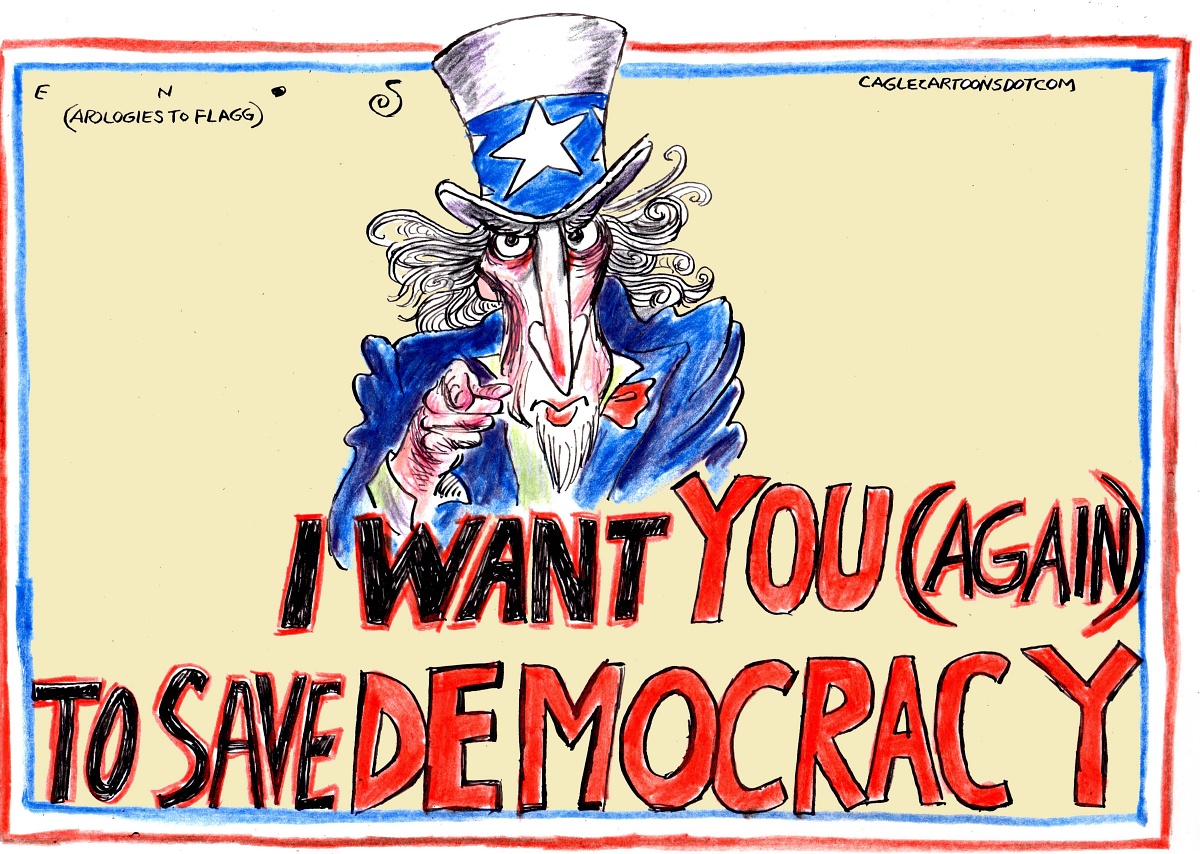


They Gave a Democracy
Jul 4, 2024 5:34 PM
Updated Jul 4, 2024 8:56 PM
Has democracy lost its mojo?
Egypt’s toying with a democratic façade began in 1952 when Gamal Nasser led a coup that toppled King Farouk. After the coup, Nasser became prime minister, while fellow coup plotter Mohamed Naguib became president. Soon after that, Nasser survived an assassination attempt by a member of the Muslim Brotherhood, an Islamist group that he then banned, imprisoning and torturing many of its members. Nasser then placed Naguib under house arrest and assumed his duties, officially becoming Egypt’s president in 1956.
In 1970, Nasser was succeeded—peacefully—by yet another coup participant, Anwar Sadat. Sadat eased restrictions on the Muslim Brotherhood in exchange for its support against his political rivals. In 1981, Islamist army officers assassinated Sadat and replaced him with Hosni Mubarak, who retained power for nearly 30 years until, amid the regional upheaval of 2011’s Arab Spring and the local chaos of Egypt’s January 25th Revolution, he resigned under pressure. A military junta then ran Egypt until, after a series of elections later in 2011, voters opted for an Islamic theocracy, first by empowering the Muslim Brotherhood, and then, in 2012, electing Islamist Mohammed Morsi president.
When Egypt’s judiciary repeatedly rebuffed Morsi’s attempts to Islamize the government, he imposed a provisional Islamist constitution that granted him unrestricted authority. In 2013 a coup led by Abdel el-Sisi—who as minister of defense oversaw the military—deposed Morsi. The Muslim Brotherhood was again banned, its leaders and many members imprisoned, and its charities shuttered. In 2014, El-Sisi officially became, and remains, Egypt’s president.
Similarly, Turkish voters in 2014 chose Islamist Recep Erdoğan as Turkey’s first popularly-elected president. Erdoğan had already served several terms as prime minister after his Justice and Development Party (AKP) won parliamentary majorities. Erdoğan had formed the Islamist AKP in 1999 after getting out of prison; he’d been jailed for inciting religious hatred and banned from Turkey’s (then) secular politics. As prime minister, Erdoğan led a transition from a parliamentary system, modified the constitution, expanded the presidency’s powers, blurred church-state separation, replaced thousands of secular officials with political and religious loyalists, weakened the judiciary, jailed journalists—Turkey holds a third of the world’s incarcerated journalists—and closed media outlets, all in service of restoring Turkey to the Islamist theocracy it had been under the Ottoman Empire. Making clear their approval of Turkey’s religious conversion, voters have reelected Erdoğan twice.
Related stories
Given the theocratic authoritarianism burgeoning in these and other Muslim states (Iran, Afghanistan, Iraq), it’s tempting to attribute “democratic backsliding”—incremental suppression of voting rights and press freedoms simultaneous with steady erosion of secular democratic norms—to Islam. That impulse is the product of bias. Rising autocracy, whether theocratic, nationalistic, or hybrid, is global—Vladimir Putin’s Russia, Xi Jinping’s China, Viktor Orbán’s Hungary, Jair Bolsonaro’s Brazil, Benjamin Netanyahu’s Israel, Nayib Bukele’s (his grandparents were Palestinian) El Salvador, Javier Milei’s Argentina—stressing even smug democracies like France, the U.K, and the U.S. Erdoğan’s Islamist-supported assault on Turkey’s century of secularism provides a bleak preview of Donald Trump’s Christian Nationalist-supported assault on two-and-a-half centuries of U.S. secularism should he be elected to a second—and then third—term.
Has rational discourse lost its mojo?
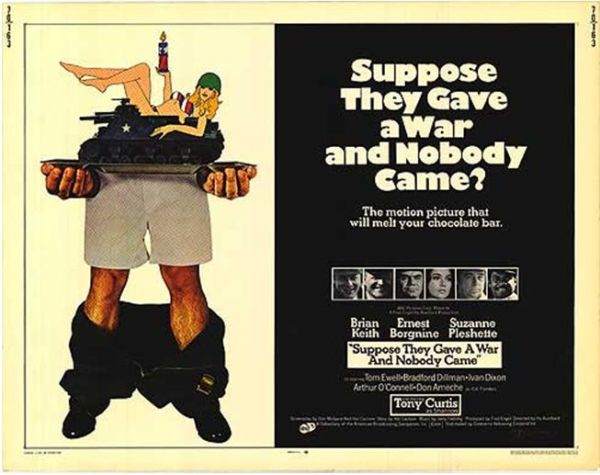
The title of this essay is an update of Suppose They Gave A War And No One Came?, the title of a 1966 essay in McCall’s by Charlotte Keyes. (A similarly titled movie was released in 1970.) The line, which Keyes took from Carl Sandburg’s 1936 book-length poem, The People, Yes, became popular during our “involvement” in the Vietnam “police action.” That “conflict” (when euphemisms start flying, duck) launched a thousand bumper stickers that, like the owners of the vehicles sporting them, yelled reductive slogans past each other. Demonstrating the devolution of American political discourse, pro-war bumper stickers included America Love It Or Leave It, Peace Through Victory, Freedom Isn’t Free, and Stand Behind the Flag, Not On It. Anti-war versions, all of which reflected a wistful, bell-bottomed belief that peace was possible if we would only talk to, instead of at, each other—included, in addition to Suppose They …, Make Love Not War; War Is Not The Answer; and War Is Not Healthy For Children And Other Living Things.
I see the writing on the bumper
But Sandburgs’s/Keyes’s line augured a far darker variant: Suppose they gave a democracy and no one came? Every functioning secular democracy contains cult-bait, hypnotees susceptible to a charismatic’s confident assurances that something better beckons just over the next rise. Unable to abide intimations of mediocrity, they are willing to trade the challenges, disappointments, insecurities, and responsibilities of secular autonomy for a (false) sense of security. Before the internet, geography limited the size of most cults, but online, as vulnerable souls find and reciprocally affirm each other, grievance-groups coalesce first socially, then politically. As their numbers increase, their organizers leverage a host democracy’s tolerance of dissent to influence its elections and legislation, altering a working, secular democracy into a tableau DINO—Democracy In Name Only—while camouflaging their increasing authoritarianism behind democratic pageantry.
We hold these truths to be self-evident
All political disruptions—fundamental constitutional revisions, rebellions, full-on civil wars—are accompanied by Great Principles, Noble Sentiments, and Sacred Scrolls that we know are Great, Noble, and Sacred because they are Capitalized. Cloaked in pious and stentorian rhetoric—the more pious and stentorian, the more defensive—rebellion rhetoric mixes excuse, aspiration, and rationalization. The American Revolution’s Sacred Scrolls—the Declaration of Independence, the Constitution, and the specific enumerations of the Bill of Rights—are calligraphy-inscribed parchments of querulous grievance and self-justification grandiosely expressed.
When, in the course of human events, it becomes necessary for one people to dissolve the political bands which have connected them with another, and to assume, among the powers of the earth, the separate and equal station to which the laws of nature and of nature's God entitle them, a decent respect to the opinions of mankind requires that they should declare the causes which impel them to the separation.
But Great Principles and Noble Sentiments do not by themselves spur rebellions, are not the wind that lofts a revolutionary kite but its tail (and its tale). Ideals do not trigger uprisings because uprisings are strictly pragmatic affairs—guns, ammunition, soldiers, food, transport—while Ideals mix conjecture, hypothesis, and wishful thinking. For a conjecture to spur action, the possibility of its occurrence must exceed some arbitrary threshold of plausibility.
Prudence, indeed, will dictate, that governments long established, should not be changed for light and transient causes; and accordingly all experience hath shown, that mankind are more disposed to suffer, while evils are sufferable, than to right themselves by abolishing the forms to which they are accustomed.
We don’t scratch a hypothetical itch; we scratch an itch. Though it’s always theoretically possible that it might rain, we don’t carry an umbrella unless we hear a weather report or see dark clouds. We know that lightning can strike hikers beneath clear skies, that airplanes can fall out of those skies, that cars can crash, but judging those risks as remote and nebulous, we hike, fly, and drive. Thresholds of plausibility are mutable mixtures of belief, experience, susceptibility, and imagination, all factors that we weigh idiosyncratically while judging others who weigh them differently to be skittish or foolhardy. I ride motorcycles but won’t consider skydiving (too dangerous); others skydive but won’t consider riding a motorcycle (too dangerous).
Though “reactionary” connotes toxic right-wing nostalgia, all revolutions—in fact, all politics—are, broadly speaking, reactionary. People won’t risk their lives until those lives have become intolerable. Our own revolution was triggered not by Great Principles and Noble Sentiments but by pent-up resentment of daily British humiliations and insults large and small against which colonists had no recourse. The enshrinement of freedom of speech and press was born not of Idealism but of the criminalizing of opinion—spoken, printed, or merely thought—to which the Crown or its agents objected, often arbitrarily. The 1765 Stamp Act initially spurred no violence; what aroused colonial mutiny—in 1776—was having to spend hard currency to pay the tax. The Third Amendment to the Bill of Rights—No Soldier shall, in time of peace be quartered in any house, without the consent of the Owner, nor in time of war, but in a manner to be prescribed by law—was not added because its authors conjectured that citizens might in the future be required to house and feed British soldiers but because, under the authority of the 1765 and 1774 Quartering Acts (the latter intentionally coercive) the British forced colonists to quarter soldiers.
But when a long train of abuses and usurpations, pursuing invariably the same object, evinces a design to reduce them under absolute despotism, it is their right, it is their duty, to throw off such government, and to provide new guards for their future security. Such has been the patient sufferance of these Colonies; and such is now the necessity which constrains them to alter their former systems of government. The history of the present King of Great Britain is a history of repeated injuries and usurpations, all having in direct object the establishment of an absolute tyranny over these States. To prove this, let facts be submitted to a candid world.
Revolutionary governments explicitly define themselves by what they are not. Though they speak in highfalutin tongues, newly established governments build no shining cities upon hills; rather they reactively redress concrete complaints, crafting bespoke policies and laws ranging from specific (no quartering of troops) to general (no limiting of expression). The uninfringeable right of all citizens to keep and bear arms was a reaction to aristocrats having reserved that privilege for themselves. The Eighth Amendment— Excessive bail shall not be required, nor excessive fines imposed, nor cruel and unusual punishments inflicted—forbids excessive fines and bail because of the Crown’s abuse of both to keep citizens in jail indefinitely, thereby meting out punishment before an adjudication of guilt. Cruel and unusual punishments are forbidden because of unspeakable acts—drawing and quartering, disemboweling, burning at the stake, outright torture—that those in power had for millennia visited upon literally anyone to whom they took a dislike for literally any reason at all. Because a new regime’s policies and laws are direct responses to and mirror-opposites of a prior regime’s, that prior regime inevitably function as a negative template.
Narrative is the infrastructure of all politics
Post-rebellion, partisans of a new government, having experienced firsthand the previous regime’s grievances, tacitly understand the reasons for the new regime’s reactive—not to say reactionary—policies and laws. This lasts for several generations, but as the number of those who lived through a revolution’s dark days diminishes, revolutionary consciousness wanes and collective memory fades. Subsequent generations, absent lived experience with the prior regime’s noxious practices, come to take hard-won rights for granted.
A post-revolution government’s good faith efforts to redress the grievances that spawned it can, as it eliminates those grievances, come to seem detached from reality to those who didn’t experience pre-revolution hardship. Once the target grievances are successfully redressed, policies and laws, crafted as reactions to prior odious conditions, are left standing alone and naked. Over time, as down-stream generations uncouple from the harsh realities that spurred post-rebellion policies and laws, dramatic accounts of revolutionary battles and hardships drift unmoored into mind space occupied by fiction, fable, myth, legend, yarn, tall tale, even lie. To callow and reflexively skeptical descendants, these stories come to sound like melodramas that they greet with eye rolls: No ‘quartering of troops’? Really? Don’t troops live on, like, army bases? They come to seem silly, capricious, suspicious, even unjust and oppressive, these latter two leaving descendants prey to exploitation and sedition by those who benefit from loss of national cohesion. Thus, a conscientious government can, by staying true to its revolutionary roots, inadvertently aid those seeking to undermine its legitimacy and credibility.
Believing is seeing
For this reason, a revolutionary government’s long-term stability requires it to expend significant time, energy, and resources justifying and defending its continued existence by connecting new generations of citizens to its past. In authoritarian regimes, these efforts are imposed top down via the military, police, and clandestine services assisted by informants. But because liberal democracies work from the premise that their legitimacy arises from the support of the governed, such efforts must be bottom up, a far more complex undertaking. As following generations leave revolutionary-era grievances farther and farther behind, a working secular government, no longer able to depend on its citizens’ living memory of pre-rebellion hardship, must inculcate in enough—not all, only some self-generating enough—of its newer citizens an appreciation of the prior, objectionable conditions that permeate its policies, laws, and norms. (In governments founded on majority rule, unanimity’s not being required affords an advantage because dissent expressed in limited numbers is politically ineffectual, giving those governments the luxury of appearing supportive of freedom of speech, press, and assembly; however should dissent become politically effectual, civil liberties are swiftly abrogated.)
Lest we forget
Because maintaining its legitimacy requires a government to constantly cultivate devotion in its citizens, it must, in effect, propagandize—from the government’s point of view “educate”—them so they continue their support. This requires a vast and unceasing effort that includes not only education, but also myriad pop-culture initiatives—entertainment, arts, news, statues, namings, commemorations (parades, holidays, memorials, statues), patriotic organizations, sporting events (where the national anthem must be played and military fighters fly over), youth activities, jobs, patronage, services—that normalize and naturalize a government. Revolutionary- or other conflict-era artifacts, left in place, simulate living memory: For decades after the French Revolution, a model of the Bastille—made from the stone of its original walls—was carried in ceremonial parades; in many European cities, unrepaired machine-gun scars from World War II battles still rake the fronts of buildings both official and residential. These serve as visceral reminders of the reasons for post-conflict policies, laws, and norms.

But education itself is by far the single most effective tool of government self-continuance. Gatherings of the young present irresistible opportunities to “explain” to impressionable minds why their form of government is best. The U.S. Constitution’s authors, though they did not agree on how to implement public education, believed that an informed citizenry was crucial to their new republic’s functioning and survival. In 1819, Thomas Jefferson founded the University of Virginia, designing its initial curriculum and architecture. Its original governing "Board of Visitors” included three former and current U.S. presidents: Jefferson, James Madison, and James Monroe.
When right-wingers complain about “liberal” education, those of us who are devoted to secular democracy choose to interpret their concerns as pedagogical, as good faith critiques of curricula lacking balance; we choose to believe that they are sincerely advocating for coverage of an underrepresented viewpoint, just as we advocate for the inclusion of underrepresented non-White-male authors. Their pose is a fraud. When they decry liberal education, just as when they decry liberal news media, they seek no adjustments. Liberal is code for liberal democracy; it is that, not some sham imbalance, they seek to end. Their intention is not to balance the curriculum but to disrupt our communal narrative.
This is why their unembarrassedly biased media outlets offer alternative histories, going out of their way to present counter-narratives that subvert, pervert, and capsize revolutionary-based policies, laws, and norms, and it is why the charter-school movement, sold to emotionally-manipulated parents as “educational choice,” is so enthusiastically—i.e., financially—supported by the right and its billionaires. Charter schools weaken public oversight, thereby diluting the influence of liberal state education departments. This disrupts curricular commonality, which disrupts the communal narrative, which weakens the bonds of nationhood. Just as public education is the most direct and effective tool for binding a nation, it is singularly suitable for unbinding one. In 1981, T. H. Bell, the Secretary of the U.S. Department of Education, tasked a commission with reporting on the quality of education in America. That 1983 report, A Nation at Risk: The Imperative for Educational Reform, contains in its introduction this sentence: If an unfriendly foreign power had attempted to impose on America the mediocre educational performance that exists today, we might well have viewed it as an act of war. That is the right-wing’s goal.
What has Joe Biden done for me?
The disruption of communal narrative undermines a citizen’s sense of a supportive public, of a contributory society providing roads, bridges, election workers, police officers, and bus drivers. Undermining individuals’ sense of the public’s importance blurs their awareness of the inseparable symbiosis between individual and society and, critically, of the public’s role in defining individual identity. This blurring diminishes individuals’ sense of any obligation owed the public, and it allows them to deny their community’s role in their successes. The public becomes invisible the way water is invisible to fish, and that absence permits individuals’ sense of self-worth and -entitlement to expand unconstrained. Right-wingers view the public not as a contributor to their success but as a barrier to the even greater reward their efforts undeniably deserve. They see not what they owe but what they are owed, ask not what they can do for their country but why their country is screwing them. That a second Trump term will damage American democracy, perhaps fatally, is of no concern. What is of concern is that it will increase their take-home pay.
During a recent conversation, a Black Trump supporter asked, “What has Joe Biden done for me?” I replied, “I would never say that the Democrats are without flaw, but they are not actively seeking to take this country back to a time when Whites could with impunity take away what you have earned.” The problem we face among those whom we see “voting against their own interests” is that once a grievance has been redressed, the callow can no longer see it, and it ceases to matter. Feckless Democrats have done a feeble job of reminding us what life was like for non-White people before and can easily be again. Despite all the endless punditry about White grievance, we have overlooked its true source: Liberal democracy has thwarted Whites’ ability to aggrieve Others, and this is why they loathe it. Even if Biden wins the upcoming election, as I pray he will, we are only buying time, only delaying the resurgence of White’s ability to aggrieve. If we do get the extra time, it would be good to use it wisely.
We constantly talk about “the government”—“The government did this” and “The government did that”—but “the government” does nothing; it is an idea. It is the people who operate the levers of power who are the source of a government’s benefits or abuses. Our Founders were sophisticated-enough thinkers to understand this, and it informed their attempts to keep the government on a beneficial course. Their Great Principles, Noble Sentiments, and Sacred Scrolls aside, there were only two truly radical changes our Founders instituted: expanding (not eliminating) the aristocracy to allow any White males—not only the male scions of some White families—access to power, wealth, and privilege; and acknowledging human frailty by articulating thou-shalt-nots that restrain those who happen to be in power. (The Trump Court is neutering those thou-shalt-nots.)
On a macro level, to stymie abuses of power, our Founders either removed or drastically constrained the influence of the three main sources of hierarchy: heredity, religion, and the military. Envisioning a government that took its thumb off the scales of (White) privilege, they created a fundamentally administrative state that based policies and laws on data gathered, assessed, and presented as objectively as humanly possible. This is a crucial difference between working and tableaux democracies: The latter treat facts as obstacles to policies and laws based on doctrinaire—or simply wishful—thinking. Autocrats happily undermine science, garble and distort data, suppress or misreport news, and discredit the people who collect, analyze, and disseminate both; suppressing objective data permits them to fabricate justifications for their human-control and -exploitation projects.
Most of our Founders would be chagrined to learn that the Idealism permeating their Great Principles, Noble Sentiments, and Sacred Scrolls would, when its flowery logic was extended, lead to an unintended consequence: allowing access to power, wealth, and privilege beyond White males. But that is what happened, and it is precisely what White-wingers are complaining about. When they say, “I don’t recognize my country anymore,” what they mean is I see Black people. Their racial angst fuels their fervor to sabotage the democracy that we have become. From a White-wing perspective, the inclusive, i.e. liberal/secular, left has, by implementing our Founders’ Great Principles and Noble Sentiments, violated their intent: to expand aristocracy so it included all White—and only White—citizens. Toxically nostalgic reactionaries seek a return to the good old days when, as Archie Bunker sings, “goils were goils and men were men,” when access to power, wealth, and privilege were limited to them. (That same toxic nostalgia drives the Trump Court’s sophistic and inconsistently-applied Constitutional Originalism).
Right-wingers who extol competition fail to complete their sentences. When they say, “Competition is good,” what they mean is, “Competition is good for others.” Not good, however, are policies, laws, and treaties that spur actual competition for them: reducing tariffs and other obstacles to trade, increasing work-force competition by allowing Others in, using affirmative action to open access to better-paying jobs for the formerly excluded, allowing Others to live in our neighborhoods, expanding voting rights so Others have representation. Having to share more than they ever thought they would and having to compete with, and sometimes lose to obvious (because not White) inferiors, incites reactionaries’ ire. Attention must be paid! Someone must be blamed! Preferably a deep-state cabal! Per Steve Bannon, the only way to fix this is to burn down the government abetting that (imaginary) cabal.
And so, ecce MAGA!
In the age of the internet, hostile forces—foreign and domestic—easily disrupt the processes by which governments propagate communal narratives. It’s zero-sum: As a dissent-group like MAGA coalesces and its counter-narrative—really a counter-revolutionary narrative—strengthens, its number increases as the number of citizens committed to the extant nation decreases. That decrease weakens the extant community’s bond, and if it continues, the number will eventually fall below the sufficiency required to sustain the nation. As MAGA has gained organizational coherence, strength, and confidence, its zealots, who consider sedition to be patriotic, have grown bold enough to renounce secular democracy publically. And because the extant communal narrative formed in reaction to autocracy and is therefore fundamentally anti-autocratic, it naturally follows that the MAGAn counter-revolutionary narrative will take on autocratic characteristics in reaction.
The kind of liberty our Founders designed, because it is based on individual autonomy, puts success or failure into our hands; if—no, when—we fail, we have only ourselves to blame. It is that self-blame MAGAns cannot live with. They accept their demagogues’ assurances that the game is rigged because they want to; it means that the blame for their defeats lies elsewhere. Autocracy—whether hereditary, religious, legal, or cultural—attracts MAGAns because its structures and strictures, its explicit limits on social mobility, reduce their exposure to failure: One cannot lose if one may not enter. For MAGAns, with their low tolerance for the stress and distress that accompany individual striving, frustration, and failure—i.e., the real life of an autonomous citizen in a secular democracy—autocracy provides cultural insulation that White-wingers experience as care, as a security blanket furnishing a warm, fuzzy feeling that their (White) government is (finally) looking out for their (White) asses interests. Autocracy provides relief and release to which they become addicted; it is a drug for which they will violate any norm.
It is this—the growing number of people who cannot abide the responsibilities and challenges of secular democracy’s political autonomy—that is the mortal danger we face. And that danger is global: Two groups of citizens hold mutually exclusive views: One understands democracy as an idea that drives policies and laws that provide all citizens with equal opportunity to pursue happiness; the other understands it as land, an area that can be physically and metaphorically fenced to keep out the competition, to bar entry to those who would also like a chance to pursue happiness.
America’s Founders assumed that future (White male) citizens, once having learned—presumably via a public education—of the limits that aristocracy places on social mobility, would fiercely defend their government’s most valuable promise: that they and theirs would have the opportunity to compete in any arena they chose. But because too many Others have been allowed onto the field, MAGAns (and others like them around the world) see this as a promise broken.
To them. and Fecure the Bleffings of Liberty to Ourfelfes and our Pofterity
John Marshall thought the Constitution would endure for ages to come; Henry Clay said that it was made not merely for the generation that then existed, but for posterity—unlimited, undefined, endless, perpetual posterity. How long is Posterity? Will there someday be a Museum of Democracy? It’s too soon to tell whether the global flirtation with autocracy, its devaluing of science, its sowing of doubt about the benefits of actual—as opposed to pageant—democracy, will merely further wound, or will end, the world’s great experiment with individual autonomy, because a paradox exists at the core of every liberal/secular democracy: We The People are free vote it away.
Comments

Powered by RoundtableAn AI/DeFi-powered Enterprise Media Operating System. Learn more at Roundtable.io.© Roundtable 2026. By using this site you agree to the Terms of Use and Privacy Policy