
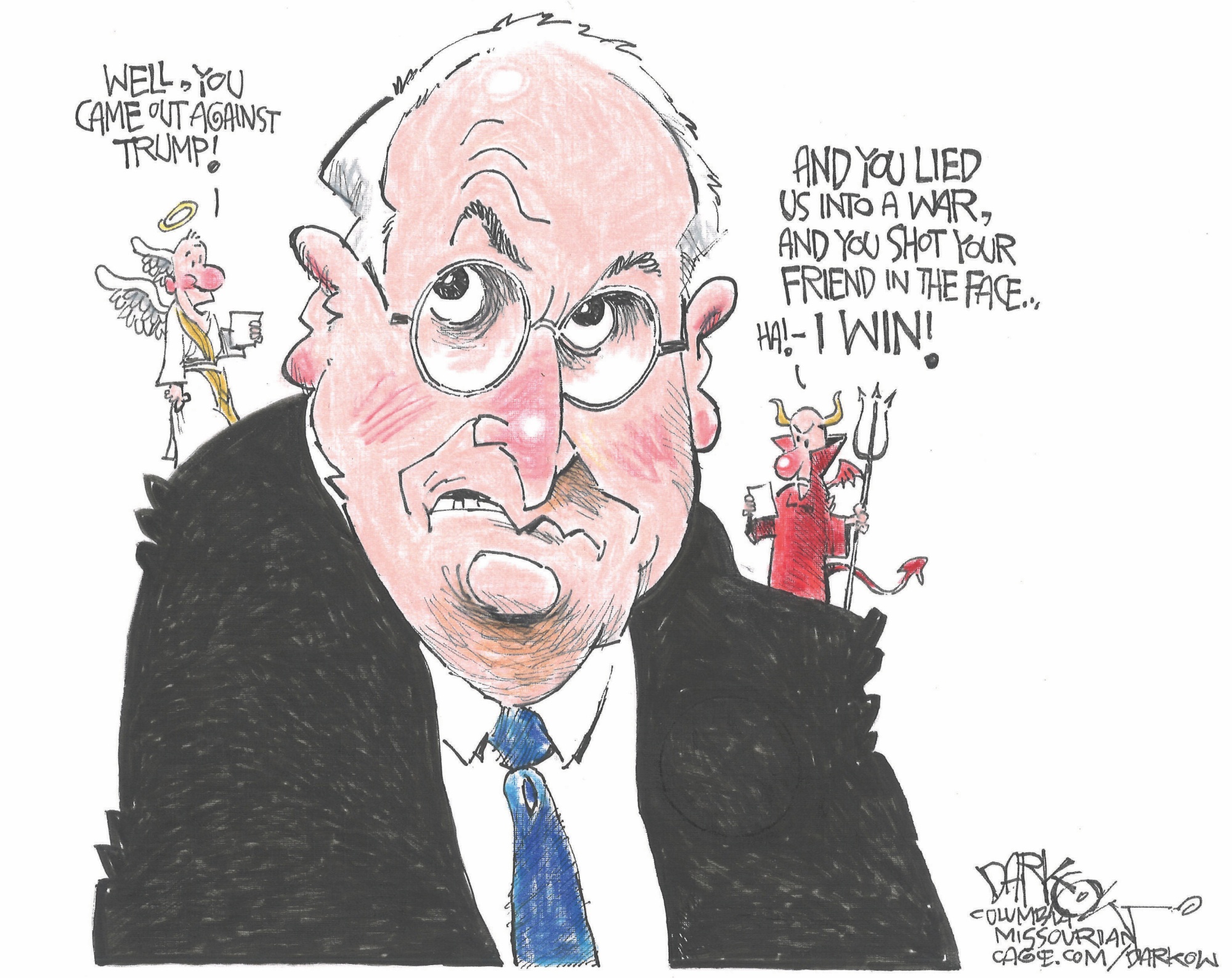


I want to believe he thought he was doing the right thing but consequences remain and Cheney’s choices helped create the climate in which Trump became possible.
Nov 8, 2025 2:58 PM
I want to believe he thought he was doing the right thing but consequences remain and Cheney’s choices helped create the climate in which Trump became possible.
The news feed in my laptop tells me Dick Cheney has died. Former vice president, secretary of defense, Wyoming congressman, White House chief of staff, board chair and CEO of Halliburton—that Dick Cheney. He was 84. Only a few years younger myself, I might not be far behind him. But I have to wonder, if I run into him over in The Big Out There, what will I say to him? And what will he say to me?
I guess I’d want to start by telling him how angry I was when he and his president sent troops to invade Afghanistan, and then did the same thing in Iraq. They believed Osama bin Laden was in Afghanistan, so they ordered the Taliban to hand him over.
The Taliban said they’d be happy to do that as soon as the Bush team showed them evidence supporting their accusations against bin Laden as the mastermind for the 9/11 attacks. Rather than accept the reasonableness of the Taliban refusal, and determined to remove Saddam Hussein from power at whatever cost, the two men used those details as a pretext to start a war that didn’t end until three presidents later.
I was angry because there was no mystery about what motivated the attacks.
Related stories
They were aimed with precision at the most conspicuous symbols of United States economic and military power. And nobody seemed to wonder what provocation could make other people so hostile toward American money, weapons, and political influence as to carry out such dramatic attacks on their symbols.
Like the attack on Pearl Harbor, 9/11 came out of nowhere for most Americans, unprovoked and undeserved, another Day of Infamy, independent of any historical context that might have helped to explain what happened. But there was no discussion of context, of provocation, only gruff and blustery talk about evildoers and vengeance.
I was angry because of the transparent justifications Cheney, Bush and the rest of their team offered for their decision to invade two countries, neither of which had played any role in the attacks. Wild ranting about global terrorism and dark but unsubstantiated warnings about weapons of mass destruction found a warm welcome in the minds of Americans struggling to understand why anyone could hate our country so much.
And Cheney would arch one eyebrow and nod knowingly, happy to froth up public support for new wars of choice by talking incessantly about that hate, that terrorism, those fearful weapons being prepared for use against us because their makers hated our freedoms.
These are some of the things I’d want to discuss with Dick Cheney.
I’d want him to tell me what his role was, how much of that was on him. Barring the appearance of new memoirs with hitherto unknown details, we surely never will know who was the lead author of the war on terror. President Bush was the face of the war, of course, but there was a widespread belief that Bush himself was no more than a poster boy for an agenda crafted by others.
Many observers put the onus directly on Cheney, and in their public appearances, Cheney hovering just behind Bush’s shoulder, it often seemed that he was manipulating the strings of a Bush marionette. And Bush himself often gave an impression of cluelessness that helped support the suspicion that he was no more than a muppet being posed and postured by Cheney and others.
We’ll never know the actual cost of the war on terror. Estimates of the financial cost range from six to eight trillion dollars. Some sources anticipate costs of two and a half trillion just to cover health care for American veterans of those wars. To this day we’re still grappling with the economic costs, both locally and globally.
Estimates of the cost in human life range well over a million. The cost in human suffering is impossible to estimate, and it seems profoundly offensive even to try to quantify it.
I’d like to tell Cheney how angry I am about that.
There’s one other thing I’d want to take up with Cheney. I’d want to ask him how he managed to raise two daughters, both of whom have shown more courage and conviction than he might ever be able to imagine.
Younger daughter Mary has been a fearless advocate for same-sex marriage in a time of dramatically increased hostility toward same-sex unions, even as her father outspokenly opposed them in public. Older daughter Liz willingly sacrificed her political career to take a principled stand on the issue of loyalty, not to the president or to her party, but to the people who elected her, and to the Constitution under which we all live. There must be some credit for Dick Cheney in that, but in light of his public career, it’s difficult to pinpoint where it might lie.
True, in his final years, Cheney himself became an outspoken critic of both Trump and the Republican party so utterly corrupted and compromised by Trump and his minions. But against the costs of the wars over which he presided, wars that together lasted more than two decades and posed questions that have torn great rifts in America’s political fabric, Cheney’s eleventh hour awakening to the corruption of the party he served his entire life seems too little, too late.
I want to believe that he thought he was doing the right thing with every choice he made, that the destructive consequences of his choices were unintended. But the consequences remain, and there’s a pretty good chance that some of Cheney’s choices helped to create the climate in which Trump and MAGA became possible.
That said, it no longer matters to Dick Cheney. All we can do now is wish him happy trails, and get on with our own lives, remembering his life as an example, a cautionary tale.
Comments

Powered by RoundtableAn AI/DeFi-powered Enterprise Media Operating System. Learn more at Roundtable.io.© Roundtable 2026. By using this site you agree to the Terms of Use and Privacy Policy