
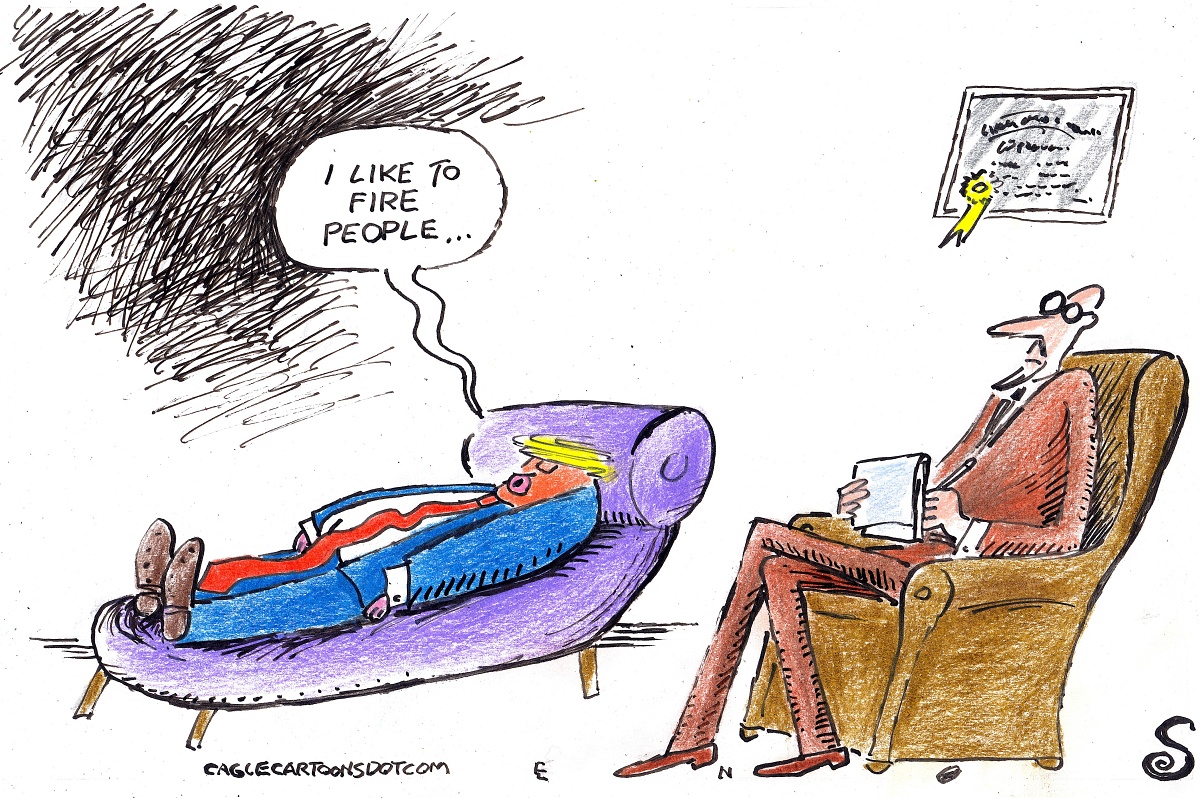
Cagle Cartoons: Randall Enos


Feb 19, 2025 6:12 PM
Updated Feb 22, 2025 9:36 PM
When individuals are forced into relentless competition for survival, they lose any sense of shared responsibility, making them more susceptible to the cruelty that defines contemporary politics.
Neoliberalism’s Embrace of Cruelty and Its Assault on Social Bonds
Neoliberalism has always been more than an economic project; it is a political and educational weapon designed to erode social solidarity and dismantle the foundations of democracy. It does not merely defund public institutions like healthcare, education, and welfare—it delegitimizes them, recasting them as burdens rather than essential public goods. As a pedagogical and ideological assault, neoliberalism has championed unfettered greed, unchecked self-interest, and a notion of government devoid of any sense of social responsibility. It has conditioned people to see mutual care as weakness and competition as the only natural order of society. When individuals are forced into relentless competition for survival, they lose any sense of shared responsibility, making them more susceptible to the cruelty that defines contemporary politics. Neoliberalism is a precursor to fascism, especially at a time when it can no longer defend itself as a force for improving the quality of life. In fact, its promotion of extreme inequality, the concentration of power in few hands, and its view of democracy as a poisonous vehicle for equality and inclusion creates the conditions for both extreme violence and cruelty.
Neoliberalism’s fundamental tenet—that the market is the blueprint for all social relationships—draws a direct line between capitalism and fascism. At its core, this ideology is driven by a colonizing logic that seeks racial cleansing, economic exploitation, and the eradication of social responsibility. The forces it champions—privatization, deregulation, commodification, social death, and ethical degradation—do not merely threaten democracy; they assault its very foundation, stripping away the values of justice, equity, and communal care. In this framework, democracy is not just undermined; it is actively dismantled, replaced by a cold, ruthless market that cares only for profit at any cost. Neoliberalism’s corrosive logic sets in motion a slow but inexorable erosion of democratic structures, where the retreat of social responsibility and the rise of ruthless individualism make the leap to fascism not merely possible, but almost inevitable over time.
To understand fascist politics, we must reckon with its most visceral expression—a culture of cruelty. This cruelty is not an abstraction; it is inscribed on bodies and minds, destroying lives with calculated precision. As Brad Evans reminds us, violence must never be studied in an “objective and unimpassioned way,” for it demands a reckoning that is both ethical and political. A culture of cruelty exposes not only how systemic injustice is endured but also how the machinery of power turns the so-called American Dream into a dystopian ordeal, where millions struggle simply to survive.
Since the 1980s, cultural politics has turned toxic as ruling elites have seized control of dominant cultural apparatuses, transforming them into pedagogical machines of disimagination. These instruments of ethical numbing churn out endless images of degradation and humiliation, casting the poor, immigrants, Muslims, and all deemed disposable as excess lives destined for exclusion. Meanwhile, the capitalist dream machine is back in full force, delivering obscene profits to the ultra-rich, hedge fund managers, and financial elites. In this landscape of wealth, fraud, and manufactured scarcity, a fanatical capitalism fuels a winner-take-all ethos, merging a culture of cruelty with the forces of white nationalism. It aggressively dismantles the welfare state while driving millions into precarity and despair. The moral and political decay of this order has become the guiding principle of a world governed by privatization, surveillance, and hyper-consumption, where public life is replaced by zones of social abandonment, thriving on the energies of the walking dead and avatars of cruelty and misery.
Related stories
Writer Pankaj Mishra captures this shift with chilling precision, arguing that neoliberalism has so thoroughly restructured society that compassion is now treated with contempt, and empathy in a market-driven world is regarded as a pathology. He writes:
The puzzle of our age is how [compassion as an] essential foundation of civic life went missing from our public conversation, invisibly replaced by the presumed rationality of individual self-interest, market mechanisms, and democratic institutions. It may be hard to remember this today, amid the continuous explosions of anger and vengefulness in public life, but the compassionate imagination was indispensable to the political movements that emerged in the nineteenth century to address the mass suffering caused by radical social and economic shifts. …One result of mainstreaming a bleak survivalist ethic is that 'most people, as they grow up now,' the psychoanalyst Adam Phillips and the historian Barbara Taylor wrote in On Kindness, 'secretly believe that kindness is a virtue of losers.'
Trumpism is not an aberration but the logical extension of a neoliberal system that thrives on hierarchy, disposability, ignorance, and fear. The destruction of public goods accelerates the emergence of what Etienne Balibar calls "the transition from the social state to the penal state"—where repression replaces care, and policing takes the place of welfare. The gutting of federal aid programs, the assault on diversity, equity, and inclusion (DEI) initiatives, and the defunding of institutions that support the most vulnerable are not incidental; they are central to the neoliberal strategy of dispossession that has aligned with the principles of white supremacy. In the age of Trump, cruelty becomes an organizing principle of violence as is evident in homegrown notions of fascism that define citizenship in racist inclusive terms for white Christians only, sanctions genocide in Gaza, promotes mass poverty, and supports the ecological destruction of the planet. What we are witnessing as Pankaj Mishra notes is the emergence of a culture convulsed in hatred and rancor matched by an ongoing process of dehumanization and a “retreat into grandiose fantasies of omnipotence.” Trump’s presence in American politics appears as the current endpoint in which hate, bigotry, and sanctioned ruthlessness “have reached a new peak of ferocity.” It also signals an era where reason gives way to irrationality, truth is supplanted by falsehoods, and informed arguments are replaced by conspiracy theories. One consequence is a politics that blends ignorance, incompetence, and brutality.
Trump's upcoming budget will epitomize this cruelty. There is no question it will slash funding for “health care via the Medicaid program and reduce access to food assistance via the Supplemental Nutrition Assistance Program (SNAP).” Moreover, there will be further cuts to Medicaid, low-income housing, job training, and safety net programs for children to fund $4.5 million tax breaks for billionaires and the largest military buildup since the 1980s. As Robert Reich has pointed out, this is not a question of fiscal responsibility but of priorities: the poor and working class are sacrificed on the altar of militarism and corporate welfare. The ideology of hardness, as Adam Serwer notes, runs through American culture like an electric current, ensuring that suffering is not just tolerated but celebrated. Under the grip of gangster capitalism, especially as Trump's second administration unfolds, the essence of politics is not merely diminished but obliterated, erasing the fundamental possibility of human community and the emancipatory power of the social, public goods, and the global commons.
Trumpism and the Politicization of Cruelty
Trumpism is not simply a reaction to neoliberal decay; it is the explicit performance of cruelty as an ideological principle. Unlike past presidents who, however flawed, at least feigned a commitment to democratic ideals, Trump embraces a politics of humiliation and vengeance. In a series of actions emblematic of authoritarian retribution, Trump has systematically targeted individuals he perceives as adversaries, employing state mechanisms to exact his personal vengeance. Notably, he revoked the security clearances of former President Joe Biden, Letitia James, the New York attorney general, and Alvin L Bragg, the Manhattan district attorney, both of whom prosecuted him. Further intensifying this campaign of fear, terror, and intimidation, Defense Secretary Pete Hegseth, under Trump's directive, stripped retired General Mark Milley and Anthony Fauci, among others, of their security detail and clearance, actions that not only humiliate but also endanger those who have previously challenged or criticized the administration. There is no appeal to our better moral and democratic ideals here. This approach to governance thrives on retribution, weaponizing state power to instill fear, suppress dissent, and erode democratic principles, This is the ideology of fascist barbarism, with its knee-jerk contempt for “all that is reflective, critical, and pluralistic.”
The death of moral authority in politics breeds a climate of cruelty in which the unimaginable is normalized. For instance, the alleged helping hand of the U.S. has now been turned into a brutal fist, accompanied by the sneers of billionaire techno zombies, such as Mark Zuckerberg, Elon Musk, and Jeff Bezos, who endorse an anthology of proto-Nazi sentiments. How else to explain Trump’s dismantling of the U.S. Agency for International Development (USAID), leading to the suspension of essential services, including HIV treatment in Uganda and cholera prevention in Bangladesh, exacerbating global health crises? How else to explain Trump pushing for the ethnic cleansing of Palestinians in Gaza in order to build beachfront property along with his intensified efforts to deport millions of undocumented immigrants, planning mass deportations on a scale unprecedented in modern American history. As Fintan O’Toole observes in The New York Review, the farce of Trump’s first term has now transformed into the brutal realities of a second term. The unchecked lust for power and the disastrous consequences of war are now giving way to land grabs and dangerous imperial ambitions, as Trump seeks to realize his vision of a unified Reich.”
Trump’s efforts to eliminate USAID, and his plan to forcibly remove all Palestinians from Gaza are not unrelated. Both are central to a fascist project in which as Etienne Balibar notes particular forms of cruelty cross the lines of extremity [and] become worse than death.” In this instance, politics and violence merge in a new visibility that exists as a show of force, a spectacle of terror, rather than a representation of horror to be condemned.
The Trump-Musk administration is not saving money in cutting of foreign aid for the U.S,A.I.D. since it amounts to about 0.6% of total us annual government spending of $6.75tn. Yet, what is at risk in eliminating USAID are “H.I.V. medication for more than 20 million people; nutrition supplements for starving children; support for refugees, orphaned children and women battered by violence.” Moreover, as Ralph Nader notes, in an utter disregard for the health and spread of diseases on a global level, “Trump is also cutting monitoring for the emergence of deadly epidemics such as Ebola, drug-resistant Tuberculosis, Malaria and other lethal viruses and bacteria, which could come to the U.S. like COVID-19 did.”
The moral emptiness and cruelty of politicians whose mouths drip with the blood of their actions are starkly revealed in the Trump-Musk assault on USAID, which will inevitably lead to the deaths of countless children. As Anne Applebaum astutely observes, the deliberate effort to purge USAID employees—those who work in the world’s most perilous places, risking terrorism and violence to deliver food and medicine to the planet's most vulnerable—will have tragic consequences. These are the workers who “provide special meals to malnourished children.” Without such meals, their lives will be lost. This is nothing less than state-sanctioned terrorism cloaked in the false guise of efficiency, a regressive and heartless ideology that masks its destruction with the rhetoric of progress.
Yet, this cruelty is not limited to public health; it extends to the horrifying spectacle of ethnic cleansing in Gaza. Trump’s tacit support for Israel’s actions, and the looming threat of forcibly removing over two million Palestinians from Gaza, exposes a deeper, genocidal logic. This isn’t just a violation of international human rights; it is a death sentence for countless Palestinian children, women, and the elderly—those who are already enduring an unrelenting cycle of violence and deprivation. This calculated disregard for the lives of nonwhite people is emblematic of a white supremacist project that views these lives as expendable, undeserving of basic human dignity or rights.
It is worth repeating that both Trump’s actions at home and abroad—whether in cutting USAID or in supporting the ethnic cleansing of Palestinians—are not isolated or coincidental. They are threads in a single, cohesive political agenda that thrives on division, cruelty, and the calculated erasure of those who do not fit into the narrow, violent vision of a fascist state. These policies, far from being budgetary decisions, are part of a larger strategy that seeks to normalize a culture of cruelty, reduce lives to disposable commodities, and manipulate violence as a spectacle of power.
In another act of extreme cruelty, the administration has aggressively targeted sanctuary cities—jurisdictions that limit cooperation with federal immigration enforcement—by threatening to withhold federal funding and prosecute local officials who uphold sanctuary policies. These measures not only undermine public safety and erode trust between immigrant communities and law enforcement, but they make clear a governance style deeply rooted in vindictiveness, leveraging the apparatus of the state to intimidate and punish, thereby eroding democratic norms and fostering a climate of fear.
For Trump, governance has never been about serving the public but about wielding power as a cudgel against the weak, His rallies have always embodied a theater of cruelty and spectacle that encouraged his supporters to find joy in the suffering of others. His celebration of violence as a legitimate tool of political power is thoroughly documented. Whether mocking a disabled reporter, humiliating women, referring to undocumented immigrants as vermin, or encouraging police brutality, Trump has a long history of cultivating cruelty not as an unfortunate byproduct but as the very glue that held his movement together. In this worldview, empathy is weakness, and domination is strength.
Trump has fully embraced the logic of state-sponsored violence and weaponized governance, ensuring that social abandonment and the politics of disposability and extermination is not just a byproduct of neoliberal policy but a core feature of state ideology. This orchestrated form of domestic terrorism targets marginalized communities and those courageous enough to hold power accountable, waging an unrelenting war against advocates of justice, equality, and freedom. America is at war with itself.
Manufactured Precarity and the Weaponization of Resentment
The devastation wrought by neoliberal fascism creates widespread precarity, forcing people into conditions of perpetual insecurity. When social safety nets are dismantled and economic mobility is stalled, individuals become more desperate for stability, making them prime targets for right-wing demagogues who offer scapegoats rather than solutions. Trumpism exploits this desperation by redirecting economic anxiety toward manufactured enemies—immigrants, welfare recipients, transgender individuals, Black and Brown people, and marginalized communities—rather than toward the corporate and political elites responsible for social decline.
Central to the weaponization of resentment is the takeover of those old and new cultural apparatuses that shape mass consciousness, individual and collective agency, and social values. Citizens are increasingly constructed through a mass produced language of contempt for the vulnerable, poor, and others considered unworthy. A constant torrent of hate and bigotry now spreads with tsunami force through podcasts, corporate controlled media, and right wing platforms, all of which legitimate an ideology of hardness, cruelty, and lies, sapping the strength of social relations and individual character, moral compassion and collective action. As I have said elsewhere, “Algorithmic authoritarianism and neoliberalism’s ‘disimagination machines’ have gutted the public sphere, eroding critical thought with conformity and turning truth into the enemy of politics and everyday life. Historical consciousness is now deemed as dangerous, and dissent is branded as treason.” Matters of life, death, and politics now converge in a MAGA party shaped by asocial and ocular order marked by a militaristic and misogynistic notion of masculinity, the celebration of profit over human needs, and an addiction to violence. Shared values and truths have given way to political corruption and the allure of escape from moral responsibility.
Trump and his corporate sycophants are erecting a vast cultural machinery designed to mold individuals into subjects fit for authoritarian rule. This is a subject governed by fear, stripped of agency, and molded into the shape of blind devotion—a body surrendered to the iron grip of the strongman; a mind seduced by the narcotic pull of certainty.
Ensnared in a culture of ignorance, they drift in the fog of anti-intellectualism, where thinking is neither required nor desired. Difference becomes anathema—the Other—an enemy, a poison to be eliminated. They are prisoners of language, trapped within what Zadie Smith calls autoimprisonment, where words do not liberate but constrict, where thought itself is reduced to the blinding poison of manufactured ignorance and consent. Their world flattens into crude binaries—good and evil, us and them, purity and contamination. Complexity is the first casualty, sacrificed on the altar of simplicity, where nuance is a threat and history is rewritten to serve power. This is not merely a political issue; it is existential. It is the slow, methodical erasure of the ability to question, to dissent, to see beyond the walls built around them. It is fascism’s most insidious triumph: not just the crushing of resistance, but the engineering of subjects who no longer know they should resist at all.
Trump’s “rancid and irredeemable character” now washes over America in pandemic-like fashion, weakening the body politic and degrading the substance of language itself. His ruthless attack on transgender athletes, his claim that the collision of an Army helicopter with a commercial airliner was the result of “the Federal Aviation Authority… hiring disabled people as air traffic controllers—saying they suffered from 'intellectual disability, psychiatric disability, and dwarfism" and his false claim that government agencies were funding "transgender comic books" and "sex changes" in foreign countries do more than legitimate toxic policy changes. What is in fact at work here is an ideological crusade designed to reinforce white supremacist and patriarchal hierarchies. Balibar describes this as the "preventive counterrevolution"—a strategy where extreme violence and mass insecurity are systematically used to prevent collective movements of emancipation.
From Neoliberal Decay to Fascist Restoration
Neoliberalism does not simply fail; it creates the conditions for authoritarian restoration. As public goods are gutted and civic life is eroded, the only function left for the state is repression. This is why the rise of Trumpism has coincided with an expansion of the police state, the criminalization of protest, and the increasing use of the judiciary as a tool for political warfare. The collapse of the social leaves a vacuum, and that vacuum is filled by the authoritarian impulse to restore order through force.
One of the defining features of authoritarian rule is the alignment of the state with extralegal violence. Under the first Trump administration, we saw the embrace of white supremacist militias, the incitement of political violence, and the normalization of attacks on journalists, educators, and activists. These tactics are not aberrations; they are hallmarks of a system in transition—from neoliberal disorder to fascist consolidation. Balibar's warning that globalization has divided the world into "life zones and death zones" is evident in Trump's policies, which privileged corporate elites while criminalizing the poor, dispossessed, and marginalized.
The Fight for Public Goods as the Fight for Democracy
The fight against this culture of cruelty cannot be waged solely through electoral politics; it demands a radical reimagining of public goods as the bedrock of democracy. The call for universal healthcare, free public education, living wages, and strong labor protections is not merely about economic policy—it is a direct act of resistance against an authoritarian logic that reduces human life to mere survival. More pointedly, it is a rejection of the false equation of democracy with capitalism--a system driven almost exclusively by financial interests and beholden to two political parties that are hard-wired to produce and reproduce neoliberal violence . Resistance begins with language, with exposing power, and in this era of resurgent fascism, the most urgent task is to make clear that neoliberal capitalism is not a pillar of democracy but its betrayal—a gateway to fascism, not freedom.
Balibar argues that democracy requires an "insurrectional element"—a constant struggle against the forces that seek to exclude and dehumanize. The political order is always fragile, always in need of radical renewal. Rebuilding the social is not merely about reversing neoliberal policies but about reclaiming politics from those who have weaponized it as a tool of domination.
Democracy cannot survive in a society where people are forced into constant competition for dwindling resources. Without public goods, civic life collapses, and despair takes its place. Hope, in this context, is not naïve optimism but a call to organized resistance—a refusal to accept the conditions of cruelty as inevitable. The challenge ahead is not only to expose the logic of neoliberal destruction but to fight for a future in which public life is not dictated by profit, and social solidarity is not dismissed as a relic of the past.
With Trump’s second term looming, the stakes could not be higher. Fascism is no longer a distant threat but an unfolding reality, accelerating the collapse of democratic institutions and the expansion of state violence. What is particularly dangerous in this new world order is that Trump and his rich Vichy tech stooges are not simply out to get more tax cuts. The threat they pose is much larger. It is about the resurgence of a totalitarian instrumentalism which, as Mike Brock notes in a recent essay, The Plot Against America, “is not about efficiency. It is about erasure. Democracy is being deleted in slow motion, replaced by proprietary technology and AI models. This is a coup—not with guns, but with backend migrations and erased databases, a digital purge designed to rewrite history and consolidate power.” Under the Trump administration, this erasure will accelerate alongside acts of overt violence. Countering this new stage of state brutality requires not only understanding the deep roots of neo-fascism in the United States but dismantling the economic, political, and cultural forces that sustain it.
Writing in The New European, Suzanne Schneider delivers a sharp critique of far-right ideologue Curtis Yarvin’s embrace of “turbocapitalism.” She notes that “the engineers... represent the triumph of instrumental reason in our new century. They fetishize efficiency and understand the democratic state as an impediment to the sort of ‘progress’ they desire.” This is not just about controlling information systems; it is a clear indication that education itself has become a political battleground. In this framework, knowledge is no longer a means of enlightenment but a tool for reinforcing authoritarian power.
Only through a massive educational and political struggle can we dismantle the culture of cruelty and its underlying form of “turbocapitalism,” which has taken root in the United States. The aim of which was stated by Peter Thiel, who wrote in 2009 that “I no longer believe that freedom and democracy are compatible.” Yarvin, a much celebrated fixture of the right-wing media landscape goes further and argues “that American democracy should be replaced by what he calls a “monarchy” run by what he has called a “C.E.O.” — basically his friendlier term for a dictator.” The fusion of gangster capitalism and MAGA techno-fascism has deepened the crisis of democracy, but it has not yet crushed the possibility of renewal. That possibility endures—but only if we refuse to surrender and fight to reclaim the future.
The question Americans face is: Will we surrender to the forces of disposability and repression—or whether we will reclaim a sense of collective agency, opposition, political imagination, and the renewed struggle for a world where democracy is not just a hollow promise, but a lived and collective reality. We live in a time too urgent to abandon hope for a more just and radical future. We face an immense task in recognizing that hope is wounded but not lost and as Alain Badiou states, what we now face is “showing how the space of the possible is larger than the one assigned—that something else is possible, but not everything is possible.” The task before us is not just to resist, but to widen the horizon of the possible—to refuse the suffocating limits imposed by neoliberal fatalism and authoritarian rule, and instead, to fight for a future where justice is not a dream deferred but a struggle embraced, where democracy is not a relic of the past but the foundation of what must come next.
Comments

Powered by RoundtableAn AI/DeFi-powered Enterprise Media Operating System. Learn more at Roundtable.io.© Roundtable 2026. By using this site you agree to the Terms of Use and Privacy Policy