


Aug 29, 2026 6:36 PM
Updated Aug 29, 2026 6:41 PM
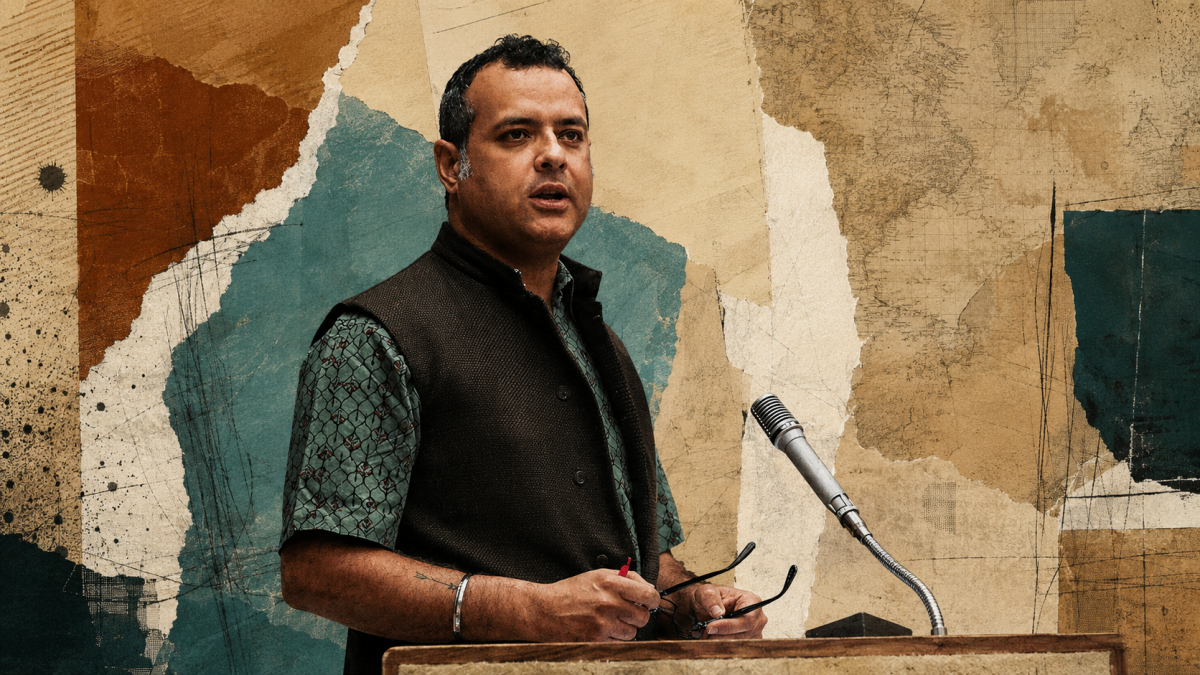
The historian and journalist argues that the U.S. attack on Iran must be understood within a much longer history of imperial power, racial hierarchy, and peoples’ struggles for sovereignty.
When we sat down recently with historian, journalist, and author Vijay Prashad, we expected to talk about Iran. We ended up talking about something much larger: the political habits that allow powerful nations to attack weaker ones while continuing to present themselves as defenders of freedom.
Prashad had recently published a sharp response to an open letter signed by a number of prominent left intellectuals and activists. What disturbed him was not that the letter criticized the Iranian government. It was that, in his view, the letter appeared to place Iran’s treatment of political prisoners alongside the U.S.-backed military assault on the country as though the two were morally equivalent.
For Prashad, that framing obscures the central issue.
“This is a war of aggression,” he told us. “It’s illegal. It’s a war crime.”
Related stories
Any serious statement coming from intellectuals in the United States or Britain, he argued, should begin by confronting the attack itself. Questions about Iran’s internal political life can be debated, he said, but they should not be used to blur the distinction between a nation’s domestic shortcomings and an outside power waging war against it.
Prashad was particularly skeptical of blanket demands that Iran release all political prisoners while the country is under attack. He did not deny that governments repress dissent or imprison people unjustly. Rather, he argued that states facing military assault must also contend with espionage, sabotage, and foreign intervention.
To ignore that reality, he said, is to apply abstract liberal principles without acknowledging the conditions created by war.
Prashad also questioned the intended audience of the open letter. If it was truly addressed to Iranian political prisoners, he asked, why publish it primarily in English in The Guardian rather than in Farsi through outlets likely to reach Iranians?
His conclusion was blunt: he believes the letter spoke less to Iranians than to Western liberals.
That disagreement led us into the larger argument that runs through much of Prashad’s work, including The Darker Nations and The Karma of Brown Folk. The modern world, he reminded us, did not emerge peacefully. The enormous accumulation of wealth that helped create industrial capitalism was built in substantial part through colonial extraction and enslaved labor.
Yet those centuries of exploitation also produced something humanity had never possessed before: enormous collective productive capacity.
“We have all this social wealth,” Prashad said. “Why can’t we socialize it?”
We can travel into space, communicate instantly across continents, manufacture vast quantities of food and medicine, and deploy machines to perform work unimaginable to earlier generations. Yet billions continue to live with scarcity while individuals such as Jeff Bezos and Elon Musk command fortunes measured in hundreds of billions of dollars.
For Prashad, the contradiction is no longer defensible.
The same struggle over wealth and power shapes the question of national sovereignty.
He drew a line from the national liberation movements of Vietnam, Cuba, and Iran to struggles inside the United States, including the Black Panther Party. In each case, he sees people attempting to determine their own political and economic future—and entrenched power attempting to prevent them from doing so.
That brought us back to Iran and Donald Trump.
Prashad believes Trump entered the conflict expecting Iran to collapse quickly. Instead, Iran has resisted, challenging the assumption that overwhelming U.S. military superiority necessarily translates into political victory.
He compared that resistance to the determination of Cubans not to return to the Batista era or Iranians not to return to the rule of the Shah.
Whatever criticisms outsiders may have of Iran’s government, Prashad argued, deciding Iran’s political future belongs to the Iranian people.
“That’s for them to decide.”
For Sharon, the discussion raised another question: Can Americans understand imperial violence abroad without confronting racial domination at home?
She argued that Americans repeatedly underestimate the brutality their own society can produce because they remain attached to a comforting story about American liberal democracy.
Prashad agreed.
“Don’t underestimate what society has been produced by hundreds of years of brutality,” he said. “You think it’s liberalism, but it’s not. It’s absolutely brutal.”
But the conversation did not end in despair.
Dick pointed to resistance around the world and asked whether we might be witnessing the beginnings of a turning point. Prashad did not dismiss the possibility.
History, he said, works through contradiction. Repression generates resistance. The harder people are pushed down, the more forcefully they may eventually rise.
“The deeper you push down and try to oppress people,” he said, “the more they try to stand up.”
That may be the most important thread running through Prashad’s work.
Imperial power is formidable. But it is never uncontested.
For those of us trying to build a multiracial and multiethnic progressive movement in the United States, the task is to connect these struggles rather than separate them—to understand that racial hierarchy at home and imperial domination abroad are not unrelated phenomena.
Prashad’s message was not that victory is inevitable.
It was that submission is not inevitable either.
Comments

Powered by RoundtableAn AI/DeFi-powered Enterprise Media Operating System. Learn more at Roundtable.io.© Roundtable 2026. By using this site you agree to the Terms of Use and Privacy Policy