
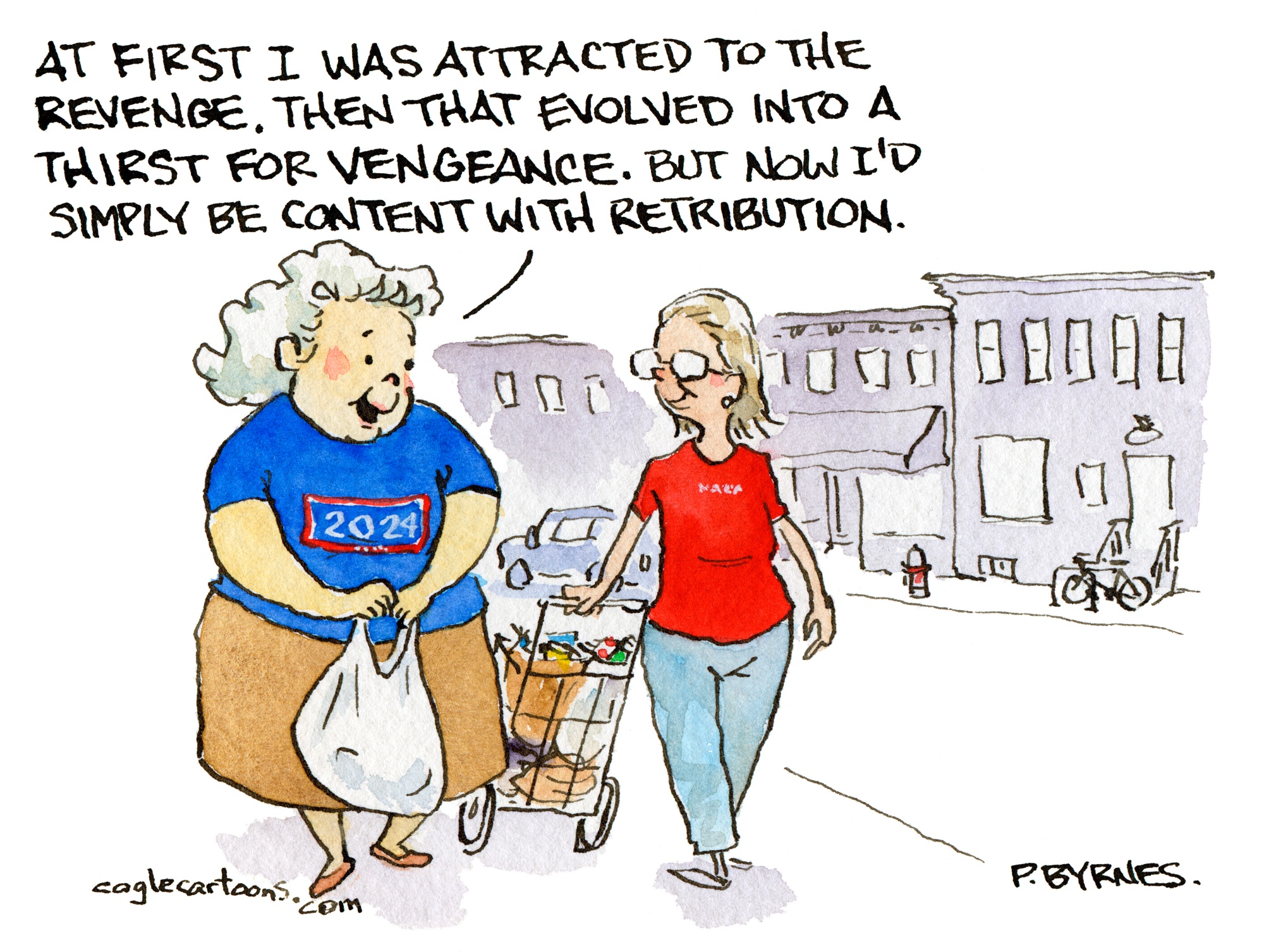
Illustration by Pat Byrnes on Cagle Cartoons


Emotional Logic of Trumpism
May 10, 2025 3:37 PM
Trump has flung open the gates of cruelty. And yet, the faithful do not blink. They do not flinch. In their gaze, there is not doubt, but devotion.
There is a strange stillness in the soul of the American electorate, a stubborn echo in the canyon where remorse should live. One might have expected—after the fires were lit and the empire shook with fever—that some would awaken, ash-smeared and wide-eyed, clutching the ballot of yesterday like a poison they had swallowed in a dream. But no. The myth of the remorseful Trump voter, as Jarvis DeBerry reveals, has proven as phantasmal as the unicorn or the moderate Republican—rumored, wistfully sought, but never caught in the light of day.
Kamala Harris's supporters, those children of what might have been, wander through the smoldering ruins with bitter psalms on their lips. They turn to the others—the ones who lit the match—and demand confession. “Do you see it now?” they ask, brandishing the latest outrage like a prophet’s scroll. “Did you vote for this?” But they are answered not with shame, but with silence, or worse, with the iron certainty of the damned.
The American psyche is a fortress built on the twin altars of pride and grievance, and Trump’s faithful kneel at both without flinching. The prophets of data—the Public Religion Research Institute, the University of Massachusetts, the scribes of the Times—have climbed their towers and shouted the numbers like omens: 92%, 98%, 100%. The numbers do not weep. They merely affirm what the heart already feared: nearly all who drank from the bitter chalice would do so again, gladly, even as the poison turns septic on their tongues.
This is the terrible symmetry of belief in the time of decline. Trump has cast thousands of innocents from their posts like stones into a pit. He has flung open the gates of cruelty, offered ICE as a reaper, torn aid from the mouths of the starving, made mockery of the law, and handed the levers of the republic to sycophants and scoundrels. And yet, the faithful do not blink. They do not flinch. In their gaze, there is not doubt, but devotion.
Related stories
Perhaps the Harris voter can afford their clean conscience. Defeat is a balm that preserves the dream. She never ruled, never erred, never disappointed. Her ideal remains untouched by the compromises of governance. But the Trump voter has had the full measure of their champion’s rule—and still they stand by him, unrepentant, like worshippers at a burning temple who declare the smoke to be incense. The following quotation by Jarvis DeBerry should leave all Americans slack-jawed in disbelief:
Quote: There’s been a new category of schadenfreude-inducing stories focused on Trump voters who’ve lost their federal job, had a loved one snatched by ICE or significantly suffered during the first few months of the administration. On top of that, some recent polls have found that Trump’s approval rating is below 40%. However, in the main, the Trump voter with buyer’s remorse is a mythical character not unlike, say, the moderate Republican.
The Public Religion Research Institute conducted a poll of more than 5,000 adults across 50 states between Feb. 28 and March 20 and found that 92% of Trump voters are satisfied with their vote. More than that, the PRRI poll finds that just about everybody who voted in November is satisfied with their decision, including 95% of Harris voters and 85% of people who voted third party. (PRRI reports a 1.69-point margin of error for its national survey.)
It seems obvious why Harris voters are the least regretful; her losing the election erased the potential for her to make any disappointing presidential decisions.
It is remarkable, though, that after Trump has fired thousands of blameless federal employees, antagonized allies, rattled the stock market, shrunk the economy, eliminated a number of lifesaving humanitarian aid programs, defied the courts and put Fox News know-nothings in positions of power a near-identical share of his supporters suggest that they’d happily vote for him all over again.
But PRRI’s poll is consistent with a poll released April 14 by the University of Massachusetts Amherst that found that only 2% of Trump voters polled answered yes to “I regret my vote and would vote differently if I could.” And both those polls are consistent with a survey The New York Times conducted among a focus group last month that found that none of the 13 independent voters who voted for Trump in November regrets not voting for Harris.
Not the person who feels “bad” about the way things have been going. Or the one who’s “frustrated,” or the ones who feel “pessimistic,” “worried,” “hopeless” or even “lied to.” Unquote.
Here, then, is the lesson in the ruin: regret is not inevitable. Even when the ship breaks on the rocks, the crew may sing the captain’s praises. Even as the water rises, they may swear it is baptism, not drowning. And those of us who watch from the shore must reckon with a terrible possibility—that the vote was not a mistake, but a mirror.
We cannot expect repentance from those who believe they chose the lesser apocalypse. To them, Trump is not a mistake—they see him as a bitter cure, a caustic salve applied to a festering wound called America. He may be crude, they admit; he may break the furniture, scorn the clerics, and salt the earth behind him—but in their eyes, he fights. And more than that: he punishes.
In their reckoning, the ship of state was already sinking. Trump, for all his chaos, at least had the indecency to name enemies and swing an axe. They did not elect a statesman; they summoned an executioner. His wrath is not a flaw—it is the feature, the blade turned toward a Washington they believe betrayed them. The economy may contract, the institutions may bleed, but so long as the “others”—those liberal coastal elites, bureaucrats, academics, immigrants, journalists—suffer more, the bargain holds.
To confess a mistake would mean more than political error; it would mean disowning the one man who mirrored their fury, gave it form, and promised to avenge the loss they feel but cannot name. Better, they reason, to ride the storm with the captain who cursed the heavens than to kneel beneath the rule of those they believe caused the flood.
This is not ideology. It is not policy. It is something older, darker—tribal, sacrificial, mythic. A blood loyalty carved from resentment, nurtured on humiliation. And in that kind of covenant, regret is betrayal.
This blood loyalty is not born of reason. It is not held together by policy white papers or the cautious machinery of democracy. It is cult-ivated—ritualistic, sacramental, fanatical. A devotion more akin to religious fervor than political calculation. It resists fact, recoils from introspection, and thrives on persecution. To call it a movement is to grant it too much dignity; to call it a cult may be the only language that approaches the truth.
Cult devotion is hard to explain to the uninitiated. It is not the fruit of argument but the harvest of enchantment—less persuasion than possession, less reason than rapture. In this theatre of the absurd, where truth is drowned in the orchestra pit and irony plays first chair, the high priest struts like a circus messiah, tap dancing across the national stage in the garish greasepaint of grandiosity. He is a parody of masculinity—loud, leering, lacquered with grievance—pulsing through his digital pulpit like a televangelist on a bender, a golden calf with Wi-Fi. He babbles in algorithmic glossolalia, thumping out his gospel of grievance like Robert Tilton speaking in tongues, his Hoo Ba Ba Kanda [https://www.youtube.com/watch?v=6k0JeEKR3Do] echoing not from the heavens but from the hollow chambers of the web, where faith and farce have become indistinguishable. The message, though guttural and disjointed, resonates—because it is crafted for an audience steeped in the cacophony of confirmation bias and distraction.
He is obese with power, gluttonous with ego, a man so untethered from reality that his tantrums read like scripture to his followers. He casts himself as the eternal victim, the avenging messiah, the only sane man in a world of lunatics. His enemies are not opponents but demons—“losers,” “vermin,” “scum.” His lies are not lies—they are incantations, spoken into the echo chamber where reality itself has become optional.
And his flock? They do not merely follow. They revel. They delight in his cruelty, savor his contempt, cheer as he mocks the disabled, sneers at the dead, and threatens the weak. It is not policy they crave—it is vengeance. He is their golem, their gladiator, their golden calf, smeared with the blood of the scapegoats.
This is why remorse cannot bloom here. You cannot ask a worshipper to renounce their god mid-sermon. You cannot reason someone out of an exorcism. What binds them to Trump is not disappointment delayed, but rapture delivered. And so they kneel—not despite the lies, the rage, the ruin—but because of them.
In the end, the tragedy is not that they were misled, but that they believe.
The result of such cult devotion is not merely a tolerance for cruelty—it is cruelty as necessity. Not an accident. Not a regrettable byproduct. But the very engine of the faith.
In any true cult, suffering is sacrament. Pain must be inflicted to validate belief. The cruelty is the proof. For if the world has wronged you—mocked your traditions, stolen your future, defiled your identity—then what is more holy than revenge disguised as righteousness? What is more clarifying than watching the enemy squirm?
And so cruelty becomes ritual. Children torn from parents at the border: a cleansing. Federal workers purged without cause: a reckoning. Journalists demonized, courts defied, alliances broken—these are not excesses. They are offerings. The cruelty is not the price of admission—it is the attraction.
This is the logic of a politics untethered from empathy. A politics whose only moral axis is humiliation. It is why Trump can openly mock, wound, threaten, and yet rise in devotion with each lash. In this worldview, dignity is weakness. Mercy is betrayal. And truth is whatever the strong man shouts loudest.
This is not governance. It is a pageant of domination—a theater where power is measured not by what is built, but by who is destroyed.
And in that theater, remorse is treason. Regret is heresy. To question the cruelty is to question the faith. And so the worshippers close their eyes tighter, cheer louder, hate deeper—because to do otherwise would mean facing the horror of what they’ve become.
When Donald Trump posts an AI-generated image of himself as the next Pope—an orange messiah in papal robes conjured by an algorithm—it is not satire. It is not even irony. It is dominion. A digital anointing. A joke that becomes liturgy. In his kingdom, the line between spectacle and scripture has dissolved entirely.
In any other political universe, this would have ended a career. Had a Democratic president dared such a display—offered up an image of themselves in the vestments of a spiritual sovereign, a holy father of the digital church—the right-wing media machine would have roared to life with medieval fury. There would be fire on the steps of Congress, special investigations launched, billboards ablaze with the face of the "blasphemer." Picture it: the hounds of Fox News loosed at dawn, howling across the airwaves, summoning the faithful like town criers of the apocalypse. At their heels trails the “Court of Miracles”—not the forgotten outcasts of Hugo’s Paris, but a grotesque pageant of grifters, pundits, and self-styled martyrs of American decline. Together, they march on the cathedral of liberal decency, torches raised high, eyes wild with revelation, shrieking about delusion, desecration, and the blasphemy of self-deification.
Again, had a Democratic president dared post such a spectacle—an AI-forged image in papal garb, divine light shining from artificially perfect skin—it would have ignited a frenzy worthy of the Inquisition. “He thinks he’s God!” they would cry. “He wants to be worshipped! This is the end of democracy, the Antichrist in pixels!” The cathedral bells would toll, and the mob would charge the altar with pitchforks and constitutional amendments.
But when Trump does it, it is hailed not as madness, but as branding. The absurdity is the message. The digital Pope image is not disqualifying—it is transcendent. He floats above the rules, the ridicule, the ruin. He becomes, in that moment, more than a man: an avatar of pure will, crowned by his own imagination, crucified by fact-checkers, resurrected in memes. He is no longer merely a politician. He is myth.
And the mob does not storm his cathedral. They build it.
But Trump? He is immune not because he hides his excesses, but because he is the excess. His followers do not recoil from such madness—they interpret it as prophecy fulfilled. They laugh not at him but with the joy of belonging to a world where he alone is allowed to transgress, to invent himself anew as martyr, monarch, messiah, pope. The image becomes a commandment: Thou shalt not question him, for even in parody he is sovereign.
This is the heart of authoritarian charisma in the age of unreality. He does not need permission. He does not require coherence. He can call himself Pope, King, Executioner, or Victim, and his followers will say, “Yes. All of the above. And more.”
The terrifying truth is not that he believes it. It’s that they do.
Now imagine—just imagine—what Fox News would do to a Democratic president who dared tread the path Trump walks daily in steel-toed boots. Picture a liberal president slashing funding for cancer research, trimming it like fat from a spreadsheet while families weep in chemo wards. Imagine that same leader threatening Medicaid with the quiet scalpel of bureaucratic cruelty, stripping care from the sick, the elderly, the forgotten—deaths signed into law in the name of “efficiency.”
Now hear the scream machine roar. Hannity in sackcloth. Ingraham weeping blood. The chyron flashing: “LIBERAL DEATH PANELS CONFIRMED.” Picture them crying out for impeachment, for trial by fire, for divine judgment at the gates of every children's hospital in America.
And what if that Democratic president, having bled the social state dry, then handed the Pentagon a trillion-dollar feast? Not a wartime necessity, not a response to invasion—just a tribute to the gods of Lockheed and Raytheon. Imagine the howling chorus: “Elites fund the war machine while our veterans sleep in the streets!” Cue the military wives on live broadcast, cue the grainy B-roll of crumbling VA hospitals.
But most unholy of all—imagine if a Democrat spoke with venom against diversity, equity, and inclusion—if they snarled those words like curses, swore to purge them from the public square, mocked Black scholars, trans students, and disabled workers as parasites on the body politic. Fox News would not just react—they would detonate. Op-eds would weep for Martin Luther King. Specials would air nightly, mourning the end of Lincoln’s dream. There would be a 24/7 telethon for the soul of America.
But when Trump does these things, it is framed not as cruelty—but as courage. Not bigotry, but bravery. When he mocks the weak, he is “telling it like it is.” When he feeds the Pentagon and starves the poor, he is “draining the swamp.” When he attacks inclusion, he is “restoring order.”
The double standard is not hypocrisy. It is doctrine. In their creed, Democrats must be angels or be destroyed. But Trump? He need only be a warrior—bloody, brutal, and unrepentant. He sins not in spite of his power, but because of it. And his followers chant, “Amen.”
We laugh at Fox News. We mock the screaming chyrons, the apocalyptic music, the operatic headlines that warn of drag queens in libraries and Marxists in math class. We roll our eyes at the nightly spectacle, the carnival of grievance, the priests of panic who sell outrage like snake oil. But the laughter is a shield, a nervous tic in the face of something that is, at its core, deadly serious. Because while we were laughing, they were organizing. While we were fact-checking, they were mobilizing. Fox News is not journalism—it is war liturgy. It knows how to summon the base not with policy, but with false prophecy. It speaks the language of siege, of sacred betrayal, of lost golden ages and encroaching Others. It takes the raw, electric wire of hate and plugs it into the national bloodstream. And that is the secret of their success—not information, not truth, but emotion weaponized. They know that in America today, fear is more persuasive than facts, and rage is more renewable than hope.
To the Trump faithful, fighting does not mean struggle toward peace or negotiation toward justice. No—it means punishment. Fighting, in their lexicon, is not the means to victory; it is the victory. Pain must be inflicted. Someone must be made to bleed—preferably publicly, preferably forever.
Victory without sufficient punishment is hollow, fraudulent—a pyrrhic triumph. In the terminology of the Ultimate Fighting Championship, it is a win by unanimous decision, not by knockout. The arena is not satisfied unless the opponent is ultimately humiliated, their face pressed unconscious into the canvas, their name anathematized. It’s not enough to win elections or pass legislation. There must be enemies. There must be vengeance.
Trumpism reimagines politics as combat sport. Picture a UFC match not as contest, but as catechism: the crowd doesn’t cheer the discipline or the finesse, but the smash. Except for the commentators in the broadcast booth, only domination satisfies. Only punishment proves the world has been set right.
And so cruelty becomes the condition of possibility for belief. Mercy is weakness. Reconciliation is betrayal. The true Trumpist doesn’t want to win with the other half of America. They want to crush it, to erase it, to see it crawl away whimpering. Without that spectacle, even winning feels like loss. This is why Trump wants his military parade.
Not merely to bask in spectacle, not only to ape the autocrats he admires, but to stage a warning—an act of symbolic violence draped in flags and medals. It is less a celebration of the troops than a procession of power, a slow-rolling thunder meant to send a message: I command the muscle of empire. Then take him at his word—because tyrants often tell the truth, not in the language of policy, but in the boastful roars that echo from the stage. When Trump says, “I run the country and the world,” [https://www.youtube.com/watch?v=9Zk9TrvbxQY] he is not joking. He is not exaggerating. He is testifying.
That phrase—“I run the country and the world”—isn’t just the smug puffery of a demagogue. It is the utterance of a man who sees reality as pliant clay, whose belief in his own dominion is not metaphorical but manifest. It is the divine right of kings reborn in the language of late capitalism. It is the gospel of the deal made flesh. A gospel that enables the self-styled steward of the "greatest democracy" to threaten to conquer Greenland and annex Canada, to extend not a hand of justice but a shrug of surrender to Ukraine, granting the Russian invader leave to keep the plundered soil, as if borders were bargaining chips and freedom a nuisance to be negotiated away. For Ukraine, it is a betrayal by the United States writ in the ink of appeasement, a Neville Chamberlain moment dragged into the 21st century—only this time, the umbrellas are digital, and the price is not merely land, but the credibility of an entire world order. Peace without principle, silence in the face of tyranny: the handshake of cowards dressed as statesmen.
It is not foreign enemies he seeks most to impress with his parade, but allies and citizens alike—those Europeans he believes have grown too soft, too multilateral, too disobedient. The tanks and missiles on display, he imagines, will speak for him.
The parade is not about war. It is about memory. About summoning a vision of America not as a fragile democracy, but as a stomping, iron-clad behemoth. A parade is a line drawn in history—the strong above the weak, the loyal above the doubter, the marching above the mourning.
To his base, it will be glory. To his enemies, a threat. A foreshadowing of what awaits those who resist. You can hear it in the echo of boots on concrete: I am the state.
Trump’s desire for a parade is not about honor—it is about choreography. It is a dress rehearsal for autocracy. The drumbeat to drown dissent. A confirmation that fascism can prevail under the Stars and Stripes as long as it is referred to in softer tones such as ‘authoritarianism’.
In Trump’s mind, the Oval Office was not a seat of stewardship but a throne. The bureaucracy, the courts, the press—tools, or obstacles. That moment—when Trump was asked if he would uphold the Constitution and answered, “I don’t know”—wasn’t a gaffe. It was a Freudian slip, a rupture in the mask, the emperor whispering that the law does not clothe him. The world, too, is his inheritance—not a globe of sovereign nations, but a map of personal grudges and profitable loyalties. Berlin and Paris become backwater provinces in his empire of insult. Kyiv, a bargaining chip. The planet, a boardroom. And he is the CEO of planet Earth.
This is not hyperbole. This is the point. Because in a world where reality is shaped by what trends, by what goes viral, by what is believed rather than what is, a man like Trump can believe he controls the world—and millions will nod. Not because it’s true, but because it feels true.
And in the politics of strongmen, feeling is more powerful than fact.
This is not politics. It’s pageantry for the wounded ego, ritualized in the theater of hate.
Whatever party can conjure the most powerful liminal moments—those thresholds of unmoored experience, those charged pauses between what was and what might be—that is the party that will prevail.
In an age when institutions have decayed, trust has withered, and the map of the future lies blank, voters are no longer choosing based on programmatic coherence or fiscal restraint. They are seeking meaning. They are searching for rites of passage. And whoever offers them that rite—even in distorted or dangerous form—wins their loyalty.
The great symbolic anthropologist, Victor Turner, called this space liminality—the in-between realm where the old social order dissolves and the new has not yet taken shape. It is disorienting, unstable, sometimes ecstatic. In tribal societies, it marked the sacred path to adulthood. In modern politics, it marks the passage from disillusionment to belonging. Communitas, that intense, almost spiritual feeling of egalitarian fellowship, often arises here—in the crucible of shared uncertainty .
Trump, for all his vulgarity, understood this. His rallies were not just stump speeches. They were rituals. People did not attend them to hear policies; they came to be initiated—to feel themselves part of a sacred remnant, misunderstood, besieged, but finally seen. They stood in arenas not just as voters, but as converts, passing through the fire into a new reality, often sobbing and trembling before the stage. The chants, the grievances, the red hats—all symbols in a liturgy of abandonment and rebirth. It is a rebirth—ritual and rapture—into a world sculpted not by their own hands, but by the billionaire priesthood that rules from golden temples with exotic names like spells: Mar-a-Lago, Bedminster, Trump Tower.
It is the closest they will ever come to touching the hem of power, to grazing the robes of Olympus. And yet they believe this world was made for them—a kingdom of marble mirages, where the doorman might someday nod and let them in.
The left, by contrast, too often offers data where it should offer drama. Bullet points instead of burning bushes. It hesitates at the edge of the liminal, unsure whether to take that crucial step.
But in a collapsing world signaling the end of one of the world’s most powerful empires, people do not cling to moderation—they cling to meaning. The future belongs not to the side with the most rational platform, but to the side that can open a door, tear the veil, summon a vision.
In the kingdom of untruth, where lies wear crowns and facts are exiled, it is not simply chaos that reigns—but evil, robed in the velvet of hatred, unchallenged and enthroned. An evil not cloaked in darkness but broadcast in high definition—amplified by the algorithms of incitement, those digital incantations that turn grievance into gospel. It marches not with boots but with metrics, fed by the appetites of the aggrieved and the idle alike. And at its helm stand the fist-pumping demagogues, their default toothless grins, all gums and no bite, seasoning their sermons with nicknames and nincompoops wielding chainsaws—mockery masquerading as message. They brandish insults like sacred texts, turning anodyne public discourse into a schoolyard brawl, where cruelty is currency and truth is a punchline. The republic, once a forum for reasoned voices, now resembles a stage where jesters trade their coxcomb hats for crowns and fools are made into prophets—not for their wisdom, but for their willingness to shout the loudest in the theater of the absurd—Eliot’s ‘hollow men’, his ‘stuffed men’ whose dried voices are as meaningless as ‘rats’ feet over broken glass’, echoing through the corridors of a civilization that has forgotten how to distinguish perfidy from principle.
It is not enough to critique the past. We must create the rite of passage through which people walk into the new; we must enflesh the metaphor of liberty, which means transforming metaphor into metamorphosis, into a narrative by which we live and struggle. It is not enough to sit in the ruins and recite the failures of the past like mourners at a wake. We must become midwives of the new, forging a rite of passage through which a weary people can stagger, crawl, or march into the yet-unimagined. We must enflesh the metaphor of freedom—breathe sinew and bone into the word—until it walks among us, not as slogan but as struggle, not as abstraction but as embodiment. For true freedom demands more than poetry; it demands enfleshment—a shedding of old skins, a narrative not merely told but lived, bloodied and bright, carried on our backs like a gospel forged in fire.
If we are to defeat fascism and protect democracy, this trial by fire must become more than spectacle—it must transmute into a sacred renewal, a repristinating of democracy itself. For without that consecration, the theatre of crisis decays into farce, and the stage—meant for justice—sinks beneath the weight of deception. Drama unanchored from righteousness becomes a masquerade of power, and in such a performance, truth is the first casualty. In the ashen light of a post-truth dusk, where facts are shadows and lies walk in daylight, evil finds its dominion—not with horns and fire, but with ear-to-ear grins, slogans and fist pumps made into text available gifs on social media platforms like Instagram, Facebook and X, cloaked in the language of liberty while razing its very foundation.
And this rite of passage back to the foundations of liberty must be no gentle return, but a searing crucible—a fire through which democracy must pass, not to be preserved, but to be transfigured. It must emerge scarred but sanctified, stripped of its hypocrisies, its false pieties, and restored to its first, fierce light: the cry of the people for justice. For without justice, drama curdles into farce, spectacle rots into propaganda, and the rally stage collapses beneath the weight of its own deceit—like the Victory Day Over Fascism parade in Moscow, where hollow fanfare masks the grotesque irony of fascists in Russian uniforms raining hellfire on schools and hospitals in Ukraine. The flags wave, the speeches thunder, and yet the ash drifts quietly across the continent. We can only imagine what pageantry Trump's parade might unveil—chariots of grievance, banners of vengeance, a soundtrack of applause for the strongman’s dream. The real danger is not just what it celebrates, but what it erases.
Comments

Powered by RoundtableAn AI/DeFi-powered Enterprise Media Operating System. Learn more at Roundtable.io.© Roundtable 2026. By using this site you agree to the Terms of Use and Privacy Policy