


Aug 16, 2020 7:00 PM
Updated Feb 10, 2022 10:40 PM
Sara Roos: political parties are only quasi-governmental. They “play one on TV” but are in fact owned and operated as a private club.
How to Assure Representation in a Public-Private Partnership?
In California’s primary on March, 2020 Angelenos voted for delegates to our County “Central” political “Committee”. Democrats selected from among a total field of 309 candidates, for seven individuals per assembly district whose role would be to represent us, the electorate. We have a reasonable expectation to be represented faithfully by these representatives, selected politically via a democratic, electoral process.
Political parties are only quasi-governmental. They “play one on TV” but are in fact owned and operated as a private club.
In fact, however, political parties are only quasi-governmental. They “play one on TV” but are owned and operated as a private club. The political party utilized for endorsing and ultimately selecting our public, government officials, is itself not mandated by sunshine laws or public sector requirements, but by its own private bylaws. The expectation of representation, at least in terms of 1 person:1 vote, is simplistic.
In the case of LA County’s (LAC) Central Democratic Committee, the LACDP, there are 24 constituent state assembly districts (ADs), the geographic boundary that defines CA state Assembly member’s territory; find yours here. In 22 of these ADs, the LAC registrar conducted contested elections this past Spring. For the two without elections, delegates were appointed to seat vacancies by the Democratic Party (DP) chair for a total of 168 “elected” members of the LACDP (table 1).
Related stories
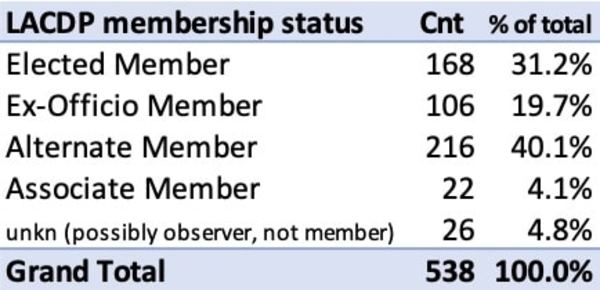
But the full denominator of membership may never be fixed as associate members come and go, and chair-appointments are hard to reckon. Currently the full LACDP is well over 500 strong, including members elected to state- and county-wide offices (“ex-officio” members) who vote in the general assembly of the Central Cmte; non-voting members associated, for example, with Democratic clubs; and alternates for most of these members who vote in the general assembly only in the absence of the representative for whom they are an alternate. Consequently the relative proportion of voting members in the general assembly must remain approximate.
Committee membership is also labile but appointment and full voting privilege there is not tied to the elected or ex-officio member. Alternates are appointed to committee in their own right. They serve at the pleasure of the LACDP chair, as full voting committee members.
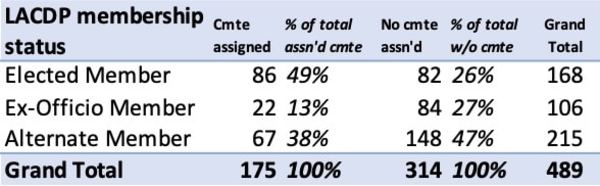
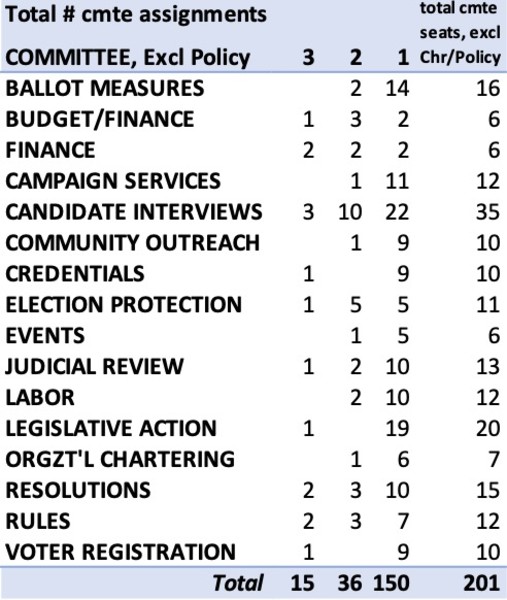
Therefore total elected representatives to the root “County Central Committee” of the national DP’s pyramidal structure, constitute at most under one-third of the local membership. And while the proportion of elected representatives may hover around 60% of any given full assembly meeting’s voting delegates (168/N(elected, Ex-officios) = 274), the work of a large organization is accomplished in committee. And just under half the elected delegates (first row, table 2) have been excluded from any committee assignment whatsoever …even while nearly 30% of those assigned to committees (51 of 175 unique individuals) serve on more than one (table 3). When we vote for representation on the local DP, we summon but a faint fraction of it.
There is a bias in assignment of committee work that favors longevity in the party (familiarity) and affirmation of incumbency (conformity).
Immediately upon swearing in this term’s members, leaders were elected from within each assembly district membership. Without LACDP disclosure of alternates and ex-officio members, the electorate was unknown and unknowable. Incumbents were familiar with one another; newcomers do not know who is involved or the scope of the delegation which whom they are unfamiliar. Campaigning, then, is a function not of ideas or persuasion but of who can be reached; a function of prior familiarity.
It took a spontaneous resolution during the full party’s first “organizational” meeting to compel the LACDP to distribute a simple list of the electorate to officer candidates. But it is not only the passive control of information and prior familiarity that constrains LACDP elections of party leadership. As it happens individual’s personal choice regarding party leadership is not private. In stark contrast with LACDP which holds its group-organizational prerogative fiercely secret, individual’s policy-selections are publicly disclosed.
Conducted in advance of committee assignments, the association between voting to favor incumbency and committee membership, suggests either passive or active bias in subsequent committee assignment. For one reason or another, committees are composed of members who do not challenge the party line (table 4).
Among four officer elections a score of 1 is ascribed each vote for an incumbent, 3 for a challenger and 2 for an abstention. This simple “AEI” index ranges from 4 to 12 and reflects favor of party-line incumbency vs alternative leadership.
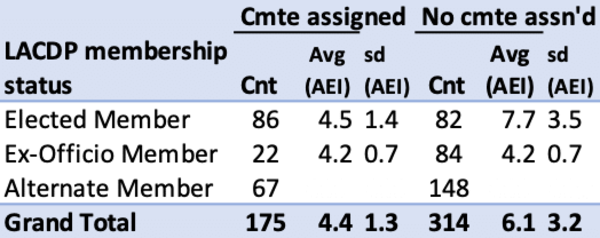
The association of leadership preference with assignment to any committee is not attributable to a proclivity for incumbency alone. Cause and effect are not clear, but at the least a difference in tolerance for incumbency among membership types is significant.
Ex-officios are different from elected members in ways likely to be reflected in committee voting.
Committees composed of varying membership-types (table 5) do reflect some slight variation in their membership’s preference for leadership, but none even close to the average among elected members excluded from committee membership (“AEI” = 7.7 ± 3.5 vs 4.5 ± 1.4).

Having long heard of party shenanigans, it is another matter altogether to witness the microcosm of its sausage in the making. The opportunity to be a constituent part of the Democratic Party as is the prerogative of members elected by a believing public in order to be representative of their interests, is curtailed by our very own local-version of shenanigans. Representatives of the LACDP unwilling to vote indiscriminately for LACDP incumbents are at least initially excluded from meaningful participation, ensuring robust continuation of Party status quo.
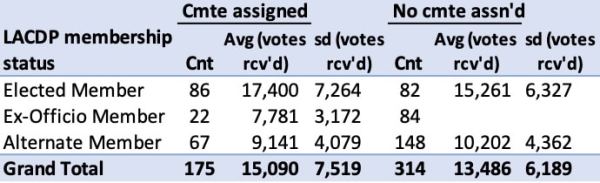
This bias of longevity and familiarity might be understood to favor experience and institutional memory. Across all ADs the average number of votes received in the March primary among members assigned a committee is larger than among those who were not (table 6). Candidates not elected outright often are instead appointed by an elected member as their alternate, thus manifesting a popular vote count even when technically ‘not-elected’. Popularity might be high for a variety of reasons, e.g. as a function of incumbency and also as a function of electorate excitement for an alternative candidate. The difference is trivial among alternates in vote count between those assigned committees and not. On average, that is.
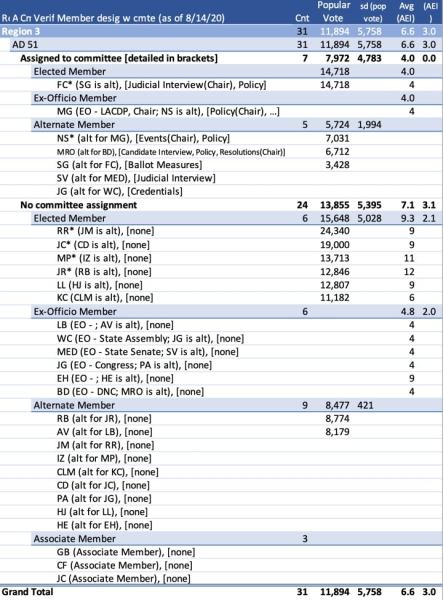
But in specific districts popularity is systematically inversely proportional to popular vote as well as association with leadership conformity (table 7). The singular elected member there assigned to committee has less votes than the average of the remainder, unassigned electeds; all the assigned alternates have lower totals than the unassigned alternates. And among the unassigned elected members, the index tracking tolerance for leadership challenge is striking. A conclusion of retribution attached to committee assignment is hard to avoid. At least in some ADs.
It is frustrating to be elected to a central political committee and be blocked from involvement before the session ever begins. It is frustrating to publicly demand electoral reform, to witness the horror of elections tampering over decades by the opposition and daily from the current federal executive regime ... only to then witness a mirror image of finagling within the lowest rung of my own political party.
Does any of this matter? Most assuredly – this is where an organization grows its continuity and absorbs the new flavors of an evolving electorate. Without feedback from new sensibilities there is no way to update relevance and stay useful, representative. To systematically oppose the new or different is to fetishize the status quo and enable otherwise-ordinary degeneration.
These political parties, it turns out, are the original Public-Private Partnership. As private organizations they attach themselves to the body politic and extract its public resources for private gain. When representativeness is thwarted for private purposes, whether of an individual or a party for its own sake, the individual-as-citizen – me, you – is disenfranchised. This matters.
If you would like to see popular opinion represented upstream across the national stage, then look to the doings at a local level and hold the officials there accountable. If you elected someone to represent you in the local political party, then make sure you stay aware of whether that wish of yours is respected. This first month witnessing the shenanigans of our local LACDP has been a shock almost as dispiriting as watching the Kabuki from DC.

Sara Roos
Comments

Powered by RoundtableAn AI/DeFi-powered Enterprise Media Operating System. Learn more at Roundtable.io.© Roundtable 2026. By using this site you agree to the Terms of Use and Privacy Policy