
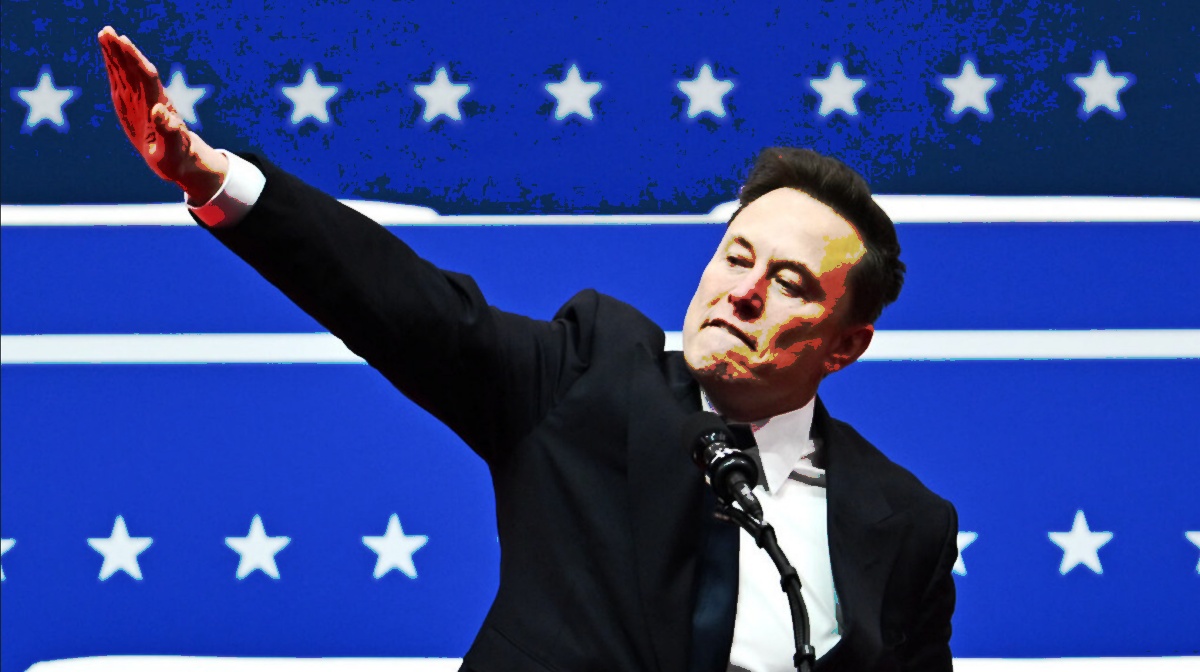


elon musk salute
Jan 24, 2025 7:35 PM
For many, Musk’s actions signal a dangerous normalization of far-right extremism, with his considerable influence as a tech magnate amplifying its reach.
The controversy surrounding Elon Musk’s gesturing at President Donald Trump’s inauguration on January 20, has become a flashpoint in the ongoing debate over rising extremism and antisemitism in American society. Musk’s gesture—thumping his hand over his heart with fingers spread, followed by an upward extension of his arm, palm down—sparked outrage and alarm, with many interpreting it as disturbingly reminiscent of the Nazi "Heil Hitler" salute. The gesture involved Musk thumping his right hand over his heart with fingers spread wide, then extending his right arm upward at an angle, palm down and fingers together. He repeated this action while facing away from the camera, saying, "My heart goes out to you."
In response to the ensuing criticism, Musk addressed the allegations on his social media platform, X (formerly Twitter). Accompanied by a snooze emoji, Musk's statement, “Frankly, they need better dirty tricks. The ‘everyone is Hitler’ attack is sooo tired,” struck many as glib in the face of such grave allegations.
The gesture drew fierce backlash from Jewish lawmakers and antisemitism watchdogs, and understandably so. Representative Jerry Nadler took to X, writing, “I never imagined we would see the day when what appears to be a Heil Hitler salute would be made behind the Presidential seal”. Similarly, Representative Dan Goldman, who leads the House’s antisemitism task force, delivered a scathing critique [Dan Goldman (D-NY), a Jewish lawmaker who heads up the House's antisemitism task force, said : “Viewed in the context of Musk’s repeated amplification of racist and antisemitic conspiracy theories, including the ‘Great Replacement’ theory, and his tolerance of anti-Jewish hate on X, this gesture can only be interpreted as a Sieg Heil salute synonymous with Nazi support for Hitler.” Goldman further tied Musk’s actions to broader far-right movements, warning of their symbolic resonance with extremist groups. "Just as the Proud Boys understood Donald Trump's urging to ‘stand back and stand by’ as a direction to mastermind the January 6 riot, neo-Nazi and far-right extremists have interpreted Musk's salute to refer to the Seig Heil salute to Hitler," Goldman continued. "It is no coincidence that Musk's fascistic salute occurred just hours before President Trump pardoned far-right, violent domestic extremists who assaulted law enforcement officers at President Trump's direction in an effort to overturn the 2020 election."
Goldman emphasized that there was no mistaking what everyone saw: "Elon Musk has repeatedly pushed for the racist and antisemitic 'Great Replacement' conspiracy theory, endorsed the Nazi-sympathizing German Political Party AfD, and allowed anti-Jewish hate to proliferate unabated on his website, X.".
Related stories
“If you’re cool and want to defend the ‘Sieg Heils’ and the Nazi salutes … whatever you want to do, that’s on you,” she said. “I’m on the opposite side of that. I’m not with the Nazis.” She further remarked that “two of probably the most foundation-defining things about American history is that we beat the Confederates, and we beat the Nazis.” “I don’t know what side people may be on today, but I am still not rocking with anyone sympathetic to Nazis, and I will do that until I am 6 feet in the ground”
Far-right commentators, meanwhile, hailed Musk’s gesture, interpreting it as an endorsement of their rot-infested ideologies.
For many, Musk’s actions signal a dangerous normalization of far-right extremism, with his considerable influence as a tech magnate amplifying its reach.
As Matthew Chapman reported, the incident has reignited calls for accountability, not only from Musk but from all public figures whose actions and words variously shape the cultural and political landscape. The questions now echo: how far can symbols of extremism seep into the mainstream before they fracture the fragile fabric of democracy? And at what point does silence become complicity?
The once-vibrant stage of American politics, where ideals clashed and compromises were forged, now resounds with the echo of Trump’s triumphal march—a parade of grievances masquerading as a coronation. Beneath its gleaming façade lies the rot of ambition, long festering among those weary of the grinding gears of democracy, their discontent now satiated. Their prayers, whispered into the void of despair, have been answered as Trump emerges from the wings of the stage, crowned with the laurel wreath as the first American Caesar. His political wardrobe is draped in the cloak of populism and with it a promise to dismantle, piece by piece, the fragile scaffolding of shared governance.
The pillars of the republic tremble beneath his tread, their cracks deepening as his flim-flam rhetoric casts itself as both salvation and reckoning. The audience, spellbound or aghast, watches as the performance transforms into a spectacle of empire, where power consolidates and the ideals of many yield to the will of one.
It is not the thunderous applause that fills the air but the murmur of unease, the shadow of questions too dangerous to voice. How long can the stage bear the weight of this new Caesar? And when the curtain falls, what will remain—ashes or embers of a once-bright flame?
From the rafters, the watchers of history recall the fall of other republics, their voices lost in the roar of a crowd intoxicated by the theater of power. The republic's architects, their blueprints faded and frayed, seem to warn of the perils of unchecked ambition and the seductive allure of absolute authority.
But how has Trump pulled this off? How has he managed to con half of the country and retain an iron grip on at least 25 states? Part of the answer lies in his genius for cultivating his brand. David Levinthal remarks on Trump’s first presidential term:
- Since his inauguration, Trump has conducted at least 57 political rallies—funded in part by his campaign and not official White House business. All but a half-dozen took place in states he won in 2016, allowing him to bolster his bases of support.
- During the 35-day partial federal government shutdown triggered by Trump’s desire to fund a wall on the southern border, Trump repeatedly solicited supporters with shutdown-themed fundraising messages. Come-ons included buying a “brick” for $20.20 to send to Speaker of the House Nancy Pelosi and contributing to an “Official Secure the Border Fund"—this wasn’t a government fund, but rather, Trump’s re-election committee. Trump’s website featured “Build the Wall” products when on Friday he declared a national emergency to secure wall funding, and his campaign texted supporters, "We have an INVASION!"—to send money.
- Trump has expertly and endlessly marketed his political brand, peddling Trump T-shirts and trinkets and MAGA swag, the proceeds from which go directly to Donald J. Trump for President. “They push those products so hard,” said Bentley Hensel, president of political e-commerce firm 1776 Consulting, who estimates 30 percent of the Trump campaign’s contributions during 2017 and 2018 could have come from merchandise sales.
- Trump has consolidated political power, moving to turn the Republican National Committee into a subsidiary of his own campaign committee by sharing office space, staff and fundraising operations — a move aimed at increasing efficiency and limiting internal squabbles. Numerous Trump allies, advisers and former staffers meanwhile help run a constellation of pro-Trump super PACS and nonprofits, which may raise and spend money without restraint. While these groups are nominally independent of Trump’s own campaign committee, Trump keeps some of them as close as he legally can, even attending fundraisers last year for the America First Action super PAC.
While he does not don the full regalia of the fascist dictators of old—there are no black shirts marching in lockstep, no iron-fisted control over every facet of society—he prowls the stage like Caliban, a disfigured felon borrowing fragments of costumes from the wardrobes of Mussolini, Franco, and Hitler. He wears their gestures like a borrowed cloak—just enough to stir the ghosts of history, to ignite the embers of latent hate, and to embolden those who wait in the wings with dreams of blood-soaked retribution.
Trump’s rhetoric, more cudgel than scalpel, cleaves the body politic with the blunt force of slogans and scapegoats. Migrants are “vermin,” the press is the “enemy of the people,” and the faithful are anointed warriors in a divine battle against a profane, imagined enemy.
Like the carnival barker luring crowds with promises of spectacle, he offers a grotesque vision of "greatness" that thrives on conflict and chaos. He does not write manifestos; he tweets provocations. His playbook is not Mein Kampf but a discordant medley of grievance, tribalism, and opportunism.
To call Trump a fascist is to wrestle with the weight of history and the limits of language. To dismiss him as merely authoritarian or para-fascist risks underestimating the shadow he casts. He does not march in front of legions but is flanked by the world’s most powerful ‘tech bros’; he does not write their creeds but amplifies their wealth and political influence. At least 13 billionaires are set to have government posts under his presidency, with his expected cabinet worth at least $7bn, double that of his own first term and an astonishing 60 times more than the net worth of the current one. Musk, Zuckerberg, Cook, Bezos, and all the others stand silent before history’s indelible stain. The mobs’ roar—the unholy cacophony of rage echoing from the Capitol steps—and the whispered oaths of militias sharpening their purpose in shadowed woods are met with their studied detachment. They are titans of industry, architects of boundless connectivity, yet when the fault lines of democracy split open, they avert their gaze.
Their silence is a monument to motivated amnesia, a collective refusal to acknowledge the storm clouds they helped to seed. The platforms they built, engines of progress and profit, now churn with disinformation and fury, their algorithms amplifying the chants of the mob while they look the other way. In boardrooms insulated by wealth and power, they craft statements of neutrality, as if the erosion of democracy were merely a bad quarter to be written off.
History’s judgment waits in the wings, but their eyes are fixed elsewhere—on markets, on innovation, on the minerals waiting in Greenland or the surface of Mars, on anything but the unraveling. They have become shadows in their own narrative, silent witnesses to a play they pretend not to direct, their hands clean only by the illusion of distance. Yet Trump’s mobs roar on, their violence politically justified, as the woods fill with white supremacist militia and the laughter of the Proud Boys, the crack of rifles aimed at the very heart of the republic. Trump’s pardons have shattered what fragile guardrails remain, unleashing extremist forces emboldened to act without fear of consequence. By absolving those who engaged in violent acts on January 6, he not only signaled approval but effectively dismantled the deterrent power of legal consequence. The message was clear: violence in service of his cause is not only tolerable but rewarded.
This erosion of accountability reverberates far beyond organized extremist groups like the Proud Boys. It reaches into the broader public, sowing seeds of impunity among citizens who might otherwise have hesitated to cross the threshold into politically motivated violence. For these individuals—disconnected from formal affiliations yet deeply influenced by extremist rhetoric—the pardons serve as both a permission slip and a precedent. If those who stormed the Capitol can be pardoned after attacking the very foundation of democracy, what limits remain for the average citizen harboring grievances and discontent?
Legal consequences once served as the last bulwark against chaos, a mechanism to curb the escalation of political violence. With these pardons, that bulwark has been weakened, leaving the country exposed to a surge of violent individuals emboldened by the absence of repercussions. The deterrent effect of law depends on consistency and predictability; without it, the line between lawful dissent and violent insurrection becomes perilously blurred.
Trump’s actions have normalized the notion that violence, when wielded for political ends, is a legitimate tool—a normalization that is as dangerous as it is corrosive.
The pardons not only amplify the threat posed by organized militias but also pave the way for lone actors and ordinary citizens to believe that their rage, too, is exempt from consequence. This erosion of accountability, combined with a rising tide of divisive rhetoric, leaves democracy teetering on the brink, its guardrails splintered and its foundations under siege.
Trump’s apologists argue that he lacks the intellectual rigor or systematic cruelty to be a true fascist, as though the absence of a manifesto absolves him. But fascism is not merely a blueprint; it is a spirit, a virus that mutates to fit its host. In Trump’s America, it often finds expression in the normalization of violence as a tool of political expression. It thrives in the white supremacist militias who see themselves as the vanguard of a holy war, and in the forced complicity of institutions too fragile to hold the line.
Barbara Epstein reminds us that fascism thrives not in the stillness of authoritarian rule but in the turbulence of conflict, in the sharpening of divisions until neighbor turns on neighbor and the very fabric of society begins to fray. Trump’s genius—and his threat—lies in his ability to summon this chaos, to weaponize the grievances of rural, working-class Whites, and to redirect their fury away from the architects of their despair and toward convenient scapegoats, the present case including Canada, Mexico and Panama. Like a dark alchemist, he transforms economic pain into racial hatred, turning despair into a potent fuel for his political engine.
Trump may not be a Mussolini or a Hitler, but he is a harbinger. He is a warning siren that reminds us how easily democracy can be undermined, how quickly the language of hate can become normalized, and how fragile the bonds of civic trust truly are.
Thom Hartmann writes that when decisions or actions prioritize the interests of a small, privileged group or industry over the needs of the majority, they undermine the very idea of democracy. Hartmann goes so far as to categorize these actions as evil.
He writes:
Such actions can be rightly viewed as “a force that causes bad things to happen” for the broader population, eroding trust and equality within the system. Evil, in other words.
Today’s Republican Party is now fully in the service of:
- The fossil fuel industry, which is threatening all life on Earth and just this week helped light Los Angeles on fire.
- The for-profit health insurance industry, which is (according to The Lancet) responsible for over 65,000 Americans dying unnecessarily every year.
- A group of rightwing billionaires who appear committed to replacing American democracy with oligarchy, which, as noted before, eventually morphs into tyranny.
- The gun industry, responsible for terrorizing and psychologically scarring our nation’s schoolchildren with active shooter drills, not to mention the highest gun homicide rate in the developed world.
- For-profit movements to end/privatize public school and keep college unaffordable.
- An investment industry financializing housing, which has caused a crisis of affordability and widespread homelessness.
- The predators in the banking industry who crashed our economy on George W. Bush’s watch and then walked away with hundreds of billions in taxpayer money.
Evil, Hartmann warns, is insidious in its capacity to reshape systems meant for good into mechanisms of harm.
When decisions and actions veer toward the benefit of a privileged minority, whether an elite class or an entrenched industry, they deviate from this sacred mandate. The result is the slow corrosion of trust, a fracture in the foundation of equality, a refusal to hold lawmakers to facts and the erosion of the principles that hold the structure of democracy upright.
Evil does not need to roar or dance onstage or do ‘the weave’ (ramble incoherently and pretend it’s a rhetorical strategy) or make stiff accordion gestures when trying to explain something; it only needs silence, apathy, and the slow dimming of collective vigilance. In this way, it wins, even as it wears the mask of compromise. Evil manifests itself when you operate out of bad faith. It occurs when you pledge allegiance to the big tech industrial complex, when you place conditions on states who desperately need disaster relief, when you pander to your funders and ignore your constituents.
Historically, disasters brought Americans together. It’s a human instinct, among normal people, to reach out to care for other humans in crisis.
But not with Trump and today’s GOP: they are absolutely set on exploiting this climate-change-driven disaster in California to destroy Democrats. Trump is leading the charge, and elected Republicans and rightwing media are enthusiastically jumping on board.
And for some inexplicable reason, outside of Gavin Newsome, most Democrats are not aggressively fighting back. They should instead be using his and the GOP’s outrageous efforts to exploit this disaster to hammer them.
For Hartmann, a manifestation of evil occurs whenever Republicans say “that cutting taxes on billionaires will help average people, that a national healthcare system and free college won’t work in America, that more guns means less violence, or that Iraq played a role in 9/11 and had weapons of mass destruction.”
On the day after Trump’s inauguration, Hartmann penned a missive that resounded like the tolling of a distant bell, a harbinger of dark days ahead. He deserves to be quoted at length:
Welcome to your first full day in the new Confederate States of America. Much like the old CSA, the new CSA (also known as MAGA America) is devoted to:
- Making American as white as possible,
- Stripping women and minorities of political and economic power,
- Gutting workers’ rights,
- Rigging election outcomes,
- Leaders nakedly taking bribes,
- Using a phony veneer of Christianity to justify brutal policies,
- Making queer people invisible,
- Reconfiguring schools for indoctrination,
- Having militias terrorize minorities and their opponents, and,
- Maintaining a government of, by, and for rich white men.
Hartmann’s words cut like a scythe, revealing a harvest of corruption. Never before, he proclaimed, had America’s highest seat of power hosted so many pale titans of wealth, their fortunes vast enough to rival the GDPs of nations.
The sun had risen on this brand new day not to gild an era of progress but to cast its cold light upon a land splintered by greed, fear, and the ruthless resurrection of old hierarchies.
Echoing Thom Hartmann, in this new Confederate States of America, rechristened MAGA America, the ghosts of a brutal past slipped their chains and strode boldly into the halls of power. Americans watched in awe as the soil of democracy was being salted with policies designed to make the rich richer and the poor poorer. Never before had an inaugural procession of billionaires marched so brazenly into the heart of the Republic, their golden ambitions trailing behind them like plumes of flatulence, heavy on the hydrogen sulfide.
At its helm stands a leader who sells laws like trinkets in a bazaar. Trump, Hartmann revealed, had recently promised fossil fuel barons that for a billion-dollar tribute, he would obliterate the nation’s environmental defenses—laying rivers, forests, and air itself upon the altar of profit.
Like moths drawn to the flicker of a flame, the wealthiest among us now orbit this golden inferno. Each hopes to seize their prize: subsidies disguised as blessings, regulations reduced to dust, the sword of anti-trust laws shattered at their feet. And above all, the dream that dances eternally in the eyes of the rich: to drain the lifeblood of the working-class through more tax cuts for the rich, leaving a hollowed husk where a democracy once stood.
In the quiet of Hartmann’s prose lies an unspoken truth: this is not merely the birth of a new Confederacy but the crumbling of a nation that once aspired to be a beacon to all. And if the people do not rise to reclaim the promise of their republic, they may soon find themselves mourning its ghost.
Seizing upon the opportunity, the nation’s richest people have flocked to Trump’s side, each presumably hoping for their own desired gifts.
By proposing an end to birthright citizenship, the cornerstone of the 14th Amendment, Trump seeks to unravel one of the most fundamental guarantees of equality under the law. This executive order, signed with a flourish at his inauguration gala, symbolizes a stark pivot from the inclusive ideals that have defined America as a nation of immigrants.
The 14th Amendment, ratified in 1868, was a post-Civil War promise to grant citizenship to formerly enslaved people, enshrining the principle that "all persons born or naturalized in the United States" are citizens, regardless of ancestry or status. Trump's argument—that undocumented immigrants and their children fall outside the amendment’s protections because they are not “subject to the jurisdiction” of U.S. law—represents a legal interpretation aimed at eroding this guarantee.
This rationale is not only legally tenuous but also steeped in exclusionary politics. The phrase “subject to the jurisdiction” has historically been understood to mean anyone who owes allegiance to the U.S. and is governed by its laws, including undocumented immigrants. To argue otherwise is to twist the Constitution into a tool of division, targeting communities that Trump has consistently maligned, from Black-majority nations to Muslim and Latinx immigrants.
By attempting to strip citizenship from children born in the U.S., this policy echoes past dark chapters of American history, such as the Dred Scott decision, which denied citizenship to Black Americans, and the Chinese Exclusion Act, which sought to curtail Asian immigration. Trump’s actions, couched in the language of law and order, are a blatant attempt to reshape the nation into one that favors whiteness, echoing his infamous remarks about “shithole countries” and his broader push to harden borders and expel immigrants.
Trump's moves to redefine citizenship raise profound questions about what it means to be American and whether the nation is willing to abandon the ideals of inclusion and equality in favor of exclusion and hierarchy. By targeting the most vulnerable—children born on U.S. soil—Trump’s actions strike at the heart of the American dream, redefining it not as a beacon of hope but as a fortress of privilege.
The Trump administration plans to take their argument to the Supreme Court, where it may receive a favorable hearing. If successful, they might even have a case for stripping citizenship from and then deporting tens of millions of mostly Hispanic American citizens whose parents were undocumented.
Trump’s administration is also set on ending abortion rights and ending affirmative action and DEI programs, gutting both civil rights and voting rights laws and
allowing companies with white leadership to give preference to white men up for jobs or promotions.
More attempts are being made to promote what is known as voter suppression. Quoting Gellman, Dennis Tourish reports that some state Republican officials, “have rewritten statutes to seize partisan control of decisions about which ballots to count and which to discard, which results to certify and which to reject. They are driving out or stripping power from election officials who refused to go along with the plot last November, aiming to replace them with exponents of the Big Lie. They are fine-tuning a legal argument that purports to allow state legislators to override the choice of the voters”.
Hartmann warns that the Trump administration will rig elections outcomes by making it harder to vote. He writes:
When the plantation oligarchs ended democracy in the Old South during the 1840-1860 era, they continued to allow elections. But white men who voted (they were the only ones allowed to vote) for anybody other than the oligarch’s men often lost work, were beaten, and even sometimes lynched.
Republicans today are a bit more sophisticated, but their ability to rig elections has endured.
In the years immediately following the Republicans on the Supreme Court’s Shelby County decision that eviscerated the Voting Rights Act of 1965, over 1600 polling places were closed by Republican-controlled states, most in Black neighborhoods. GOP-run state after state passed laws making it harder to register to vote, allowing challenges to voters and purges of voting rolls, and making it easier to refuse to count mail-in votes from cities with Democratic majorities by claiming signature mismatches.
Reporter Greg Palast estimates that if this had not happened and every eligible voter was allowed to vote and every vote cast was counted, Kamala Harris would today be president.
Republicans also work hard to select their voters, rather than allowing voters to select their representatives. While Democratic states have largely abandoned gerrymandering — which could have given Democrats a majority in the House today — Republican states have doubled down on the practice year after year.
Hartmann points out that 2014 was the first year when nonwhite children outnumbered white kids in the nation’s public schools. Trump's actions and rhetoric regarding education have once again thrust the nation into a debate about its identity and commitment to its founding principles.
The Trump administration’s proposals to reshape education represents perhaps the most egregious aspect of Trump’s MAGA vision as it represents a dramatic encroachment on the autonomy of schools and a troubling attempt to rewrite the narrative of American history and governance. By pledging to “defund schools that engage in inappropriate political indoctrination,” MAGA Republicans are setting the stage for a top-down, ideologically driven overhaul of the national curriculum that threatens to stifle critical thinking and undermine the pursuit of truth in education.
At the heart of this initiative is the apparent goal of erasing uncomfortable truths about America’s history—its legacy of slavery, patriarchy, and white supremacy. By removing or sanitizing references to these pivotal aspects of the nation's past, the administration seeks to present an anemic, airbrushed version of history that aligns with its political ideology, rather than fostering an honest reckoning with the systemic injustices that continue to shape American society. Such omissions not only do a disservice to students but also perpetuate ignorance, preventing future generations from understanding and addressing the roots of inequality.
The proposed curriculum changes also aim to serve the interests of billionaires and corporations. By rewriting economic and social studies textbooks to cast a glowing light on neoliberal capitalism while vilifying socialism, the administration is attempting to condition students to view social safety nets—like Social Security, Medicare, and unemployment insurance—as inherently flawed or dangerous.
This framing risks turning education into a tool of propaganda, prioritizing the interests of the wealthy over the needs of the broader populace.
The implications of such policies are far-reaching. They threaten to deepen divisions in the nation by denying students access to a well-rounded, fact-based education that prepares them to grapple with the challenges of the future. They also erode trust in the educational system, as parents and teachers may rightly fear that curriculum decisions are being dictated not by educational experts but by political agendas.
This vision of education seeks to replace a diversity of perspectives with a single, state-approved narrative. Education should empower students to think critically, challenge assumptions, and understand the world in all its complexity. Instead, the Trump administration’s proposals risk turning it into a mechanism for reinforcing power structures and suppressing the very freedoms it purports to protect.
The Trump administration’s education proposals loom like storm clouds over the landscape of learning, threatening to erode the bedrock of intellectual freedom and replace it with a barren desert of conformity. These plans are the opening act in a grand play of control—an orchestrated attempt to recast the story of America, excising its imperfections to create a glossy mirage of the past.
The administration dreams of stitching together a sanitized vision, one that hangs proudly in the halls of power but leaves its viewers blind to the systemic injustices that have shaped the nation. By smoothing over the jagged edges of history, they offer students not the raw materials of understanding but a brittle facade, a counterfeit memory unfit for navigating the complexities of modern life.
In this revisionist landscape, education becomes a gilded cage, its walls lined with propaganda in the guise of lessons.
Economic and social studies are set to be redrafted with the precision of a merchant’s ledger—portraying capitalism as an untarnished hero and relegating socialism to the shadows as a villain of progress. It is an anti-indoctrination curriculum engineered not to educate but, in fact, to indoctrinate, bending young minds in alignment with the cult of MAGA.
Classrooms, once sanctuaries of discovery, risk becoming factories of uniformity, where students march in lockstep under the watchful gaze of ideology.
The consequences of such a transformation are seismic. As the nation fractures along political and social lines, these proposals would widen the fissures, denying students the tools to bridge the divides. Trust in the educational system, already fragile, would crumble as curricula are commandeered by political agendas and delivered as a single, state-sanctioned mandate.
To brand this as a war against "indoctrination" is an Orwellian sleight of hand, for it seeks to replace diverse perspectives with fact-free ones. Education should be a lantern, casting light into the shadowed corners of the world, helping students to question, to dream, and to navigate the labyrinth of human experience. Instead, these proposals threaten to extinguish that light, leaving a generation to wander in the dark, vulnerable to bilious right-wing wokeism of the Hoover Institution.
And so, the nation stands at a crossroads. The classrooms of today shape the citizens of tomorrow, and the question remains: will we nurture minds that seek truth and justice, or will we cede their growth to the architects of power, who build their empires on the sands of ignorance?
Today, a menacing network of white supremacist groups and independent militias operates openly, their rallying cries echoing the dangerous ideology of white supremacy and Christian nationalism. Fueled by resentment and emboldened by a culture of impunity, groups such as the Proud Boys and the Oath Keepers have flourished in the shadows and, increasingly, in the light. President Trump’s pardoning of those involved in the January 6th insurrection—a violent attack on the very heart of American democracy—sends an unmistakable message: these forces are not only tolerated but tacitly invited to mobilize once again, this time under a more incendiary banner of retribution. "I am your warrior, I am your justice,” Trump said in a nearly 90-minute speech delivered on the tarmac of Waco Regional Airport in Texas. “For those who have been wronged and betrayed … I am your retribution." The words were carefully crafted by Trump’s handlers to sound like they came from the lips of an Old Testament prophet. “They want to silence me because I will never let them silence you” … “I am the only one who can save this nation…” “God saved me so I could restore America’s greatness.” These words from a malignant narcissist who is scamming the American public.
The pardons recently enacted by Trump were more than acts of clemency; they were a green light for extremism. Trump’s generous gesture signals a commitment to empowering the militias and far-right groups that see him as their champion, as a man aggrieved, a victim of prosecutorial misconduct, a man overwhelmed by witch hunts designed to destroy him.
By absolving individuals who violently attempted to overturn a democratic election, he has erased the legal consequences of their actions and sanctified their cause. It’s a deliberate move to strengthen these groups, allowing them to rebuild their ranks and prepare for future confrontations, not as rogue elements but as extensions of his political will.
White supremacist militias, cloaked in the rhetoric of patriotism and faith, are anything but defenders of democratic ideals. Their vision of America is exclusionary, rooted in the belief that the country belongs solely to white Christians. Their targets—immigrants, Black Americans, Jews, LGBTQ+ individuals, and anyone who challenges their vision—face the threat of violence in a nation where the line between ideology and action has blurred dangerously.
The pardons conferred upon the January 6 insurrectionists weakens the foundations of accountability, sending a chilling message that the rule of law bends to political expediency. If insurrectionists can storm the Capitol, injure members of the Capitol police and walk free, what limits remain for those who see violence as a legitimate means to achieve their ends? The deterrent effect of legal consequence, already fragile, is eroded further, creating a dangerous precedent for future challenges to democracy.
In granting these pardons, Trump has aligned himself with the most extreme elements of his base, tethering his political fortunes to their resurgence. The question is no longer whether these groups will act but when and how. Their renewed confidence, coupled with a leader willing to harness their fury, marks a turning point for a nation teetering on the edge of democratic erosion. Hartmann writes: “The bottom line is that the oligarchy of the old Confederacy never really went away and arguably has just taken over the United States 164 years after they first fired on Fort Sumpter, this time with “Tech Bros” replacing plantation owners”.
Most recently, Meta CEO Mark Zuckerberg announced the elimination of fact-checking on Facebook posts, to be replaced with a user-driven comment system similar to the Community Notes feature on Elon Musk's X.
Donald Trump’s executive order on “Ending Federal Censorship” masquerades as a defender of free speech, yet beneath its gilded surface lies a chilling mechanism to embolden insincere actors and amplify the din of disinformation. Framed as a blow against censorship, the order undermines the essential guardrails that protect the public sphere from the corrosive forces of propaganda, deceit, and chaos.
At its core, the order severs federal agencies from partnering with social media platforms to flag misinformation—a decision that abandons the battlefield of truth at a time when lies have become the most potent weapon of destabilization. Elections, public health, and civic trust—all vulnerable to the coordinated campaigns of foreign adversaries and homegrown manipulators—are now left unguarded. This isn't a defense of speech; it's an open invitation to pollute the airwaves with calculated falsehoods.
While its supporters hail the directive as a bastion of free expression, critics recognize the thinly veiled agenda: to dismantle efforts aimed at curbing demonstrably false narratives, particularly those that expose the tactics of bad actors. The grievances fueling this move echo long-standing accusations from right-wing circles and Trump loyalists, who claim bias against conservative viewpoints. Yet these grievances serve as a smokescreen, obscuring the real aim—to clear the path for unchecked lies that serve political and financial interests at the expense of the public good.
The stakes could not be higher. By dismantling the cooperative framework between federal agencies and social media platforms, the executive order leaves the nation exposed to an unrelenting deluge of disinformation. Without the infrastructure to identify and neutralize coordinated campaigns of deceit, the information landscape risks becoming a wasteland, where truth struggles to take root in the soil of doubt and distortion.
This isn’t merely a policy shift—it’s a betrayal of the democratic ideal of an informed citizenry. As disinformation thrives in the cracks left by this executive order, citizens are forced to navigate an information ecosystem where the line between fact and fiction blurs beyond recognition. The result? A nation increasingly fragmented, its electorate divided and disoriented, vulnerable to the whims of those who profit from confusion and chaos.
Trump’s executive order doesn't end censorship; it weaponizes free speech to silence truth itself. By dismantling the very mechanisms that safeguard public discourse, it transforms the marketplace of ideas into a sordid cacophony where lies dominate and critical voices are drowned out. Far from liberating the public, this directive leaves the nation captive to the shadowy forces that thrive in an unregulated, unaccountable wilderness of information
In essence, Trump’s vision for America is not just a departure from democracy but an active campaign to replace it with a system that glorifies domination, enforces conformity, and punishes dissent. It is a vision steeped in fascism—a coherent and dangerous ideology that seeks to reforge the nation in the image of its leader and his most zealous followers. If left unchecked, it threatens not only the democratic ideals of America but the very notion of governance as a means to serve the common good.
Here it is important to emphasize that the danger we face is not so much Trump’s authoritarian populism, but fascism. Barbara Epstein writes:
Authoritarianism means rule by one person or group. It may not be accompanied by major upheavals or conflict. Fascism, on the other hand, describes a system in which a group comes to power, and maintains its power, by inflaming existing prejudices and conflicts and setting one or more sectors of a population against others. Fascism thrives on internal conflict and violence. In the US, it rests on racism and, to a lesser but growing extent, antisemitism, and it also rests on sharpening the differences between cultural and or political groups, creating crises that escalate and promote violence, inflaming racism, and creating conflicts among whites as well. A fascist system involves violence from above and also promotes violence between groups within the population. An escalation of this sort is a real possibility, which none of us wants. That means that we have to take it seriously, and we have to be smart about how we go about opposing it.
It is worth remembering the following warning by Tourish:
A new Trump administration might not begin as a fully-fledged fascist regime, although this is a possibility. It may be worth remembering that when Mussolini became Italian Prime Minister, in late 1922, he initially formed a coalition government and promised that he would abide by the constitution. It took a further two years before he announced that this hadn’t worked, and he would now impose a full-scale dictatorship on Italy. On Christmas Eve 1925 he acquired full powers without any oversight and gave himself the title of Head of Government. Even Hitler’s first government had only two Nazi Party members at the beginning, though this soon changed.
There is, however, one dimension of the Trump administration that could prove promising—Trump’s attitude towards ending the war in Ukraine. Trump seems to be serious about this and has showed some courage in threatening Putin with sanctions should he refuse to come to the bargaining table. This is a good sign. Trump needs our support in ending the war. We can only hope Trump will remain resolute.
Comments

Powered by RoundtableAn AI/DeFi-powered Enterprise Media Operating System. Learn more at Roundtable.io.© Roundtable 2026. By using this site you agree to the Terms of Use and Privacy Policy