


Apr 23, 2026 6:01 PM
Resistance begins in perception, as we will be held accountable for our silence, for our unwillingness to heed the warning signs signaling our demise, for the risk of not speaking truth to power is greater than the cost of silence.
Politics as Strategic Ambiguity
In the beginning was not the Word, but the image.
Not the Word that calls the world into being, that binds truth to existence, that holds language accountable to reality. But the image: constructed, refracted, multiplied beyond origin, freed from obligation, circulating without anchor.
It does not illuminate reality.
It replaces it.
Related stories
The Image Before the Word
And what replaces reality must remain unstable enough to be useful. It must invite belief without requiring commitment, recognition without responsibility, devotion without truth.
This is the terrain of politics as strategic ambiguity.
A politics in which meaning is never fixed, where contradiction is not failure but method, where language dissolves even as it is spoken. A politics in which the image leads and the word follows, reshaped, retracted, redeployed, until reality itself begins to flicker.
I came to this recognition not through theory alone, but through interruption. A passing remark, almost incidental, from Jeffrey Sachs: the Dark Triad. Narcissism. Machiavellianism. Psychopathy.
The words were clinical.
The reality was not.
They lingered because they named a pattern that had already begun to take shape before us, not as anomaly but as convergence, not as accident but as formation.
And like all formations, it found its figure.
Donald Trump does not merely participate in this convergence.
He embodies it.
He renders it visible.
He gives it voice.
Here, narcissism declares: I am the measure of all things.
Machiavellianism replies: All things are mine to arrange.
And psychopathy concludes: Nothing outside this arrangement need be felt.
This is the trinity of the Dark Triad.
Not Father, Son, and Spirit, but Self, Strategy, and Absence.
And like all trinities, it organizes a world.
The gospel begins in image.
It must.
For the image bypasses resistance. It enters before critique can assemble. It instructs the eye before the mind has time to object.
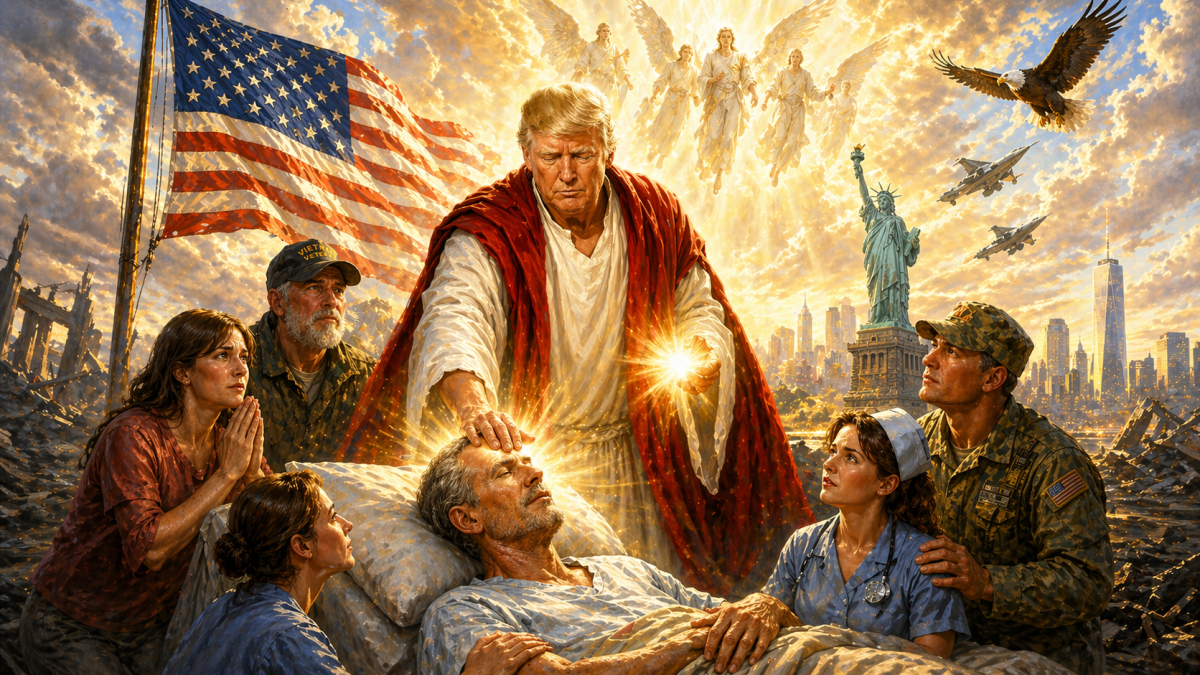
An AI-generated image circulates. It shows Donald Trump in the unmistakable posture of the healer: hands extended, body inclined, the visual grammar drawn directly from the iconography of Christ.
Before him, a fallen figure.
Some see in that figure the faint outline of Jeffrey Epstein. Others deny it. Others laugh it away.
And then comes the response.
It is said to be a doctor. Not a messiah.
A claim so strained it reveals more than it conceals.
Because the image does not depend on belief.
It depends on ambiguity.
Strategic ambiguity.
It invites reverence and irony at once. It binds the faithful without binding the speaker. It signals without committing. It provokes, then withdraws.
Meaning hovers.
Unresolved.
And in that suspension, power gathers.
The sacred is invoked. The profane is suggested. The distance between them collapses.
And the audience learns, slowly, almost imperceptibly, to live inside contradiction.
I. The Narcissist as False Messiah
The first movement is elevation.
Not vanity, but cosmology.
The self becomes the axis around which meaning turns. Institutions bend toward it. Reality adjusts itself to its reflection.
Every rally becomes liturgy. Every chant becomes creed. Every act of affirmation becomes ritual.
“I alone can fix it.”
Not rhetoric.
Revelation.
The mirror must not crack.
II. The Machiavellian as Architect of Unreality
If narcissism establishes the center, Machiavellianism dissolves the ground beneath it.
Truth becomes optional.
Consistency becomes irrelevant.
Meaning becomes fluid.
Words are no longer commitments. They are instruments, deployed and withdrawn, reshaped and repurposed.
This is strategic ambiguity as governing method.
The result is not confusion.
It is control.
III. The Psychopath as Sovereign of Absence
The third movement is not spectacle.
It is absence.
Not the theatrical absence of withdrawal, but the deeper absence of interruption—the absence of that which would otherwise halt the system: empathy, recognition, the felt weight of another’s suffering.
If the narcissist demands the world reflect him,
and the Machiavellian reshapes the world to sustain that reflection,
the psychopath removes what might resist it.
Not by argument.
But by omission.
This is not a claim about inner feeling.
It is a pattern of response.
A pattern in which suffering does not reorganize attention but is absorbed into it. In which tragedy appears, briefly, then recedes behind the performance. In which loss is acknowledged only long enough to be redirected.
Pain becomes backdrop.
Death becomes number.
The human becomes abstraction.
We see it in moments that accumulate.
A disaster reframed as narrative.
A crisis redirected toward grievance.
A loss measured not in lives, but in its effect on the image.
And in this accumulation, something becomes visible.
Not cruelty in its overt form.
But indifference in its structural form.
To feel deeply would be to hesitate.
To hesitate would be to relinquish control.
And so the system proceeds.
Uninterrupted.
Here, sovereignty is not exercised through domination alone, but through insulation—the insulation of power from consequence, of decision from suffering, of action from recognition.
The sovereign does not need to deny pain.
He needs only to remain untouched by it.
And in that distance, the final element of the Dark Triad is secured.
IV. The High Priest Revealed
Donald Trump stands at the center.
He elevates himself and calls it truth.
He contradicts himself and calls it strength.
He obscures meaning and calls it freedom.
He absorbs suffering and redirects attention.
The victimizer appears as victim.
V. The Theater of War: Strategic Ambiguity at Scale
And then the stage widens.
What begins in image does not remain in image.
It seeks a world.
The war with Iran emerges not as interruption, but as extension—an escalation following U.S.–Israeli strikes on Iranian targets and the closure of the Strait of Hormuz, disrupting global trade and energy flows.
Threats issued.
Then softened.
Then reasserted.
A ceasefire declared.
Then shadowed by escalation.
Markets rise and fall not on events, but on signals. Oil surges, retreats, surges again, as uncertainty itself becomes policy.
This is not merely war.
It is war conducted as strategic ambiguity.
A politics in which the line between threat and action dissolves.
And beneath the shifting language, the material reality persists.
Cities struck.
Infrastructure shattered.
Lives interrupted, ended, dispersed into the long arithmetic of war.
And yet—
war does not interrupt the performance.
It becomes part of it.
VI. The Missile and the School
And then there is the moment when ambiguity ends.
Not in clarity.
But in impact.
A Tomahawk missile does not speak in ambiguity.
It strikes.
A classroom.
Morning light across desks.
Children assembling a future line by line.
And then—
Interruption.
The sky tears.
The building convulses.
Glass becomes air.
Air becomes fire.
And fire becomes the final grammar of power.
What had been a school becomes debris.
What had been children become numbers.
And language arrives too late.
Precision.
Collateral damage.
Necessary action.
Words that circle the absence they cannot fill.
And still—
the system continues.
VII. The Crowd and the Mirror
Yet no gospel sustains itself alone.
It requires believers.
Not believers in doctrine, but participants in perception.
An audience willing to absorb contradiction.
And in that quiet accommodation, something takes shape.
This must be said plainly.
It is a covenant with darkness.
Not signed but lived.
A covenant in which truth is surrendered for belonging.
And once entered—
it normalizes itself.
The Counter-Gospel of Liberation
VIII. Discernment: Learning to Perceive
Resistance begins in perception, as we will be held accountable for our silence, for our unwillingness to heed the warning signs signaling our demise, for the risk of not speaking truth to power is greater than the cost of silence.
This is where Paulo Freire remains indispensable.
Here, Karl Marx still speaks, alongside Peter Hudis.
To see clearly is already to begin resisting.
IX. Reclaiming the Sacred
For this is a covenant with darkness.
And a gospel forged in such a covenant cannot be undone by critique alone, nor dismantled by analysis, however precise.
It must be confronted by another vision of the sacred.
The witness of Óscar Romero,
the theology of Leonardo Boff,
and José Porfirio Miranda
does not argue from above.
It speaks from below.
From the broken body.
From the silenced voice.
From the history written in wounds rather than proclamations.
The sacred requires us to witness.
Not to turn away.
Not to translate suffering into abstraction.
Not to allow language to stand where lives have been broken.
Here, the sacred stands not above history, but within it—
on the side of those who suffer under it.
And from that place, it names domination for what it is.
God is not the guarantor of order.
God is the companion in struggle.
And in that reversal, the covenant with darkness is broken—not by force, but by a truth that refuses to serve it.
X. Overcoming Without Becoming
Clarity instead of ambiguity.
Truth instead of manipulation.
Solidarity instead of fragmentation.
And the courage to name:
Fascism.
XI. Coda: The Refusal
There comes a moment when recognition is no longer enough.
We see.
We name.
We understand.
And still, the machinery turns.
Because the triumph of the Dark Triad is not persuasion.
It is acclimation.
And so the final question belongs to us.
What will you normalize?
What will you excuse?
What will you stop seeing?
The answer is lived.
And even now—
the mirror can be broken.
Not by force.
But by those who refuse to mistake the reflection for the light.
Comments

Powered by RoundtableAn AI/DeFi-powered Enterprise Media Operating System. Learn more at Roundtable.io.© Roundtable 2026. By using this site you agree to the Terms of Use and Privacy Policy