


Jul 10, 2017 7:22 PM
Updated Feb 10, 2022 10:10 PM
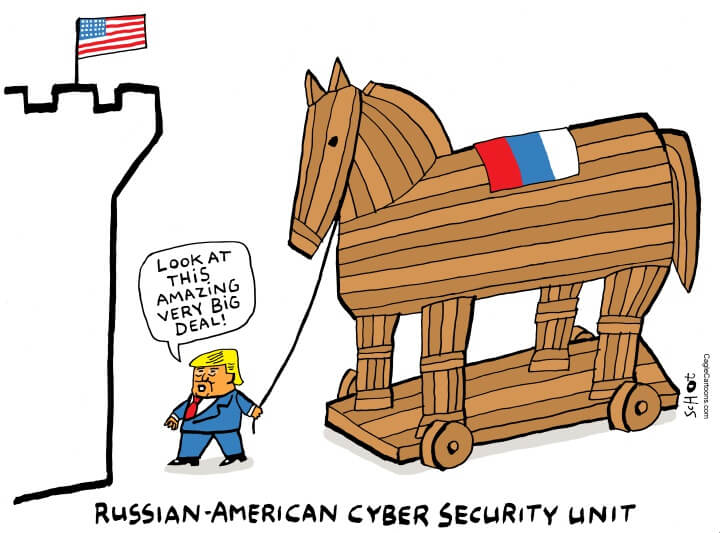
John Peeler: Having admitted that a Russian cyber-attack may have occurred, having refused to say whether he believes Putin’s denial, he says that what we need is a joint US-Russian Task Force on Cybersecurity!
One of the more interesting features of Donald Trump’s foreign policy is his argument that the US and Russia could productively cooperate on matters of shared interests such as counterterrorism. Indeed, back when the Cold War was ending and the Soviet Union was dissolving, there was a window of opportunity for forging such a cooperative relationship. But a succession of US administrations of both parties have persisted in viewing Russia as an adversary and insisted on expanding NATO to include the former Soviet satellites on Russia’s western border. That persistent US and Western opposition helped to produce Vladimir Putin, who reciprocates the skepticism. Putin is not our friend, however much Trump would like him to be.
Having admitted that a Russian cyber-attack may have occurred, having refused to say whether he believes Putin’s denial, he says that what we need is a joint US-Russian Task Force on Cybersecurity!
American intelligence agencies have unanimously concluded that there was a Russian cyber-attack on the US election last year, and that it was intended to hurt Hillary Clinton. Specifically, Russian intelligence agencies are said to have hacked into Clinton campaign emails, and passed the information on to Wikileaks, which published them. The Trump Justice Department has appointed a special prosecutor to investigate whether there was collusion between the Russians and the Trump campaign. Donald Trump has nevertheless tweeted multiple times since the election that there was no such Russian intervention.
So here he is in Europe last week, meeting Putin for the first time, and he makes a big public deal about how he privately questioned Putin about the alleged intervention. Putin denies everything, of course (the old spy certainly knows how to arrange plausible deniability). This was the first time Trump has publicly admitted that the intervention actually happened. And he has refrained from saying whether he believes Putin’s denial or not.
Having thus publicly acknowledged that a cyber-attack took place and that Russian involvement in it is a serious issue (remember that this was a private meeting and Trump chose to bring it up publicly), he then returns to his long-standing theme that it is time to move beyond the scandal and work cooperatively with Russia. As if what he has just admitted is of no import.
Related stories
And he doubles down: having admitted that a Russian cyber-attack may have occurred, having refused to say whether he believes Putin’s denial, he says that what we need is a joint US-Russian Task Force on Cybersecurity! That’s right, he wants the fox in charge of the henhouse.
As best we can tell, Donald Trump is unaware of how contradictory and ironic this whole sequence is. He uses words as disposable, plastic utensils to achieve a momentary effect. He doesn’t expect us to notice what he himself doesn’t notice: that his words contradict themselves. He doesn’t do irony; he does plasticity.
John Peeler
Comments

Powered by RoundtableAn AI/DeFi-powered Enterprise Media Operating System. Learn more at Roundtable.io.© Roundtable 2026. By using this site you agree to the Terms of Use and Privacy Policy