


Apr 13, 2026 6:04 PM
Updated Apr 13, 2026 6:35 PM
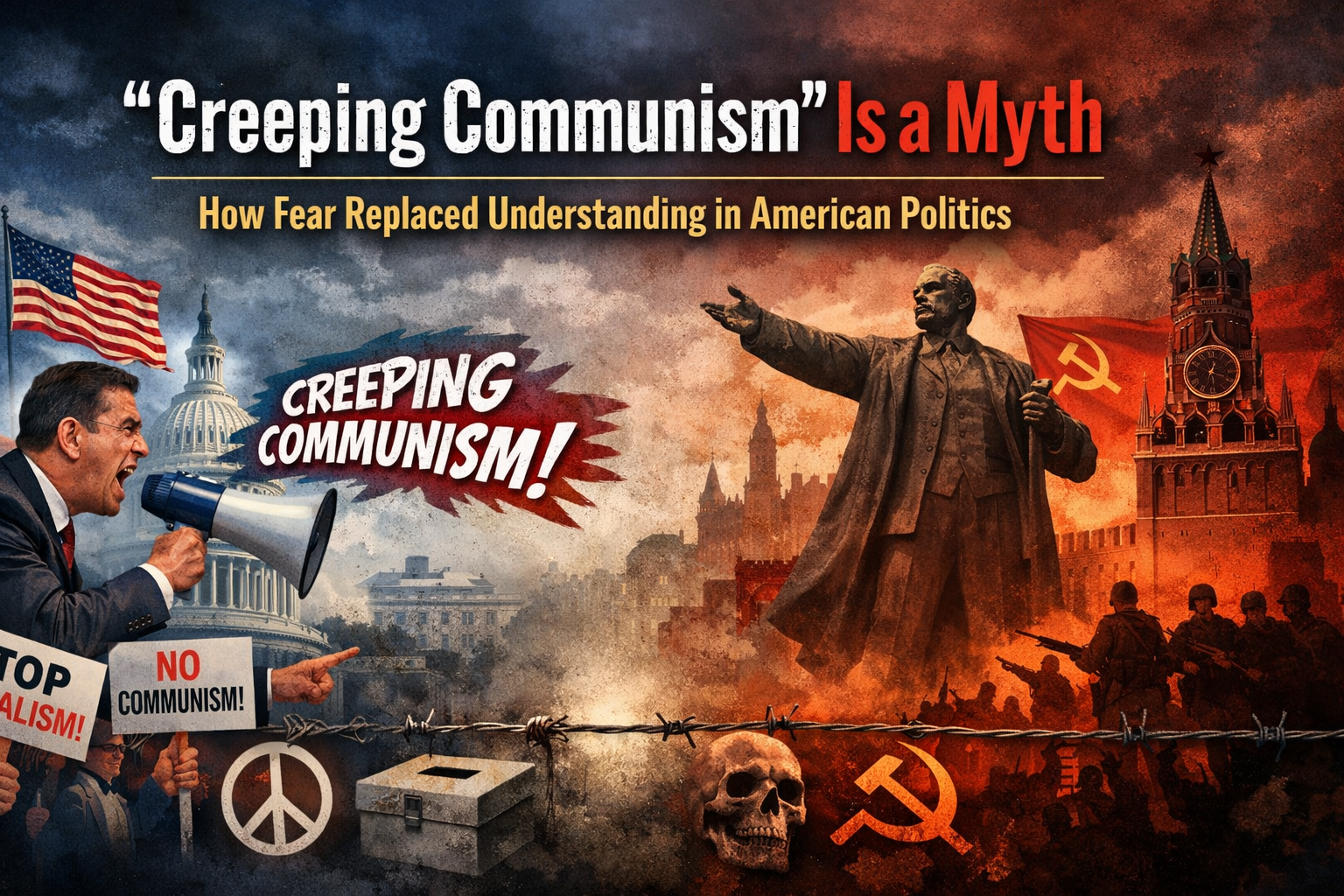
The real danger was never socialist goals—it was revolutionary methods. Why Americans still confuse the two, and how that confusion distorts public debate.
Conservative American politicians have often denounced disliked policy proposals as “creeping Communism.” Although the proposed policies did not imitate the Soviet Union, the critics were implying that they would be a step towards making the U.S. like the U.S.S.R., which was governed until 1991 by a political party calling itself Communist.
The Strange Logic of “Creeping Communism”
“Creeping Communism” was a very strange idea, almost as odd as “instant powdered dry water.” The gradualism implied by “creeping” was the exact opposite of the fast paced revolution by which the Communist Party of the Soviet Union (CPSU) came to power and governed.
Americans have long failed to distinguish between the goals pursued by the CPSU and the drastic, rushed, and violentmethods it employed to come to power and govern. The horrible results--- one party rule in a totalitarian and undemocratic Soviet Union--- were sufficiently dramatic for Americans to tar everything connected with the U.S.S.R. with a very black brush.
It was this failure to distinguish between the socialistic goals of the Communist Party and the methods it used that allowed Americans to criticize proposals deemed socialistic as “creeping Communism.” What most of us missed was that the terrible situation in the U.S.S.R. was almost totally the result of the Communists’ methods. The problems did not lie in the socialist goals themselves, but in how the CPSU went about pursuing them, extremely rapidly rather than gradually.
Related stories
The Fabian Alternative: Gradualism Within Democracy
A different method of pursuing socialistic goals was employed by the Fabians in England. They formed the nucleus of the new Labour Party that displaced the Liberals as the second main party in the early 1900s. “Creeping” was an apt summary of the pursuit of socialism used by the Labour Party, which believed in the “inevitability of gradualism” and was willing to attempt reforms within the democratic institutions of the British political system.
That it was revolution rather than socialistic goals that led to the Soviet mess is suggested by the terrible results produced by other revolutions that did not have socialistic goals. The French revolution, beginning in 1789, produced a very large number of casualties and resulted in a political system that remains unstable more than 200 years later.
Revolutions Without Socialism: A Pattern of Chaos and Violence
The German revolution that happened after the Nazis came to power in 1932 (3?) led to tremendous internal bloodshed and to World War II, during which millions died and German forces slaughtered around six million Jews.
The Iranian revolution which seized power in 1978 killed large numbers of people after it succeeded and has continued to do so in order to remain in power.
Part of the Soviet Union’s problems was due to the Communists’ attempt to implement Karl Marx’s hostility to economic markets. Marx blamed the enormous economic inequalities in Europe on “capitalism” with its market economies, whereas the problems that he blamed on markets were (and still are) instead caused by the legal conditions within which markets operate.
Eliminating markets required extreme and arbitrary limits on individual freedom.
Democratic socialists have only tried to reform the legal conditions within markets operate, not to eliminate them. This is not to say that all of their reforms and proposed reforms were good ideas, but in democracies bad ideas can be rejected, or if enacted they can be amended or even totally reversed if they don’t work out.
Why Gradual Change Is Not a Threat—but a Strength
This is true of reforms in general, “socialistic” or otherwise. When Prohibition, a major reform in the U.S., did not produce the desired good results, the Constitution was again amended to repeal it.
No such amendments were possible in the U.S.S.R.
“Creeping” is actually desirable when big changes are introduced into a society. Peaceful reforms, unlike revolutions, can introduce big changes gradually. Graduality minimizes disruption of personal life and allows corrections when the reforms produce unexpected side effects.
Charges of “creeping Communism” are attempts to plaster the Bad Housekeeping Seal of Disapproval on a policy proposal and thus to prevent people from even considering its costs and benefits. We should give this tactic our undivided suspicion.
Comments

Powered by RoundtableAn AI/DeFi-powered Enterprise Media Operating System. Learn more at Roundtable.io.© Roundtable 2026. By using this site you agree to the Terms of Use and Privacy Policy