


Aug 2, 2026 4:16 PM
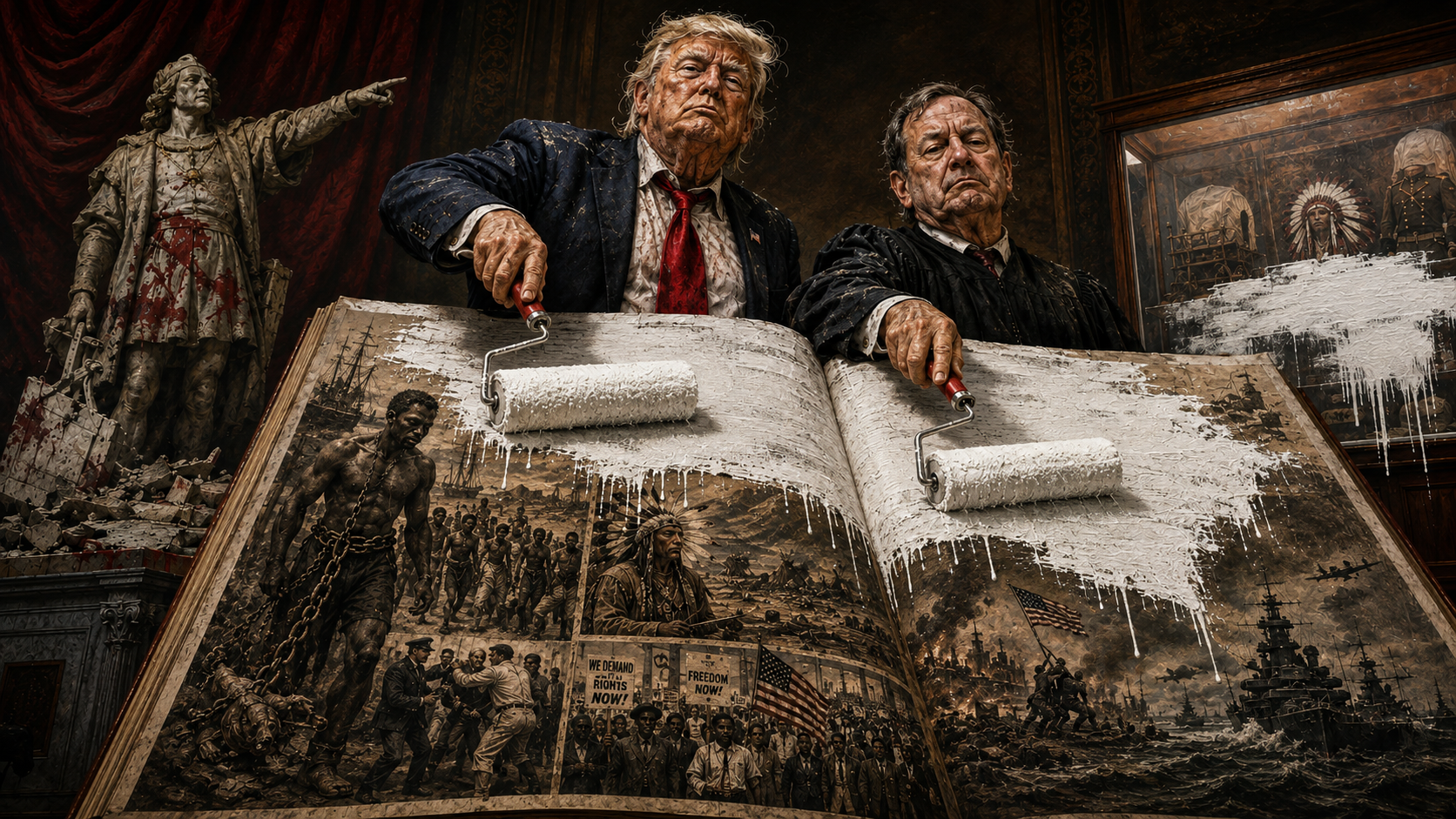
Samuel Alito’s defense of Columbus is part of a larger campaign to erase slavery, colonial violence, and the nation’s uncomfortable past.
Over the years, I have written often of President Trump’s misunderstanding of history (see, e.g., here), but every few months—or even more frequently—he or his enablers demonstrate it anew. The latest instance I’ve discovered is that of perhaps his biggest Supreme Court supporter—Justice Samuel Alito Jr.
Upon examining a new book about him—Peter S. Canellos’s “Revenge for the Sixties: Sam Alito and the Triumph of the Conservative Legal Movement”—I came across the following about the Supreme Court Justice, who was descendent from Italian immigrants. His father was one, and his mother was the daughter of two of them.
Canellos notes that for Italian-Americans “Columbus was central to their belonging,” and in 1959, when Alito was nine, his city of Trenton, NJ, erected a statue of him, greatly pleasing the city’s Italian-American community, which made up about 25 percent of the city’s foreign-born population.
But then in 1980, historian Howard Zinn published “A People’s History of the United States,” in which (according to Canellos) he indicated that “Columbus was a major target: he brought not civilization but exploitation . . . opening the western hemisphere to slavery, colonization, genocide, and human trafficking.” Zinn’s assertion did not gain universal agreement, but enough historians thought that there was some truth in his Columbus criticism. (See my 2024 article “Columbus and the Native American 'Indians.’”)
Related stories
As with criticisms of Washington and Jefferson—and other presidents—having slaves, we must be cautious about judging others by today’s standards, but denying facts or dismissing them as irrelevant is not the path we should pursue.
Yet, Samuel Alito’s reaction when Trenton decided to dismantle the Columbus statue was that it “rankled him. It was unfair to people whose hopes, dreams, and even identity were founded on the assumptions of an earlier time.” In an online publication, Canellos tells us, Alito recounted “being present at the dedication of the statue and declared himself to be ‘very upset’ by its fate.” He was less concerned about “the wrong done to Columbus than the one done to those who’d once embraced him. The great explorer had at one time been a hero to all . . . but for Italians, he meant that much more, and that’s why they were especially injured in the backlash.”
Alito’s reaction reminds me of an observation that conservative New York Times columnist Ross Douthat made in 2017, early in Trump’s first term. He pointed out that Trump’s victory partly represented an attempt by “white-male-Protestant-European protagonists” to “restore their story to pre-eminence.” They saw themselves as in the Christian tradition. Their story had its defects and “maybe no unifying story is really possible . . . but any leader who wants to bury Trumpism . . . would need to reach for one—for a story about who we are and were, not just what we’re not, that the people who still believe in yesterday’s American story can recognize as their own.”
As I’ve indicated earlier, “the problem with Douthat’s approach is that too many of Trump’s followers—and Trump himself—do not wish to acknowledge the full sweep of the bad parts of U. S. history—slavery, segregation, the treatment of Native Americans and women, and imperialism in areas like Latin America, Hawaii, and the Philippines.”
Moreover, the main aim of history is not to please people, but as Yale historian, David Blight has noted, it “is to search everywhere and anywhere for the truth and then to convert it into narrative and convert it into stories that are compelling.”
In addition to Alito’s defending the glory of Columbus—and his continuing determination to view history through conservative lenses—Trump and his other defenders continue to blast and alter history that is not to their liking.
Three indications of this in late July 2026 were:
- An advisory council dominated by allies of President Trump voting to weaken federal oversight of construction affecting historic sites;
- Trump ordering “Inaccurate” warnings outside the Smithsonian’s National Museum of American History; and
- exchanging an outdoor exhibit at a George Washington house near Independence Hall in Philadelphia so that it downplays Washington’s support of slavery.
Third, let’s briefly examine the changes outside a Washington house in Philadelphia that downplays his support of slavery. According to The Atlantic magazine, “Where once the exhibit focused squarely on the individuals Washington enslaved, the new exhibit views Washington’s ties to slavery through the lens of his personal conscience, extensively highlighting his statements opposing slavery.”
In its March-April 2026 issue, Mother Jones magazine carried a piece called “Trump’s War on History.” It pointed out that “American history offers a medium through which Trump can wage the all-encompassing cultural, political, and legal battles animating his administration . . . American history is being subordinated to Trump’s cult of personality . . . The semiquincentennial is just one part of the commander in chief’s broader campaign to harness the mechanisms of the federal government to enforce his preferred version of the nation’s history and culture.”
Several months later, the Trumpian onslaught of history continues and shows no signs of decreasing.
Comments

Powered by RoundtableAn AI/DeFi-powered Enterprise Media Operating System. Learn more at Roundtable.io.© Roundtable 2026. By using this site you agree to the Terms of Use and Privacy Policy