
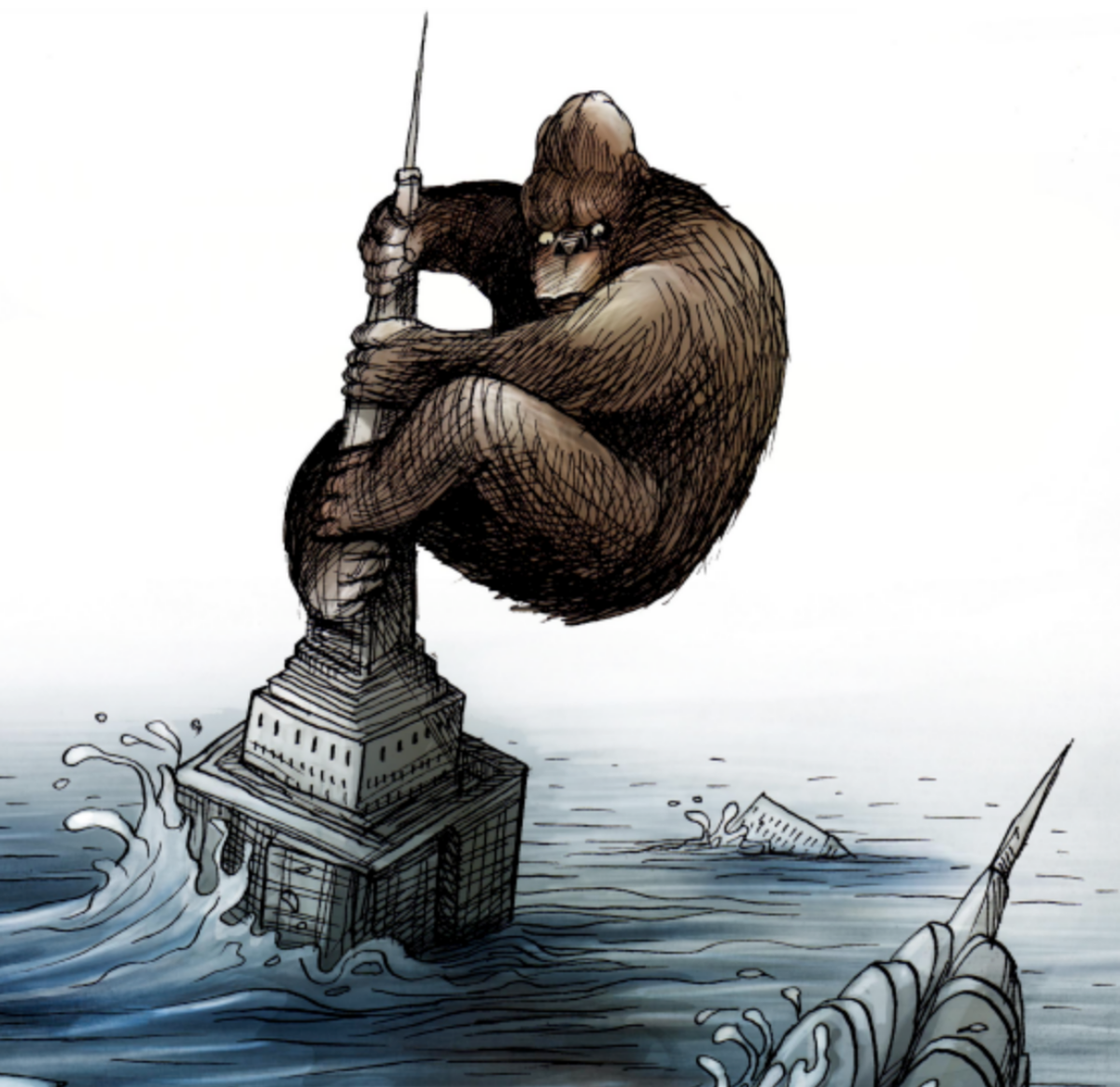
Cagle Cartoons: Angel Boligan


Our Collapsing Empire
May 21, 2025 10:33 PM
Hudis argues that we stand now on the smoking threshold of a new imperial dispensation, a tectonic shudder in the foundations of world power.
Peter Hudis is Distinguished Professor of Philosophy and Humanities at Oakton College in Chicago and a leading scholar of Marxist theory and contemporary political thought. He is the author of Marx’s Concept of the Alternative to Capitalism, which examines Marx’s vision of a society beyond capital, and Frantz Fanon: Philosopher of the Barricades, a study of Fanon’s revolutionary humanism and anti-colonial legacy. Hudis also serves as the General Editor of The Complete Works of Rosa Luxemburg, a landmark project that is making Luxemburg’s writings fully available in English for the first time—six volumes have been published to date. He is one of the foremost living experts on global politics—a thinker whose moral compass remains steady amid the turbulence of empires. I have been reading Peter Hudis for decades, drawn not only to his grasp of political theory, but to the ethical depth with which he engages the crises of our time. What follows is not a comprehensive analysis, but rather a sketch—an outline—of his position on the shifting tectonics of global power today. It is a map traced in the ink of conviction, for those willing to read with their conscience as well as their eyes.
Hudis argues that we stand now on the smoking threshold of a new imperial dispensation, a tectonic shudder in the foundations of world power. If Trump’s grotesque courtship with Putin is a danse macabre of old-world fascism reborn, then the U.S.-China confrontation is the churning engine of a future apocalypse—the long-prophesied clash of titanic behemoths, each armored in algorithms, steel, and artificial cognition.
Unlike the shadow play with Russia, here the stakes are not symbolic—they are planetary. China is not merely asserting itself; it is uncoiling across the globe like a dragon of surplus capital, laying down its arteries in the form of railways, pipelines, and satellite ports. Through the Belt and Road—a trillion-dollar superhighway of influence—it tightens its grip on mineral veins in Africa, ports in Asia, lithium fields in Latin America. It moves like a chess grandmaster playing in five dimensions, buying what was once stolen by the West and selling it back at interest.
The West, rattled and aging, responds not with wisdom but with weapons. Washington’s eyes are no longer turned toward peace or even pretense—they are locked on Shenzhen and Taipei with the manic stare of a gambler holding a losing hand. This is no longer Cold War nostalgia—it is a thermonuclear fever dream: a zero-sum war for who will command the mind of the machine, who will own the microchip and the robot arm, who will teach artificial intelligence to speak in their accent, kneel to their flag, enforce their order.
Related stories
Europe, for now, lingers in the anteroom of this coming storm, reluctant to cast its lot too quickly. But the fire is already licking the edges of the continental curtain. As the locus of global capital pivots eastward—from the rusting skyscrapers of Manhattan to the humming circuitry of East Asia—we are not witnessing a mere geopolitical rivalry. We are entering the storm spiral of a new epoch of imperialist war, one coded not in tanks and trenches but in fiber optics, cobalt mines, and quantum supremacy.
Peter Hudis, ever the Cassandra of our dismembered Left, has warned us: this is no localized scuffle, no traditional war of spheres of influence. It is the global capitalist hydra splitting itself, turning one head against the other, while the people of the world are left to suffocate in its coils.
The hour is late. The earth groans under the weight of empire. And unless we unmask both monsters—American and Chinese—we may soon awaken to a world where freedom is not crushed by boots, but erased by bots, and the human spirit is soldered into the circuitry of a machine it no longer controls.
In this brief expository essay, I examine Hudis’s vital contribution to our understanding of the ongoing realignment of global power—a transformation whose contours pose a grave threat to the future of humanity. Americans, in particular, must reckon with the dangers inherent in this geopolitical shift, especially as it intersects with Donald Trump’s foreign policy.
Hudis provides a crucial framework for grasping how and why Trump has forged what increasingly resembles an unassailable alliance with Vladimir Putin. By tracing the ideological and geopolitical dimensions of this relationship, Hudis illuminates the deeper logic of authoritarian convergence—one whose consequences transcend partisan boundaries and imperil the very foundations of international order and democratic life.
Let’s begin with the infamous meeting between Trump and Zelensky in the Oval Office, with the odious JD Vance looking on. Hudis is not one to mince words. By any measure, it was not just a meeting—it was an ambush. In the dim corridors of diplomacy, February’s confrontation between Donald J. Trump and President Volodymyr Zelensky did not simply echo with tension; it thundered with the sound of shifting tectonic plates. History tilted, however imperceptibly, beneath our feet. It was not the usual handshake of a former president and a wartime leader; it was the hush before the storm, the tableau before the empire strikes anew.
This was no ordinary skirmish of words. It was an imperial annunciation. The former commander-in-chief of the world’s most powerful democracy (in name if no longer in soul) summoned the president of a bleeding nation—not to offer aid, but to deliver an ultimatum veiled as diplomacy. What passed between them may never be fully known, but the air was thick with the ghosts of previous pacts, previous betrayals: Nixon’s sly pivot to Mao’s China, which stranded Vietnam in a purgatory of napalm and empire; or worse still, the infamous Molotov-Ribbentrop Pact of 1939, a devil’s handshake that redrew borders in blood and consigned millions to death and ruin.
Now, we stand at another threshold. And we had better brace ourselves. The global map, once painted in Cold War binaries, is being redrawn in the murkier hues of twenty-first century multipolarity. The U.S., no longer the unchallenged sun around which all vassal states orbit, flirts with isolationism even as it fondles authoritarianism at home. Russia, with its necromantic nostalgia for empire, advances like a wolf in the snows of Ukraine. China, the silent dragon, waits and watches, investing in infrastructure while extracting allegiance. And Europe, ever fractured, mumbles about values as it counts its euros and tightens its borders.
The realignment is not just geopolitical. It is metaphysical. It is the death of the post-Cold War dream, the unraveling of the Pax Americana, the rise of a world where no single empire holds sway, yet all hunger for dominance.
It was not merely a diplomatic slight. It was a ritual humiliation—a brazen takedown of a democratically elected head of state, performed before the altars of empire. When Donald Trump summoned Volodymyr Zelensky in February, just five weeks after the dark pageantry of his second inauguration, the message was not whispered but shouted: submission or suffering. Ukraine, bruised but unbowed, was to be made an example—not for failing to resist Russia’s imperialist invasion, but for failing to yield entirely to the erratic whims of a resurgent American caudillo. The consequences will be savage. Ukraine now stands naked before the Kremlin’s war machine, its fate dangled as a warning to others: obey, or perish.
This moment is not without precedent. History is a hall of mirrors, and the imperial powers never tire of rehearsing old scripts with new actors. The most obvious analog, according to Hudis, is Nixon’s clinical pivot to Mao’s China—a diplomatic masterstroke that masked a moral collapse. The price of that “opening” was paid in Vietnamese blood, as Nixon used his handshake with Beijing to strangle Hanoi’s leverage and prolong a war he had no intention of ending in justice. Mao, eager to join the ranks of global respectability, scaled back support for the Vietnamese revolution in return for a seat at the capitalist table. Hudis not only peels back this détente forged in betrayal, but warns that an
even darker shadow looms behind us: the Molotov-Ribbentrop Pact of 1939, in which the twin beasts of fascism and Stalinism carved up Poland like vultures dividing carrion (I was able to witness the damage first hand as the last of the Soviet troops pulled out of Warsaw). To recall that monstrous accord is not, argues Hudis, to claim that World War III is upon us—though the possibility is hardly remote—but to recognize that such alliances are more than geopolitical calculations. They are ideological earthquakes. That pact forced the Left to look itself in the mirror and ask: what does it mean to be anti-imperialist if you excuse one empire’s crimes to denounce another’s? Many clung to Stalin’s betrayal in the name of “anti-Westernism,” while others broke away, bitter and disillusioned, but committed to a deeper internationalism.
Today, Hudis argues, we face another such rupture. The outlines of a grotesque realignment are emerging—not formalized in treaties, but forged in silent complicities and shared interests. Trump’s contemptuous treatment of Zelensky signals something far more insidious than isolationism. It signals the embryonic formation of a new axis—an informal convergence between Trumpist America, Putinist Russia, and other strongmen regimes united by ethno-nationalism, fossil fuel lust, and loathing for democratic resistance.
And once again, the ideological tremors reach deep into the Left. There are those who, in their reflexive opposition to U.S. power, have found themselves echoing the logic of the far right: casting Ukraine as a NATO pawn, denying its people’s right to self-determination, and even suggesting that Russian tanks are somehow less imperial than Western ones. These strange bedfellows—campist leftists and MAGA Republicans—now find themselves murmuring the same talking points, as if moral clarity had been bartered for geopolitical positioning. In Hudis’ own words:
Most revealing, Trump demanded that the Ukrainian government repay $500 billion to the U.S. (at least four times as much as the value of all the military and economic aid it received under Biden) by surrendering 50% of the proceeds from its sale of national resources, such as minerals, oil and gas, and port fees. Ukraine was moreover expected to repay the U.S. twice the value of any future U.S. aid (it does not indicate whether this would include any military assistance). This amounts to paying $100 percent interest on top of the total principle of a “loan.” Taken as a whole, this would entail that a higher percentage of Ukraine’s GDP become turned over to the U.S. than the allies demanded in the form of reparations from defeated Germany after World War I.
That would clearly amount to turning what is left of Ukraine (Putin is demanding annexation of parts of it he does not now control) into an outright economic colony of U.S. imperialism. If this mis-named “peace plan” were to go forward, the U.S. would reap profits at Ukraine’s expense and Russia could secure the conquest of parts of its territory while building up its diminished military apparatus (Russian forces are nearing exhaustion due to heavy losses, especially in soldiers and heavy weapons like tanks and artillery) in order to ready itself to launch a renewed assault in a few years.
Donald Trump has suggested that the presence of U.S. corporations on the ground in Ukraine—primarily to extract its vast but largely untapped mineral wealth—would serve as a form of “automatic security.” It’s a bold claim, notes Hudis, detached from the stark realities on the ground. Ukraine, as it stands, lacks the technical capacity to exploit more than a fraction of its mineral resources. And as many Ukrainians have pointed out, the presence of U.S. firms in the country’s east did nothing to deter Vladimir Putin from launching his full-scale invasion and occupying those very regions. Over half of Ukraine’s known mineral reserves lie beneath territory currently under Russian control. It is difficult to imagine Trump making such claims without eyeing those occupied riches—resources Putin would no doubt be willing to offer up, in exchange for a weakened, demilitarized, and diplomatically abandoned Ukraine.
At the same time, warns Hudis, European members of NATO have begun to discuss increasing military aid to Ukraine, but such deliberations offer little immediate solace. Even with the best intentions, it could take years to make up for the loss of U.S. assistance. Hudis reminds us that the British Army today possesses fewer artillery pieces than a single brigade did in the 1990s. The imbalance is stark. In the meantime, Russia can afford to bide its time—pausing, regrouping, rearming—before resuming its long-standing aim: the total subjugation of Ukraine.
As Hudis attests with his signature sharp clarity, the Trump-Putin axis is more than a transactional alliance—it is an ideological arson, setting fire to the architecture of democratic memory and moral clarity. The fallout is already thick in the air. Like toxic smoke from a fire set deliberately in the archives of history, Putin’s falsified narrative of Ukraine as the aggressor has begun to cloud the minds of not only his own citizens, but also segments of the American Right and their global imitators.
Trump now echoes Putin’s claims with the casual venom of a demagogue unburdened by fact. That Ukraine, not Russia, started the war; that Zelensky is a dictator; that the democratic will of Ukrainians is somehow illegitimate. In doing so, he lends the weight of a U.S. president to a campaign of ideological inversion. This is not just the revision of history—it is its planned demolition, a bulldozing of reality in service of a new authoritarian myth.
Hudis reminds us that this is not a contest driven, like so many before it, by economic rivalry between great imperial centers. Russia’s economy is too small, its capital too weak, to threaten the West structurally. What drives Putin is something more dangerous: a paranoid, wounded ideology that glorifies aggression as a form of salvation. Hudis cites Russian sociologist Ilya Matveev who notes, it is not capital that propels the Kremlin forward, but a doctrine of permanent siege, a worldview in which offense masquerades as defense and annihilation is rebranded as historical justice.
This ideological core is what makes the Trump-Putin convergence so perilous. Trump does not merely tolerate Putin’s lies—he amplifies them. He makes space for them in the halls of power, even as Ukraine bleeds and NATO teeters. His betrayal of Zelensky—humiliating him in public, denying him a seat at the table where his nation’s fate is being discussed—signals a turning point. It is as if a page has been torn from the 1930s playbook, and we are being asked to watch, helpless, as the ink dries on a new kind of Molotov-Ribbentrop Pact—one not signed in secret, but tweeted in daylight.
In this new alignment, Zelensky is cast as the tyrant and Putin the negotiator. Truth is stood on its head. Meanwhile, as Hudis presciently argued in mid-2024, the West is offering Ukraine just enough to survive, but never enough to win. The pipeline of support flows, but in measured, tepid bursts—leaving Ukraine suspended between martyrdom and abandonment.
Europe, unmoored and unready, stumbles through this shifting terrain like a sleepwalker on a fault line. Trump’s open contempt for NATO—unless it serves his own ends—has exposed the fragility of the postwar consensus. Neoliberal Europe, trained to think in markets and trade balances, has found itself in a battlefield of ideologies with no map, no compass, and no shared memory of what resistance truly means.
Yet amid the smoke and shattered mirrors, Hudis’s voice offers a kind of moral cartography. His work reminds us that to oppose empire in our time means rejecting all forms of occupation and domination—whether they unfold in the trenches of Donetsk or the ruins of Gaza. The Left, too long trapped in the fog of campist nostalgia, must awaken to the reality that we now live in a world of multiple empires, each capable of monstrous violence, each cloaked in its own lies.
But Hudis signals that there is another path, one that rises from the rubble. Across the globe, voices are breaking with the false binaries of Cold War logic. They reject all occupations—whether in Palestine or Ukraine. They denounce all forms of colonialism—be it settler, military, or economic. They understand that anti-imperialism must be indivisible, or it is nothing.
This is the beginning of a reckoning. The pageantry of empire has returned, but so too has the spirit of resistance—polyglot, intersectional, and unafraid. What is being formed now is not just a new world order, but a new battlefield of ideas. And we must choose: to be loyal to states, or to struggles; to be servants of power, or defenders of liberation.
Trump’s confrontation with Zelensky was more than an insult. It was a declaration. The world is shifting again, and not gently. Let us not be the last to see it. Let us not be the last to speak.
This is no time for selective anti-imperialism or ethical ambiguity. In the growing shadow of authoritarian convergence, Hudis calls us back to first principles: solidarity with the oppressed, truth over propaganda, and resistance—unyielding, unbought, and internationalist to its core.
Reading Peter Hudis is not easy—not because his prose is dense, but because his moral clarity burns too brightly for post-Americans, those citizens of empire numbed by endless wars, scrolling spectacles, and bipartisan betrayals. His words pierce through the fog of cynicism and the haze of ideological convenience. They do not flatter—they expose.
For those who have grown used to calling occupation “security” and war “freedom,” Hudis is a rude awakening. He names what others euphemize. He refuses the luxury of moral amnesia. And that is precisely what makes him indispensable in a moment when the very architecture of democracy is being auctioned off by oligarchs and strongmen.
To read Hudis is to risk reawakening one’s conscience. It is to feel the weight of Gaza and Donbas, not as distant headlines but as symptoms of a world order cracking under the contradictions of capital and empire. It is to see, perhaps for the first time, that there is no salvation in choosing one imperial camp over another—only in opposing them all.
For many Americans—especially those conditioned to see power only in red, white, and blue—this is too much light, too much truth. But the question is not whether Hudis is easy to read. The question is whether we are still capable of reading the signs of our own unraveling.
My message to the far-right is this: Put aside your partisan scorn, your recycled slanders against Zelensky, your MAGA talking points wrapped in the stars and stripes. Put your ears to the ground—feel that low, relentless rumble? It is not the sound of liberal pundits or Beltway elites. It is older than that, deeper than that. It is the sound of history sharpening its knives.
That rumble? It’s the march of tanks through shattered towns. It’s the cry of children orphaned by airstrikes. It’s the thunder of a global order cracking at its imperial joints.
It is not Zelensky who threatens your vision of America. It is your silence in the face of Trump’s alliance with a war criminal. It is your refusal to see that when you mock the leader of a sovereign nation fighting for its survival, you mock democracy itself. You don't have to love NATO. You don’t have to cheer every Pentagon move. But know this: when you parrot Putin’s propaganda and call a democratically elected president a tyrant, you are not “America First.” You are freedom last.
Listen again. That rumble is not distant anymore. It’s here. It’s in the rot of your institutions. In the books you ban, the votes you suppress, the fascist dreams you normalize. It's in the new world order that’s being written without you—by despots, by AI, by billionaires who think your Constitution is just a quaint relic and Professor Watch blacklists are at the heart of Making America Great Again.
The ground is shaking, Republicans. Will you stand on the side of liberty? Or will you go down in history as the party that traded Lincoln for Stalin, Reagan for Rasputin, and democracy for the delusions of a failed real estate mogul in love with a czar?
The choice is still yours. But the hour is growing late.
Comments

Powered by RoundtableAn AI/DeFi-powered Enterprise Media Operating System. Learn more at Roundtable.io.© Roundtable 2026. By using this site you agree to the Terms of Use and Privacy Policy