
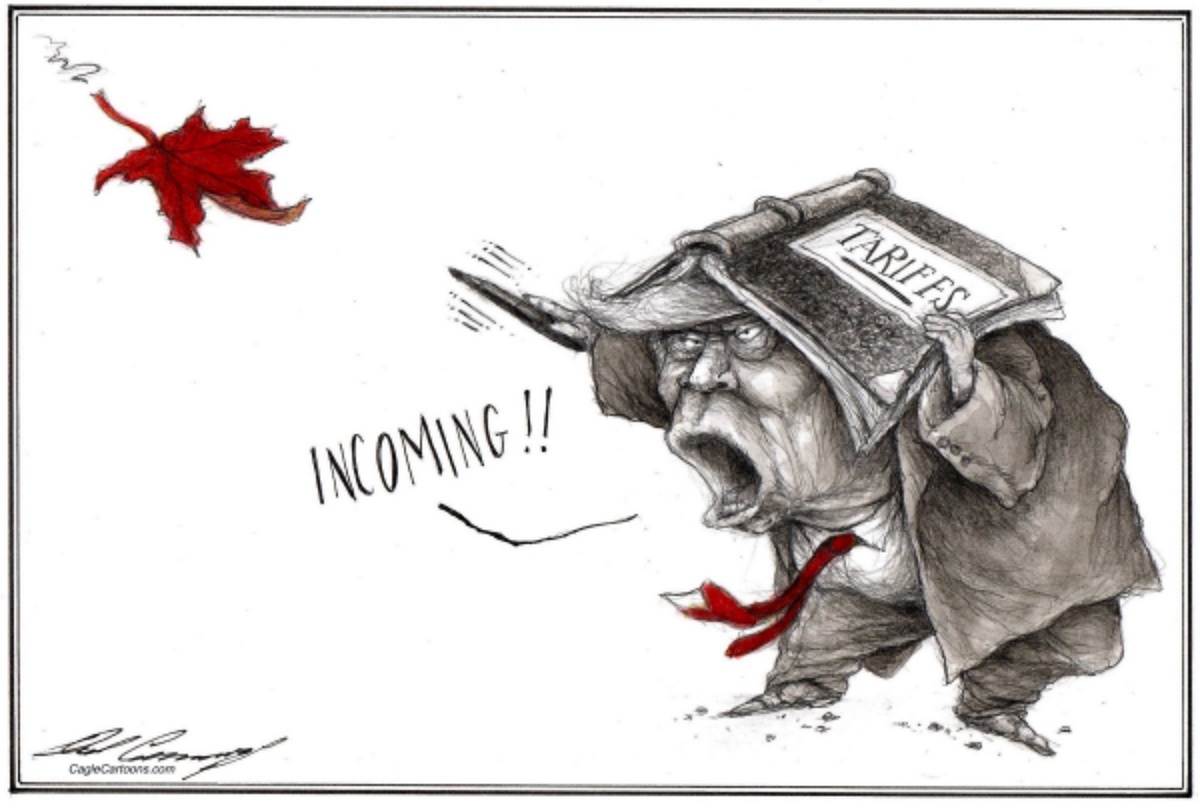
Cagle Cartoons: Dale Cummings


Canadian Resolve
Apr 14, 2025 6:00 PM
Trump, with a venomous turn, lashed out at us, his neighbors, as though we were not companions of peace but adversaries on the opposite side of a great chasm.
I came to America in the quiet days of 1985—not as a tourist, not as an entrepreneur, but as a teacher, summoned by a university in the Midwest to share my research on the daily rituals of education in the crumbling corridors of inner-city schools. I crossed from Canada not with capital to invest, but with chalk and conviction packed alongside a thousand books and journals, all wedged into a trembling U-Haul tethered to the back of a weary Volkswagen Beetle. My oak bookshelves, sacred scaffolds of thought, swayed with every bump in the road—a caravan of ideas on a journey south.
I came with eyes ablaze, the fire lit long before the engine turned. Not to seek comfort or fame, but to craft a pedagogy forged in the furnace of public struggle, not polished for corporate lobbies. A pedagogy meant to strip the veneer from corporate citizenship and hold fast to the stubborn dignity of critical citizenship. I did not cross that border to bow to the invisible hand of the market, but to lift the lantern of inquiry into the dark corners it avoids. For true education must be truth-tested, not market-tested—conscience-wrung and unafraid to speak power's name aloud.
Mine was not a solitary passage toward dual citizenship (which I was accorded in 2000). I was one of many—children of the North called not by exile, but by kinship. We were drawn to the promise of collaboration across the 49th parallel, a line as permeable as memory, more bridge than boundary. We arrived with hearts still wrapped in red and white, but hands outstretched toward shared labor, shared hope, and the quiet resilience that grows between neighbors in times of trouble. We were not strangers. We were allies in the making.
We did not come to stand above nor beneath, but to walk beside, equal in our shared humanity. Yet, in the heat of America’s culture wars, we found ourselves labeled—some of us as 'radicals’ or ‘communists,' others as outsiders who bore the light of reason in a country known for its crime and gun violence.
Related stories
We stood not as adversaries, but as harbingers of a similar vision: one that called for a society that prized the mind over the muzzle, that welcomed the stranger not as a threat, but as a thread woven into the fabric of a greater, richer whole.
Together, we joined the long, weary labor for justice, hand-in-hand with our American friends who had welcomed us into their homes and hearts. We marched alongside our American counterparts against the devastation of Iraq and the occupation of Afghanistan. We called for books instead of bullets, bread instead of blood. We dared to imagine a future in which socialism was not defamed as heresy, but embraced as a shield for the poor, a song for the worker, a sanctuary for the forgotten.
And like many of our American brothers and sisters, we found our guiding stars in the constellation of shared struggle. We drew courage from Martin Luther King Jr.’s dream and Malcolm X’s fire. From W.E.B. Du Bois’ piercing intellect, and bell hooks’ fierce love, we found our souls drawn closer together. But our ethical compass stretched further still — to Yuri Kochiyama, who stood beside Malcolm and never blinked in the face of empire; to Grace Lee Boggs, whose revolutionary spirit aged like oak, deepening with time; to Vine Deloria Jr., who taught us that the land remembers even when the treaties are torn; to César Chávez and Dolores Huerta, who proved that dignity can rise from the soil in a field worker’s hands; to Angela Davis, whose voice could shake prison bars and still nurture hope. These were not merely names, but flames — torches passed hand to hand in the long night of injustice.
We brought our own fire with us — not a blaze of conquest, but a steady flame of conviction. We shared with our American brothers and sisters the defiant cry of Louis Riel, the Métis rebel and dreamer, who believed a nation must remember its roots or risk forgetting its soul. We carried the universal healthcare vision of Tommy Douglas, who dared to believe that healing should not be sold, and that compassion could be a cornerstone of policy. We shared the unrelenting courage of Terry Fox, who, with one leg and the heart of a thousand runners, moved a nation not in miles, but in meaning. And today we lift the voice of Autumn Peltier, fierce and wise beyond her years, who speaks to the rivers as if to sisters, reminding us that water is not a commodity — it is sacred kin.
These are just a few of our torchbearers — our prophets in parkas — who taught us that justice wears many coats: sometimes red serge, sometimes denim, sometimes the worn threads of those history forgot. They remind us that the true north is not only strong and free, but also stubborn in its principles and unshakable in its quiet perseverance.
We did not come to America empty-handed. We crossed that border bearing the stories that made us, the struggles that scarred us, and the flame that still burns within us — not a fire for empire, but a fire for dignity. We brought our music, too — not just for background sound, but resonance for the soul. From Stompin’ Tom Connors, who gave a voice to the working man’s boots and backroads, to Gordon Lightfoot, whose ballads rolled through our forests and freight yards like smoke over still water. We carried Joni Mitchell’s hymns of hope and heartbreak — painter of skies and prophet of change.
We brought Leonard Cohen, with his gravel grace and psalms of broken hallelujahs — a monk of melody who taught us that the cracks are where the light gets in. We brought The Band, whose rhythms straddled the border itself, fusing southern soul and northern roots into something altogether untamed.
We brought Shania Twain — country star forged in northern fire, who reminded the world that small towns raise loud voices. We brought Celine Dion, whose voice could part oceans and mend broken hearts, a titan of feeling and faith. And yes, we brought Drake — the poet of the postmodern skyline, who turned Toronto slang into global rhythm, and made it known that even the 6ix has a song to sing.
This was our chorus — diverse, defiant, and unashamed. Our music did not ask for permission. It did not knock on the door of culture. It kicked it open with a melody and made itself at home. We came not only with the fire of protest, but with the rhythm of resilience, the harmony of heritage, and the beat of a people who know that sound can be sanctuary — and a drumbeat can be a form of defiance.
We came with the belief that America, a land forged by the dreams of immigrants, would welcome our ideas and ideals, adding richness to the already vibrant cultures that had made this nation renowned across the globe.
I joined a chorus of Americans whose hearts, like mine, beat to the rhythm of a Brazilian dreamer — the educator, philosopher, and revolutionary, Paulo Freire and to freedom fighting scholars Henry Giroux , Donaldo Macedo, and Stanley Aronowitz, three of Freire’s close American allies. Together, they labored in the field Freire once sowed with exiled hands and unwavering hope. The field was named critical pedagogy — not a curriculum, but a calling. Not a classroom, but a movement. And I was eager to join them.
Freire, the gentle insurgent, stood as an enemy to fascism and empire — and for that, he was imprisoned. His crime? Believing that the children of sugarcane cutters and landless farmers could rise not just as citizens, but as intellectuals — voices capable of reshaping the world that had tried to forget them. He taught that critical consciousness — the ability to name one’s oppression, to dream beyond it, and to act against it — was not the inheritance of elites, but the birthright of the people, the popular classes.
When he returned from exile, the people of Brazil did not merely welcome him home. They proclaimed him the patron saint of education, the gardener of minds long trampled by boots of power. His blackboard was a battlefield, his chalk a sword, his words a sanctuary. And from his teachings, we built a pedagogy that did not ask students to memorize the world — but to change it.
In those days, many critical educators faced attacks not only of ideology, but of cold calculation. Wealthy donors, draped in patriotism and profit, placed bounties on our heads — payments offered to students to report the contents of our lectures, to turn truth into contraband. It was the Red Scare reborn, not in smoky hearing rooms, but in fluorescent lecture halls and anonymous tip lines.
Where once there was dialogue, there came distrust. Where once ideas were kindled like campfires, now we taught beneath the shadow of surveillance. The classroom — once a haven of radical hope — became, at times, a crucible of quiet betrayal.
Still, we stood. Still, we taught.
Because the spirit of Freire does not flinch.
Because truth, once awakened, cannot be put back to sleep.
And because we believed that American democracy was resilient and would welcome our contributions.
Then, in 2025, came a radical rupture. Donald Trump made a pivotal political turn; it came as a spiritual shockwave to Canadians. Trump, with a venomous turn, lashed out at us, his neighbors, as though we were not companions of peace but adversaries on the opposite side of a great chasm. With the world's longest, undefended border stretched between us like an open wound, our economies intertwined in a delicate, mutual dance, he accused us—us, the quiet northern kin—of stealing from the very hand that fed us, of ‘ripping off’ the United States in unfair trade practices, as a thief would from the pockets of a trusting friend. He spoke of annexing us, of folding us into his empire as though we were but an afterthought, the 51st state, a footnote in a manifest destiny gone awry.
And as his gaze turned southward to Panama, then northward to Greenland, it was then that the true shape of his vision emerged. Like an imperialist on a reckless campaign, he revealed himself no different than the tyrant Putin, seeking to gobble up sovereign lands as if the world were his to remake. The words of annexation echoed with the cold finality of empire, and we—once safe in the belief of shared values and neighborly trust—suddenly understood. He did not see us as partners; he saw us as prey. But we were not the only victims.
Trump’s tariffs tore through the body politic like a thunderclap over prairie fields, waking the dormant furies of xenophobia, nativism, and belligerent nationalism. Suddenly, the new administration’s hostility, laced with casual cruelty and performative aggression, turned northward.
Canada, long viewed as a dependable partner in both diplomacy and defense, suddenly found itself reframed—as an adversary, a burden, even a target. What came was not a military threat, but something more insidious: tariffs wielded like cudgels, trade negotiations dripping with disdain, and a rhetoric of annexation cloaked in bravado. The friendly handshake of alliance began to close into a fist.
This was not the posture of an old friend in disagreement, but of an empire mistaking patience and politeness for weakness. And this, we could not accept.
Canadians are often cast as gentle and courteous, and in many ways that is not a myth. We are a peaceful people—not only by nature, but by long, deliberate choice. We have labored in the shadow of great powers, finding our strength not in dominance but in perseverance. Ours is a culture built on quiet resolve, on winter’s endurance and summer’s brevity, on skepticism toward empire and faith in coexistence. We do not shout our identity—we live it.
Yet peace, like freedom, must sometimes be defended. Not with bluster, but with clarity. Not with conquest, but with conviction. The notion that Canada could be reduced to an economic satellite or a de facto 51st state is not only an affront to our sovereignty—it is a misunderstanding of who we are. We are not a nation easily folded into the designs of another. We remember the winters before we had walls. We remember building peace not with threats, but with the patient labor of diplomacy and principle.
And we remember our history.
There was a time when the United States and Canada were not allies, but adversaries. The War of 1812 taught us that while geography may assign neighbors, it does not dictate friendship. That friendship must be earned, tested, and renewed. And in the generations since, it was. From the trenches of the First World War to the beaches of Normandy, from the Cold War’s silent vigil to joint missions in Korea, the Balkans, and Afghanistan, we stood shoulder to shoulder—not as clients, but as comrades. Even in disagreement, our partnership was rooted in mutual recognition.
In the wake of 9/11, Canada opened its skies and its homes to stranded Americans. Entire towns welcomed them with open arms, not because of treaties, but because of shared humanity. These gestures were not calculated acts of diplomacy—they were instinctive. They reflected the deep well of solidarity that had grown between our peoples.
But solidarity is not submission. And friendship is not ownership. The Trump era has forced many of us to confront a painful truth: alliances, no matter how longstanding, are not invulnerable to corrosion. The language of partnership can quickly be replaced with the language of acquisition, especially when power is wielded without humility.
In that moment, many Canadians—myself included—were reminded of our identity, not just as collaborators in the North American project, but as custodians of a different political ethic. We do not define ourselves in opposition to the United States, but neither do we define ourselves by its approval. Canada is not a beta version of American democracy. We are not a sub-brand of Western liberalism. We are a sovereign nation—shaped by our own histories, cultures, and aspirations.
This is not an indictment of the American people, many of whom are resisting the drift towards fascism, a plague that threatens not only America but many countries worldwide. It is a reminder, to ourselves and to the world, that the quiet nations must sometimes speak with thunder. That the gentle must sometimes grow unyielding. And that sovereignty is not a slogan—it is a living, breathing trust, passed through generations, paid for not in blood alone, but in principle and in quiet defiance.
The blueprint of MAGA lies not in some forgotten corner of American tradition, but in the shadowed corridors of Orbán’s Hungary—a manual for dismantling the scaffolding of democracy brick by brick. It is a fascist politics, the algorithms of which have been discreetly woven into American domestic policy by the Heritage Foundation in their Project 2025. It is not a charter of liberty but a map for the conquest of power: power without pause, without principle, without end.
It is a script written in the ink of authoritarian ambition, designed to weaken the guardrails of law so that no court, no institution, no election might halt the march of the despot. It teaches how to seize the media and silence dissent, how to build an echo chamber so vast that truth itself is drowned in the noise. Enemies are not to be debated but punished; ideology is not to be shaped by free minds but by fear and force. This is why Trump is confident he can run for the presidency again in 2028. "President Trump is going to run for a third term, and President Trump is going to be elected again on the afternoon of January 20th of 2029. He's going to be President of the United States," Steve Bannon declared. Bannon, the dark alchemist of political malfeasance, enemy of democracy and architect of chaos, declared—not with hesitation but with grim conviction—that the dismantling of the administrative state was not merely a goal, but a prophecy. With the zeal of a doomsday preacher and the cunning of a court sorcerer, he cast institutions as corrupt temples ripe for ruin, truth as an illusion to be bent, and power as a thing to be seized—not earned. His words, slick with menace, did not fall—they slithered, infecting airwaves and echo chambers alike, setting the stage for a politics not of persuasion, but domination.
This Trumpian vision preached by Bannon, is not the rule of law. It is the law of rule—total, merciless, unyielding. It is the dream of kings dressed in the language of patriots, a revolution not of freedom but of control.
Canadians, proud and tempered by a quieter patriotism, would be wise not to mistake distance for immunity. For no border, however vast or peaceful, can keep out the slow, seeping fog of ideology.
The alchemy of MAGA—its dark enchantment—does not stop at customs checkpoints or yield to the northern cold. It works in whispers, in algorithms, in the slow corrosion of trust. It dresses itself in grievance and drapes itself in flags, speaking not only to Americans but to anyone who fears change more than chains.
To believe ourselves untouched is to forget that fire leaps fences, and that the winds of history blow north as easily as they do south.
We are not without options, nor are we alone. There are nations—steadfast and clear-eyed—that would stand with us still, eager to build bridges in trade and commerce, to join hands in shared prosperity, and to stand firm in mutual defense against those who would threaten peace—whether they be distant foes or familiar faces wearing unfamiliar masks. Even Trump, with all his bluster and bravado, cannot erase the quiet strength of alliances yet to be forged. For while he shouts of dominance, we speak the language of partnership—and that, in the end, is the more enduring force.
While Trump’s tariffs hammer away at the livelihoods of federal workers, teachers, and students—and while state schools starve, environmental justice offices shutter, and even the agency entrusted with tracking our weather is left adrift—his war on the public good marches on. The division responsible for safeguarding 26,000 works of American art is swept aside. University research institutions are throttled, starved of funding and purpose. A wrestling executive is installed as a placeholder while the Department of Education is gutted from within, its field offices closed, its mission hollowed out.
Trump has orchestrated the mass cancellation of student visas and accelerated deportations with a chilling efficiency. He has pardoned 1,500 insurrectionists who stormed the Capitol on January 6, who assaulted police officers and defiled the seat of American democracy. Voices who speak out against the MAGA movement are doxed and swatted, silenced through digital intimidation and physical threat. And now, Elon Musk—playing emperor in a digital empire—plots to slash two trillion dollars under the guise of DOGE-fueled disruption, the line between economic sabotage and political spectacle growing ever more blurred.
This is not governance. This is the unraveling of a nation under the guise of greatness.
Across the American landscape, the ivory towers are cracking. Once proud citadels of inquiry and research in the common interest are lowering their banners with a speed that leaves dust in the air and silence in the halls. Colleges and universities—those ancient beacons where democracy learns to argue, question, and breathe—are capitulating to the will of President Donald Trump, bending beneath the twin pressures of financial blackmail and ideological siege.
The transformation is not slow. It is not subtle. It is a thunderclap.
At Columbia University, where once ideas burned like gas lamps against the dark, administrators now prepare to hand over their convictions in exchange for a thawing of $400 million in frozen federal funds.
This is not a negotiation—it is a hostage release, paid in the currency of compromised values.
These are not isolated incidents. They are signals, smoke rising from dozens of campuses now scrambling to cleanse themselves of any trace of “diversity, equity, and inclusion”—three words that once stood as modest markers of progress, now treated as incendiary threats. Events are canceled. Web pages vanish. Statements are walked back or buried.
What is happening is not reform. It is retreat. A retreat from principle, from courage, from the very mission of higher education itself. The academy, long entrusted with the sacred task of nurturing democratic imagination, is being transformed into something far smaller: a quiet, well-managed bureaucracy of compliance.
And so, the question now is not whether free thought will survive, but whether it will be remembered—when the last lecture ends, and the lights dim on the seminar rooms where truth once dared to speak its name.
Amid the intensifying crackdown on diversity, equity, and inclusion (DEI) initiatives in U.S. higher education, a cadre of courageous administrators, department chairs, and professors are striving to preserve these programs. Their efforts are met with formidable challenges, as federal directives and political pressures mount.
The U.S. Department of Education has issued ultimatums to institutions: eliminate DEI initiatives or risk losing federal funding, including Title IV and support for students with special needs. This has led to a surge of DEI program cuts across universities, with some institutions like Ohio State University dissolving all DEI offices and programming.
Despite these pressures, some institutions are adapting to maintain their commitment to diversity. Rice University, for example, has renamed its DEI office to the "Office of Access and Institutional Excellence," aiming to broaden its reach while navigating federal threats. Similarly, Colorado College has launched HAVEN, a DEI program specifically designed for transfer students facing discrimination due to anti-DEI legislation in other states.
These efforts underscore the resilience and dedication of educators and administrators who, despite an uphill battle, continue to advocate for inclusive and equitable educational environments.
I have confidence that democracy will triumph in America—but it will be a world-weary fight against crony capitalism, marked by bruises, setbacks, and the long fatigue of those who still believe in the promise of the republic. The courage of the left has not dimmed; it burns steady, if not always visible in the halls of power. What remains is for that courage to find its way into the bloodstream of the Democratic Party—not as a radical transplant, but as a return to principle, to people, to the unfinished work of justice that democracy demands.
Alexandria Ocasio-Cortez and Bernie Sanders may, at first glance, seem an unlikely pairing—a generational divide, a stylistic contrast, a Bronx firebrand alongside a Vermont stalwart. But in this moment, they carry the message all Americans need to hear. It is a message rooted not in nostalgia or fear, but in possibility—in a vision of justice that reaches across race and class, in a politics that dares to put people before profit, and in a future that refuses to be sold to the highest bidder. Together, they speak not just to the left, but to the deep, unmet longing in the American soul for dignity, decency, and a government that finally works for the many, not the few.
And in the meantime, let those of us who love Canada and have faith in our American friends, take solace in this:
Canada still stands.
Canadians have not bowed, not vanished into the roar of empire.
We are still sovereign—imperfect, yes, but unbroken.
We are still charting our course through the storm and shadow of authoritarian populism, still believing that peace is not weakness, and that neighborliness is not naivety.
We still believe in a world worth building—
a world shaped by hands joined, not swallowed;
together, but not absorbed.
Allies, not acquisitions.
Voices, not echoes.
Canada—vast and steadfast, carved from glacier and fire, stitched together by rivers and resolve—moves forward not with swagger, but with quiet, enduring grace. A nation forged in dialogue, not dogma; in peacekeeping, not provocation. Resilient as its northern pines and brave as the winter wind, it stands unshaken in the face of rising tempests.
Against the storm of MAGA and its minions—those apostles of division, those peddlers of nostalgia weaponized into rage—Canada does not flinch. It does not mirror the noise; it holds to its own music: democracy humming through its veins, compassion rooted in its soil.
This is a country not just surviving, but destined to outlast—to rise above the fever-dream of authoritarian seduction with the patient strength of a people who know who they are. A lighthouse nation in a fog of fury, holding the line not with might alone, but with meaning.
Comments

Powered by RoundtableAn AI/DeFi-powered Enterprise Media Operating System. Learn more at Roundtable.io.© Roundtable 2026. By using this site you agree to the Terms of Use and Privacy Policy