


Feb 25, 2025 7:37 PM
Like Midas, whose golden touch turned even food to dust in his mouth, Trump’s brand of riches is not life-giving but corrosive.
The heart of the multitude of believers was one and their soul was one, and not a single one said anything of what he had was his, but all things were in common. …There was no poor person among them, since whoever possessed fields or houses sold them, bore the proceeds of the sale and placed them at the feet of the apostles; and a distribution was made to each in accordance with his need. [Acts 4:32, 34–35]
Trump is worshiped by many as if Midas himself had risen from the annals of myth—his grasping hands promising gold but delivering only ruin. Like the fabled king of Phrygia, known as much for his foolishness as for his greed, Trump turns everything he touches into a spectacle of wealth, yet leaves behind a kingdom of decay. His followers see in him not just a man, but a vessel for their aspirations—a golden idol promising that his prosperity will somehow spill over into their own lives.
Trump’s supporters believe his wealth is a sign of divine favor, that his success is proof of his wisdom. Yet, like Midas, whose golden touch turned even food to dust in his mouth, Trump’s brand of riches is not life-giving but corrosive. It is built on deception, on broken promises, on an insatiable hunger for power that consumes everything in its path. The people he claims to fight for remain trapped in struggle while he revels in excess, fattening himself on their devotion. Trump has sacralized what was once considered profane.
But still, they kneel. Still, they chant his name, mistaking the glitter of fool’s gold for salvation. And as Midas learned too late, there is a terrible cost in worshiping wealth for wealth’s sake—it turns even what is sacred into something lifeless, something reified and cold.
Related stories
His followers see in him not just a man, but a cipher for their own desires—a promise that his prosperity will somehow become their own, that his policies will tilt fortune in their direction. Never mind that his wealth, tangled in bankruptcy and deception, is little more than a house of gilded cards. Never mind that the people he claims to champion remain as struggling as ever while he grows richer at their expense. The illusion persists, and the faithful believe.
Musk, too, is exalted for the same reason, his immense fortune mistaken for wisdom, his hoarding of wealth seen as ambition rather than avarice. That he amasses billions while workers labor under punishing conditions is brushed aside. That his riches grow while the poor are left scrambling for dignity is ignored. In a world where capitalism has ascended to the status of religion, wealth is worshiped as the ultimate virtue, and the richest among us are canonized as its saints. Musk, seated at the highest altar, is draped in the vestments of excess, his fortune mistaken for wisdom, his influence seen as divine providence rather than the brute force of capital accumulation.
Little can tarnish him, not even his flirtations with the far-right, his overt support for the AfD—Germany’s neo-Nazi party—or the chilling moment when his hand, raised at Trump’s inauguration, echoed a salute that history has condemned. The faithful do not waver, for in their eyes, he is untouchable, a prophet of progress whose sins must be excused, lest the golden illusion shatter.
To question him, to scrutinize his power, is to commit heresy against the god of the free market. And so the congregation bows its head, unwilling to see that their saint is no savior, but merely another emperor draped in the tattered robes of an empire built on greed.
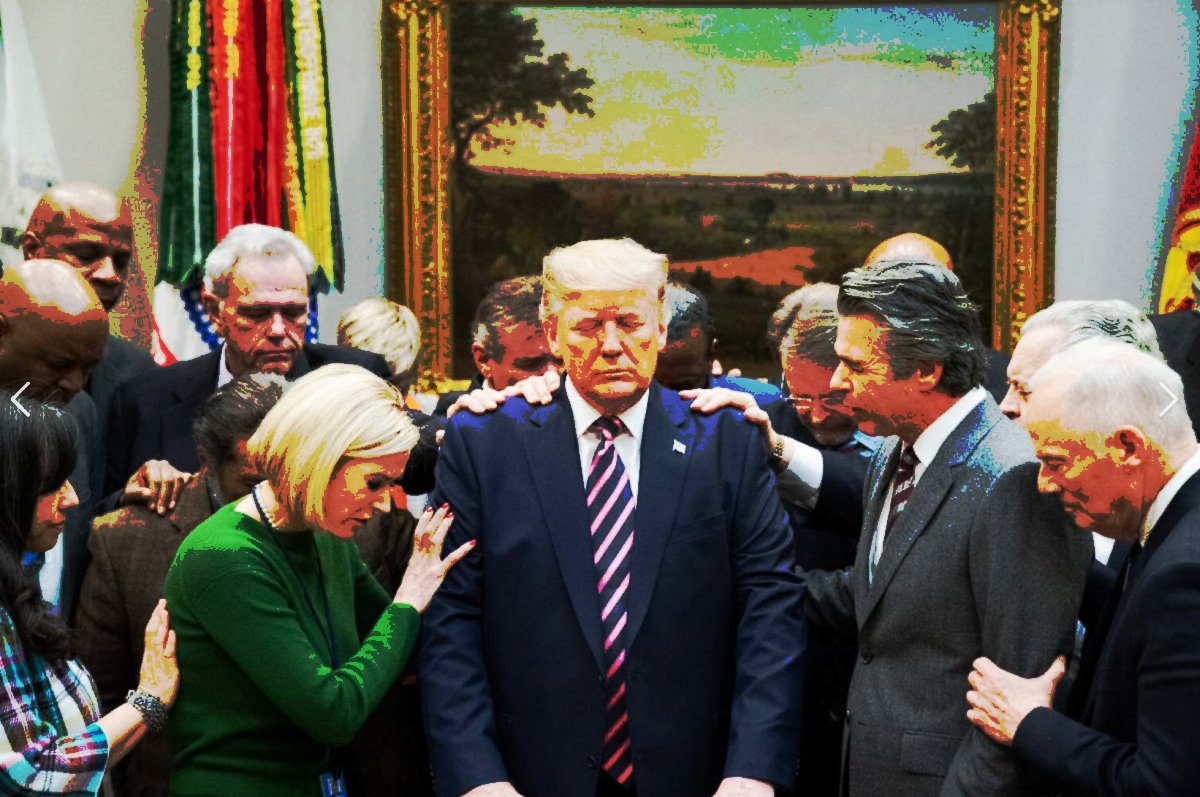
And then there is Trump’s Christian base—a congregation that overlooks threats, deceit, cruelty, and even criminality in their chosen idol. They chant his name despite his felon’s brand, despite his vulgarity, despite his blatant attempt to steal an election and crown himself king. He lies, and they believe. He sins, and they absolve. He boasts of virtues he does not possess, and they accept his word as truth. Their moral compass, once sharp in its judgment of others, suddenly falters when it points toward him.
If the Gospel can be bent so easily to excuse the powerful while condemning the weak, is it still the Gospel at all? Or has it been replaced with something else entirely—a hollow idol cast in gold, standing tall not in the name of Christ, but in the service of empire?
Jose Porfirio Miranda was a fiery prophet in the storm-tossed wilderness of history, a Jesuit who saw the footprints of Christ leading not to gilded cathedrals but to the barricades of revolution. In his vision, the Gospel was no lullaby for the contented but a war cry for the dispossessed. He traced the pulse of divine justice through the veins of history and found it quickening in unlikely places—among the thinkers and agitators who dared to dream of a world where no one starved while others feasted.
Like an alchemist of ideas, Miranda dissolved the boundaries between scripture and radical thought, revealing that the fire that burned in the Sermon on the Mount was the same fire that smoldered in Das Kapital. He argued that Jesus, scourge of the money changers and champion of the poor, had whispered truths that found their way, centuries later, into the mind of Karl Marx.
For Miranda, this was no blasphemy but a revelation—the Messiah and the revolutionary were brothers in the struggle against the empire of greed. Miranda’s words are not for those who seek comfort in a tamed and toothless faith. He demanded that the followers of Christ take up not only the cross but also the weight of history, recognizing in the cry of the oppressed the very voice of God. In Miranda’s world, the Kingdom of Heaven was not some distant dream but a call to arms, a relentless demand for justice here and now.
The gilded halls of power have long sought to soften the sharp edges of Christ’s words, to turn his fiery warnings into whispers, his upheaval into obedience. But the Gospels do not bend so easily. They burn with an unrelenting truth: Jesus did not merely frown upon wealth; he condemned the chasm it creates. His words, like a sword, cut through the justifications of the comfortable, sparing no one who hoards while others hunger.
Jesus does not damn the harvest of the earth when it nourishes all, as the blessings of Deuteronomy reveal. But when wealth becomes a wall—when it separates the haves from the have-nots, when it turns brothers into masters and servants—then it stands under the full weight of his wrath. “Happy are the poor,” Jesus declares, not because suffering is sacred, but because the poor shall inherit what was always meant for them. “Woe to you who are rich,” not because abundance is evil, but because riches built on the backs of the suffering are a sin.
Miranda reminds us that “rich” and “poor” are not isolated states; they are forged in relation to one another. A world where wealth blooms in the gardens of the few while the many toil in the dust is a world at war with the Kingdom of God. Yet exegesis recoils from this message. It tries to sand down its teeth, to smother the fire. But the fire remains.
To call oneself a follower of Christ while upholding a system that breeds inequity—what does that make of one’s faith? This is no question of party politics, of blue or red, left or right. It is the oldest struggle: the struggle to be fully human. To embody justice. To love not only in word but in action.
No, socialism itself does not anoint a nation as holy, nor does capitalism inherently defile it. A system that binds its people in chains—whether of poverty or of oppression—is equally distant from the Kingdom. But justice, economic and otherwise, is not some afterthought of faith; it is its foundation. The Kingdom of God is not a distant dream, nor a promise to be redeemed only in the afterlife. It is at hand. It is in the breaking of bread, in the sharing of burdens, in the turning over of tables.
And yet, we are told otherwise. Every day, the machinery of this world sings the same weary lullaby: that the divide between rich and poor is natural, inevitable, even righteous. But it is a falsehood. A carefully spun deception meant to keep the powerful enthroned and the meek in chains. Christ did not walk among us to bless this arrangement. He came to tear it apart. The following argument follows from Miranda’s ideas on wealth and profit found in his book, Communism in the Bible.
Jesus maintains an intransigent condemnation of the rich. He does not condemn wealth in the absolute sense, as when the wealth of the whole people is praised in Deuteronomy 28: 1–14. But when Jesus says “Happy are the poor” and “Woe to you the rich,” he is attacking the fact that some people are poor and others are rich. As Miranda emphasizes, “rich”
and “poor” are correlative terms. Jesus’s “inexorable reprobation” to which he subjects wealth refers not to absolute wealth but to differentiating wealth, that is, to relative wealth, and Jesus does so “implacably,” “intransigently” and “unexceptionably” according to Miranda.
Justice is not solely economic, but without economic justice, the Kingdom of God remains a mirage. We can pray for our own salvation and that of our brethren, but to ignore the suffering before us is to refuse the grace that makes the Kingdom possible. For Christ did not speak of a distant paradise alone; he spoke of a revolution of love, a kingdom born not in the afterlife but in the breaking of chains, the lifting of burdens, the leveling of mountains made of gold in our sacred home, the earth.
And yet, we are told that wealth disparity is the natural order of things, as unchangeable as the tides. This is a falsehood, an incantation recited by those who benefit from its spell. The machinery of finance capitalism grinds on, spinning its false inevitabilities into the fabric of our daily lives, until its injustices feel like common sense, until even the faithful begin to believe that there is no alternative.
Even liberation theology, in its righteous fire, stumbles when it speaks of a “preferential option for the poor.” It is no mere option. It is an obligation. A debt of justice, written into the very marrow of the Gospel. To ignore it is not simply a failure—it is complicity. There is no neutrality here, no safe middle ground where one can worship without consequence. The existence of poverty in a world of abundance is an accusation, and Christ himself stands as witness against those who look away.
The struggle is not one we can choose to enter or leave at will. It is upon us, and it demands a response. Will we stand with the poor as Christ did, or will we turn away and call ourselves innocent? To refuse restitution is to embrace injustice. To abstain is to take sides. The Kingdom of God is at hand—not in words alone, but in the fight for a world where love and justice are not dreams, but reality.
Jesus’ identification with the poor can convincingly be seen throughout the New Testament but particularly in passages such as John 12:6, 13:29 and Luke 8:1–3. Jesus went so far
as to make the renunciation of property a condition for entering the kingdom of God. When Luke says, “Happy the poor, for yours is the Kingdom of God” (Luke 6:20) and adds, “Woe to you the rich, because you have received your comfort” (Luke 6:24), Luke is repeating Mark 10:25 when Jesus warns that the rich cannot enter the Kingdom.
Essentially, Jesus proclaims that in the Kingdom of God, the very foundations of social hierarchy crumble into dust. There can be no thrones built upon the labor of the poor, no palaces rising above the hunger of the many. The Kingdom, whether or not it pleases Trump and Musk, is a classless society—a realm where the first are last and the last are first, where wealth ceases to be a fortress and becomes a banquet table set for all.
It is not a distant utopia, not a dream deferred to the afterlife, but a radical rupture with the world as it is.
It is a revolution not merely of spirit but of structure, a reckoning with the lie that some are born to excess while others are condemned to struggle. And so, the rich resist. They fashion a Christ in their own image—one who blesses their fortunes and sanctifies their rule. But the real Christ overturns their tables, calls them out by name, and warns that their kingdom will not stand.
For in the true Kingdom, there is no place for lords and servants, no room for exploitation masked as merit. There is only justice, only love, only the great leveling where humanity is restored, and the false gods of wealth and power are cast into the abyss.
Consider what Luke says in Acts: All the believers together had everything in common; they sold their possessions and their goods, and distributed among all in accordance with each one’s need. [Acts 2:44–45]. The heart of the multitude of believers was one and their soul was one, and not a single one said anything of what he had was his, but all things were in common. …There was no poor person among them, since whoever possessed fields or houses sold them, bore the proceeds of the sale and placed them at the feet of the apostles; and a distribution was made to each in accordance with his need [Acts 4:32, 34–35].
The early Christians had a strong sense of community, often meeting in small, house churches—a practice that facilitated deeper intimacy as they wrestled with this new faith, together. In addition to exploring their faith in a relational way, they also put undiluted community into practice by rejecting the concept of individual ownership in lieu of an “according to need, according to ability” redistribution of wealth system—a practice that enabled them to eradicate poverty in their community.
“From each according to his ability, to each according to his needs!” was a famous phrase used by Marx in a letter he wrote in 1875 to the Social Democratic Workers’ Party of Germany which came to be part of his Critique of the Gotha Program. If you refer to Acts 4:34–35, you will see that Marx simply paraphrased what is written in the New Testament. Does that mean that the early Christians were communists? Perhaps it is better to say that communism proper is a Christian principle (that was perverted and distorted in the totalitarian communist regimes of the former Soviet Union and Eastern Bloc countries). The first part of the principle—from each according to their ability—can be understood to mean that all members of society will have the right to use their creative abilities to produce that which benefits the entire society. The second part of the principle—to each according to their needs—explains that citizens will receive from society a fair return for their labor, that is, what is necessary to fulfill their needs. Needs here does not simply refer to material needs, although material needs must be met in order for other needs to be satisfied.
But didn’t Jesus advocate paying taxes? Rendering unto Cesar what is due Cesar? Jesus’s remark about giving Cesar what is due Cesar is decidedly ironic,
and not a capitulation to Roman authority. Consider the following verse cited by Miranda concerning economic transactions found in the Bible: For the sake of profit, many have sinned; the one who tries to grow rich, turns away his gaze. Stuck tight between two stones, between sale and purchase, sin is wedged.
[Ecclus. 27:1–2]
Miranda notes that biblical scripture condemns the term “interest” (the Hebrew word is “neshet”) numerous times: Exodus 22:24; Leviticus 25:36, 37; Deuteronomy 23:19 (three times); Ezekiel 18:8, 13, 17, 22:12; Psalms 15:5; Proverbs 28:8. And numerous times profit making through commerce, loans at interest and productive activity itself (the process of production) are condemned (production likely here referring to agriculture). Does not James condemn the acquisition of wealth by agricultural entrepreneurs (see James 5:1–6)? And does he not, in fact, attack all the rich (James 1:10–11)? In James 2:6, does he not say: “Is it not the rich who oppress you and who haul you before the tribunals?” Does he not also say: “See, what you have whittled away from the pay of the workers who reap your fields cries out, and the anguish of the harvesters has come to the ears of the Lord of Armies” (James 5:4)? Does it now surprise us that Jesus would call money, “money of iniquity”
(Luke 16:9, 11)?
What this verse is doing is explaining the origin of wealth. Its intention is not to refer to some particularly perverse rich people who have committed knaveries which other rich people do not commit. The letter’s attack is against all the rich. This is the biblical reprobation of differentiating wealth as Luke vituperates those who have defrauded workers and impugns all the rich. According to Miranda, profit is considered to be the source of (differentiating)
wealth. Miranda argues that for James, differentiating wealth can be acquired only by means of expropriation of the produce of the workers’ labor.
James condemns differentiating wealth with an unflinching voice, a prophet's thunder against the seductive mirage of profit. There is no hedging, no compromise—only a fierce indictment of an economy built not on need but on the relentless hunger for accumulation. To amass wealth at the expense of others is not merely unjust; it is a fundamental betrayal of the moral order, an affront to the divine call for justice.
Miranda sharpens this critique, revealing its radical implications: “Where there is no differentiating wealth, where economic activity is directly for the purpose of the satisfaction of needs and not for trade or the operations of buying and selling for profit, government becomes unnecessary.” In such a world, the structures that prop up inequality—the hierarchies, the mechanisms of control, the very scaffolding of power—crumble into irrelevance. The Bible does not simply denounce wealth hoarded in idle hands; it condemns the very machinery that generates it, the entire architecture of exploitation masquerading as commerce.
This is no modern revelation. Even the prophets—Micah, Amos, those wild voices crying out from the margins—knew that wealth does not accumulate without violence, that behind every mansion stands a house stripped bare. They saw through the illusions of empire, understood that profit, in its most insidious form, is a veiled act of theft—an elegant robbery clothed in the language of markets and transactions.
And so the question lingers, as haunting now as it was in the days of the prophets: What shall it profit a man if he gains the world, yet forfeits his soul?
To stand with Christ is to stand against the forces that perpetuate suffering. It does not mean that a socialist state is inherently more Christian than a capitalist one, particularly if that socialism descends into authoritarianism. But justice—true justice—demands economic reckoning. Without it, the Kingdom of God remains a distant ideal rather than an urgent call.
The Kingdom is not merely a future hope; it is at hand. It is not ushered in through pious words alone but through the labor of love and the struggle for justice here and now.
The idea that wealth disparity is simply the natural order of things is a lie, whispered into our ears by the institutions that benefit from our complacency. We are taught, day after day, that inequality is inevitable—that the machinery of finance capitalism, with its hoarding of wealth and its manufacture of poverty, is beyond question. And too much of modern Christianity has fallen into this deception, building its theology atop a crumbling foundation.
The key point in Miranda’s theological argument is that the eschaton has already arrived, the eschaton of justice and life for all, in the example of Jesus Christ. If Christians don’t believe that the eschaton has already come, then they are likely to relegate Jesus to a non-temporal and eternal or Platonic realm.
But the eschaton cannot be indefinitely held captive in some mythic future; the historical moment of salvation is not repeatable since Jesus is the divine singularity—the definitive “now” of history. If this were not the case, “then the imperative of love of neighbor becomes an intro-self concept. It does not speak as a real otherness, because anodyne time, even if it is present, truly has no reason to command me more than any other time”
Christians, argues Miranda, can’t postpone the commandment to love their neighbor in the fathomless future, because this would make of God an unassimilable otherness, a perpetual language game in which postmodernists would love to participate without a commitment to any political imperative except narcissistic self-cultivation. And thus we could never be contemporaneous with God. Eternal life is not life after death but the defeat of death, that is, the defeat of suffering and injustice in the here and now. Of course, what should be condemned are the totalitarian police states that claimed to be communist (such as the Soviet Union) but which were, in the final instance, formations of state capitalism.
We need to be reminded that the first writing by Marx in his Gesamtaus-gabe was composed in 1835 (when Marx was a 17-year-old student at the Trier Gymnasium) and was a devotional essay on the fifteenth chapter of St. John’s gospel called “The Union of the Faithful in Christ.” And the last 500 pages of The German Ideology certainly illustrate that Marx had a clear understanding and detailed knowledge of the New Testament. While Marx did not identify as a Christian during his life, it is clear that he was influenced by the message of the New Testament regarding differentiating wealth and the necessity for the struggle against it.
What is clear from a reading of the Gospel accounts of Jesus is that the world is in the thrall of the monetary god, and that the true Kingdom of God requires a commitment to social justice. Did not the very person who baptized Jesus and who was a major figure inaugurating the Kingdom of God—John the Baptist—proclaim: “The man who has two tunics is to share with him who has none; and he who has food is to do likewise” (Luke 3:11)? Did not Jesus Himself declare, “No one can serve two masters, for either he will hate the one and love the other, or he will be devoted to the one and despise the other.
You cannot serve both God and money” (Matthew 6:24)? What does this say about capitalism, the greatest and most rabid colonizing force in history, sweeping across the parched plains of the planet like a dust storm from hell and arriving at temples of usury called banks and investment firms?
Of course, to point out that Jesus did not support politico-ethical neutrality-in the face of injustice is not a popular message, especially for those who use God-talk as a politically pacifying force.
And don’t we at present possess the technological capability to free humanity from the travails of brutal, backbreaking labor but we choose instead to burn our surplus crops and allow people to starve? The fruits of our labor should be the creation of the Kingdom of God, and not the Trump Towers!
We are so paralyzed by the dark cosmovision of capitalism—the money nexus, individualism, ruthlessness, lack of compassion—that we fear being roundly chastised for having the temerity to denounce the incontrovertible presence of social sin, or structural sin or the sin of state capitalism. We are chastened and rebuked to restrict our concern to our own sins and our personal atonement and repentance and to eschew condemning structural entities such as the state or our economic system. After all, are we not all sinners?
Who are we to attack capitalism at its roots since we ourselves have transgressed the word of God? Yes, of course we are sinners, but that knowledge should not paralyze us so that we submit to the sins of the state. We should not remain silent while watching the furnaces of predatory capital being stoked.
The theology of liberation, which first stirred to life within the crucible of Latin American Catholic history, was not merely a political awakening—it was a profound spiritual reckoning. It was the voice of the Gospel crying out from the margins, the faith of the poor rising like incense against the gilded altars of indifference. This radical theology was shaped by the winds of Vatican II, that brief and luminous moment when the Church, for all its centuries of rigidity, opened its eyes to the world and glimpsed the suffering it had too often ignored.
For decades, the Catholic Church had recoiled from movements of social justice, wary that the struggle for the oppressed carried the taint of communism. The fear was canonized in Pope Pius XI’s Divini Redemptoris (1937), an encyclical that cast Marxism as a specter of godlessness, a mortal threat to the Church’s moral and doctrinal authority. This opposition to left-wing movements placed the Vatican in tension with those within its own ranks—priests, nuns, and laypeople who saw, not heresy, but holiness in the fight for dignity and justice.
Dorothy Day, with her Catholic Worker Movement, stood at the fault line of this contradiction. Branded as suspect in her lifetime, she now teeters on the edge of sainthood, recently named Servant of God by the very institution that once viewed her with unease. The irony is thick, yet perhaps fitting—history has a way of anointing its radicals long after the dust of their struggle has settled. And so the Church, slow to embrace its prophets, edges toward an uneasy reconciliation with its own revolutionaries, even as the spirit of liberation theology continues to burn in the hearts of those who refuse to see faith and justice as separate callings.
Pope John XXIII, sensing the tremors of a world on the brink of transformation, recognized that the Catholic Church could no longer remain a fortress walled off from the suffering of the masses. The Church, once a beacon for the persecuted, had long since become entangled in the machinery of empire, its hands bloodied by the Crusades, the Inquisition, and the colonial plunder that followed the cross like a shadow. With the convocation of the Second Vatican Council (1962–1965), John XXIII sought to reclaim the Church’s earliest spirit—those first three centuries when it stood not as an institution of power, but as a refuge for the dispossessed.
Vatican II was a watershed, an attempt to wrest Christianity from the grip of clerical elitism and return it to the people. Yet, it was not merely a theological renewal—it was a reckoning. A few years later, the Conference of Latin American Bishops in Medellín, Colombia (1968) took this mandate further, forcing the Church to confront its own complicity in colonial conquest and economic oppression. The bishops gathered in Medellín declared, in unequivocal terms, that the Church must stand with the poor—not as charity, but as a moral and theological obligation. They called for a preferential option for the poor, a radical stance that drew directly from the teachings of Jesus, who did not merely preach to the impoverished but called for their liberation.
But the theology of liberation was born in fire. The late 1960s through the 1980s were brutal decades for Latin America. The region was ravaged by U.S.-backed authoritarian regimes, their caudillos waging war against campesinos, workers, teachers, and revolutionaries. Developmentalist economic models, crafted to appease global financial powers, deepened inequality—enriching the urban elite while crushing the rural poor. The Church, long accustomed to silence, now found itself at a crossroads: remain complicit, or become a church of the people, a church of the poor.
This was not an abstract debate—it was a matter of life and death. Priests, bishops, and nuns who embraced liberation theology found themselves hunted by death squads. The Gospel of the oppressed became a dangerous text, its pages stained with the blood of those who dared to proclaim that the poor had the right not only to sustenance, but to dignity, to power, to a world remade in the image of justice rather than greed. And yet, despite the persecutions, despite the Vatican’s own unease with its radical priests, the fire of Medellín could not be extinguished. The Church of empire had been called to account. And for those who listened, faith was no longer an abstraction—it was insurrection.
The war against Liberation Theology was as much ideological as it was physical. The Catholic hierarchy, led by Pope John Paul II and later reinforced by Cardinal Ratzinger (the future Pope Benedict XVI), viewed it with suspicion, believing that its Marxist leanings threatened Church authority. Yet, what truly alarmed both the Vatican and the U.S. government was not simply its rhetoric but its impact. Liberation Theology was empowering the poor—not just spiritually, but politically.
Peasants reading the Bible with pastoral workers did not interpret it as a call to passive suffering, as prosperity gospel preachers insisted. Instead, they saw in Christ’s words a revolutionary demand for justice. Jesus, after all, was not a figure of wealth and power but one who stood with the oppressed, overturning the tables of money changers and denouncing the hypocrisy of the elite. The U.S., long accustomed to using the Catholic Church as a stabilizing force in Latin America, realized that a Church aligned with the poor—and, by extension, with peasant resistance movements—was a direct threat to imperial control.
The Reagan administration acted swiftly. As Chomsky has noted, this was the first religious war of the 21st century, waged with CIA funding and military support for authoritarian regimes. The School of the Americas in Fort Benning, Georgia, became an incubator for terror, training soldiers and death squads in counterinsurgency tactics. The goal was clear: eradicate any movement that dared to challenge the established order.
The price of this war was written in blood. Saint Oscar Romero, the archbishop of San Salvador, became one of its most famous martyrs. Initially cautious about Liberation Theology, Romero was radicalized by the unrelenting violence of the state against the poor. He became a voice for the voiceless, condemning the government’s brutal repression from the pulpit. His defiance sealed his fate. In 1980, as he lifted the Eucharist during Mass, a bullet from a right-wing death squad struck him down. His murder was not an anomaly—it was a warning. In El Salvador alone, six Jesuits were later executed for trying , their bodies left as a grim message to others who might dare to follow the path of Medellín.
And yet, despite the assassinations, the betrayals, and the Vatican’s own efforts to silence its radical clergy, Liberation Theology endured. It refused to be erased because its foundation was not in politics alone but in the deepest convictions of faith—that the Kingdom of God could not be built on exploitation, that justice was not an abstraction, and that the poor did not need permission to demand dignity.
Imagine what life was like in Jesus’ time. In Jesus’s time the basic social, economic, cultural and political unit was not the peasant household, but the oikos, the great household of the elite, aristocratic families, which were basically trading houses, export-import businesses, where wealth was concentrated, often obscenely concentrated. The elites used their wealth to make loans to peasant farmers. This enabled the farmers to plant the crops. Interest rates were, researchers conclude, from 60 percent up to 200 percent. The masters of the great households were not so much interested in profit, but wanted to acquire land as collateral. The elites would foreclose on their loans during hard times when the crops were failing due to drought or disease and could not cover their incurred indebtedness. The elites, and their servants were adapting to the growing effects of commercialization on the agrarian economy and were more interested in the control of land, not just the control of the peasants who lived on them. There were efforts in Jesus’ time to displace peasants from their patrimonial lands and to reduce their status to dependent laborers. Children were forced to become day laborers. The sick and those with injuries or disabilities were left to die. The dynamics of debt that impacted peasant households in Jesus’ time was horrific.
Who could begin a revolution that truly represented the interests of the poor? To answer that question I need to recall a moment from the past. Venezuela President Hugo Chávez had invited me to be an audience member on Alo Presidente!, his weekly broadcast, a spectacle where politics and performance blurred into one. I was seated behind Ernesto Cardenal. Father Cardenal was a poet of fire and faith, a man who wove verse and revolution into a single, unbreakable thread. He fashioned his poetry to protest the Somoza regime in Nicaragua and supported the Sandinista Revolution that overthrew President Somoza in 1979.
His words did not merely adorn the pages of books; they marched, they rebelled, they prayed. In the rhythms of his poetry, one could hear the echoes of the Gospel and the rumblings of insurrection, a voice that stood with the poor and against the empires that sought to silence them.
His activism was not the detached musings of an intellectual but a lived defiance. As a priest, he embraced liberation theology, believing that faith without justice was an empty vessel. As a Sandinista, he served in the revolutionary government of Nicaragua, refusing to separate the sacred from the struggle. And for this, he was chastised on the world stage, famously kneeling before Pope John Paul II on the tarmac of Managua’s airport, only to be rebuked with a pointed finger and a refusal to bless—a moment that became a symbol of the Church’s uneasy reckoning with those who dared to place Christ among the revolutionaries.
Yet Cardenal remained undeterred. His poetry continued to sing of justice, of exile and return, of a world where the Kingdom of God was not a distant promise but a call to arms for the here and now. His praise of President Chávez was effusive.
President had wanted me bring Freire’s work to the Venezuelan countryside. He was serious about his battle for the poor of his nation: to sow the seeds of critical consciousness in the soil of his Bolivarian dream.
It was an offer laden with history, with possibility, with peril. Freire’s work had long been a weapon in the hands of the oppressed, a lantern in the darkness of ignorance. To bring it into Chávez’s revolution was to step into a whirlwind—a movement both emancipatory and fraught, where education was not just learning but a battleground of ideologies.
That moment crackled with the weight of history, as if the very air pulsed with the echoes of past revolutions. Two titans of Latin American resistance—Chávez, the firebrand leader who sought to remake his nation, and Cardenal, the poet-priest who had once defied the Vatican itself—stood together, their presence a living rebuke to the forces that had long sought to silence the cries of the oppressed.
Cardenal’s very existence in that gathering was a testament to an old and bitter struggle, the Church’s uneasy dance with liberation theology, a battle waged not only in whispered prayers and radical scripture but in the harsh glare of power. His confrontation with Pope John Paul II on the sun-scorched tarmac of Managua had become legend—a moment when the weight of Rome descended upon a man who dared to wed faith with revolution. That defiant spark had not dimmed. It burned still, casting long shadows over the moment, mingling with the charged air of Chávez’s grand stage.
Liberation Theology calls for a faith that stands with the oppressed, but Trump’s evangelical base appears to have chosen a faith that worships power. They bypass his cruelty toward migrants, ignoring that Jesus himself was a refugee, fleeing Herod’s tyranny. They cheer his alliance with Putin, disregarding the biblical call to protect the vulnerable rather than side with oppressors. They have forsaken David for Goliath, preferring the strongman’s iron fist to the humble shepherd’s courage. Trump’s claim that Zelenskyy is a tyrant and that Ukraine is to blame for the war is not just historically illiterate—it is a chilling echo of the rhetoric that paved the way for some of history’s darkest atrocities. Just as Hitler framed Czechoslovakia and Poland as threats to justify invasion, Trump parrots the same twisted logic, casting Ukraine as the aggressor while Putin’s missiles reduce cities to rubble.
It is the language of the aggressor who feigns victimhood, the justification of conquest disguised as self-defense. In the 1930s, the world watched as Germany manufactured grievances, decrying imaginary oppression to rationalize expansion and domination. Now, Trump revives that same deceit, shifting blame from the invader to the invaded, twisting reality until the victim becomes the villain.
This is not just dangerous revisionism—it is an invitation to tyranny. To accept it is to walk, eyes wide open, into the abyss of history repeating itself not as tragedy but as farce.
In the world of Trump’s acolytes, wealth is not an obstacle to salvation but proof of divine favor. Trump, a man of excess and deceit, is hailed as a modern-day King Midas, turning everything he touches to gold—yet, like Midas, his touch brings ruin, not prosperity, except for those already at the top. This is the prosperity gospel in its final, grotesque form: a theology that equates power with righteousness, that sees the suffering of the poor as either deserved or irrelevant.
But Liberation Theology tells a different story. It reminds us that Christ was not found in the palaces of emperors but among the poor and the persecuted. He did not bless the powerful; he cast them down. He did not build walls; he welcomed the stranger. He refused to embrace empire, to worship at the feet of Caesar. Nobody understood this as profoundly as Paulo Freire, who helped to bring the spirit of liberation theology into the realm of pedagogy as the great Catholic educator, James Kirylo, has explored in his important work, Paulo Freire, The Man from Recife.
Pope Francis has been a lighthouse in a storm, casting his glow upon the weary and dispossessed, requesting safe passage to those adrift in the tempests of poverty and despair. In the early days of Francis’ papacy I was critical of the Vatican, suspicious that the election of Francis was a plan to halt the development of liberation theology in Latin America. My suspicions turned out to be ill-founded, as Francis has been a champion of the poor, and while he rejects the Marxist aspect of liberation theology, he supports a “theology of the people”, according to a conversation I had with Archbishop Colombo, Argentine prelate of the Catholic Church, who has been archbishop of Mendoza since 2018. Meanwhile, Trump stands as a mad sculptor, chiseling fear into the foundations of a nation, even as he longs to see his own likeness carved into the granite heights of Mount Rushmore, a monument to his own vanities, and even as history weighs the hammer and chisel of judgment.
Comments

Powered by RoundtableAn AI/DeFi-powered Enterprise Media Operating System. Learn more at Roundtable.io.© Roundtable 2026. By using this site you agree to the Terms of Use and Privacy Policy