

The government-owned Andrew W. Mellon Auditorium boasts a spectacular ballroom that can seat more than 650 people. (Photo: GSA)


May 16, 2026 5:57 AM
Updated May 17, 2026 1:04 AM
Located less than a mile from the White House, the Mellon Auditorium fits the bill
Donald Trump just loves to spend taxpayer dollars on his vanity projects. Congress has already allocated $40 million for his National Garden of American Heroes, but lawmakers will likely have to cough up more to cover additional plans for reflecting pools, dining facilities and an amphitheater. Then there’s Trump’s makeover of the Lincoln Memorial Reflecting Pool. The no-bid contract he signed with his favorite swimming pool contractor to repair it and paint it blue will cost taxpayers about $13 million, seven times more than his original $1.8 million estimate. And then there’s the $15 million the National Endowment for the Humanities has stashed away for Trump’s proposed 250-foot arch across the Potomac River from the Lincoln Memorial.
But the project that is roiling Capitol Hill these days is Trump’s proposed $400 million ballroom to replace the White House East Wing he demolished. It’s fair to say that Trump is obsessed with it. A recent Washington Post analysis of his public remarks and social media posts found that he brought up the project, often out of context, on three dozen days during the first three-and-a-half months of this year.
Democrats have seized on the project as a symbol of Trump’s misguided priorities. “Instead of dumping even more money into Trump’s golden ballroom, we need to put an end to this corruption and focus on lowering costs for American families,” Massachusetts Sen. Elizabeth Warren said in an April 29 statement on the Senate floor. “That is what Democrats are laser-focused on. Republicans should join us to get it done.”
The public, meanwhile, opposes the ballroom by a 2-to-1 margin. A late April surveyfound that 56 percent of Americans disagree with Trump’s decision to tear down the East Wing for his planned ballroom. Only 28 percent support the project.
Related stories
In any case, the controversy has made great theater, and the press has been following every twist and turn. Since the beginning of the year, the dispute has generated sustained coverage from virtually every major national news organization, including The Washington Post, New York Times, NPR, AP, Reuters, ABC, CNN and PBS.
But while the news media have focused mainly on the ballroom’s ballooning cost and who will ultimately pay for it, they have missed two critical facts: First, presidents rarely hold events that require a ballroom, and second, the newly renovated, government-owned Andrew W. Mellon Auditorium—which includes an ornate ballroom and looks a lot like what Trump is clamoring to build—is located very close to the White House.
In other words, we don’t need a new ballroom at any price.

State dinners are rare
Trump originally promised that “patriotic” corporate donors would pay for the ballroom, and as late as March 30 he told reporters that “not one dime of taxpayer money is going into” it. But after the shooting at the White House Correspondents’ Dinner late last month, the project was suddenly all about national security, and Republican members of Congress—led by South Carolina Sen. Lindsey Graham—began insisting that the public pick up the $400 million tab. “Private donations can be used,” Graham said, “but I think they should be used for buying china and stuff like that.”
On May 5th, the ballroom’s projected price tag more than doubled. Senate Republicans inserted a $1 billion allocation for the “East Wing Modernization Project” into a Border Patrol and Immigration and Customs Enforcement funding bill they want to push through Congress by the end of the month. The proposal, which doesn’t specifically mention the ballroom, focuses primarily on “security adjustments and upgrades.” But the White House is applauding the measure, contending that it would remove the legal obstacle that the project requires congressional approval.
When the Trump White House announced its plans to build the ballroom in July 2025, its stated rationale for the new facility is a president’s inability to “host major functions honoring world leaders and other countries without having to install a large and unsightly tent approximately 100 yards away from the main building entrance.” The East Room of the White House—the largest room in the executive residence—has only a 200-person seating capacity, the press release added, while the “ornately designed and carefully crafted” White House State Ballroom will have a seated capacity of 650. (Later Trump said he wanted a ballroom that can fit 999 people, but he didn’t indicate if they would be seated or standing.)
The key question is: How often would a $400 million, or even a $1 billion, ballroom actually be used for such a big event? If the recent past is prologue, rarely.
During Trump’s first term, the White House held only two state dinners. One, in April 2018, honored French President Emmanuel Macron. The other, in September 2019, was for Australian Prime Minister Scott Morrison. Joe Biden, meanwhile, hosted fivestate dinners in Washington during his one-term presidency and Barack Obama hosted only 12 during his two terms. So far, the recent state dinner for King Charles III is the only one Trump has hosted since taking office for a second time.
Likewise, there is no evidence that either Trump or Biden ever hosted a White House state dinner for anything close to 650 guests, let alone 999. In fact, available evidence suggests that the number of attendees at modern state dinners generally run in the low hundreds, occasionally reaching the 400 to 500 range when tents are erected on the South Lawn.

A golden opportunity to use an existing facility
The Andrew W. Mellon Auditorium, completed in 1935 for $2 million ($48.6 million in today’s inflation-adjusted dollars), has all of the amenities—and the glitz—Donald Trump desires.
As Trump knows, there are three things that matter when it comes real estate: location, location, location. Situated at Constitution Avenue and 13th Street NW, the Mellon Auditorium is less than a mile from the White House. Trump and his Secret Service entourage could drive there in 8 minutes at most or walk there in less than 20.
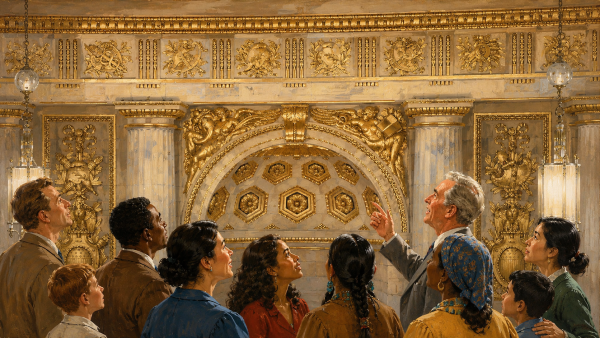
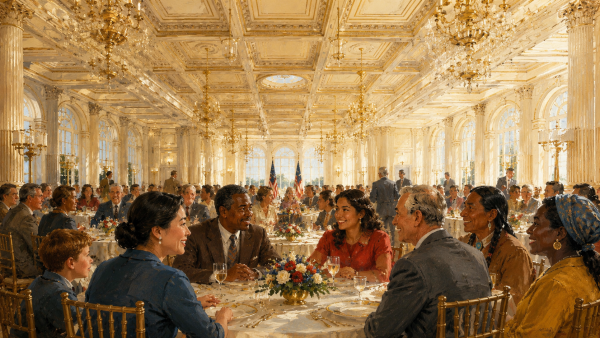
Not only is it close by, it’s also a Neoclassical beauty with a monumental temple front featuring six fluted 62-foot Roman Doric columns. Its grand interior staircase leads to the jewel of the facility, a stunning multipurpose auditorium, which can function as a ballroom that can handle more than 650 seated guests or as many as 1,000 people for a standing reception (one more than Trump’s 999). The 8,000-square-foot space features 45-foot-high Roman Doric columns lining its perimeter, a 60-foot-high ceiling, and a newly restored, gilded gold frieze. The building also contains three equally opulent smaller rooms, three foyers and an outside portico that, depending on their size, can accommodate between 50 and 250 guests. The building hosts both government and private events, including parties, weddings and concerts.
The Mellon Auditorium’s interior is made to order for a president known for his love of gold décor. After the building was renovated in 2023, the General Services Administration, which manages federally owned property, awarded Ridgewells Catering the responsibility of managing it. The theme of the company’s grand reopening gala was gold.
“Mellon Auditorium is brimming with gold adornments on the walls and ceilings, plus massive stone columns with gilded scrollwork, and the elevator doors, the grand staircase and front iron gates are dipped in metallics,” said Ridgewells CEO Susan Lacz in a press release. “And [like] everywhere in fashion right now, we’re also seeing gold!”
As it turns out, Trump knows the Mellon Auditorium well. He attended a press event there in late January to promote his Trump Accounts. He was there in July 2025 to speak at a White House-sponsored summit on artificial intelligence. And in 2020, the building served as a central hub for the Republican National Convention and was where President-elect Trump and Vice President-elect Mike Pence gave their acceptance speeches. Trump supporters, meanwhile, have thrown huge parties at the facility. In January 2025, the crypto industry held an inaugural ball there for 1,500 revelers.
The facility also has hosted major international conferences. The signing of the North Atlantic Treaty took place there in 1949, establishing NATO. Seventy-five years later, in July 2024, President Joe Biden hosted a three-day NATO summit in the very same building.
The National Trust isn’t backing down
Last December, a week after the Trump administration finished demolishing the East Wing to clear the way for the ballroom over the objections of the National Trust for Historic Preservation and other historical preservation groups, the National Trust filed a lawsuit challenging the president’s plan. The nonprofit argued that the administration failed to undergo legally required reviews or obtain congressional approval for the project. “No president is legally allowed to tear down portions of the White House without any review whatsoever,” the complaint states, “not President Trump, not President Joe Biden, and not anyone else.”
In late March, a U.S. District Court judge ruled that ballroom construction “must stop until Congress authorizes its completion.” He noted that the National Trust’s lawsuit is likely to succeed, so he granted a preliminary injunction. “The President of the United States is the steward of the White House for future generations of First Families,” the judge wrote. “He is not, however, the owner!” A few days later, however, a three-judge federal appeals panel allowed ballroom construction to continue into June. The panel scheduled arguments for June 5 to reconsider if all construction should be blocked."
After the shooting at the White House Correspondents’ Dinner, Trump’s acting Attorney General Todd Blanche asked the National Trust to drop its “frivolous lawsuit” in a social media post, while Trump argued that the incident showed how difficult it is to ensure his security at large events outside the White House grounds. (Then why does he routinely attend large sporting events?)
The National Trust declined. “We are not planning to voluntarily dismiss our lawsuit,” National Trust President and CEO Carol Quillen said in an April 27 statement, “which endangers no one and which respectfully asks the administration to follow the law.”
What’s next?
Before it was demolished, the White House East Wing housed the first lady’s office and her staff and was used for a mix of ceremonial, operational and visitor-related functions. Beneath it was the highly secure Presidential Emergency Operations Center, known as the White House bunker, which dated back to World War II. It served as a shelter and command center for the president, vice president, senior White House staff and military personnel during emergencies. It famously was used during the September 11 attacks, when Vice President Dick Cheney and others were taken there.
Although Trump plans to replace the bunker as part of his ballroom project, it is currently not available in the event of an emergency. Meanwhile, the offices above the bunker Trump bulldozed were used on a daily basis. His proposed 650-seat ballroom would be used at most two times a year, if that. It is clear that building a multimillion-dollar ballroom on the site makes no sense, especially when there is a perfectly good alternative virtually next door.
Perhaps the best solution would be to rebuild the East Wing for the offices that it housed, rebuild the bunker in the basement, and force Donald Trump to pay for it out of his own pocket.
Comments

Powered by RoundtableAn AI/DeFi-powered Enterprise Media Operating System. Learn more at Roundtable.io.© Roundtable 2026. By using this site you agree to the Terms of Use and Privacy Policy