


Jun 8, 2026 8:49 PM
Updated Jun 13, 2026 7:11 AM
From Death Row to Freedom Schools: Bill Ayers on Building Movements, Changing Narratives, and Expanding Democracy
Dick & Sharon: From Death Row to Freedom Schools: Bill Ayers on Building Movements, Changing Narratives, and Expanding Democracy.More Videos
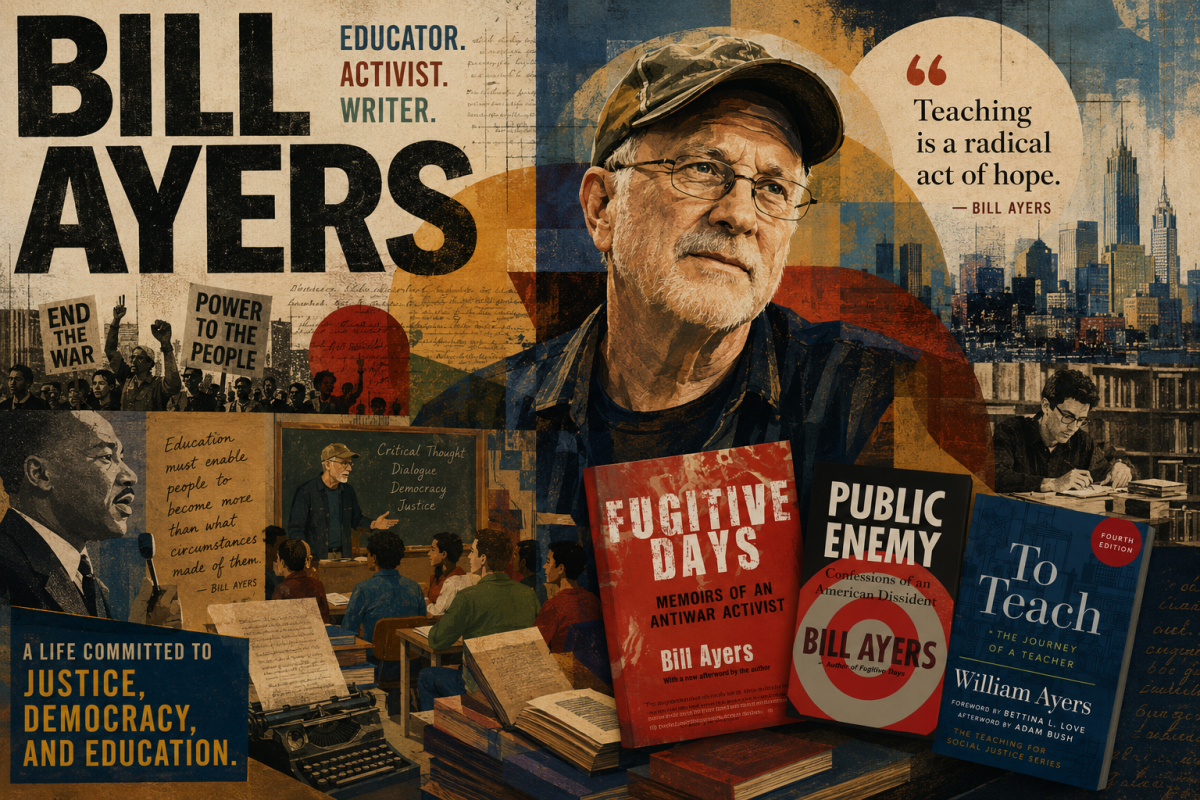
Bill Ayers has lived several public lives: antiwar activist, educator, writer, professor, prison teacher, and longtime advocate for democratic education. In a recent conversation with LA Progressive, Ayers made clear that although he retired from the University of Illinois Chicago 16 years ago, he has not retired from teaching, organizing, or imagining a more humane society.
“I haven’t stopped teaching,” Ayers said.
Much of his current work is with College Unbound, a degree-granting higher education program based in Providence, Rhode Island, that serves students around the country through cohort-based learning. Ayers’ Chicago cohort meets every Tuesday evening in his apartment. There are nine students, all formerly incarcerated. Together, they have spent more than 150 years in Illinois prisons.
Ayers cooks dinner for them each week.
Related stories
“I learned long, long ago that if you feed the students, all else can go to hell, but at least everybody ate,” he said. “We break bread, and that builds community.”
Two of those students, Stanley Howard and Renaldo Hudson, were recently honored by Death Penalty Focus in California. Both men spent decades in prison. Both were once on Illinois’ death row. Stanley Howard, author of Tortured by Blue, was a leader of the Death Row 10, a group of men who discovered that several of them had been tortured into false confessions by Chicago police.
Ayers described that discovery as a classic movement-building moment: people experiencing oppression individually began to recognize it collectively.
“They didn’t even know that they shared an oppression,” he said. “They didn’t know how to name it.”
With outside organizers, lawyers, journalists, family members, and advocates, the Death Row 10 helped build the movement that eventually led Illinois first to suspend and then abolish the death penalty.
For Ayers, this history is not abstract. It is evidence that abolition is not a utopian fantasy. It has happened. Illinois did abolish its death penalty. And it happened, he emphasized, because the people closest to the violence of the system became central to exposing and resisting it.
Ayers is blunt about the language often used in progressive circles. He rejects the idea that white people should think of themselves merely as “allies” to Black struggle.
“If you’re an ally, you may be like Lady Bountiful, patronizing and condescending,” he said. “But if you’re a comrade, you actually believe that your freedom depends upon the freedom of others.”
That distinction runs through his politics. For Ayers, the death penalty, mass incarceration, racism, misogyny, war, and empire are not separate crises. They are linked expressions of a society that repeatedly turns human beings into objects.
For Ayers, the death penalty, mass incarceration, racism, misogyny, war, and empire are not separate crises. They are linked expressions of a society that repeatedly turns human beings into objects.
That is why Renaldo Hudson’s work, which he calls “demonsterization,” matters so deeply. The state, Ayers said, can execute people only after turning them into monsters.
“You want to make us a monster because you can only kill a monster,” Ayers said, describing Hudson’s insight.
Ayers sees the same mechanism in war. The Vietnamese could not simply be human beings with mothers, fathers, children, songs, and dreams. They had to be reduced to slurs and enemy categories–gooks and dinks–before American soldiers could be persuaded to kill them.
“Once you humanize people, killing them is a lot harder,” he said.
That is why narrative change is central to abolitionist work. Ayers believes movements must change the story society tells about people on death row, people serving life sentences, and people trapped in the carceral system.
But changing the narrative is not enough. It must lead to policy and power.
He points to Illinois as a possible model for California, where the death penalty remains on the books, not used because of moratorium signed by Governor Gavin Newsom, who leaves office at year’s end. He urged organizers to think beyond moral opposition and toward movement strategy.
“Let’s talk organizing,” Ayers said. “Let’s talk movement building. Let’s not just talk about the horrors of the death penalty.”
He believes successful movements walk on “two legs”: mass mobilization and real political engagement. In Illinois, activists organized families, churches, classrooms, journalists, lawyers, and public officials. They also engaged then-Governor George Ryan, a Republican, who ultimately commuted death sentences and helped end the death penalty in practice.
Ayers argues that abolition must go beyond removing one punishment. It must confront the entire carceral framework.
“Most of us who think of ourselves as abolitionists don’t for a minute think that it’s a matter of simply opening gates or opening doors,” he said. “It’s a matter of creating a society where the death penalty is not necessary, where prisons are not necessary, where police are not overloaded with money.”
In Illinois, he is now involved in campaigns against new prison construction and for categorical commutation. The state, he said, found $900 million to build a new “gender-sensitive, trauma-informed” prison after closing the decaying Stateville prison.
That language appalled him.
“What we don’t need, of all the things we don’t need in Illinois, is a $900 million prison,” he said.
His alternative is simple: ask what would actually make communities safe and flourishing. Arts. Jobs. Mental health care. Housing. Gardens. Schools. None of the many young people asked by his daughter-in-law to imagine how to spend $900 million chose prisons.
Ayers’ own path into prison education came through a lifetime of teaching. He began as a young teacher influenced by the civil rights movement and Freedom Schools. Teaching, for him, was never separate from social justice.
“Teaching in a democracy, even a failed or aspirational democracy, always points to enlightenment and liberation,” he said.
He later taught in juvenile detention facilities, wrote about incarcerated youth, and joined abolitionist educators teaching at Stateville prison. There he found students who lacked formal educational preparation but brought extraordinary insight and depth.
He has taught elite university students, graduate students, incarcerated students, and formerly incarcerated students. He says he learned from all of them.
“You learn from your students,” Ayers said. “That’s one of the great things about being a teacher. You are a lifelong learner.”
Asked what he would say to young people today, Ayers rejected nostalgia for the 1960s.
“This is the most terrifying and challenging and glorious time to be alive,” he said.
He named overlapping crises: racial reckoning, climate collapse, empire in decline, attacks on Cuba, the struggle over Palestine, and the ongoing crisis of mass incarceration. But he also sees extraordinary young organizers, artists, abolitionists, climate activists, and movement builders.
Ayers remains convinced that the only adequate response is a broad, interconnected movement.
“We need a big movement for big change,” he said. “That’s what we’re going to require.”
At 81, Bill Ayers is still teaching, still writing, still organizing, and still insisting that education is not preparation for democracy. It is democracy in practice.
Comments

Powered by RoundtableAn AI/DeFi-powered Enterprise Media Operating System. Learn more at Roundtable.io.© Roundtable 2026. By using this site you agree to the Terms of Use and Privacy Policy