
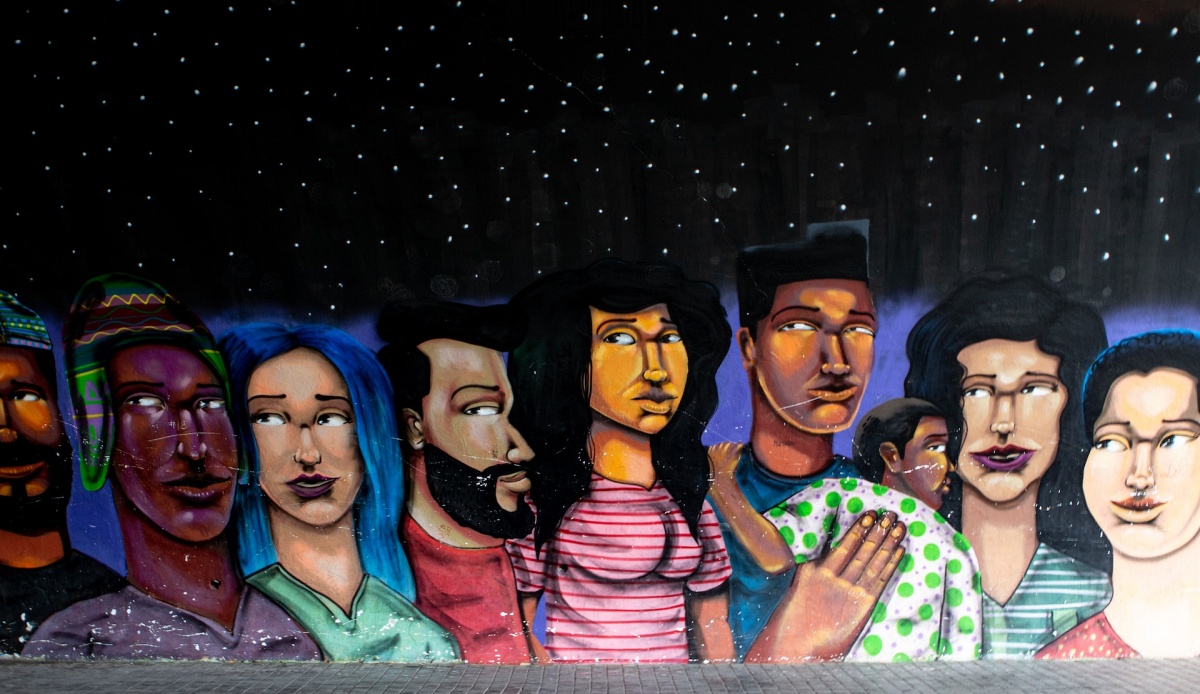
Photo by Miles Peacock on Unsplash


Beware of Right-Wing Authoritarianism
Dec 1, 2023 5:41 PM
Killing us “with abandon” can happen when we let our identity instill in us a sense of superiority so that we regard others who do not share this identity as inferior.
In 2018, in the leftist British newspaper The Guardian, Amy Chua wrote that “identity politics on both sides of the political spectrum,” was “leaving the United States in a perilous new situation.” For “almost no one is standing up for an America without identity politics, for an American identity that transcends and unites all the country’s many subgroups.”
Two years before that an article on Vox noted that “Identity Politics” is “a very vague phrase” and that for Donald Trump, according to his advisor Steve Bannon, it was “great.” It is this type, the Trumpian type, of identity politics that is literally “killing us” and is likely to kill more of us, many more of us, if he or those like him continue to come to power in other parts of our globe. (See here for more on the latest warning of Trump creating a “Trump dictatorship.”)
In his Identity and Violence Indian-born, Noble-Prize winning, economist Amartya Sen wrote that “a sense of identity can be a source not merely of pride and joy, but also of strength and confidence...And yet identity can also kill—and kill with abandon.”
Killing us “with abandon” can happen when we let our identity—as members of a nation, ethnic group, religion, or some other entity—instill in us a sense of superiority so that we regard others who do not share this identity as inferior.
Related stories
It happened with Nazi Germans who killed millions of Jews (as well as others they considered inferior). It happened when the Ottoman Turks killed perhaps a million Armenians in 1915-16. And it even happened here, in “the land of the free,” when over many centuries we whites, considering ourselves superior, caused the premature deaths of millions of Native and African Americans in what could be labeled our own holocausts.
It even happened here, in “the land of the free,” when over many centuries we whites, considering ourselves superior, caused the premature deaths of millions of Native and African Americans in what could be labeled our own holocausts.
Whether it be religious differences, imperialism, nationalism, or simply ethnic clashes, the list goes on and on. It happened with Catholics and Protestants who killed each other in large numbers during the 16th and 17th centuries and were still killing each other in Northern Ireland in the 20th century.
It happened in the late 19th and early 20th centuries with imperialism. For example, in the Congo during the period of Belgium King Leopold’s personal possession of the area, millions of natives died premature deaths resulting from oppressive policies. And in the Philippines from 1899-1902, where some 200,000 Filipinos died as the USA took over that country. According to one U. S. officer, “Our men have been relentless, have killed to exterminate men, women, and children, prisoners and captives, active insurgents and suspected people, from lads of ten up, an idea prevailing that the Filipino was little better than a dog, a noisome reptile in some instances.”
Almost a century later in the early 1990s, ethnic groups were still at it as Serbs and Croats were killing each other in the former Yugoslavia, while many more Hutus and Tutsis were doing so (about 800,000 total deaths) in Rwanda and Burundi. (See here for figures cited in the above two paragraphs)
And a quarter century later? In 2023? The dehumanization of others, which so often in the past has been justified to kill, is still going on and is coming mainly from right-wing authoritarian sources. President Donald Trump referred to “radical left thugs that live like vermin within the confines of our country, that lie, and steal, and cheat on elections, and will do anything possible...whether legally or illegally, to destroy America and to destroy the American Dream.” The Israeli Defense Minister justified Israel’s methods of attack in Gaza by saying, “We are fighting against human animals, and we are acting accordingly."
In late November two of the three mothers of Palestinian Americans shot in Vermont decried the dehumanizing of Palestinians that influenced some people in the USA, including apparently the shooter. One of the fathers added, “What happened to our kid is part of a larger crisis, and we hope the world will see it this way...There are others that die every day and no one even talks about it. So I hope that one day the world will start seeing our kids in Palestine equivalent to others, because the way we see it is a human soul is a human soul, no matter of the color or religion or race.”
And how about future prospects? Just weeks ago two right-wing authoritarians were victorious in important elections. First, Javier Milei, an economist and former television personality, was elected president in Argentina. Then, a few days later, “hard-right icon Geert Wilders and his anti-European Union, anti-Muslim and anti-immigration Party for Freedom landed a shocking first place finish” in parliamentary elections in the Netherlands.
For our purposes in this essay, the Wilders’ victory was the more important because of its ties with anti-immigration policy. Milei’s victory on the other hand seemed due more to economic misery—in early 2023 Argentina’s inflation rate more than doubled as compared to the same month in 2022—“the highest level in 32 years.”
In Europe immigration has become a big issue and has helped fuel right-wing successes. In late November a New York paper carried the headline “European Voters, in a Shift Rightward, Are Turning Against Unchecked Immigration From Africa and the Mideast.” Its first sentence read, “From the Irish Sea, to Italy, to Lapland [in Finland], Europeans increasingly appear to want to shield their continent from uncontrolled migration from their impoverished southern neighbors.” At about the same time another paper, The New York Times, declared that Finland “was temporarily closing its only remaining open border crossing with Russia to stem an influx of asylum seekers that it accuses Moscow of orchestrating.”
Meanwhile in the U. S., Donald Trump, still the overwhelming front runner for the Republican presidential nomination in 2024, is continuing his anti-immigrant stance, even hardening it from previously. In early November, CNN reported that he “is planning a widespread expansion of his first administration’s hardline immigration policies if he is elected to a second term in 2024, including rounding up undocumented immigrants already in the US and placing them in detention camps to await deportation.”
Furthermore, hostility to (and fear of) “undocumented immigrants” remains strong among Congressional Republicans. In late November PBS stated that they were pushing for border security to be part of any kind of package for Israel and Ukraine. News stories such as the following just heightened such alarm: “More than 24,000 Chinese citizens have been apprehended crossing into the United States from Mexico in the past year. That is more than in the preceding 10 years combined.”
Six and a half years ago, early in the Trump presidency, I wrote, “What is happening at present in various parts of the world is a reaction against globalization, immigration, terrorism, and other phenomena that are changing people’s worlds faster than they can cope with, all encouraging nostalgic nationalism.”
At about the same time I more specifically honed in on U. S. Trumpian nationalsim. First mentioned were the Trump supporters suffering from “usurpation anxiety syndrome . . . the feeling that one is, or is about to be, scooped, overrun, or taken advantage of by some Other [e.g. immigrants] with questionable intentions.” Then there were the historical views of the Trump voters. As conservative columnist Ross Douthat indicated in early 2017, they preferred “the older narrative” of U.S. history, the one that glorified Columbus, the Pilgrims, the Founding Fathers, Lewis and Clark, and Davy Crockett, the one that emphasized the melting pot (not multiculturalism) and the U.S. Christian tradition. That view, as Douthat wrote, was an attempt by “white-male-Protestant-European protagonists” to “restore their story to pre-eminence.”
This Trumpian view, which continues to be adhered to by many today, contrasts sharply with one that was earlier articulated by abolitionist Frederick Douglass and later reinforced by Martin Luther King Jr. (MLK). It is one I have long preferred. In MLK’s Vietnam speech at New York’s Riverside Church in 1967, he stated, “All of us who deem ourselves bound by allegiances and loyalties which are broader and deeper than nationalism and which go beyond our nation’s self-defined goals and positions...are called to speak for the weak, for the voiceless, for the victims of our nation, for those it calls ‘enemy.’” He went on to lament “the madness” of our war in Vietnam and tried to speak “of the people who have been living under the curse of war for almost three continuous decades now.”
At the time he gave this speech I was working on my Ph.D, dissertation about a 19th century Russian philosopher and poet (Vladimir Soloviev) who was battling nationalists (“the Russophiles”) who puffed themselves up with feelings of national superiority. In the Preface to the dissertation, I wrote about Russophile believers: "They all seemed to believe that Russia was superior to the contemporary western world. . . . that Orthodoxy was superior to any other religion...and that forces that were not naively Russian, such as Catholicism, Judaism, western culture, and liberalism, represented a threat to Russia.” As opposed to the Russophiles, Soloviev (1853-1900), whose views I approved of, was a trenchant critic of nationalism and antisemitism and was an early ecumenical thinker.
In the summer of 1968, following Martin Luther King’s assassination, I spoke out against white racism and stated, “I’m more sympathetic to the non-violence of a true Christian like Martin Luther King than I am to anyone who offhandedly dismisses the killing of an innocent whether...white, black, or yellow.”
During the following half century my views regarding white racism or other forms of supposed ethnic superiority have not changed. And in 2019 I summed up these beliefs in my essay “Do We Want the America of Frederick Douglass or Donald Trump?”
Whereas Trump has stoked up fears—in 2018 he said about some undocumented immigrants, “You wouldn't believe how bad these people are. These aren't people. These are animals”—Douglass advocated a “composite nation,” a concept historian Jill Lepore has called “a strikingly original and generative idea, about a citizenry made better, and stronger, not in spite of its many elements, but because of them.” In Douglass’s day, there were great fears regarding Chinese immigrants, but he also thought that they could enrich our nation. “Do you ask, if I favor such immigration, I answer I would. Would you have them naturalized, and have them invested with all the rights of American citizenship? I would. Would you allow them to vote? I would. Would you allow them to hold office? I would.”
The abolitionist also believed that the talents various immigrants would bring to the USA, the example of nationalities and creeds living harmoniously together that we would set for the rest of the world, and the honoring of “essential human rights” more than outweighed any disadvantages.
Stressing the advantages that immigrants would bring to our country, as my Douglass essay mentioned, also characterized future President John Kennedy’s 1958 book, A Nation of Immigrants. In he states that “the contribution of immigrants can be seen in every aspect of our national life. We see it in religion, in politics, in business, in the arts, in education, even in athletics and entertainment. There is no part of our nation that has not been touched by our immigrant background. Everywhere immigrants have enriched and strengthened the fabric of American life.’’
Nevertheless, the essay’s final paragraph notes that the present immigration question is complex—and this is true globally—and “needful of thoughtful consideration,” but “the Trumpian fearmongering now going on, is not the way to approach it.”
In a 2021 article in this LA Progressive, I contrasted Trump’s alarmist rhetoric with Pope Francis’s approach. The pope noted that “weapons of war are produced and sold in other regions [the same might be said about producing harmful climate change] which are then unwilling to take in the refugees produced by these conflicts. Those who pay the price are always the little ones, the poor, the most vulnerable...Our response to the challenges posed by contemporary migration can be summed up in four verbs: welcome, protect, promote and integrate.”
Our approach to other ethnicities, nationalities, or religions must be what Dorothy Day wrote in 1954, “We must always be seeking concordances, rather than differences—that is the basis of the ecumenical movement, which is part of the peace movement.” A year later, poet and Lincoln biographer Carl Sandburg observed, “Though meanings vary, we are alike in all countries and tribes...in the need of love, food, clothing, work, speech, worship, sleep, games, dancing, fun. From the tropics to arctics humanity lives with these needs so alike, so inexorably alike.” And in 1968, while the Cold War was still ongoing, Wendell Berry’s poem “To a Siberian Woodsman,” like Sandburg’s words, wonderfully reminds us of all the commonalities that someone from another country shares with us.
Finally, contrary to an “identity politics” that stresses the superiority of one group, be it ethnic, national, or religious, over another, I would recommend a few lines from the film Belfast. When a young boy, who is Protestant, asks his father whether he has any future with his little girlfriend who is Catholic, his Dad replies, “Why the heck not? That wee girl can be a practicing Hindu, or a Southern Baptist or a Vegetarian Anti-Christ. But if she’s kind and she’s fair, and you two respect each other, she an’ her people are welcome in our house any day of the week.”
Comments

Powered by RoundtableAn AI/DeFi-powered Enterprise Media Operating System. Learn more at Roundtable.io.© Roundtable 2026. By using this site you agree to the Terms of Use and Privacy Policy