
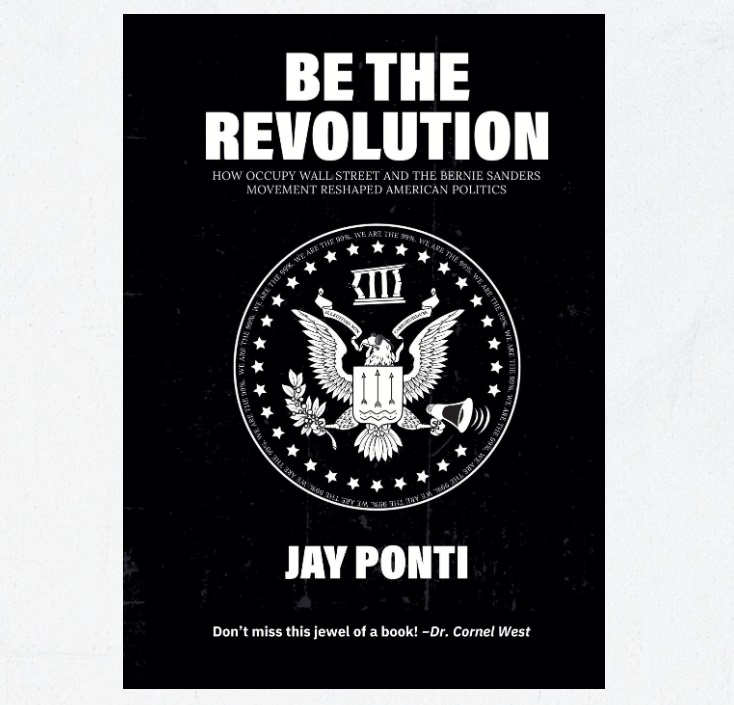
Jay Ponti


Be The Revolution
Mar 8, 2024 4:43 PM
Updated Mar 8, 2024 9:16 PM
Meg Slay engages with Jay Ponti, author of "Be the Revolution: How Occupy Wall Street and the Bernie Sanders Movement Reshaped American Politics,"
In this interview, Meg Slay engages with Jay Ponti, author of "Be the Revolution: How Occupy Wall Street and the Bernie Sanders Movement Reshaped American Politics," released in October. The conversation reveals the origins of the progressive movement, tracing its humble beginnings and detailing the untold story of activists propelling Bernie Sanders into the 2016 presidential race. Beyond merely recounting historical events, the discussion and the book aim to inspire progressives who might feel disheartened by establishment defeats, emphasizing that the movement never truly ended.
Ponti stresses the importance of understanding this history, often overlooked by corporate media, for revitalizing the spirit of grassroots activism. For those seeking a profound understanding of transformative political change and the continuous evolution of the progressive movement, "Be the Revolution" stands as a vital resource. The conversation delves into the transformative history of progressive ideals, tracing its roots from inception to the ongoing rebirth of the American labor movement, providing valuable insights for those navigating the complexities of grassroots activism and political change.
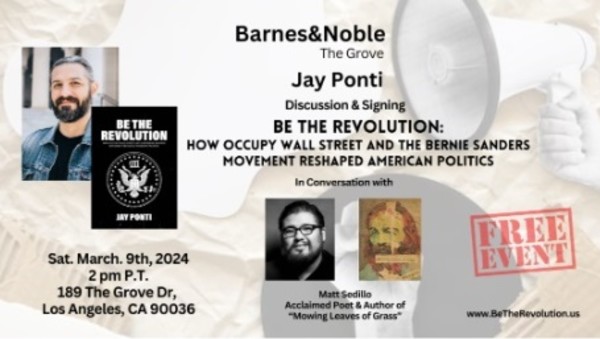
Meg Slay: Jay, it's great to have you here. Let's dive into your new book. It covers over a decade of movements in the United States, from Occupy Wall Street to the present day, including PDA, Bernie Sanders, the Divest L.A. campaign, and Standing Rock. What inspired you to write your book?
Jay Ponti: It's really our story—the history of the progressive left. Unlike books often written by journalists or academics, this comes from the heart of the grassroots. The goal was not just to record history but to emphasize that these are not separate movements. It's crucial to grasp this, especially for those who joined grassroots political organizing during Bernie 2016 or 2020. It might be easy to get disillusioned, thinking the establishment is too powerful. But understanding the real history is essential. Bernie 2016 was a tactic not widely known; Bernie didn't initially want to run. It's crucial for newcomers to know this and avoid losing hope, realizing that real change is possible with a deeper understanding of the history.
Related stories
MS: When we first talked about Be The Revolution back in 2020, you mentioned the book as a history lesson, you invoked the quote, "Those who do not remember the past are condemned to repeat it." Can you share more about the book and why Nina Turner called it “a love letter to our movements”?
JP: Absolutely. It's a blend of history and activism, a guide for political revolutionaries. It's crucial to understand the larger story and learn from the past to better organize the future.
MS: You've emphasized that it is not widely known that Bernie 2016 was a tactic of leftist organizers. Can you elaborate on the role of grassroots activists, from Occupy and Progressive Democrats of America, in pushing Bernie to run?
JP: Bernie didn't initially want to run, but Occupy activists and PDA played a crucial role in pushing him. Most people think that Occupy Wall Street failed and that Bernie Sanders simply went viral in 2016 because he appealed to unrealistic millennials, but the truth is that Occupy activists launched the People for Bernie initiative, activating the network. Meanwhile, Progressive Democrats of America had already been running a simultaneous campaign to follow Senator Sanders around the country, chanting “Run Bernie Run!” In 2014, Tim Carpenter, founder of PDA, tried to get his team on board with the idea. Simultaneously, Charles Lencnner gathered Occupy cohorts, initially aiming to recruit Elizabeth Warren under the banner "Ready for Warren." However, Warren declined, leading them to pivot to Bernie Sanders in early 2015. The movement then launched "99 Events for the 99%," an open letter supported by Occupy activists endorsing Bernie Sanders for president before his official announcement. The approach was decentralized, non-hierarchical, offering autonomy to local groups like "Black Men for Bernie" and "Millennials for Bernie who sprang out of the campaign." Despite having no resources, People for Bernie managed to surpass the Hillary Clinton campaign’s in daily social media performance throughout the entire primary
MS: The book also traces the roots of the modern progressive movement to the 2004 Dennis Kucinich campaign. Can you say more about that?
JP: It could be argued that the modern progressive movement was born with the creation of PDA, which emerged from the 2004 Dennis Kucinich campaign, advocating anti-war and pro-peace sentiments in the aftermath of 9/11. During this time, left-leaning voices faced challenges within the Democratic Party, Pelosi hated them. Despite this, a small group, inspired by principles like "health care, not warfare," remained the plucky lone resistance to the Third Way corporate Democrats.. Tim Carpenter's brilliance in rebranding the movement as “the progressive movement” set the stage for the modern movement. It was a response to the Democratic Party’s decades long shift towards corporate neoliberalism and war mongering.
MS: That's fascinating! I'd love to know more about PDA pushing Bernie to run. Is there a particular passage from your book you could share?
JP: Of course. Here’s an excerpt:
“In 2014, while Tim Carpenter, the founder of the Progressive Democrats of America, lay in bed battling cancer, he posed a question to a group of colleagues: "What if we could convince Bernie Sanders to run for president?" Tim, characterized by his rotund figure, easy smile, and unwavering passion for organizing, had established the Progressive Democrats of America to counter the militaristic corporate agenda of the contemporary Democratic Party. Often seen sporting a "Healthcare, not Warfare" T-shirt beneath his blazer, he sweated profusely. Although his colleagues held immense respect for him, they were skeptical of this latest idea.
"He's an Independent, he's not even a Democrat!" protested the PDA's political director, Conor Boylan, a bearded Irishman. Others joined in with their objections. However, Tim remained steadfast; his vision and intentions were crystal clear. Amidst Barack Obama's second term, he saw something that eluded his team: a future that everyone could believe in.
"Slow down," urged Tim. "Hear me out." He implored the group to reflect on why they had entered politics, reminding them of the campaigns and issues they had fought for. "Bernie ticks every box. We are going to be out in front of this. We are going to get him to run, and run as a Democrat. It's going to be fun."
Years later, Conor reminisced about this deathbed conversation with his old friend, boss, and mentor. He recalled a moment when something seemed to click inside Tim, who radiated energy while discussing the prospect of Bernie Sanders in 2016.
"None of us could see it at the time, or thought he would win," admitted Conor. "Tim had a way of seeing around corners that we couldn't see." Unfortunately, Tim passed away in April 2014, too soon to witness his dream of a Bernie Sanders candidacy come to fruition. John Nichols, a writer and co-conspirator, later remembered in The Nation, "Not many hours before I learned that he had passed, Tim had been on the phone with me, running through the latest numbers from a national petition drive he and the PDA had organized to urge Vermont Senator Bernie Sanders to seek the presidency. There were over ten and a half thousand. A few hours after the call, he emailed me, with more numbers. There were over eleven thousand. That was typical Tim. His enthusiasm for politics was immeasurable and infectious."
Carpenter founded the Progressive Democrats of America during the 2004 Democratic National Convention, alongside former staffers and supporters of the unsuccessful Dennis Kucinich campaign. That year, the Kucinich campaign served as the preferred platform for delegates and activists concerned about the centrist and rightward shifts in the party.
Kucinich, US Rep. Barbara Lee, the Reverend Jesse Jackson, Tom Hayden, Marianne Williamson, and Code Pink’s Medea Benjamin had contributed to launching the organization, an idea that had been brewing throughout the campaign. Kucinich’s campaign manager, Dot Maver and her then-assistant, Charles Lenchner, spearheaded the brainstorming on how to harness the energy and enthusiasm around the campaign to continue mobilizing grassroots efforts after the election.
At that moment, the small group had no inkling that they were laying the groundwork for what would evolve into the Bernie Sanders movement.
During the Kucinich campaign, Tim Carpenter joined as a field organizer. When the Democratic Convention finally arrived, he took the initiative with the idea. Tim and a few others managed to acquire the email addresses of every Kucinich delegate, which they utilized to launch the PDA early the following year. It’s a morally ambiguous area, but sometimes political revolutionaries need to think outside the box. Just consider the world we would be in if Tim Carpenter hadn’t taken charge of the campaign email list. Kucinich never effectively utilized it for grassroots activism, and without those contacts, PDA might never have taken off, thus potentially never encouraging Bernie to run. Sanders had no ambition to seek the Oval Office. He needed a significant push from the people.
After the Kucinich campaign, the group set its sights on the entire mainstream of the party. The Clinton Administration had solidified a political realignment that had shifted the party so far to the right that they were essentially like the Republicans of the 1970s. After enduring repeated defeats by Reagan, Clinton’s Third Way Democrats were pleased to finally have corporate America on their side.
These “new Democrats” held disdain for Tim and the PDA. The group’s initial supporters in Washington were few, mostly limited to Maxine Waters, Barbara Lee, and Lynn Woolsey (known as the “triad,” they were akin to an original “squad”). After the 1994 election cycle, the new Republican Speaker of the House Newt Gingrich changed the entire strategy of the GOP to focus on fundraising. Democrats soon followed suit, and Congress began its descent into the depths of the corporate money swamp.
Later, in 2002, Nancy Pelosi (one of the wealthiest women to hold elected office) became House Minority Whip, then rose to House Minority Leader in 2003. According to PDA members active at the time, Pelosi detested the triad and did her utmost to bring them under control.
Back then, there was no such thing as a “progressive movement.” People identified as “liberal,” but that had become an ambiguous term. People hadn’t identified as “progressive” since Teddy Roosevelt, who had been a Republican. Tim’s genius was to rebrand the movement to the left of the party as forward-looking and distinct from Clinton, Pelosi, and other “new” Democrats.
After Tim died, PDA was left without a leader. However, the team was driven by a desire to fulfill Tim’s dying wish of a Sanders presidential campaign. They organized PDA events for Bernie in Iowa and elsewhere, even as Sanders himself remained skeptical of the idea. The senator from Vermont didn’t know if he could raise enough money and had reservations about subjecting his family to the scrutiny and spotlight of a national campaign.
The PDA was not the first group to try to persuade Sanders to run for president. In 2014, the Green Party courted Sanders to run on its presidential ticket. That same year, a schism developed within the Democratic Socialists of America over whether or not to support a Sanders campaign. Tim, a long-standing member of the DSA, had been a close friend of its founder, Michael Harrington, whom he believed would have supported Sanders as part of an inside-outside strategy, or the leveraging of grassroots power to win elections and eventually control institutions.
In 2014, the DSA had only five thousand members nationally. Its debate over whether to work within the Democratic Party or to break from it echoed earlier debates among socialists over whether or not to oppose FDR’s New Deal and military alliance with Stalin and Churchill. Within the DSA, a caucus known as Bread and Roses vehemently opposed the party’s support for a Sanders presidential run.
In the meantime, the PDA wasn't sitting around waiting for others to resolve their debates. They initiated the groundwork for electing Bernie by organizing numerous "We Want Bernie" house parties and fundraisers. PDA members, carrying signs, followed Sanders wherever he went, chanting, "RUN BERNIE RUN!"
MS: Jay, in the book, you talk about moments during Occupy Los Angeles that were pivotal to your journey. Can you share more about it and how it influenced your path into activism?
JP: One night in the fall of 2011, about 1,500 riot cops showed up to dismantle the LA encampment. I was there trying to de-escalate between the cops and some of the Occupiers who were trying to instigate violence, and suddenly, I got jabbed in the ribs with a baton. It was one of the biggest wake-up calls of my life. I realized that this is what happens when you try to fight against a system protecting those who caused the financial crisis by defrauding the American people and crashed the world economy. That was a big awakening for me, when I finally understood that the class war was real.
MS:. As you just mentioned, you discuss teaching nonviolent resistance techniques. What's your take on nonviolence vs violence in activism?
JP: As a participant in the Poor People's Campaign: A National Call for Moral Revival, I have signed a commitment to nonviolence. It gets results in other countries like France, but I believe that in America, there's no viable theory of change that involves violence. I’m not talking about spontaneous, uncoordinated uprisings that happen in communities as a backlash to police murders; I’m talking about tactics and the theory of change. Resorting to violence doesn't lead to lasting change; it often backfires. Violent tactics in America have historically led to the justification of a more draconian and authoritarian police state. The Propaganda of the Deed movement, which led to the assassination of President Mckinley led to Teddy Roosevelt creating the modern police state. My focus is on long running, Fred Hampton style rainbow coalition building rooted in nonviolent resistance, with inside-outside strategies. For me, nonviolence is a core principle. Although, on the other hand, it’s probably not a bad thing if the billionaire class also has a healthy fear that one day the guillotines and pitchforks might be coming for them.
MS: I totally resonate with what you're saying. It's vital to consider the long-term and not just focus on the next election cycle. I see that Cornel West wrote a blurb for you, describing you as “a legendary long-distance revolutionary thinker and activist whose vision, analysis, and courage are a beacon of hope in our bleak times!” He also said, “don’t miss this jewel of a book”. Can you talk more about the “inside-outside strategy”.
JP: It’s crazy, I can’t believe he actually said that. It still doesn’t seem real to me. Dr. West has always been a hero of mine since I read “Race Matters” when I was 18. The inside-outside strategy is not a term I coined; it's been around for a while. Essentially, it involves having one contingent working within the electoral system—focusing on candidates, legislation, and engaging with existing policymakers. This is the inside game. Simultaneously, you have grassroots organizing happening outside the system—taking to the streets, disrupting, and engaging in community organizing. However, what's often missing is effective coordination between the inside and outside factions. The theory of change put forth in Be the Revolution, expands the definition and argues that it's crucial not only to focus on organizing tactics in the outside real world but also on our inner landscape of our beingness. This means doing the inner work to heal from the trauma of living in a society steeped in negative paradigms like white supremacy, patriarchy, colonialism, and classism. When we don’t do the inner work, we bring these internalized “isms” with us into our organizing groups, causing useless infighting— sabotaging our efforts. Going to therapy, meditating, and doing inner work creates resilience, which strengthens our emotional stability, makes us much more effective, and gives us longevity. There’s no way I could have done this work for as long as I have without doing the work.
MS: Agreed. Doing the inner work is crucial for our movements. It's about addressing the unconscious baggage we bring into organizing spaces. Emotional resilience is so important.
JP: Especially in the face of the stress and trauma that come with activism. People burn out all the time. You’ve got to do the self-care and internal work.
MS:I completely relate to that. In 2016, there was a movement on Twitter discouraging involvement in the Democratic Party, advocating for disengagement. However, I think that we need more people like us inside those rooms to bring about actual change. The success of the Nevada DSA, starting at the county level and working their way up, is a testament to this..
JP: Absolutely. Getting inside those rooms is crucial. The Nevada DSA's success is a great example of effective grassroots organizing making a substantial impact on the state level. Like the old saying goes, “if they don’t give you a seat at the table, bring a folding chair”.
MS: Some of the overarching themes you discuss in the book are about the myth of the technocracy and not looking to political leaders as saviours. How is this relevant as we face addressing climate change, fascism, and fundamental rights like Roe v Wade?
JP: Ultimately, my fervent desire is for people to grasp the notion that no one is riding in on a white horse to save us. If you're on the lookout for a hero, take a good look in the mirror. Throughout the book there are stories about individuals or small groups, wielding the power to fundamentally reshape the world. This, I hope, becomes one of the key takeaways. In the early 90's, those Third Way Clinton corporate Democrats sold America the myth of the technocracy. They sold us on the lie that all of the really smart ivy-league graduates working for the political and corporate elite would solve the world’s problems so that the rest of us could be good consumers and fulfill our roles as cogs in the capitalist machine. The Clinton 2016 campaign lit $1 billion on fire on useless consultants and still managed to lose to a racist, sexist reality TV show hack. NAFTA decimated the middle class. They crashed the house market and the world economy. They have let the world descend into a climate apocalypse. This notion that so-called smart people have all the answers has been proven false. Let's be real—when it comes to climate emergency and defeating fascism, the truth is no one in the ruling class has a plan. I hate to be the bearer of such soul crushing news, but it's the harsh reality. But there’s no one coming to save us. But the good news is that since Occupy Wall Street, through two Bernie campaigns, and now with the rebirth of American labor, our movements have never stopped growing. We are everywhere, but now it is just a matter of bringing everyone together instead of remaining divided.
MS: Any final thoughts?
JP: I want to emphasize that there's nothing inherently special about me or my journey. I just stuck around and stayed committed. It was never my initial intention to be part of the class war. Now, I believe it's crucial for everyone else to recognize that we don’t need saviors; we need everyone. Everyone has unique and special gifts to contribute, and saving humanity is going to take the very best of all of us coming together and each of us doing our part. The book is full of stories about individuals and small groups fundamentally reshaping the world. This is the key takeaway. I address the concept of technocracy, a myth perpetuated by neoliberalism, suggesting that a select group of educated minds would lead, allowing the rest to return to consumerism. It's a grand illusion that needs dismantling. My focus now is on getting this information to young people and frontline organizers. Unlike us, they don't have the luxury of time to learn the ins and outs of the system. There's no established curriculum for this kind of education. My goal is to conduct trainings across the country, bridging the gap between college students and young activists, fostering collaboration across various issues. This effort aims to empower the younger generation with the knowledge and skills needed for effective grassroots organizing. Despite criticisms of the current administration, it's important to recognize the gains made, and I attribute much of it to the efforts of movements like Occupy and Bernie Sanders. I'm passionate about supporting young people who are coming up and didn't have the mentorship and support they needed. My current project involves touring the country to provide leadership training and share the history outlined in the book. For those interested, they can visit www.BeTheRevolution.us to get the book and access additional content. I'm open to collaborations and always willing to help, especially young activists who need guidance and support. The ultimate goal is to continue fostering progress, unity, and transformational change.
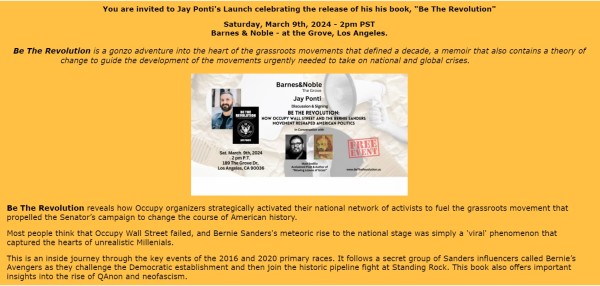
Most people think that Occupy Wall Street failed, and Bernie Sanders's meteoric rise to the national stage was simply a 'viral' phenomenon that captured the hearts of unrealistic Millenials. Be The Revolution reveals how Occupy organizers strategically activated their national network of activists to fuel the grassroots movement that propelled the Senator’s campaign to change the course of American history. This is an inside journey through the key events of the 2016 and 2020 primary races. It follows a secret group of Sanders influencers called Bernie’s Avengers as they challenge the Democratic establishment and then join the historic pipeline fight at Standing Rock. This book also offers important insights into the rise of QAnon and neofascism.
Be The Revolution is a gonzo adventure into the heart of the grassroots movements that defined a decade, a memoir that also contains a theory of change to guide the development of the movements urgently needed to take on national and global crises.
About the Author:
Jay Ponti is a grassroots political organizer, trainer, and consultant who has participated in some of the most important social movements of the last decade, including Occupy Wall Street, Standing Rock, and Bernie Sanders’s two presidential campaigns. He is the co-creator of the #BankExit fossil fuel divestment campaign and has organized campaigns and direct actions across the country. “Be The Revolution: How Occupy Wall Street and the Bernie Sanders Movement Reshaped American Politics,” is his first book, offering a fresh perspective on the transformative power of grassroots movements in American politics. For more info on the author visti JayPonti.com
Be The Revolution debuts #1 in new releases on Amazon
PRAISE FOR BE THE REVOLUTION:
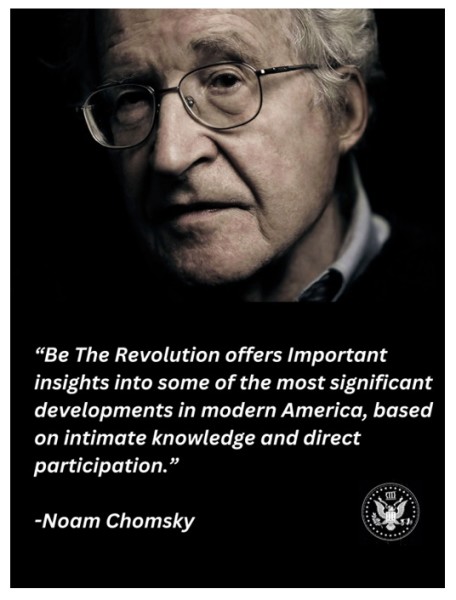
“Be The Revolution offers Important insights into some of the most significant developments in modern America, based on intimate knowledge and direct participation.”
-Noam Chomsky
“We should thank Jay for his life’s work. As an organizer, he is a wonder to watch in action. This accounting of events of the last ten years is a profound and seismic piece of American political, and cultural history that has gone all but unnoticed in the mainstream.
Be The Revolution is not about a battle of right or left, but the battle for humanity and the natural world. The timing of this book couldn’t be more right, nor the message more on point.”Ken Burns should do a doc on this!”
-Mark Ruffalo
“Jay Ponti is a legendary long distance revolutionary thinker and activist whose vision, analysis and courage is a beacon of hope in our bleak times! Don’t miss this jewel of a book!”
-Dr Cornel West
“This book is a great history of progressive action from the Occupy moment to the present—clear, invigorating, and encouraging of future efforts. We owe Jay Ponti a big thank you for his tireless efforts to change the American political landscape, and thus to help save Earth’s biosphere from a catastrophic mass extinction event. It’s crucial work he describes here, and joining the effort can give anyone a project that includes meaning and hope.”
-Thom Hartmann
“Be The Revolution is a love letter to our movements, an honest and searching testimonial from the heart of the grassroots.Jay Ponti is a ride or die revolutionary who has given us a glimpse into some of the most important moments of political struggle in the last decade. This is the book the establishment doesn't want you to read.”
-Marianne Williamson
Wopila (Thank you) for writing the blow by blow actions of the War we faced at the Oceti Sakowin Camp (Standing Rock). Jay Ponti had great influence on the two Declarations written at Oceti Sakowin , particularly the Divestment Treaty among Nations. The First Declaration defies the Doctrine of Discovery and illegal actions used by it.
The second called for Divestment by countries from fossil fuels, especially by DAPL, and all other oil corporations.. Thank you for your written words.
-Phyllis Young , American Indian Rights Activist
Investigative journalist Greg Palast Ady Barkan
Steven Donziger & Kevin Patel GZA from Wu-Tang
Mimi Kenney and Russell Greene Nalleli Cobo
LA District Atty George Gascon Jane Fonda
Ed Begley Jr., Rep. Ilhan Omar,
MN Atty Gen. Keith Ellison Mayor Mondale Robinson
Marianne Williamson, Nina Turner, Frances Fisher Henry Rollins
Climate Scientist Peter Kalmus Amazon Labor Union co-founder Chris Smalls
Gofundme
Be The Revolution Activist Training
BE THE REVOLUTION LEADERSHIP TRAINING
This event is focused on intersectional activism and ethical community engagement. It’s centered around climate, racial, health, and economic justice, based on the understanding that all these issues are interconnected. This capacity-building leadership training is for college or graduate students of all majors and frontline activists passionate about climate, racial, health, and economic justice. It will educate and inspire participants with a modern theory of change and strategies to help local coalitions work in solidarity.
This training offers life-changing leadership skills and creates a profound experience of connection and strength in coalitions. Topics covered include intersectional activism, healthy coalition building, ethical community engagement, enrollment process, the ladder of engagement, self-care, healing tools, uncovering and transforming limiting beliefs, and cultural and political disruption.
The training will be run by Jay Ponti, a grassroots political organizer, trainer, and consultant who has participated in some of the most important social movements of the last decade, from Occupy Wall Street to Standing Rock. The workshop emphasizes the accessibility of activism – that everyone, regardless of background, has a place and a voice in the movement for change and can leave feeling empowered with new perspectives and tools.
BY MEG SLAY
Meg Slay, progressive political media personality and founder of Solidarity Media. She is a purveyor of leftist memes and new age ideas— sparking conversations to shape a more equitable future. Facebook. Twitter @TheMegSlay @megslay.bsky.social @themegslay
Comments

Powered by RoundtableAn AI/DeFi-powered Enterprise Media Operating System. Learn more at Roundtable.io.© Roundtable 2026. By using this site you agree to the Terms of Use and Privacy Policy