
Cagle Cartoons: Guy Parsons


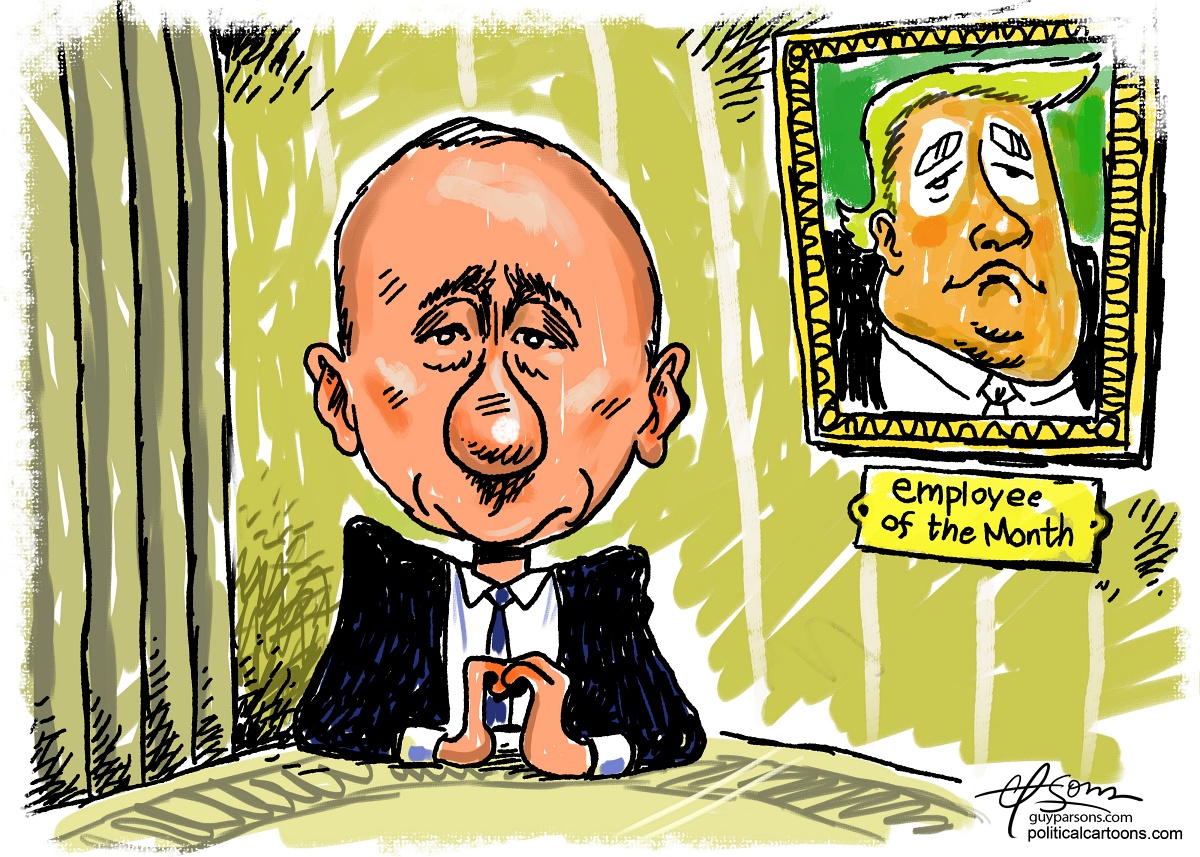
Axis of Autocracy
Mar 2, 2025 5:36 PM
Updated Mar 3, 2025 8:20 AM
The Lords of Misery and the Architects of Ruin: The Fight to Save Ukraine from Vladimir Putin and Donald Trump
The United States and Russia are twin-headed beasts of empire, their jaws locked in a violent embrace while their claws carve new scars into the earth. Each bears a name etched in suffering—Lords of Misery, Architects of Ruin—one draped in the rhetoric of freedom, the other shrouded in the banners of conquest. Their shadows stretch across continents, darkening skies with war, with greed, with the weight of history’s unburied ghosts. They do not walk in step, yet their footprints trample the same broken ground, leaving the world to writhe beneath their grasp. One cloaks its ambitions in the language of democracy and freedom, while the other wraps itself in the banner of nationalism and reclamation. But beneath these facades, their desires are the same—to expand, to control, to reshape the world in their own image, regardless of the cost to the people who call these lands home.
Both powers seek to bend the world to their will, carving up nations as though they were chess pieces to be maneuvered and sacrificed. While they may wear different masks, their underlying hunger for dominance remains identical. The U.S. projects its might through military bases and economic influence, while Russia extends its reach through force and coercion. Both are driven by the same imperial instinct, the same thirst for power, the same disregard for the sovereignty of others.
In the end, it is the people of the world who pay the price. Whether under the yoke of American capital or Russian aggression, the result is the same: a world shaped by the ambitions of empires, where freedom is a promise never kept, and sovereignty is a dream that fades into the background of war and exploitation.
Trump cannot conceal his imperial ambitions, for they spill from him like a deluge, uncontained and unabashed. He threatens to absorb Canada, to invade Greenland and Panama, and even proposes changing the name of the Gulf of Mexico to the Gulf of America—acts that echo the hubris of empires long past, where geography itself was bent to the will of the ruler. His vanity, vast and unrelenting, rivals that of history’s most dangerous figures—men like Hitler and Mussolini, whose egos demanded entire nations bend to their will, whose thirst for power led to the ruin of countless lives.
Related stories
But Trump’s imperial desires do not stop with territorial conquest. They bleed into the very fabric of American identity. GOP sycophants, in their slavish devotion, now seek to immortalize him—not just in marble but in the very currency of the nation. They propose casting his image on a $250 bill, marking his birthday as a national holiday, carving his likeness into the sacred granite of Mount Rushmore. These gestures are not just tributes—they are attempts to create a new mythology, to elevate a man whose appetite for grandeur knows no limit, and to enshrine him in the history of a nation that was once defined by the ideals of democracy, not the cult of personality.
Trump and Putin do not seek peace—they seek a pact. A deal that cements Russia’s aggression as legitimate and Ukraine’s sovereignty as expendable. A grotesque pantomime in which the fate of a sovereign nation is decided by two men who neither respect its existence nor acknowledge its right to resist.
Trump’s insistence on “peace talks” that position Putin as a reasonable actor rather than a war criminal serves a singular purpose—to rehabilitate Russia’s crimes in the eyes of the world.
Trump’s recent railing against Zelenskyy, claiming that he had no chance of defeating Russia, is a case in point: "I've been watching this man for years now, as his cities get demolished, as his people get killed, as the soldiers get decimated." He added: "I've been watching for years, and I've been watching him negotiate with no cards. He has no cards, and you get sick of it. You just get sick of it. And I've had it."
By Trump’s logic, Ukraine should have surrendered long ago.
Trump’s comments betray not just a lack of strategic understanding but a deep moral rot. His disdain for Zelenskyy—“you get sick of it”—reveals an astonishing callousness toward a nation fighting for its very survival. Instead of recognizing Ukraine’s resilience, he mocks its suffering. Instead of condemning Russia’s atrocities, he blames the victim.
Trump’s words don’t just signal weakness—they embolden dictators. By framing Zelensky’s fight as pointless against a foe superior in numbers and military might, he is giving Putin exactly what he wants: the narrative that Ukraine’s resistance is futile. But history tells us otherwise. Ukraine, like every nation that has fought for its sovereignty, is proving that survival is not about “having cards”—it’s about refusing to be conquered.
Should Britain have folded when Nazi bombs rained down on London? Should the French Resistance have given up because Nazi Germany was too powerful?
By Trump’s same logic, the American Revolution should never have happened. The United States of America should never have come into being. The Continental Army led by George Washington was vastly outmatched—facing the world’s most powerful empire, with fewer resources, no navy to speak of, and a ragtag force of farmers and militiamen. By Trump’s reasoning, Washington should have surrendered at Valley Forge, accepted British rule, and abandoned the dream of independence. But history remembers those who fight for freedom, not those who capitulate to tyranny.
Ukraine stands in the same position today—outgunned, outnumbered, but resolute. Just as the American revolutionaries refused to bow to the British crown, Ukraine refuses to submit to Putin’s imperial ambitions. To tell Ukraine to "make a deal" at any cost is to tell the Ukrainian people to accept subjugation, to abandon its right to exist as a free people.
The very existence of the United States is proof that wars of independence are not won by might alone, but by will, strategy, and the unwavering belief in self-determination. If America could defy the odds and win its freedom, why should Ukraine be denied the same right to fight for its survival?
And here’s the truth Trump refuses to acknowledge: Ukraine has already defied the odds. Russia failed to take Kyiv in days, as Putin had planned. Ukraine has reclaimed vast swaths of its territory. Its people refuse to break. If anything, it is Putin who miscalculated. And yet, Trump stands on the sidelines, sneering at the fight for freedom—because, in the end, his sympathies have always leaned toward autocrats, not those who resist them.
Zelenskyy knows that any so-called “peace deal” without ironclad guarantees is just a pause before the next Russian invasion. Russia has already shown that it does not honor agreements—whether it was the 1994 Budapest Memorandum, which guaranteed Ukraine’s security in exchange for giving up its nuclear weapons, or the Minsk agreements, which were supposed to end the war in Donbas but were used by Russia as a stalling tactic.
What we see unfolding before us is not merely political theater; it is the rise of a dangerous autocrat, one who would erase the principles that have guided this nation in favor of his own distorted vision. Trump's ambition is not just to govern—his desire is to rule, to shape the world and the nation in his image, as though history itself can be rewritten to serve his vanity. And as he makes his bid for immortality, we must ask: what price will the people pay for the indulgence of his ego? What will be left of democracy when the idols of empire are carved in stone? In the twilight of democracy, where its crepuscular light fades into the encroaching shadows, the prospect of peace grows dim. The recent treatment of Ukrainian President Volodymyr Zelensky by President Donald Trump and Vice President J.D. Vance underscores this bleak reality.
Right now, Russia under Putin and the United States under Trump stand as competing imperialisms, each vying for dominance, each seeking to crown themselves the reigning imperialist hegemon of the world. Like two monstrous titans locked in a brutal struggle for control, they move with calculated aggression, each maneuvering to ensure that the world bends to their will. This is not a conflict between nations with differing ideologies or intentions—it is a battle for power, for supremacy, for the right to define the rules of the global order.
The historical parallels are undeniable. It echoes the dark days before World War II, when Germany and Russia—two powers with imperial appetites—struck a sinister deal to carve up Poland between them, each seeking to expand their influence, each willing to erase a nation from the map in the pursuit of their own ambitions. The Molotov-Ribbentrop Pact was not just a political agreement—it was a declaration that the lives of millions could be written off in the service of empire.
As I wandered through the snow-covered streets of Warsaw, Poznań, and Toruń in the winter of 1992, my thoughts were heavy with the cost of war. Each step seemed to sink deeper into the weight of history, a history that still clung to the land, etched in the fractured cities, the rebuilt lives, the lingering grief of a people who had borne so much. I was not alone in these reflections. I was accompanying my colleague, mentor and close friend, Henry Giroux, whose sharp intellect and empathy lent a gravity to the moment that made the stillness of the streets even more profound. Our visit to Poland had been arranged by the esteemed critical theorist, Lech Witkowski, a man whose own connection to the intellectual and political currents of Eastern Europe gave the trip a sense of purpose beyond mere observation.
As we walked together, the frigid air biting at our faces, we both felt the ghosts of war in every corner, in every scar left upon the land. It was impossible not to see how the past had shaped the present—a past of violent occupation, of cities laid waste, of populations displaced and fragmented, of the horrors of the Holocaust. And yet, as we reflected on these things, there was an undeniable sense of resilience. The spirit of the Polish people, like the spirit of all those who had suffered the ravages of war, still burned fiercely in their efforts to rebuild, to reclaim their dignity, and to hold onto the ideals of justice and freedom that had been so violently taken from them.
As I walked, I reflected on the immense price of war—the lives lost, the cities rebuilt, the fractured identities that took generations to mend. Each step I took seemed to reverberate with the heavy cost of human lives lost, of cities painstakingly rebuilt, of identities torn and fractured, each piece slowly stitching itself back together over generations.
Meanwhile, in St. Petersburg, far from the snow-laden streets where my breath mingled with the cold air of history, Vladimir Putin, an ex-KGB officer with a face carved from stone and secrecy, was biding his time. He was moving through the corridors of power as deputy mayor, a specter in a crumbling empire, his ascent as inevitable as the thawing of ice in spring—slow, unrelenting, and shadowed by the ghosts of the old order. Local lawmaker Marina Sayle, who had dared to speak out against him, was pushing for his resignation, implicating him in a multimillion-dollar kickback scheme. This was a moment before the world would truly come to know the man who would one day become the architect of Russia’s resurgence under a banner of imperial ambition. The cost of war, it seemed, is not just measured in the blood shed on the battlefield, but in the power struggles that follow, the deals made in backrooms, and the quiet betrayals that shape the future.
The Bucha massacre of March 2022 stands as a chilling reminder of the depths of cruelty that war can plumb. Approximately 500 innocent Ukrainians were slaughtered in the streets, their lives extinguished in an act of senseless brutality. Yet, while the scale of this atrocity is horrific, it pales in comparison to the horrific magnitude of the Katyn Forest massacre during World War II. In that dark chapter of history, nearly 5,000 Polish military officers were methodically executed and buried in mass graves in the dense woods outside Smolensk.
For years, Stalin sought to shift blame, pointing fingers at the Nazis, deflecting the dark reality of Soviet responsibility. It wasn’t until 1990, under Gorbachev’s leadership, that the truth finally emerged: it was Soviet troops, acting under Stalin’s orders, who had carried out this massacre. The revelation was a painful acknowledgment of the lengths to which oppressive regimes will go to secure their own power, and it serves as a chilling reminder of the moral decay that often accompanies imperial ambition.
Though the scale and context may differ, both massacres expose the brutality that can infect invading forces, especially when unchecked by accountability or compassion. They reveal the deep scars left on nations, and the unspeakable cost of war—not just in lives lost, but in the dehumanization of those who perpetrate such horrors. Whether the victims are Ukrainians, Poles, or others caught in the crossfire of imperial conquest, the legacy of these atrocities reminds us of the darkness that can descend when power is wielded without conscience.
In this moment, we stand on the precipice of a similar world-altering reality. Putin and Trump do not see Ukraine as a sovereign nation—they see it as a battleground for their own imperial wars, a piece of territory to be fought over, controlled, and exploited. Just as in the days before the Second World War, the stakes are global. The consequences of their rivalry will echo across the world, for when empires clash, it is the peoples of the world—caught between their ambitions—that are left to bear the cost.
The Ukraine Solidarity Network points out that “Trump’s calls for U.S. ‘ownership’ of Gaza in Palestine and for U.S. annexation of Greenland, Canada, and the Panama Canal are as brazenly imperialist as Putin’s attempt to annex Ukraine.” But this war is not a mere transaction between two imperialist powers carving up a weaker nation for spoils. It is a brutal, unilateral assault by a fascist regime that seeks to erase Ukraine from the map, to crush its language, its culture, its very right to exist. It is not a backroom deal between two empires—it is the Kremlin’s centuries-old obsession with subjugating Ukraine, now met with the heroic defiance of a people who refuse to be conquered.
But make no mistake—there are vultures circling, waiting for the moment when Ukraine, battered and bleeding, can be forced to trade one form of subjugation for another. The Kremlin seeks to devour Ukraine whole, while Western neoliberals lurk in the shadows, eyeing its industries, its farmlands, its vast mineral wealth, calculating what price they can extract for so-called "reconstruction."
Ukraine fights not only for its survival against Russian annihilation but for its future against those who would turn its suffering into a marketplace. Those who cheered the destruction of Russia’s colonial empire now threaten to ensnare Ukraine in the iron grip of debt, austerity, and privatization.
But Ukraine’s struggle will not be bartered away. It is not a prize to be divided among powers who see war as opportunity. It is a sovereign nation, rising in fire and resistance, demanding not only victory over invasion but the right to define its own future—without Moscow’s chains or Trump’s mineral contracts.
The Trump administration has turned the lifeblood of Ukraine’s survival into a bargaining chip, freezing billions in humanitarian and economic aid, condemning millions to the abyss. Displaced war refugees, their homes reduced to rubble, wander a world suddenly indifferent to their fate. Veterans, who once stood as shields against tyranny, now find themselves abandoned, their wounds untreated, their sacrifices dismissed. Over a hundred thousand struggling with HIV/AIDS are left to battle both disease and despair, as critical medical aid withers on the vine.
In towns swallowed by winter’s merciless grip, families shiver in the dark, their only crime being victims of Russia’s deliberate destruction of power grids. The promise of warmth—firewood, electricity, the hum of life itself—has been stolen from them by Russian bombs and American neglect. Power plants lie in ruin, waiting for the tools and hands that will never come, their restoration sabotaged by a Trump administration that sees suffering not as a crisis, but as leverage.
Farmers, the keepers of Ukraine’s soil, stand amid the wreckage of their livelihoods, unable to plant, to harvest, to rebuild the silos and ports that once fed the world. The very foundation of Ukraine’s existence—its ability to sustain itself, to rise from the ashes—is being deliberately eroded. Independent voices, the lifeline of truth in an age of lies, find their funding strangled, their survival threatened. Public services, the last refuge for the weary and the broken, are left gasping for breath, abandoned to a fate decreed by those who see human lives as mere footnotes in their imperial calculations.
This is not just the withholding of aid—it is the slow, calculated strangulation of a nation, a betrayal written in the ledger of history. And when the dust of war settles, when the ruins are counted and the dead are mourned, those who turned their backs in Ukraine’s darkest hour will be known for what they are: accomplices to destruction, architects of suffering, and betrayers of democracy itself. As The Ukraine Solidarity Network points out:
The Trump administration has already frozen billions of dollars in humanitarian and economic aid that supports millions of Ukrainians, including:
- Millions of displaced war refugees inside Ukraine and abroad
- Tens of thousands of disabled veterans
- More than 100,000 HIV/AIDS patients
- Firewood for people without power due to Russia’s war crime of bombarding civilian energy infrastructure
- Repair and reconstruction of power plants and distribution grids
- Grants to small farmers for seeds, fertilizer, and the replacement and repair of war-damaged farm equipment, grain storage silos, and ports for food exports
- Independent media and civic organizations
- Budget support for social services and public utilities
The Trump administration has also disbanded the Department of Justice task force charged with enforcing sanctions and anti-corruption laws against Russia’s wealthy political elites and oligarchs.
As the Russian war against Ukraine enters its fourth year, USN will continue to work for Ukraine’s victory over the Russian invaders, criminal accountability for their war crimes, and their payment of reparations to fund reconstruction.
- We support the armed and unarmed resistance of Ukrainians against the Russian occupying power.
- We support economic sanctions against Russia’s war machinery, including its political, military, and economic elite, its access to the international financial system, its imports of weapons-related technology, and its exports of fossil fuels.*
- We demand that all Russians incarcerated for war resistance and political dissent be freed and that war resisters and political dissidents seeking refuge abroad be granted asylum.
- We demand that the tens of thousands of Ukrainian children kidnapped to Russia and Belarus be returned to Ukraine.
- We demand that the tens of thousands of Ukrainian civilians from Russian-occupied territories incarcerated for opposition to the occupation be released and returned to Ukraine.
- We support asylum in the U.S. for Ukrainians, Russians, Belorussians, Haitians, Venezuelans, Afghans and all people seeking refuge from political repression and war.
- We demand the cancellation of all of Ukraine’s illegitimate and unjust foreign debts.
- We demand the confiscation of Russian assets abroad to be used to support Ukraine’s military self-defense, social services, and post-war reconstruction.
- We oppose the U.S. policy of imposing a neoliberal economic agenda on Ukraine today and for its post-war reconstruction.
The struggle of the Ukrainian people is not merely a war of bullets and borders—it is a battle for the soul of a nation, a defiant stand against the twin specters of tyranny and exploitation. Long after the last Russian tank is driven from Ukrainian soil, the fight for self-determination, democracy, and justice will rage on, not in the trenches, but in the factories, in the fields, in the streets where workers demand dignity, where women’s voices refuse to be silenced, where the land itself cries out for protection against the greed of those who see war as a means to plunder.
Ukraine’s victory must not be the prelude to another form of subjugation. A nation that has withstood the storm of war must not be led, weary and wounded, into the iron embrace of foreign profiteers who see its suffering as a marketplace, its survival as a ledger entry. The blood of its defenders cannot be repaid with the cold chains of debt, their sacrifices reduced to bargaining chips in the hands of those who never stood in the fire.
To trade one master for another is not victory—it is betrayal. Ukraine’s reconstruction must not be dictated by those who would strip it for parts, its industries privatized, its resources auctioned off to the highest bidder. Those who carried its future on their backs through the darkest nights must be the ones who shape its dawn.
The war does not end with the retreat of an invader; it ends only when Ukraine stands unshackled, beholden to no empire, no oligarch, no foreign power—only to itself.
It is not enough to drive out the invader if the soul of the nation is then sold to the highest bidder. The battlefield does not end where the front lines are drawn—it stretches into the factories where workers fight for dignity, into the streets where women demand true equality, into the fields and rivers where the earth itself refuses to be sacrificed for profit. A nation that has endured the fire of war must not be handed over to the cold calculations of greed.
We stand with the trade unions that refuse to see labor stripped of its rights, with the women’s organizations that will not allow the burdens of war and reconstruction to fall unequally upon their backs, with the environmental movements that will not let the black smoke of destruction give way to the smog of unregulated plunder.
Ukraine must not be rebuilt on the bones of its people, its future mortgaged to foreign interests who see its suffering as an investment opportunity. The war for freedom is not won when the last enemy soldier leaves its land—it is won when the workers, the families, the people who bled and endured are the ones who decide what comes next.
We do not fight for a Ukraine that will be preyed upon by oligarchs and technocrats, where the spoils of survival are divided among those who never lifted a hand in its defense. We fight for a Ukraine where no one is cast aside in the name of economic efficiency, where justice is not an afterthought, where sovereignty means more than flags and borders—it means power in the hands of the people.
This is a time for action—for a solidarity that does not stop at the jagged lines of borders drawn in conquest, for bridges forged in defiance of the walls empires erect to fracture and subjugate. It is a time to stand, not as scattered voices drowned in the roar of tyranny, but as a chorus that echoes across continents, refusing to be silenced. The struggle for Ukraine is not a distant war, not a headline to be consumed and forgotten. It is a battle that reaches into every place where power seeks to crush resistance, where wealth seeks to devour justice, where warlords and profiteers conspire to decide the fate of nations without the voice of the people.
We will not stand by while Ukraine’s future is carved up in backroom deals, while its workers are told to sacrifice yet again, while its land and labor are treated as prizes for the highest bidder. We must strengthen the ties between those who fight for justice in Ukraine and those in the United States who refuse to let their government become an accomplice in subjugation. The hands that rebuild Ukraine must be free—not bound by the same chains that have strangled workers and movements across the world.
We must shatter the illusion that the fight for Ukraine ends when the guns fall silent. The true battle—the battle for self-determination, for dignity, for a future that belongs to the people who bled for it—has only begun. Let those who believe they can buy and sell Ukraine’s survival hear us now: this nation will not be owned. This fight will not be stolen. The world is watching, and we are ready.
The war against imperialism does not end with the retreat of an army; it is a battle waged in boardrooms and back alleys, in factories and parliaments, in the very breath of a nation fighting to own its future. To those who resist domination in all its guises, who refuse to see one master replaced by another cloaked in economic chains, we say stand with Ukraine—not only against the invader’s steel, but against the silent strangulation of debt, austerity, and foreign control. To turn away now is to betray not only Ukraine, but the very essence of freedom itself. It is time to listen to Bernie Sanders, to Richard Wolff, and to Henry Giroux and others who speak the language of critique and possibility.
In the vast and trembling theater of Ukraine’s soul, where each shattered home and each scarred street tells a story of defiance, the struggle for self-determination burns like a fire against the coming storm. This is not merely a war of weapons; it is a war of vision, of justice, of who will shape the world to come. The warriors of this struggle are not just soldiers, but the trade unions that refuse to see labor reduced to servitude, the women’s collectives that demand their voices shape the dawn, the guardians of the land who will not let the earth be bled dry for profit.
The courageous Ukrainians rise not only to resist, but to create—to cast off the rusted chains of neoliberalism, to forge a future where justice and renewal are not luxuries but foundations. This is a revolution not just of arms, but of spirit. It is a demand that Ukraine, in its hour of sacrifice, will not be sold in the aftermath. The hands that rebuild its cities must be the hands of its people, shaping a nation not as a prize for empires, but as a promise to the generations yet to come.
As the shadow of imperial ambition lengthens across the horizon, this struggle carries the weight of destiny—a warning to those who would trade freedom for the promises of tyrants. We need to forge unbreakable bonds between communities, channeling material aid and igniting public enlightenment, linking the progressive souls of the United States with their Ukrainian brethren in a unified stand against oppression.
The hour is grave; the consequences, dire. Should we relent, the very essence of democracy will be sacrificed upon the slaughter bench of conquest, leaving in its wake a barren land where the voices of the oppressed are forever silenced, where the heroes who fight are ensepulchered in the vault of deceit and betrayal.
No nation should be forced to kneel before its oppressor in the name of expedience, no people should be told to surrender so that distant powers may find comfort in their sacrifice.
Ukraine's fate is not a coin tossed in the cold chambers of foreign halls, where freedom’s price is scribbled in ink, a mere transaction on the ledger of power. The lives of those who rise for their land are not for sale, their struggles not to be bartered for empty promises. Ukraine’s leaders cannot stand as beggars in the glare of fascist lights, humiliated by the sneering faces of Trump and Vance, who would demand repayment in blood while offering no shield for the sovereignty they mock.
The wind of history blows stronger than their hollow words, and it is not the price of a nation that should be measured, but the pulse of its people, beating wild and free.
Ukraine’s earth belongs to the hands that have fought, to the voices that have risen, to the courageous people who have bled for the right to write their own future. And we must stand with them—not as passive witnesses, not as cautious sympathizers, but as unyielding allies.
There can be no compromises with tyranny. No deals made over the heads of the oppressed. No rewriting of history to serve the vanity of despots. The United States must not become an accomplice in Ukraine’s subjugation, nor in the imperialist dreams of those who see nations as prizes to be claimed.
This war is not just Ukraine’s fight. It is a battle for the very idea of sovereignty, for the right of a people to exist on their own terms. And those who stand in the way of that right will be remembered—not as statesmen, not as peacemakers, but as cowards who sold their souls to power.
Caught in the iron grip of two tyrannies—one rising from the East, one creeping from the West—Ukraine fights not just for its own survival, but for our survival. For the flickering flame of democracy, fragile as a candle in a storm. The people of Ukraine stand at the crossroads, bleeding for a future where freedom’s song is not silenced by the weight of empires.
The last breath of liberty lingers, trembling in the poisoned air, as the world staggers beneath the jackboots of rising autocracies. The architects of oppression sharpen their knives, grooming a generation to mistake brute force for strength, cruelty for vision, submission for patriotism. Their shadows stretch long, their grasp tightening around the throat of democracy. But Ukraine’s struggle is not theirs alone—it is ours. Every defiant stand, every battered city that refuses to kneel, is a beacon against the encroaching dark, a rallying cry for all who will not let the light of freedom be extinguished.
But Ukraine cannot stand alone. Their fight is our fight, and to abandon their cause is to surrender to the creeping tide of tyranny. They need more than words—they need funding, weapons, European advisors, the unwavering commitment of those who still believe that freedom must be defended. If Trump and Putin prevail, and Ukraine is left without a just peace, the world will shoulder the unbearable weight of our hesitation. The cost of inaction will be measured not only in lost lives but in the unraveling of a world order built on the fragile promise of democracy. In that moment, we will need more than regret—we will need new leaders, a new administration with the courage to stand where others have faltered, just as Americans once bled beside Canadians and the British on the shores of Normandy. The fight for freedom is not a relic of the past—it is the battle of our time, and the stakes could not be more dire.
Comments

Powered by RoundtableAn AI/DeFi-powered Enterprise Media Operating System. Learn more at Roundtable.io.© Roundtable 2026. By using this site you agree to the Terms of Use and Privacy Policy