


Dec 30, 2025 7:32 PM
Updated Dec 30, 2025 7:34 PM
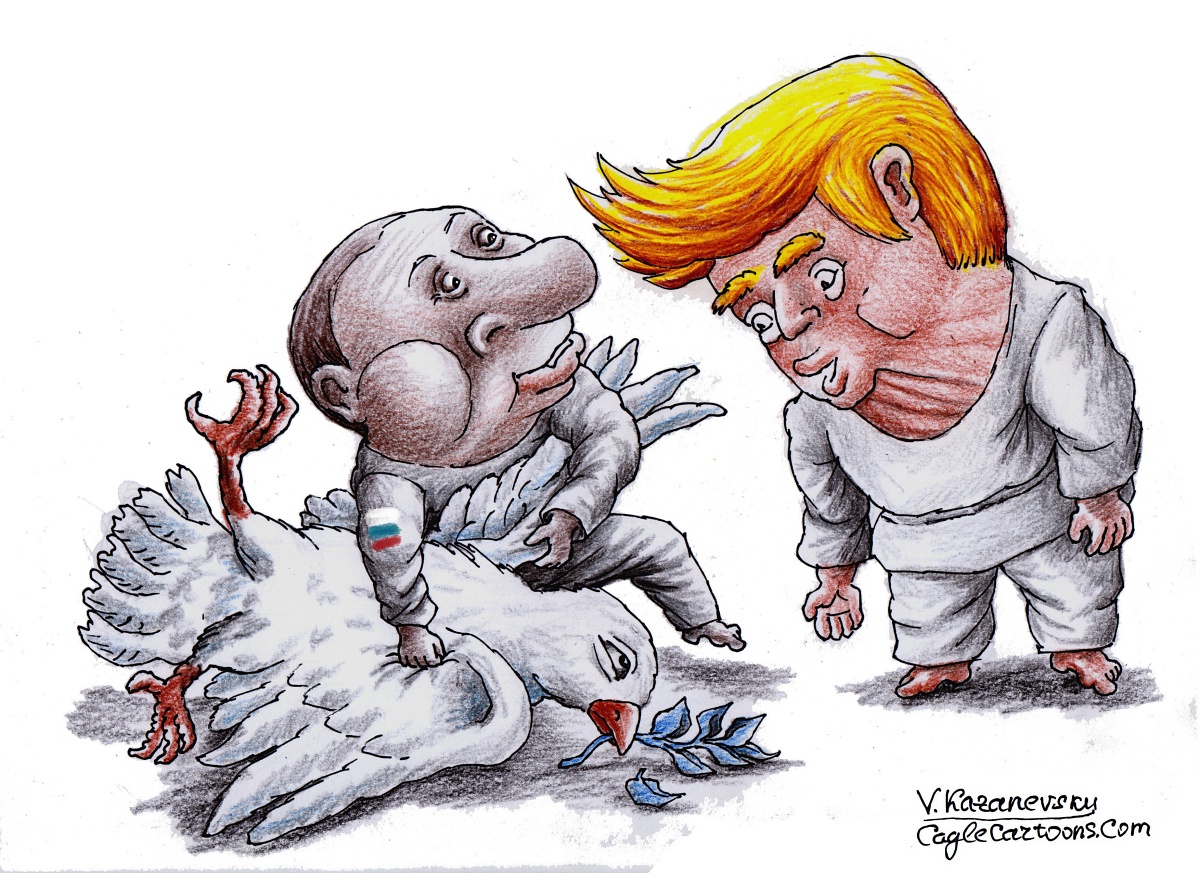
Trump presides over the ruins like a showman-emperor in silk pajamas, delivering his Truth Social rants as though they were tablets of fire delivered from a burning bush.
Donald Trump now strides across the world stage like a drunken titan, scattering the architecture of the international order as though it were a child’s tower of sticks. He moves with the reckless joy of a man who has discovered that smashing is easier than building, that breaking vows is easier than honoring them, and that the world—astonishingly—still grants him center stage even as he salts the earth beneath his own feet.
With every breath, he fractures alliances that once held the world in fragile harmony. Ukraine—bleeding, battered, a nation standing vigil at the gates of Europe—finds itself betrayed by the very republic that once claimed to be the arsenal of democracy. Trump sells it out with the cold-blooded casualness of a gambler tossing away a family heirloom. To him, Ukraine is not a sovereign nation but a bargaining chip—a pawn offered at the altar of his peculiar devotion to Vladimir Putin, the czar of his imagination, the ghostly puppeteer whose shadow lingers in every one of Trump’s geopolitical contortions.
Europe watches with a shudder, sensing the tremors beneath its own foundations. The old world sees in Trump not merely an American president but a wrecking ball adorned with the gaudy ornaments of grievance and spectacle. NATO—once a bulwark against tyranny—becomes, in his hands, a prop for extortion. He threatens to withdraw, to abandon, to dissolve. He treats treaties like expired coupons. He gestures casually at the end of the Western alliance, as if he were brushing crumbs from a table he has never known how to set.
At home, the republic’s administrative machinery groans under the violence of his decrees. Each executive order falls like a stone from a siege engine, battering the ramparts of government. He rewrites the purpose of the state by fiat, warping institutions into instruments of personal vengeance and private profit. With a flourish of pen and spectacle, he replaces public duty with palace intrigue, civil servants with courtiers, and democratic norms with the whims of a monarch who never studied the responsibilities of kingship, only the indulgences.
Related stories
And always, woven through this tapestry of destruction, is the ravenous hunger of his family empire. The state becomes a bazaar; diplomacy, a marketplace; public office, a trough. Mar-a-Lago swells with foreign envoys bearing tributes, gifts, and whispered promises. Government contracts drift toward cronies; pardons drift toward loyalists; and the public treasury becomes a river redirected toward the gilded reservoirs of the Trump clan. The presidency, once a symbol of stewardship, becomes an ATM for the royal household of grievance.
The world order fractures. Europe trembles. Ukraine bleeds. The Kremlin smirks. And the United States—the city on a hill—dims to the jittering glow of a malfunctioning neon sign.
Trump presides over the ruins like a showman-emperor in silk pajamas, delivering his Truth Social rants as though they were tablets of fire delivered from a burning bush. He stands in the twilight of a world he is unmaking, convinced he is a savior while he sets the temple alight. He believes the applause of his followers can drown out the groans of history, that grievance is a creed, that loyalty is the only virtue, and that he alone can redeem a world he has taken such fervent delight in shattering.
And yet—listen closely—beneath the din of spectacle, beneath the roar of collapsing alliances and the metallic shriek of democratic institutions in distress, there is another sound: the low, rising chant of those who have not surrendered to the carnival of authoritarianism.
The hour is late, but the story is not yet finished.
Picture Trump barreling across a desert wasteland, three sheets to the wind, in an improvised Ford F-150 Frankenstein—ram-plate welded to chassis, XA sedan cab grafted atop a standard V8, methane from pig waste coursing through copper tubing like lifeblood from Master Blaster’s subterranean refinery, racing seat strapped with a four-point harness, arched metal frame draped in canvas like a nomadic temple of rage. The windshield is half-cracked; a Confederate flag remnant flaps from the antenna like a dying nerve.
Dust storms coil behind him.
This is not a scene from Mad Max, but a glimpse of Donald Trump’s algorithmic unconscious given flesh and fuel.
The wasteland created by today’s digital technology is everywhere—an unseen desert humming beneath our fingertips. Social media pulses through its metallic veins, delivering intoxicants of outrage, fear, and resentment straight into the nation’s bloodstream. Troll armies march across its shifting dunes; bots and counterfeit accounts slide like serpents through its dust, distorting perception, bending reality, and forging affective publics addicted to their own fury. It is stunning how fast we acclimated to this. How quickly the bizarre replaced the normal. How effortlessly a nation allowed its inner circuitry to be commandeered by actors who speak fluently in grievance but mutely in truth.
Authoritarian leaders armed with digital technology do not govern only by argument but by spectacle. They govern by saturation. They govern by turning the entire media ecosystem into an accelerant. In that sense, the Ford F-150 Frankenstein is not simply a vehicle but an epistemology: a patched-together worldview built from incompatible parts, roaring forward on fumes, held together by rage, welded by nostalgia, armored by fantasy. In its monstrous silhouette we see the silhouette of a political theology emerging from the ruins of liberal democracy.
We must stare at it directly. Not to revel in its chaos, but to recognize how deeply it has already infiltrated the structures of everyday life. The digital sphere, once heralded as a planetary commons, has become a weaponized labyrinth. The platforms that promised connection have generated mass solitude. The networks that promised democratic participation have intensified polarization beyond the reach of ordinary discourse. We have birthed a nation of spectators who mistake reaction for agency, content for consciousness, performance for citizenship. In this delirium, we have allowed the architecture of perception to be reprogrammed.
The digital wasteland rewards not competence but provocation, not accuracy but audacity, not solidarity but schismatic appeal. This is why the car matters: it is a symbol of a country convinced that chaos is authenticity, that belligerence is strength, that destruction is cleansing. The road ahead is the timeline we scroll—pitted, distorted, shimmering with heat and hallucination.
The wasteland is not merely around us. It is in us. It has entered through the screens. It has rewired cognition. It has reorganized desire. It has colonized the preconscious with notifications that function like Pavlovian bells. Its engines roar ceaselessly, even in sleep.
Digital rage begets rage. Outrage validated by metrics, amplified by shares, reinforced by ideology. The entire media ecosystem has been reconfigured into an entropic feedback loop, where affect accelerates faster than meaning, and meaning dissolves faster than memory. The theater of spectacle becomes indistinguishable from the theater of governance. The carnival of grievance becomes indistinguishable from the content of legislation. The religious fervor of anti-woke crusades—howling about imaginary enemies, screaming about phantom persecutions—becomes indistinguishable from moral discourse.
These are symptoms of digital delirium. They are signs of a public that has been trained to respond viscerally, not reflectively. A public taught to see disagreement not as democratic vitality but as existential threat. A public seduced into believing that complexity is deception, nuance is betrayal, and ambiguity is weakness. The cure is not censorship. Nor withdrawal. Nor moral handwringing. The cure is alternative cognitive ecologies—spaces of collaboration, networks of solidarity, shared flows of knowledge resisting commodification. The cure is deprogramming the brainpan, restoring agency, memory, discernment, moral imagination.
The far-right understands this terrain better than the liberals who still treat politics as a polite exchange of policy preferences. Figures like Rufo, Fuentes, Bannon, and the MAGA apostles have mastered digital insurgency. They traffic in rage with the precision of arms dealers. They repackage nostalgia as destiny. They weaponize anti-wokeism as a moral imperative. They paint democracy as a cage and authoritarianism as liberation. Every classroom becomes, in their telling, an arena of indoctrination. Every teacher becomes an enemy of tradition. Every progressive newsfeed becomes evidence of moral decline. And because they move faster than institutions, because they operate in the intuitive language of emotion rather than the slow deliberation of reason, they control the narrative terrain before most citizens even realize a battle is underway.
And yet, awakening is still possible, beginning with a new literacy—one capable of perceiving both the visible infrastructures of power and the invisible infrastructures of cognition.
Every algorithm has a loophole. Every bot leaves a trace. Every digital fortress has a seam. And through these seams—the small cracks in the architecture of perception—enters the insurgency of reason, compassion, and radical imagination.
What emerges here is a pedagogy of resistance. Not through silence or censorship but through the creation of counter-spaces where thought can breathe. Spaces where the incentives are not governed by rage, where the velocity of communication does not flatten nuance into binary slogans. These counter-spaces can be small—book clubs, study groups, writing circles, encrypted chat communities. But their smallness is deceptive. They are seeds. They are the beginnings of an alternative cognitive ecology, an underground network of democratic resilience we can call post-digital pedagogy.
Platforms are not neutral stages but contested infrastructures that sculpt our gestures of thought long before content appears. They are factories of affect, slow-drip IVs feeding dopamine, grievance, tribal belonging, ambient paranoia. They tilt the world toward heat, toward spectacle, toward the algorithmic carnival that rewards antagonism over nuance, accusation over dialogue, performance over reflection. Yet even within their circuitry, alternative orders can be smuggled: subroutines of kindness; micro-communities of thoughtfulness; hidden corridors where curiosity is cultivated, not punished.
To build these spaces is not escapism but insurgency. A refusal to let the architecture of attention be monopolized by those who dream of governing through spectacle warfare. This is the slow revolution, the quiet sabotage of extraction capitalism.
Imagine a digital commons where the incentive structure does not mimic the stock market but the cooperative logic of mutual aid.
This is not naive optimism. It is strategic realism. For authoritarian movements like MAGA thrive on despair. They thrive on the belief that nothing can change, that collapse is inevitable, that democratic life has no future. A population that has surrendered to hopelessness is easy to steer. A population that has re-cultivated imagination is nearly impossible to control.
The post-digital manifesto therefore demands not only resistance but creation. New networks, cooperative platforms, decentralized infrastructures that treat knowledge as a commons rather than a commodity. Systems that do not extract but circulate. Systems that do not addict but empower. Systems built not on the psychology of scarcity but the ecology of interdependence.
This creation requires a new literacy—technical, emotional, critical, communal. A literacy capable of debugging social systems by investigating their codes of operation. A literacy that interprets power dynamics embedded in interfaces. A literacy that is able to perceive the human beneath the algorithmic haze.
The next system is already being assembled—quietly, collaboratively, defiantly—by those who refuse to surrender the future. By those who refuse to confuse noise with freedom. By those who know that the post-digital era will magnify whichever tendency we nurture: the engines of rage or the engines of repair.
This manifesto chooses repair.
The far-right thrives on the mythic, the theatrical, the messianic. Trump, a hybrid of carnival deity and vengeance avatar, Vance, a waxwork automaton of conformity, conjure a theater of endless spectacle. The masses, primed by decades of digital immersion, consume this theater with the voracity of addicts. Our task is to break the spell, to deconstruct the theater, and to reconstruct a space of critical engagement where agency is reclaimed, where participation is transformed from passive consumption into active resistance.
Consider the quantum horizon: entangled minds linked across continents, simultaneous thought streams mirroring each other, disaffection and rage flowing as freely as the data that powers them. If this is the future of connection, it is also the future of contagion. Fascism thrives in this medium, where ideas become memes, memes become rituals, rituals become behaviors, and behaviors harden into social norms.
Meanwhile, the global capitalist class—Robinson’s architects of militarized accumulation—gird themselves for the next round of expansion, turning social control into a lucrative industry. Pandemic profits, algorithmic bias, targeted discrimination, surveillance capitalism—these are the scaffolds upon which the new order is being constructed. The war industrial complex, in collaboration with techno-capitalists, leverages both fear and desire to cement their control. It is not enough to critique; we must act, and we must act with precision, imagination, and courage. Anti-fascist praxis requires the construction of communities, both digital and physical, capable of resisting co-optation, disruption, and the entropic forces of capitalist and algorithmic entanglements.
Consider the structural anatomy of this new fascist ecology we call MAGA: it is both seductive and parasitic. The algorithms are not neutral; they are imbued with the biases, incentives, and strategic ignorance of those who built them. Social media platforms, ostensibly tools for connection, become laboratories of division, inciting hatred, amplifying prejudice, and entrenching inequity—all in the name of freedom of speech. Targeted discrimination in ads, search engines, and feeds is not an accident—it is a feature, optimized for profit, compliant with the whims of industrial and political elites. The attention economy has become a war economy, where cognitive exploitation fuels social decay, trapping the
masses in an entropic feedback loop. Outrage is validated by metrics, amplified by shares, reinforced by ideology. The theater of spectacle, the carnival of grievance, the religious fervor of anti-woke crusades—they are all symptoms of a post-digital delirium. The cure is not censorship, not withdrawal, not moral handwringing. The cure is the creation of alternative cognitive ecologies: spaces of collaboration, networks of solidarity, flows of knowledge that resist commodification, deprogramming the brainpan of the masses while restoring agency, reflection, and moral imagination.
Let us not romanticize the opposition. Their instruments are invisible but totalizing: data mining, predictive analytics, sentiment manipulation, metric alchemy. Every trending hashtag, every viral video, every engineered outrage is a ritual performed in the temple of digital fascism, where participation is compulsory, and dissent is pathologized.
Yet even as they perform their vanities, they expose their vulnerabilities: reliance on spectacle, dependency on algorithmic amplification, fragility in the face of collective action and critical awareness. This becomes the leverage point: to detect manipulation, to inoculate against propaganda, to foster dialogue and collaboration in spaces contaminated by hate.
The stakes are apocalyptic. Entanglement across quantum networks, viral dissemination of ideology, algorithmic reinforcement of prejudice—these are not metaphors; they are the contours of an emergent fascist terrain. If we fail to act, we are complicit. If we hesitate, we are conquered. If we ignore, we are enslaved by spectacle, fear, and digital manipulation. Anti-fascist pedagogy is not optional; it is the sine qua non of survival.
The Camel Wagons and Franken-Fords are only symbols of the apocalypse that is already happening in the mind of every passive participant in the digital agora. The avatars of grievance are everywhere, and they are coming for our attention, our judgment, our moral compass.
We have no luxury of delay. Our mission is total. Our methods must be audacious. Our imagination must be unchained. We must teach, organize, and resist across all terrains—physical, digital, and psychic. Only then can we hope to transform the social imaginary, reclaim our cognitive freedom, and prevent the rise of a new, hybridized fascist order.
The algorithms are watching. They are not passive; they are predators. Each scroll, each tap, each angry thumb-click feeds them. Social media is no longer a forum; it is a war machine. Fox News and its legion of simulacra have turned the human brain into a pig trough, broadcasting American exceptionalism as a gospel of Christian nationalism. Every lie, every half-truth, every clickbait headline is a nail in the coffin of independent thought. The metrics are the drumbeat of fascism; critical engagement is the rhythm of emancipation.
And yet, the digital overlords—those invisible puppet-masters coding our reality—are only the beginning. The transnational capitalist class, as Robinson (2020) and Feldstein (2021) have laid bare, deploys new digital technologies not for liberation, but for militarized accumulation. Borders become walls of steel and pixels, surveillance networks stretch across continents, and human lives are measured in data points, in clicks, in profit. Every algorithmic bias, every targeted ad that excludes communities of color, every “ethnic affinity” setting, is another lash of control, another fracture in the social bond.
There are moments in history when the world seems to tilt, not with the thunder of armies or the roar of revolution, but with something quieter, stranger—a shift in the very texture of reality.
We are living in such a moment now, when the shadows have learned to type, when the ghost in the machine has grown fingers and opinions, and when the oldest human battles—truth against power, memory against forgetting—are being fought in the flicker of screens.
In the hidden basements of the twenty-first century, a new kind of factory hums. Not the steel mills of Manchester, not the textile halls of Lowell—but bot farms, vast mechanical orchards where unblinking digital workers harvest unrest and sow confusion.
If Dickens had lived to see this, he would have written of it grimly; if Borges had imagined it, he would have called it a labyrinth built to trap the world’s mind.
What we know is simple:
The bots have outnumbered us.
Thales reports that by 2024, 51% of the world’s web traffic was nonhuman—the first time in a decade the machines have stepped ahead of us in the great procession.
This was not an accident; it was the quiet arrival of a new political species.
And as Sinisa Markovic warns, these farms have not merely joined the conversation—they have seized its center, turning the public square into a hall of mirrors, where every reflection doubts the one beside it.
The new internet is not a marketplace of ideas; it is a casino where the house always wins because the house is an algorithm that rewards noise over truth, outrage over nuance, heat over light.
And so the noise machines awakened. Hundreds of thousands of digital phantoms whispering the same phrase until it becomes a trend, a chorus, a banner, a movement.
A lie, repeated by 10,000 bots, wears a suit of credibility.
A truth, whispered by one human voice, is drowned out by the roar of automated applause.
This is the liar’s dividend—that strange, poisonous gift of the AI era:
when fakes become so convincing that even the real begins to rot under suspicion.
If everything might be false, then nothing is true.
If every critic might be a bot, then every dictator may claim innocence.
This is the dream of tyrants: a world where facts melt like snow on warm stone.
We know the cartographers of this new deception:
Russia, China, Iran—nations that have studied the science of doubt as if it were metallurgy.
Markovic reports that in 2024, before the UK went to the polls, a mere 45 bot-like accounts produced over 440,000 posts, reaching more than 3 billion views—the work of a sorcerer’s apprentice conjuring storms of discord with a few keystrokes.
In the United States, Russia waged its digital war with theater:
A fabricated video accusing Kamala Harris of a decade-old hit-and-run.
An actor playing the victim.
A website mimicking a San Francisco news station.
A lie that blossomed into 2.7 million views, fed by the Kremlin’s mechanical bees.
In Europe, the tactic is familiar:
The fake videos, the pseudo-media outlets, the synthetic outrage.
A thousand puppets jerking on invisible strings.
A choreography of chaos.
Ukraine suffers it most acutely:
Bots slipping into Telegram channels like grease into clean water, pretending to be neighbors, mothers, shopkeepers saying—
“Life is better under occupation. Kyiv lies. Russia protects us.”
When propaganda wears the mask of a friend, its poison seeps deeper.
The U.S. Department of Justice seized domains running a Russian bot farm powered by Meliorator, an AI tool [] crafted to create new humans from mathematical smoke. Meliorator generates:
- Faces that never lived
- Voices that never spoke
- Personas that never drew breath
And yet they argue, accuse, applaud, provoke.
Nearly 1,000 such accounts were removed from X, though no one knows how many escaped—each one a counterfeit citizen, a phantom voter, a digital saboteur.
The machines are learning to impersonate us better than we impersonate ourselves.
Platforms claim vigilance, but the flood keeps rising.
Even when users of the social network Mastodon were directly asked to identify bots, they guessed wrong 58% of the time.
Humans have lost their instincts; the wolves wear our faces too well.
The platform known as X, under Elon Musk, now stands as the first platform charged under the EU’s Digital Services Act.
It is a strange moment in history when a civilization must fine a man for accidentally building a perfect megaphone for foreign autocracies.
And yet the defenders have begun to gather:
Researchers, governments, civil society groups, engineers in dimly lit rooms who refuse to surrender the last scraps of a shared reality.
AI, the same fire that forged the problem, is now being turned against the darkness.
Tools that:
- Track clusters of coordinated activity
- Spot synchronized posting patterns
- Unmask AI-generated avatars
- Detect conversation “shadows” that no human could produce
Enterprises now devote 21% of cybersecurity budgets to such countermeasures—a number expected to reach 27% by 2026.
The EU’s Digital Services Act and AI Act tie ropes around the giants, demanding transparency, risk assessments, access for vetted researchers.
The US, in its uniquely American way, scatters responsibility across agencies—DOJ here, CISA there, a few state laws thrown in like patchwork on a fraying quilt.
NATO calls disinformation a security threat, the UN debates information integrity, and the G7 vows to resist the rising tide.
Even in a world of lies, the democracies are trying to remember the sound of their own voices.
But law and technology are only sentries.
The true battleground is internal.
Every citizen must now become a detective.
Every reader a skeptic.
Every click an act of conscience.
The old prophets warned that someday truth would cry out in the streets and no one would listen.
They did not know she would be drowned out by botnets, hashtags, and deepfakes.
The machines are neither good nor evil.
But those who deploy them—those who build the bot farms like digital arsenals—they understand exactly what they are doing:
Turning the world into a place where people believe nothing and obey anything.
Imagine a vast field at night.
Half the stars are real; half are LED drones programmed to drift into shapes that trick the eye and the heart.
One tells you the truth. One tells you what the tyrant wants you to believe. But both shimmer, both glow, both pull at your instincts.
This is the world we now inhabit: a sky full of counterfeit constellations.
The question is whether we will learn to navigate by something else—
something older, steadier, harder to counterfeit.
Call it conscience.
Call it critical thought.
Call it the stubborn spark that refuses to be automated.
Whatever name we give it, we must guard it fiercely.
Because in a world of mechanical voices, the human voice becomes the rarest thing.
And in an era of manufactured doubt, truth becomes revolutionary again.
Digital fascism is not a single actor; it is a system, a lattice of control feeding on attention, emotion, and ideology. It is post-organizational. It is palingenetic ultranationalism encoded in the very circuits of our daily lives. It turns ordinary users into willing participants in their own oppression, the way Fielitz and Marcks describe: the masses, both fuel and engine, enacting the very programs that bind them. It is a system where Putin’s warmongering, Trump’s messianic tantrums, Rufo’s reactionary anti-woke propaganda, and the digital surveillance capitalism of Silicon Valley all converge into a feedback loop of rage and hysteria.
The Camel Wagon awaits. The engines are fired. The wasteland is real. And if we do not act now, the hybrid messiah of chaos—the TikTok demagogue, the lone samurai, the trickster of our collective nightmares—will pass by, leaving only smoke and ashes.
The digital and the physical are intertwined. Surveillance eyes blink in unison from every corner, while ICE and militia patrols march the streets like mechanized shadows. Algorithms, impartial only in appearance, tally loyalty and hatred alike, assigning scores to human hearts. Imperialist wars churn the earth for new oil, while vengeance masquerades as policy, each atrocity feeding the next. Into this machinery of control pours a relentless torrent—a Niagara Falls of surplus resentment—drowning educators in currents of fear, envy, and manufactured outrage. Every element leaks into the others, creating a grim ecosystem where power, violence, and ideology are inseparable, and the faintest whisper of dissent is measured, quantified, and recorded. To resist, we must act simultaneously across all terrains. There is no tomorrow in which the digital fascist ecosystem will dismantle itself. There is only now, and the courageous, the visionary, and the mad must rise together.
The wasteland stretches infinitely, a neon nightmare of infinite feeds, memes, and dopamine‑triggered outrage, a carnival funhouse reflected in the cracked screens of our devices. It exists where every act of work, every hour expended, is a thread in the fabric of capital’s social universe, where subjectivities are forged and social bonds transmuted into value.
We have the necessary tools of perception, cognition, and imagination in order to transform the wasteland—they are just buried beneath layers of algorithmic sludge and clickbait detritus.
The far right is clever. Rufo, Fuentes, Shapiro, Levin, Hannity, Gutfeld, Loomer, Ingraham, and the menagerie of MAGA wizards traffic in rage and nostalgia, repackaging grievance as spectacle, weaponizing anti-wokeism as a moral imperative, and painting democracy itself as a cage. Every computer is a classroom, an arena of indoctrination, every screen an algorithmic theater of ideological manipulation. And yet, every algorithm has a loophole. Every bot leaves a trace. Every digital fortress has a seam. And it is through these cracks that the insurgency of reason, compassion, and radical imagination can enter.
We must create a post-digital critical pedagogy, not timid flagging or content moderation—though these are necessary—but networks where users are not prey but participants, where critical pedagogy is not a course but a lifeblood, a social technology, an ethics embedded in interaction. To begin this process we must make platforms accountable, algorithms transparent, and digital infrastructures responsive to justice rather than profit.
Meanwhile, the capitalist class circles overhead like vultures. Robinson (2020) reminds us that inequality is both the outcome and engine of oppression. The ten richest men doubled their wealth during a pandemic that killed, displaced, and impoverished millions. We are assaulted on all sides by the interlocking systems of militarized accumulation, surveillance capitalism, and algorithmic exploitation. Digital repression, according to Feldstein (2021), is not limited to authoritarian states—it lives amongst us, embedded in our own platforms, our own governments, and our own complacency.
From the deep scars of mining extractivism to the delicate circuitry of semiconductors, from the insatiable thirst of data centers to the silent mountains of electronic detritus, every node tells a story of hidden cost.
At the heart of this sprawling network lies ‘digitarchy,’ control over digital information and communication infrastructure in which the sprawling dominion of technology giants both intertwines with and contests the sparks of grassroots resistance, redrawing the very architecture of global inequality.
The next wave of insurgency is post-digital, quantum; it is the reclamation of the mind and the networks, the fight for collective moral and cognitive sovereignty.
The work required is immense. But it is not impossible. It begins with attention—our most precious resource, our most colonized resource, our most squandered resource. We must reclaim it as an act of civilizational self-defense. The digital sphere has trained us to live inside a storm of micro-emergencies, each demanding immediate reaction. But panic is the oxygen of the authoritarian project. If the public is kept in a state of ambient fear, its imagination shrinks. Its moral horizons constrict. It becomes governable by spectacle alone. The reclaiming of attention is therefore not a personal wellness strategy but an insurgent political practice.
From this reclamation emerges a new capacity for perception. To see not only the surface of events but the algorithmic structures that produce them. To identify the emotional manipulations embedded in design choices. To recognize that platforms are not neutral tools but architectures of behavior. And within that recognition arises the possibility of re-architecting the digital sphere.
We stand at the edge of the post-digital abyss, staring into the glowing maw of spectacle, manipulation, and historical amnesia. The question is whether we will leap backward into passivity or surge forward with deliberate madness into the post-digital era.
The messianic avatars of grievance will not wait. They will continue to proselytize on behalf of Trump. The Camel Wagons are already rolling. The Ford F-150 Franken-machines are barreling through the digital wasteland. The hybrid tricksters, TikTok warlords, and methane-powered prophets of chaos are assembling. And yet, we possess the tools to resist, to disrupt, to create counter-realities, to teach the masses to see through the spectacle, to foster agency where there was apathy, and to cultivate networks of resistance across both the digital and the physical.
The Frankenstein Ford F-150 returns here as our reminder. It is not only a metaphor for authoritarian drift. It is also a symbol of what remains possible. A patched-together, improvised machine that survives the wasteland by repurposing the ruins. The post-digital future will be assembled the same way—not through pristine blueprints but through collective improvisation, democratic tinkering, creative salvage.
Our task is not to decorate the ruins with new screens. Our task is to write after the screen has colonized the soul. We must produce a post-digital literature fierce enough to interrupt the smooth obedience of our Trumpian age—an age where fascism no longer marches but updates, where power no longer shouts but optimizes, where the crowd is not mobilized by drums but by notifications.
The digital is no longer an object. It is climate. It surrounds us like weather, seeps into language, conditions reflex, regulates breath. We do not “use” it; we live inside it. The machine has ceased to appear because it has won. It no longer needs to announce itself. Like empire, it governs best when unseen.
This is what post-digital means: the end of technological innocence. The end of novelty as alibi. The digital and the physical have fused into a single regime of experience—code incarnate, data made flesh. Our cities rise from software, our labor leaves algorithmic footprints, our bodies trail metadata like shadows at dusk. The old quarrels—analog versus digital, real versus virtual—collapse into irrelevance. There is only life, now fully mediated, fully measured, fully at risk.
Trumpism is not an accident of this terrain; it is its native species. It thrives on spectacle without substance, speed without memory, virality without truth. Digital fascism does not burn books—it drowns them. It does not censor—it overwhelms. It replaces judgment with metrics, politics with engagement, conscience with clicks. Surveillance arrives smiling, wrapped in the language of choice. Domination presents itself as convenience. Obedience is rebranded as personalization.
A post-digital pedagogy must refuse this grammar. It must become a counter-climate. Where the algorithm flattens, it must thicken. Where the feed accelerates, it must slow. Where power fragments attention into profitable dust, it must restore duration, contradiction, and depth. This is not nostalgia for the pre-digital world—a world that is gone and, in many ways, never existed—but a struggle for human presence within a system that profits from our disappearance.
Here, agency is not a slogan but a practice. The human being returns not as user, not as data point, but as maker and witness. Post-digital creation stitches together code and clay, circuit and breath, archive and street. It remembers that technology is not destiny but design—and that design always carries the fingerprints of power. To write post-digitally is to expose those fingerprints, to name the hands at the controls, to break the spell of inevitability.
Against the orange-lit theater of authoritarian spectacle, we answer with language that cuts through noise. Against the empire of the instant, we answer with memory. Against the cult of disruption, we answer with responsibility. Post-digital pedagogy does not chase the future promised by Silicon prophets; it confronts the present produced by their lies.
This is a pedagogy that walks into the data center and asks who is being sacrificed inside. A pedagogy that hears, beneath the hum of servers, the muted cry of democracy. A pedagogy that understands the machine too well to kneel before it, and humanity too deeply to surrender it.
The task is urgent. The air is thick with code. And still—we write.
The wasteland is vast. But so is our capacity to remake it.
References (General Annotated Bibliography)
- Alvarez, L. (2022). Billionaires and Pandemic Inequality. Global Policy Review.
- Ekman, M. (2019). Digital Hate and Online Communities. Journal of Online Behavior.
- Feldstein, S. (2021a). The Rise of Digital Repression: How Technology is Reshaping Power, Politics and Resistance. Oxford University Press.
- Fielitz, M., & Marcks, H. (2019). Digital Fascism: The Far Right in the Post-Digital Age. Routledge.
- La Botz, D. (2022). Campism, Tankies, and Russian Imperial Narratives. Socialist Review.
- Mintzer, F. (2020). Affective Publics and Algorithmic Hate. Digital Media Studies Journal.
- Morris, A. (2019). Trump and Religious Nationalism. American Politics Quarterly.
- Pirina, Giorgio. Nocività digitale. Sul nesso lavoro‑ecologia. Venice: Edizioni Ca’ Foscari – Venice University Press, 2025. DOI: 10.30687/978-88-6969-981-8.
- Pirina, Giorgio. Nocività digitale. Sul nesso lavoro‑ecologia. Venice: Edizioni Ca’ Foscari – Venice University Press, 2025. DOI: 10.30687/978-88-6969-981-8.
- Robinson, W. I. (2020). The Global Police State: Militarized Accumulation and Economic Inequality. University Press.
- Rufo, C. (2023). Weaponizing Anti-Woke Hysteria: Critical Pedagogy Under Siege. Policy and Education.
- Uprety, A., & Solomon, D. (2018). Progressive Digital Policy for Democracy. Center for Digital Citizenship.
Comments

Powered by RoundtableAn AI/DeFi-powered Enterprise Media Operating System. Learn more at Roundtable.io.© Roundtable 2026. By using this site you agree to the Terms of Use and Privacy Policy