


Aug 18, 2026 6:06 PM
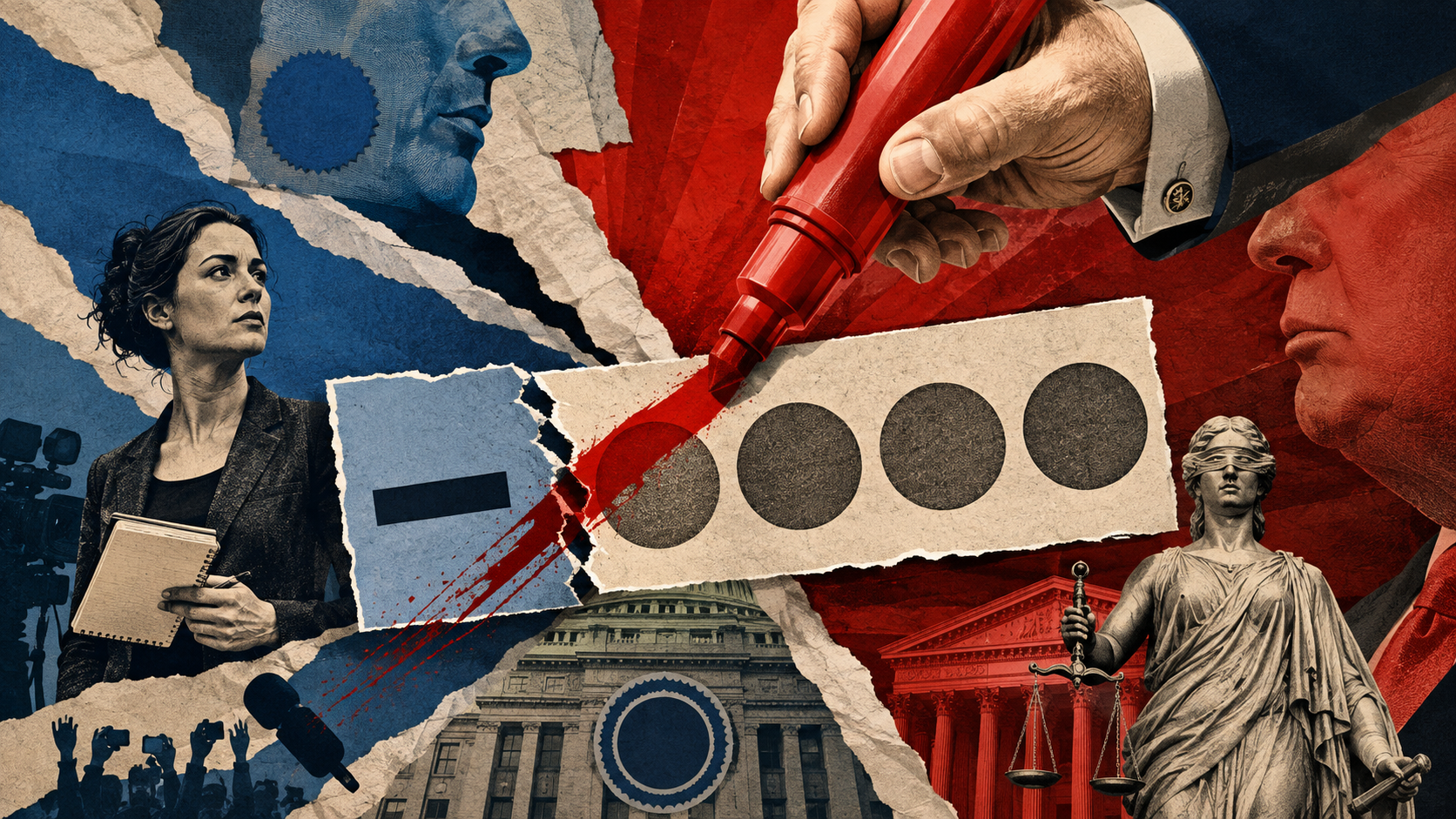
The message to administration officials, journalists, and institutions is unmistakable: submit to Trump’s will or risk being branded an enemy.
Two related things happened recently:
- Attorney General Todd Blanche refused to promise that the Justice Department would always act independently of Trump, saying, “No, I’m not going to pledge that,” and that Trump should have a voice in individual prosecution decisions. Axios Blanche also insisted that Trump would never ask him to do anything unethical or illegal. “He never has. He never will,” he said. The Guardian
- Trump attacked Fox News host Shannon Bream after she questioned Blanche about the anti-weaponization fund and the White House ballroom being built without congressional authorization. Trump complained that her program emphasized negative polls and compared watching her to watching CNN. The Daily Beast
Taken together, these incidents demonstrate that Trump sees any semblance of independence as disloyalty and uses attacks on those who display it to warn everyone else.
Blanche’s assurance may be even more revealing than his refusal to pledge independence. Asked, in effect, where he would draw the line, he employed a familiar form of question evasion: rather than define his own boundary or say what he would do if Trump crossed it, Blanche declared that Trump never would. He also substituted one standard for another—legality for independence. That is not an assertion of independence. It is an expression of faith in the leader—or submission to him.
Related stories
A president need not explicitly order an illegal act to turn the Justice Department into an instrument of his personal and political will. Trump does not need to summon Blanche and give him direct instructions. Blanche can generally discern what Trump wants by listening to his public statements or simply reading his Truth Social posts. Once he knows what pleases the president, what enrages him, and whom he considers an enemy, he can act in anticipation of his wishes. Independence then disappears not through an explicit command but through anticipatory obedience.
There’s no way to know whether Blanche saw Trump’s attack on Shannon Bream. He didn’t have to see it to understand the lesson. Bream remains one of the few Fox News hosts willing to challenge Trump’s rule.
Everyone in Trump’s orbit—and everyone who covers him—knows it: demonstrate too much independence and you may suddenly be recast as an enemy. The consequences depend largely on how much power Trump has over you. Journalists such as Maggie Haberman and CNN anchor and chief White House correspondent Kaitlan Collins have survived his repeated attacks and continued to thrive; his denunciations may even reinforce their reputations as independent journalists.
Shannon Bream occupies a different and potentially more vulnerable position. Trump cannot fire her directly, but he can try to turn MAGA viewers against her, discourage administration officials and other allies from appearing on her program, and make Fox executives worry that she is costing the network viewers and access.
An administration official is more exposed still and can be publicly humiliated, sidelined, or dismissed. The penalties differ, but the intended lesson is the same: independence has a price.
Trump has a deeply rooted psychological need to convert people and institutions into extensions of himself.
You don’t have to have taken courses in personality theory, psychopathology, or psychiatric diagnosis to recognize that wanting people both to fear you and to kowtow constantly to you is decidedly unhealthy.
I won’t drag the reader through the work of psychologists and philosophers who have described healthy and unhealthy personality characteristics and arranged them along various scales. To paraphrase Supreme Court Justice Potter Stewart’s famous observation about pornography, we may not be able to define psychological health with absolute precision, but we know it—and its opposite—when we see it.
With Trump, however, this goes beyond psychology and into the more fundamental question of character. Seeing him in his totality—as a person rather than a collection of symptoms, traits, or diagnostic labels—requires no jargon. A child who had a bad experience with someone like him might simply say, “Mom, Dad—he’s just not a nice person.”
Sometimes that simple judgment captures what pages of clinical terminology can obscure.
The problem is that when such a person is president, “not nice” is no longer merely a character flaw.
His need for submission becomes a governing principle.
The Justice Department is expected to be dependent, Fox News is expected to be obedient, and anyone who resists risks being treated as an enemy. Cross out the IN in INDEPENDENT, and you are left with exactly what Trump wants.
Comments

Powered by RoundtableAn AI/DeFi-powered Enterprise Media Operating System. Learn more at Roundtable.io.© Roundtable 2026. By using this site you agree to the Terms of Use and Privacy Policy