
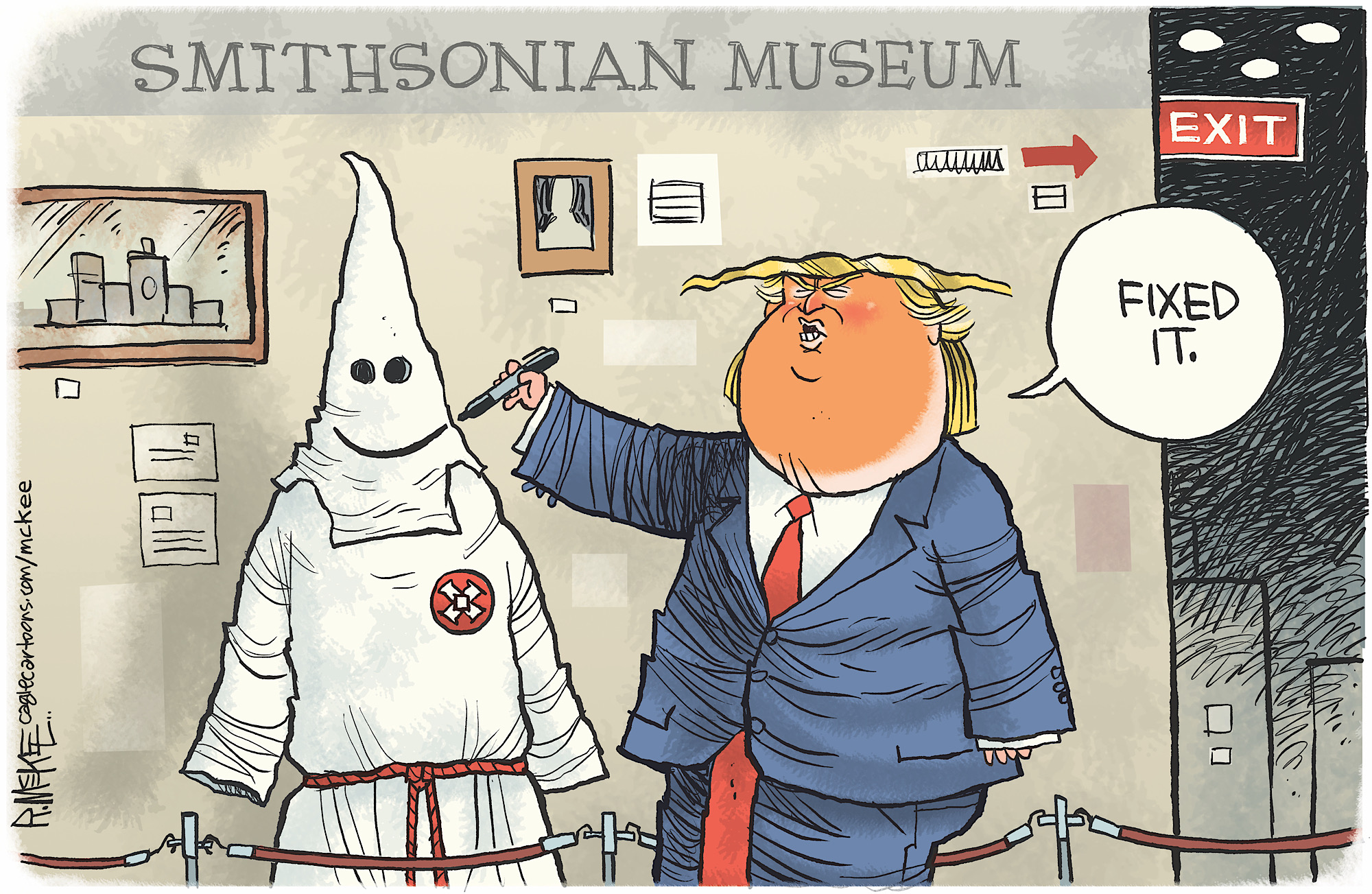
Illustration by Rick McKee on CagleCartoons.com


The president wants a usable past. He wants a version of the story of America that’s free of political, economic, religious, human diversity, and “ideology.”
Aug 22, 2025 8:20 PM
The president wants a usable past. He wants a version of the story of America that’s free of political, economic, religious, human diversity, and “ideology.”
In 1995, the Smithsonian Institution assembled an ambitious exhibit to mark the fiftieth anniversary of the end of the Pacific War (this August is its eightieth) but before it opened, veterans groups accused the museum of distorting history. Seeking to place the nuclear attacks on Hiroshima and Nagasaki in their historical context, the exhibit traced events from the 1920s through 1945.
Among its worst offenses, in the eyes of its critics, it represented the attack on Pearl Harbor as a strategically credible Japanese response to a decade of increasingly stringent economic sanctions imposed by the Roosevelt administration, rather than as a dastardly, unprovoked sneak attack.
Responding to the criticisms of the VFW and other groups, members of Congress emanded that the exhibit be cancelled. In the end, the museum reduced it to one small room containing the front part of the fuselage of the Enola Gay, the B-29 that dropped the bomb on Hiroshima.
It was accompanied by photographs and other memorabilia, but the focus of the display was on the crew of the Enola Gay and the ending of a war in whose outbreak the United Sttaes had played no role. Through political intervention, the country’s flagship museum was required to present an abridged and distorted account of history.
Related stories
If President Trump gets his way, the Smithsonian Institution will be silenced again, this time much more comprehensively. He has ordered a sweeping review of the Smithsonian’s policies, with a particular focus on both existing and upcoming exhibits. Eight of the most heavily visited units of the Smithsonian are included in the review, among them the museums of Natural History and of American, African American, and American Indian history. Even the art museums will come under scrutiny. The president wants to dictate to the museum what stories it will tell, and how it will tell them.
The Smithsonian review follows in the wake of an executive order issued last March, called “Restoring Truth and Sanity to American History.” According to that order, “Over the past decade, Americans have witnessed a concerted and widespread effort to rewrite our Nation’s history, replacing objective facts with a distorted narrative driven by ideology rather than truth. This revisionist movement seeks to undermine the remarkable achievements of the United States by casting its founding principles and historical milestones in a negative light.”
Inconveniently, it is an objective fact that hundreds of thousands of Africans were enslaved by white Americans in the first two centuries of our shared history. It is an objective fact that women and minorities in this country have been and continue to be second class citizens, despite the progress they have made toward real equality.

It is an objective fact that Europeans settling in North America dispossessed and displaced its indigenous people, driving them from their ancestral lands and confining them to squalid reservations. It is an objective fact that our government placed over a hundred thousand of its own people in concentration camps simply because they looked like the enemy. It is an objective fact that every American war since 1945 has been a war of choice, not of necessity.
Certainly objective facts such as these cast our country’s “founding principles and historical milestones in a negative light,” but they do not constitute “a distorted narrative driven by ideology rather than truth,” and keeping the country’s leading museums from exhibiting them accurately will not erase them from the past — only from the stories we tell ourselves about that past. And that, finally, is the point.
The president wants a usable past. He wants a version of the story of America that’s free of discord and conflict, free of ambiguity and complexity, free of political, economic, religious, and human diversity, free, especially, of what he calls ideology.
He wants the same thing his base wants: a story of America’s past that validates their sense of who they are and why they matter, one that leaves out everyone who’s not like them or doesn’t share their world view, one that contains nothing they might find unpleasant or confusing, one that they can pass on to their children to help guarantee that they will grow up to be just like their parents, with the same values, the same sense of what matters, the same sense of who belongs in their community and who doesn’t.
We were warned that this could happen. Seventy-five years ago, George Orwell wrote, “If the Party could thrust its hand into the past and say of this or that event, it never happened... And if all others accepted the lie which the Party imposed — if all records told the same tale — then the lie passed into history and became truth.
‘Who controls the past,’ ran the Party slogan, ‘controls the future; who controls the present controls the past.’”
President Trump’s party controls our present. And both the president and the party want to control our past, so that we will become who we remember ourselves to have been, according to the stories of ourselveswe see presented in our museums and, eventually, in our schools as well. This is why the bumper sticker says,
“Make Orwell fiction again.”
Comments

Powered by RoundtableAn AI/DeFi-powered Enterprise Media Operating System. Learn more at Roundtable.io.© Roundtable 2026. By using this site you agree to the Terms of Use and Privacy Policy