


May 4, 2026 1:30 AM
The imagination—trained for coherence, for narrative proportion—lags behind reality, struggling to keep pace with what has already taken place.
In recent days I have found myself dwelling not merely on events, but on a widening fissure—an almost tectonic split between truth and probability. Between what happens and what we have been conditioned to believe could happen. Between the real as it unfolds and the real as it is permitted to appear within the disciplined boundaries of plausibility.
We are living, increasingly, in a world where plausibility has lost its authority.
What once would have been dismissed as excessive—too theatrical, too implausible, too crudely symbolic—now arrives as fact. Not gradually, not with the soft persuasion of argument, but with the blunt force of occurrence. The improbable no longer needs to justify itself. It simply appears, fully formed, demanding recognition.
And so the imagination—trained for coherence, for narrative proportion—lags behind reality, struggling to keep pace with what has already taken place.
Related stories
That we should be living in 2026 under a president who reportedly describes himself, in private, as “the most powerful man in human history” is not simply an aberration of political culture. It is a symptom of something deeper: a transformation in the relationship between power and reality itself.
It feels unreal. And yet it is real.
Which is precisely the point.
Here, one is drawn almost inevitably to Thomas Hardy, who understood—long before our present crisis—that reality is under no obligation to remain within the bounds of the believable. “Nothing is too strange to have happened,” he wrote, not as literary flourish but as a recognition of the world’s indifference to narrative restraint.
Reality exceeds plausibility.
It is fiction that must remain disciplined—confined to what audiences will accept, constrained by probability, shaped by expectation. Reality, by contrast, answers to nothing. It does not persuade. It does not justify. It does not resolve.
Or, as Mark Twain observed with disarming clarity: truth is stranger than fiction because fiction is obliged to adhere to possibility—while truth is not.
This asymmetry is not trivial. It is the condition under which we now live.
For what we call “order” is often nothing more than retrospective coherence—a story imposed after the fact. Beneath that story lies contingency: the sudden, the excessive, the catastrophic. Events that no novelist would dare construct for fear of appearing implausible unfold daily, authenticated not by reason but by their sheer occurrence.
Imagination seeks proportion. Reality destroys it.
Even our darkest narratives retain structure. They arc. They resolve. They offer, however faintly, the reassurance that events unfold within some intelligible frame.
Reality offers no such reassurance.
It produces outcomes too abrupt, too asymmetrical, too indifferent to consequence to satisfy the demands of narrative justice. It does not build toward meaning. It erodes it.
And it is within this erosion that history, now, is taking place.
War Beyond Narrative
That the United States now finds itself in open conflict with Iran belongs not to the realm of strategic inevitability, but to Hardy’s domain: the real exceeding the plausible.
This is not war as culmination. It is war as acceleration.
On February 28, 2026, the opening strikes did not so much begin a conflict as rupture a threshold. Hundreds of coordinated attacks—precise, synchronized, mechanized—descended upon Iranian infrastructure, command networks, air defenses. The violence was not chaotic; it was calculated, almost aesthetic in its execution. War, rendered as choreography.
But what followed refused choreography.
Iran’s response did not mirror—it diffused. Ballistic missiles arced across the region. Drone swarms blurred the line between battlefield and horizon. Proxy forces activated across multiple theaters, dissolving the very idea of a contained conflict.
Geography lost its coherence.
The war did not expand in linear fashion; it metastasized. It moved through networks—military, economic, technological—transforming each into a vector of instability.
The Strait of Hormuz tightened like a constricted artery. Nearly one-fifth of the world’s oil supply—normally flowing with silent regularity—became suddenly precarious. Markets reacted not rationally, but reflexively. Prices surged past $126 per barrel, supply chains trembled, and inflationary pressures intensified across the global economy.
War, here, is not confined to the battlefield. It enters the bloodstream of everyday life.
And yet, even as systems destabilize, the language of control persists.
Each side claims success. Each side narrates advantage. Statements are issued, metrics are invoked, confidence is performed.
But beneath the language, there is no resolution—only continuation.
This is war stripped of narrative discipline.
No clear beginning. No coherent middle. No imaginable end.
Only escalation.
The Interior Life of Power
It is at this precise moment—amid external conflict and systemic strain—that another revelation surfaces, quieter but no less consequential.
Reports indicate that the president, in private conversation, has come to see himself as “the most powerful person to have ever lived” .
The statement is extraordinary not merely for its scale, but for its structure.
It contains no qualifier. No historical modesty. No institutional frame.
It is not comparative—it is absolute.
And in that absoluteness, something shifts.
For this is no longer the language of governance. It is the language of transcendence. The language of a figure who no longer measures himself within history, but above it.
The comparison is no longer to presidents, but to emperors.
Julius Caesar.
Alexander the Great.
Napoleon Bonaparte.
These names do not merely echo—they orient.
They mark the gravitational pull of power once it detaches from republican constraint and begins to imagine itself as destiny.
Power, at this stage, ceases to administer. It begins to perform.
And performance requires image.
The Architecture of Spectacle
The transformation of power into spectacle is not metaphorical. It is material.
It appears in surfaces, in structures, in the slow reconfiguration of space itself.
As reported, the president and his allies have pushed to imprint his name and likeness across institutional and symbolic sites—from proposals involving currency and passports to banners and public displays—alongside plans to reshape the physical grounds of governance itself.
Names affixed to institutions. Faces proposed for currency. Banners stretched across the facades of governance. The symbolic order begins to tilt—not toward the abstraction of law, but toward the visibility of the individual.
Even space begins to submit.
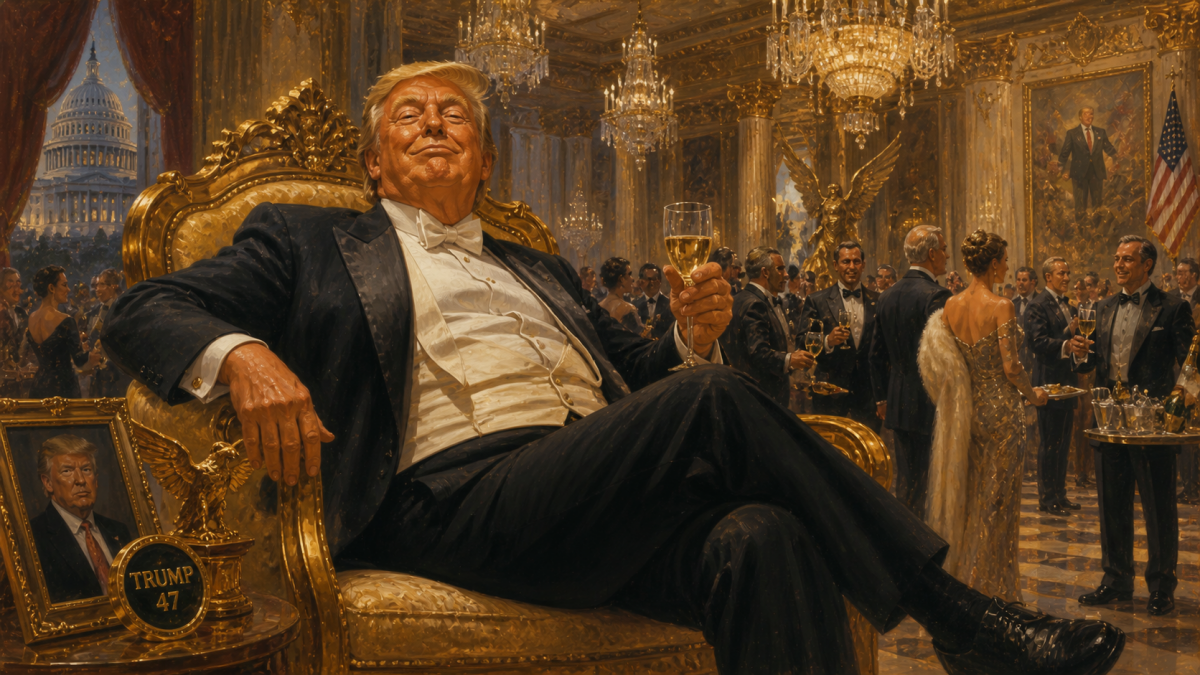
The reported demolition of existing structures to make way for a grand ballroom is not an architectural detail—it is a political text.
The ballroom is not a room. It is a declaration.
A chamber not for deliberation, but for display. Not for the negotiation of difference, but for the amplification of presence. A space designed to stage power, to render it visible, to surround it with spectacle.
And always, the return of gold.
Gold as surface. Gold as signal. Gold as historical echo.
It does not merely decorate—it asserts permanence. It reflects light in such a way as to obscure its source. It transforms space into theater, and authority into image.
Here, architecture ceases to serve the republic.
It serves the myth of power contemplating itself.
This is how authority prepares for endurance—not through law, but through symbol. Not through legitimacy, but through repetition.
Crisis is not answered with restraint. It is absorbed, transfigured, and returned as spectacle.
Vulnerability becomes monument.
Instability becomes display.
Contingency becomes myth.
Pedagogy, Theology, and the Refusal of Power
It is here—at the convergence of war, spectacle, and self-mythologizing—that the work of Paulo Freire becomes indispensable.
Freire understood that domination is never merely coercive. It is pedagogical.
It teaches people how to see the world. It shapes the boundaries of the imaginable. It invites the oppressed not only to submit, but to internalize the image of their own subordination.
Power must appear inevitable.
It must acquire distance, inevitability, even sanctity.
The oppressor becomes, in effect, a secular deity—one who acts, decides, defines reality itself.
But Freire does not leave us there.
He offers another language—one forged in struggle: a language of armed love. Not sentimentality, but disciplined commitment. A love capable of naming injustice, of refusing domination, of reclaiming the world as a shared human project.
Alongside Freire stands José Porfirio Miranda, who pushes the critique further—into theology itself.
For Miranda, God is not neutral. God does not hover above history as observer.
God intervenes.
On the side of the oppressed.
The Exodus is not allegory—it is insurrection against domination. The prophets do not soothe—they accuse. The crucifixion is the state’s claim to ultimate power—and the resurrection its negation.
In this light, the claim to absolute power is not simply political excess.
It is theological transgression.
It is idolatry.
It is the ancient temptation—to become as gods not through justice, but through domination.
History’s Memory
And yet history, stubbornly, refuses to cooperate with such ambitions.
- Julius Caesar crossed the Rubicon—and buried a republic.
- Alexander the Great conquered the known world—and left it fractured.
- Napoleon Bonaparte crowned himself—and died in exile.
The pattern does not change.
Only the scale. Only the stage.
And so the question returns, as it always does:
Will power be constrained—or embodied?
Will it serve the many—or glorify the one?
Freire answers: through consciousness, through struggle, through love that refuses submission.
Miranda answers: power without justice is false before God.
And the gospel—if it still speaks beneath the noise of empire—answers quietly:
The last shall be first.
The Other Power
To declare oneself the most powerful person in history is to attempt an exit—from contingency, from accountability, from time.
But there is no exit.
History does not forget.
And neither, if they are to remain free, can the people.
For there remains another power—less visible, less theatrical, but more enduring:
- The power to refuse.
- The power to name.
- The power to stand in solidarity with the oppressed.
Freire called it love.
Miranda called it justice.
History—if it survives us—may yet call it salvation.
Comments

Powered by RoundtableAn AI/DeFi-powered Enterprise Media Operating System. Learn more at Roundtable.io.© Roundtable 2026. By using this site you agree to the Terms of Use and Privacy Policy