
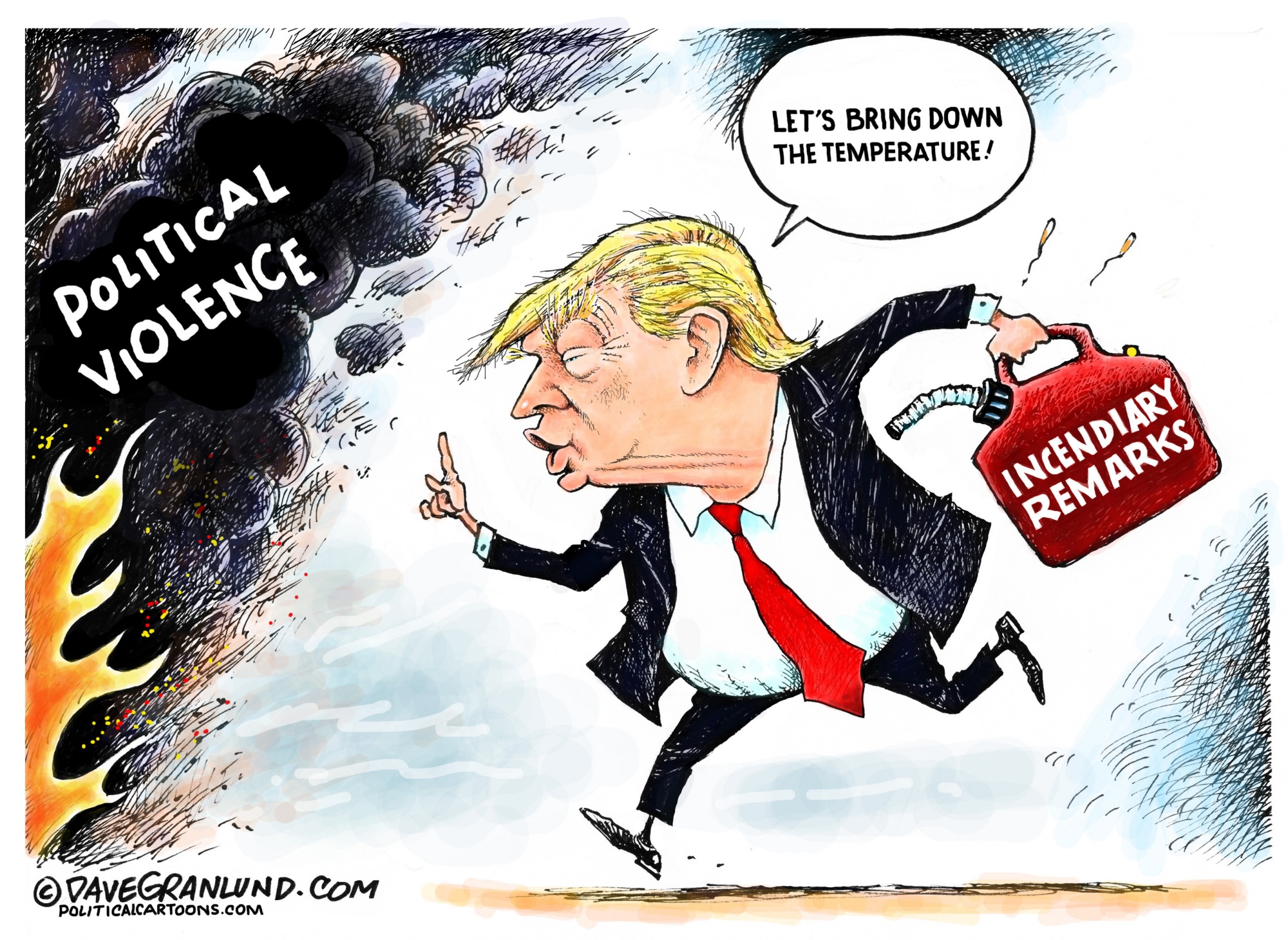
Illustration by Dave Granlund on CagleCartoons.com


Encouraging fear, not empathy, is Trump’s modus operandi. Yet, a majority of Christians voted for him. But hate, not love, comes more naturally to Trump.
Oct 5, 2025 3:13 AM
Updated Oct 5, 2025 3:21 AM
Encouraging fear, not empathy, is Trump’s modus operandi. Yet, a majority of Christians voted for him. But hate, not love, comes more naturally to Trump.
Two of President Trump’s summer/fall 2025 statements jump out at me:
- on 3 July in Iowa, he said about Congressional Democrats: “I hate them, too. You know that? I really do, I hate them. I cannot stand them.”
- on 21 September at a memorial service for conservative activist Charlie Kirk he stated, “I hate my opponent and I don’t want the best for them.”
In his The Audacity of Hope (2006), Barack Obama (then still a senator) wrote that the question of values should be at “the heart of our politics.” And I would argue that the value of love should be our number one value, thus central to our politics.
As the late Pope Francis wrote, love was the only “reality that can unify all the others,” and “in loving, we sense that we come to know the purpose and goal of our existence.”
Related stories
Since beginning his second presidential term, Trump’s actions have demonstrated much more hate, especially against his political opponents, than love. This phenomenon struck me especially forcefully while watching Stephanie Sy interview Laotian-American Alan Phetsadakone on the PBS News Hour.
As we watch or read the interview, we should ask ourselves whether the Trump administration's treatment of Mr. Phetsadakone reflects love (as Pope Francis advised) or hate.
To begin, we should note that under Trump, from February through May of 2025, ICE agents arrested almost triple the number of Asians as in a similar period in 2024.
Mr. Phetsadakone arrived in the USA as a toddler from Laos (where the U. S. dropped more than two million tons of bombs from 1964 to 1973) as a refugee in 1981. He admits to having a “tough childhood” - losing his brother to suicide then later losing his grandma who raised him.
In his late teens, he committed a “nonviolent offense,” which might have led to his deportation except, as Ms. Sy explained, there was then “no repatriation agreement between the U.S. and Laos.” Ms. Sy also pointed out that his attorneys have recently found “discrepancies in his legal defense” for that conviction and that if their challenges prevail, the conviction could be overturned.
Meanwhile, Mr. Phetsadakone straightened his life out. Toward the end of the 1990s he married and began raising a family. His wife, Eugenio, now works as a secretary in a local school district. He sometimes helps out at sporting events for their kids, the youngest of which is 13. He told Ms. Sy that he’s now “a responsible adult with a loving family. I have built my whole entire life here with my family.”
Describing his detention area he added,
“The housing unit I was in . . . housed around 70 to 80 detainees at any given time. It's an open unit. The light stays on 24 hours a day. You just have four walls, no windows, limited time to be in the outdoor yard. It's frustrating. It leaves you hopeless, stressed.”
Ms. Sy asks if he knew how much time he now had before he had “to get on a plane and be deported,” and he replied, “I have no idea. This is one of the uncertainty that's - that I feel as if I'm a lost soul. And I don't know what's going to happen to me tomorrow or two months from now or a year from now. I don't know. And it puts my life on hold, and my family's life and everybody that's close to me.”
When asked if he had thought about starting over in Laos, he answered that he would not know where to begin, that everything he has known has been in the USA. And that in Laos he’d be on his own without any family, who are all U. S. citizens.
Asked about all the support he has received from various people, he stated that it’s “been tremendous. It's been everything. It's been a reflection of me just being a good person, moving on from my past, building a community, having my family around.”
After Ms. Sy’s interview had concluded, the PBS News Hour noted that Trump’s Department of Homeland Security responded with "thanks to an activist judge, this criminal is now loose on America's streets."
But for a few decades now Mr. Phetsadakone has been a law-abiding family man as opposed to a criminal “loose on America's streets.” Pope Francis stated that in regard to immigrants, we should “welcome, protect, promote, and integrate. . . . If we put those four verbs into practice, we will help build the city of God and man.”
The second Trump administration’s treatment of Mr. Phetsadakone has been the direct opposite. Encouraging fear, not love or empathy, is Trump’s modus operandi.
Yet, a majority of Christians voted for the former TV host of “The Apprentice.” We might expect from one supported by this particular majority to preach love, not hate. Even the widow, Erika, of Charlie Kirk, who spoke before Trump at his memorial, said she would forgive his assassin “because it was what Christ did and is what Charlie would do,” adding “the answer to hate is not hate. The answer we know from the Gospel is love and always love.”
But hate, not love, comes more naturally to Trump. As Robert Reich, former Clinton Secretary of Labor, wrote recently about the present Trump administration, “It’s the opposite of empathy — treating people as if they aren’t human, as if they’re the ‘other.’”
Comments

Powered by RoundtableAn AI/DeFi-powered Enterprise Media Operating System. Learn more at Roundtable.io.© Roundtable 2026. By using this site you agree to the Terms of Use and Privacy Policy