
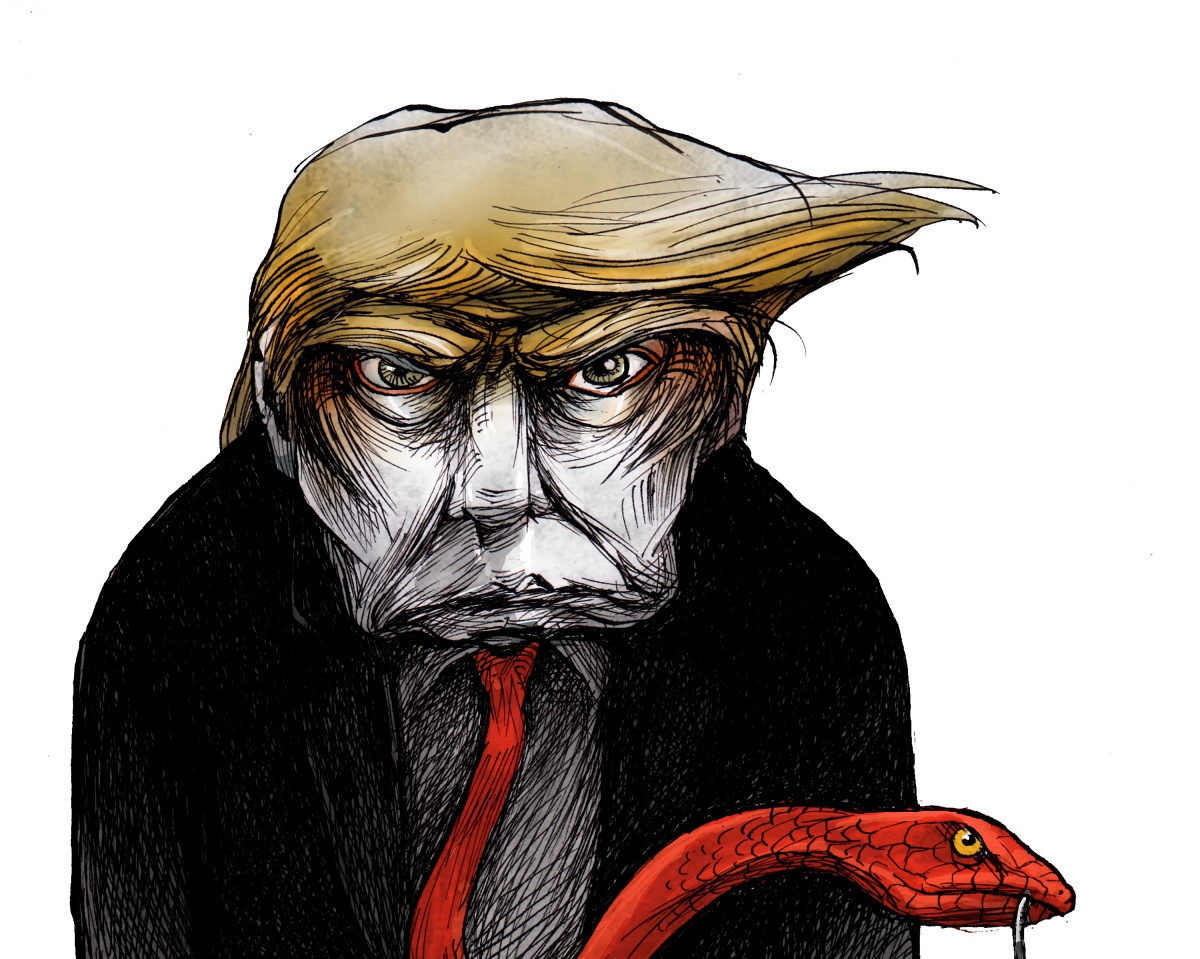
Cagle Cartoons: Angel Boligan


Trump Cuts
Apr 9, 2025 4:35 PM
Updated Apr 9, 2025 5:52 PM
The decimation of USAID was just the beginning of the Trumpian plague whose devastation would take countless lives, both in the USA and abroad.
There was a time when I was proud of our country. I’m sure I was a bit naive and overly idealistic, but I was proud when John Kennedy (JFK) established the Peace Corps on 1 March 1961 and even earlier when in his Inaugural Address he said, “If a free society cannot help the many who are poor, it cannot save the few who are rich.” The Corps went from 900 volunteers in 16 countries in 1961 “to a peak of 15,556 volunteers in 52 countries in 1966.”
As the Britannica website describes it, it was established to “assist other countries in their development efforts by providing skilled workers in the fields of education, agriculture, health (there has been a particular emphasis on combating HIV/AIDS), trade, technology, environmental protection, women’s economic empowerment, and community development. Peace Corps volunteers are assigned to specific projects on the basis of their skills, education, and experience. Once abroad, the volunteer is expected to function for two years as a good neighbor in the host country, to speak its language, and to live on a level comparable to that of the volunteer’s counterparts there.”
I was so happy about the Corps’ establishment that I even seriously thought of joining it when I got out of the army in 1962, but instead opted for graduate school at Georgetown U. Thus, I was still in our capital when JFK delivered his“peace” speech at American U. in June, 1963—another occasion that swelled my pride for our country. In it he said that world peace was the “most important topic on earth.” But that it was “not a Pax Americana enforced on the world by American weapons of war. Not the peace of the grave or the security of the slave,” but “the kind of peace that makes life on earth worth living, the kind that enables men and nations to grow and to hope and to build a better life for their children—not merely peace for Americans but peace for all men and women.” He went on to add that “total war makes no sense in an age when great powers can maintain large and relatively invulnerable nuclear forces and refuse to surrender without resort to those forces. It makes no sense in an age when a single nuclear weapon contains almost ten times the explosive force delivered by all the allied air forces in the Second World War. It makes no sense in an age when the deadly poisons produced by a nuclear exchange would be carried by wind and water and soil and seed to the far corners of the globe and to generations yet unborn.”
A few months later—and just a few months before JFK’s assassination—the U. S. and the USSR signed the Limited Test Ban Treaty, which “prohibited nuclear weapons tests in the atmosphere, outer space, and underwater.”
Related stories
The 1960s were also a period that witnessed great victories over U. S. southern segregation. In 1963 Martin Luther King Jr. gave his famous “I Have a Dream” speech before a crowd of hundreds of thousands spread out between the U. S. capital’s Lincoln Memorial and Washington Monument. The next year President Lyndon Johnson signed the Civil Rights Act, which prohibited discrimination of all kinds on the basis of race, color, religion, or national origin. The following year, the Voting Rights Act of 1965 gave the federal government powers to see that blacks could register to vote without discrimination. Largely as result of this pressure, the percentage of black registered voters increased almost tenfold in Mississippi and more than threefold in Alabama between 1964 and 1969.
In 1965, Johnson also initiated “affirmative action” by signing an executive order requiring government contractors to "take affirmative action" to ensure equality in hiring—in 1967, this order was amended in an effort to overcome gender as well as racial discrimination.
Finally, it seemed then that our long era of white-male supremacy was about to come to an end. It seemed so even though it had taken a century since emancipator Frederick Douglass had advocated a “composite nation,” one “about a citizenry made better, and stronger, not in spite of its many elements, but because of them.” Such a multi-racial and ethnic society in which our various peoples worked harmoniously together now seemed possible.
But, of course, as so often occurs in history, there was backlash, and white racism became more evident. Also in 1968, MLK and Robert Kennedy were assassinated, and the Vietnam War which they had both criticized reached its zenith. To make matters even worse, in November, Richard Nixon was elected president.
For the next half century or so, events oscillated, but U. S. progressives still had times in which they could take great pride. One was in 2008 when Barack Obama, son of a black African economist, was elected president, and again in 2012, when he was reelected.
But then there was also 2016, when Donald Trump—an unavowed white supremacist—was elected—and 2024 when he was once again chosen as the U. S. president. Only this time he revealed his true intentions from the very start of his second term.
In 2019 Washington Post columnist Eugene Robinson wrote about Trump, “Me, me, me, me, me. Always me, never anyone or anything else.” And Robinson was far from alone in commenting on the over-the-top egoism that seemed to infuse our then president. (See also here on Trump’s egoism.)
In 2025, however, after being reelected in November 2024, Trump began his new presidency not only displaying his usual egoism, but projecting it onto the nation he had once again been chosen to lead.
The nineteenth-century Russian philosopher Vladimir Soloviev, one of the world’s most trenchant critics of nationalism, referred to it as “national egoism.” Thus, it is perhaps not surprising that Trump’s personal egoism would manifest itself on the global stage as his own brand of U. S. nationalism.
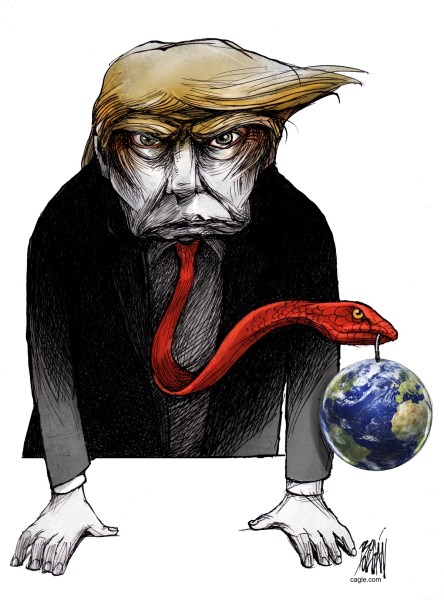
One of his favorite presidents is William McKinley, who served when U. S. progressives (whom he opposed) were prominent. Trump referred to him as a “great president”—yes, that same imperialist McKinley who began seizing the Philippines from Spain at the cost of probably over 200,000 Filipino lives. Not surprisingly, Trump has praised that former president for making “our country very rich through tariffs.” (Trump’s own tariff policy, rolled out in April 2025, has alienated many of the U. S.’s trading partners—as well, as many U. S. economists—but he thinks it is in keeping with his America-First foreign policy. A policy which has incidentally angered many NATO allies.)
A Russian historian who praised Soloviev’s criticism of nationalism also noted that “it took the modern world, or at least the part of it that is Europe, three-quarters of a century and two world wars to come up with the understanding of how important it is to subordinate . . . national interests to the interests of the community.” After WWII, although western Europe seemed to learn this lesson and created the Common Market and NATO, Trump seems to never have learned this teaching. Although most astute political thinkers think that enhancing the common good should be the main of politics, the Trumpian mindset still prioritizes individual and national egoism.
All of which brings us to the Myanmar earthquake, which occurred on March 28, 2025. By April 7th the loss of over 3,600 lives were attributed to it. Insight into the aid—or rather lack of it—that the USA provided was gained by listening to a PBS News Hour interview with Chris Milligan, who was the most senior career official at the United States Agency for International Development (USAID) during the first Trump administration, and earlier was the agency's mission director to Myanmar. (USAID, like the Peace Corps, was established by JFK in 1961 to unify several foreign assistance programs under one agency.)
When Milligan was asked about the U. S. response to the disaster he answered, “There really hasn't been a response.” He contrasted what the U. S. did in 2023 when a monolithic earthquake hit Turkey: “The U.S. government deployed a disaster assistance response team that grew to about 200 people, and 160 of those were search-and-rescue staff.” He attributed Trump’s Myanmar’s reaction primarily to gigantic cuts to USAID, stating that “The real-world impact is that the agency and the United States government does not have the capacity to help those in need.”
As a final irony, the three-person team of USAID employees who were sent to Myanmar were informed while they were there that they had been terminated. Secretary of State Marco Rubio indicated that the US was no longer going to be “the world’s top humanitarian donor.” Instead, other nations were going to have “to step up.” And, in fact, other nations did, especially China—yes, Communist China.
Asked to comment on such developments Milligan’s response was, “We had the capacity. We had the assets. We chose to turn them off, and now people are dying .. . . We provide humanitarian assistance because we're a generous country, and we do it based upon needs. However, there is a big dividend back here for America. It shows— it's a showcase of American values. It creates goodwill. It strengthens our partnerships in the world, and it supports our global leadership. By walking away from humanitarian assistance, we are creating a political void that others, such as China, can fill for their own advantage.”
Milligan concluded that a world without USAID would mean more pandemics and higher unemployment coming to America. “The list goes on and on. It's a less stable world, more conflict, more demands on American soldiers. It's a less free world, and it's a world where China becomes the global leader.”
The gutting of USAID alone could cause millions of additional deaths in the next decade. In a recent New Yorker interview, entitled “Hundreds of Thousands Will Die,” editor David Remnick talked with surgeon Atul Gawande, who for over three years served in USAID as President Biden’s assistant administrator for its Bureau of Global Health. He told Remnick that “in three years, we documented saving more than 1.2 million lives after COVID alone.” Like many scientifically-trained experts, but not Trump’s new Secretary of Health and Human Services (Robert F. Kennedy, Jr.), he was a great believer in vaccines and told Remnick that “forty per cent of the gains in survival for children under five in the past fifty years in the world came from vaccines alone.”
But the decimation of USAID was just the beginning of the Trumpian plague whose devastation would take countless lives, both in the USA and abroad. As one recent LA Progressive piece indicated about Trump’s gutting of the Environmental Protection Agency and his claim that human-caused “global warming is a hoax”: “The degree of ultimate suffering resulting from such a claim is simply incalculable.”
Comments

Powered by RoundtableAn AI/DeFi-powered Enterprise Media Operating System. Learn more at Roundtable.io.© Roundtable 2026. By using this site you agree to the Terms of Use and Privacy Policy