


Jul 19, 2026 5:16 PM
Updated Jul 22, 2026 7:11 PM
The WNBA superstar may not have created the racial backlash surrounding her, but her influence gives her the power—and responsibility—to confront it.
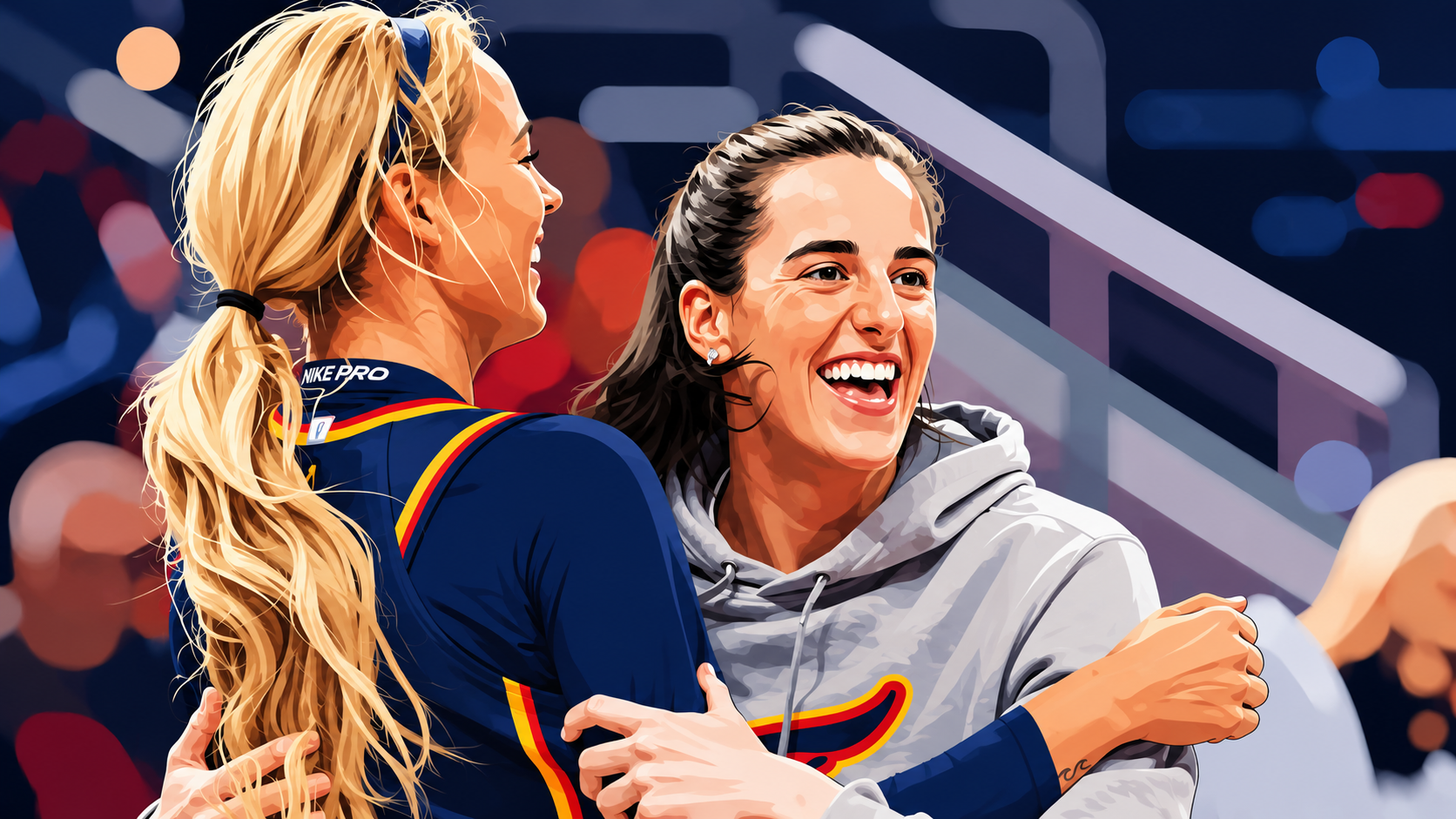
“All I have to say is I really am right in the middle, and I think a lot of America is like that,” Sophie Cunningham explained. “In our culture today, you have to choose, and you have to be an extremist, and that’s just not me. So I agree with things on both sides; I disagree with things on both sides.”
But Cunningham was not delivering a random sermon from the Church of Comfortable Centrism. She was talking about Caitlin Clark. Defending Caitlin Clark. Serving as Clark’s volunteer character witness and political fog machine, explaining why ambiguity should be mistaken for maturity and independent thought.
Clark is the center of this discussion.
Cunningham is the spokesperson explaining why the center need not identify either side.
Related stories
Because choosing is “extremist” now. Silence is wisdom. Standing halfway between the arsonists and those choking on smoke is American sophistication.
But in the middle of what?
Between racial equality and white supremacy? Between a representative democracy and dictatorial rule? Between people demanding full citizenship and those furious it must be shared with everyone who failed the old country-club entrance examination?
Where is this heroic middle? Show it to me on a map.
Caitlin Clark appears stuck in the middle, with Klansmen and white nationalists to her right and nearly everybody they despise standing to her left.
Black people, Latinos, Asians, Native Americans, immigrants, Jews, Muslims, LGBTQ citizens, workers, teachers, and defenders of multiracial democracy to the left.
To her right sits a movement marinated in white domination and control, immigrant oppression, Christian nationalism, and the belief that white Americans are persecuted whenever somebody else receives a chair, promotion, or chapter in the history book.
There stand Clark, Cunningham, and scores of other white folks, apparently overwhelmed.
So many sides. So much troublesome nuance.
Damn, it is not that deep!
The political right did not merely attract characters who missed the exit for the gun show. In 2016, the Ku Klux Klan newspaper The Crusader publicly praised Donald Trump’s candidacy. Former Klan leader David Duke also backed him, along with white supremacist and neo-Nazi figures who recognized Trump’s movement as useful. Trump’s campaign rejected the newspaper’s support, and Trump eventually disavowed Duke, but the racist enthusiasm was impossible to dismiss.
The Klan did not endorse Trump in disappearing ink hidden beneath a Confederate general’s mattress.
Yet tens of millions of white Americans voted for him anyway. Trump received more than 77 million votes in 2024, and more than 80 percent of his coalition was white. Roughly sixty million white Americans backed a movement that excited Klansmen, white nationalists, and assorted racial undertakers.
These were not sixty million robe-wearing Klansmen gathering behind abandoned barns.
That would make the problem easier.
They were mainstream America.
Doctors. Teachers. Police officers. Nurses. Accountants. Bank managers. Church deacons. Soccer mothers. People with graduate degrees, pensions, tasteful lawns, and plaques advising everybody to live, laugh, and love.
They did not endorse the Klan. Voting for a candidate supported by white supremacists does not automatically make every voter one. People vote for taxes, abortion, immigration, judges, party loyalty, resentment, or promises that would embarrass a carnival barker.
But the Klan’s enthusiasm did not disqualify Trump for them.
That is the point.
White-nationalist approval was not the rotten smell that made respectable America put down the sandwich and inspect the kitchen.
They decided that whatever attracted the Klan disturbed them less than Democrats, immigrants, Black protesters, feminists, transgender people, diversity programs, or honest history.
The hood may not have been in their closet, but it was not a deal-breaker in somebody else’s.
That is white America’s laundering operation. It insists white supremacy lives far away, safely contained inside toothless hillbillies misspelling slurs on homemade signs. Then millions of credentialed citizens support a movement celebrated by Klansmen while demanding nobody draw an impolite conclusion.
They ordered the meal, praised the chef, and left a tip. Now they wish to debate whether they were technically inside the restaurant.
This surrounds Caitlin Clark’s middle.
One side represents a movement embraced by organized racists. The other contains practically everyone they regard as inferior, threatening, or unworthy of equal citizenship.
What is Clark’s corner of America balancing between?
The Klan and the people it hates? White nationalism and its targets? A movement nourished by racial hierarchy and a coalition trying, however imperfectly, to preserve multiracial democracy?
Where is that honorable midpoint?
Limited supremacy on weekends? Equal citizenship three weeks each month? Cross burnings by permit, provided the neighborhood noise ordinance is respected?
Sophie Cunningham says people are being forced to choose.
Correct.
Sophie, some moments require choosing.
When a house burns, the reasonable position is not halfway between the fire department and the arsonist. When a bully beats a child, wisdom does not require concluding the child’s screaming is unnecessarily divisive.
The person holding the club and the person beneath it do not share equal responsibility for disturbing the peace. Standing between them and objecting to the emotional tone is not moderation. It is cowardice wearing reading glasses.
Clark did not invite racists into her fan base. She did not create Trumpism, the Klan, or America’s habit of treating white women as symbols of innocence while portraying Black women as angry, classless and threatening. She is not responsible for every bigot who wears her jersey or turns a hard foul into the second Battle of Fort Sumter.
But once Clark understood that her image was being used to vilify Black women and racialize the WNBA, silence stopped being entirely innocent.
At that point, silence became management.
Ambiguity became branding. Vagueness became PR.
Clark has condemned racist and misogynistic behavior committed in her name. But rejecting the ugliest conduct does not fully reveal where she stands inside the cultural machine around her.
Caitlin Clark is no longer merely a basketball player. She is a cultural symbol, economic engine, television attraction, and racial Rorschach test wearing sneakers.
To many new fans, Clark is the Great White Rescue Mission, sent from Iowa to save a league built largely by Black women who apparently had the nerve to exist before certain sports commentators discovered the schedule.
Those fans treat every hard foul as attempted manslaughter. Every glare becomes racial hostility. Every disagreement proves jealous Black women are trying to destroy the innocent white star carrying television ratings and corporate salvation beneath her arms.
Clark did not write that script.
But powerful people cast her in it.
That gives her unusual power to reject it.
She can say plainly that Black women are not her enemies; that the players who built the league deserve respect; that her success must not be weaponized against colleagues; that racial hostility is neither support nor admiration.
This would not require Clark to become Angela Davis with a crossover dribble or deliver a seminar on intersectionality before tipoff.
Moral clarity sometimes requires one sentence:
“Racists do not represent me.”
There. Civilization survives. Sponsors still sell shoes. The basketball remains inflated.
But Cunningham suggests asking Clark for clarity is unfair because Clark is “in the middle.”
No. Caitlin Clark is not merely in the middle.
She is at the center.
She is at the center of the WNBA’s growth, media attention, racial tension, and cultural storytelling: a spectacle that treats her as fully human while reducing Black players to villains and disgruntled supporting actresses in The Caitlin Clark Story.
At the center, what she says carries weight.
What she refuses to say does too.
Cunningham transforms that refusal into nobility. She calls it balance and independence. But “I agree with things on both sides” is not a philosophy. It is a bumper sticker for people who want credit for independent thought without revealing an actual thought.
Which things? Which side of voting rights, immigrant humanity, bodily autonomy, and equal citizenship is far, far too complicated to name?
A person claiming the middle should describe the territory. Otherwise, the middle becomes witness protection for opinions.
This privilege is partly racial. Black athletes become political the moment they mention racism. White athletes remain neutral until they personally arrive at the Capitol carrying a flag and a battering ram.
A Black woman raising her fist is making a statement. A white woman remaining silent is supposedly concentrating on basketball.
Blackness is treated as ideology. Whiteness is treated as wallpaper.
Black players must explain their anger, expressions, fouls, and the political opinions of every Black person encountered since kindergarten. Clark gets to be an individual. Black women get appointed ambassadors to an entire race before the postgame interview.
Clark did not invent that privilege, but she benefits from it. Cunningham helps preserve it by shielding Clark from questions other athletes routinely face.
The larger problem is mainstream white America pretending extremism is committed only by extremists.
White supremacists publicly welcomed Trump. Mainstream America saw them cheering and walked toward the same voting booth.
Doctors, nurses, teachers, cops, and white women who understood sexism voted for him. The movement was not carried by Confederate tattoos alone. Respectable people in scrubs, uniforms, suits, and PTA name tags carried it into power.
America keeps searching for white supremacy beneath a pointed hood while it sits beside us at the dentist, teaches algebra, writes prescriptions, patrols neighborhoods, and manages retirement accounts.
It hunts extremism in the forest while extremism parks a Lexus at the orthodontist.
Mainstream support does not make an extremist movement less extreme.
It makes extremism mainstream.
That is the world in which Cunningham says Clark should not choose.
But neutrality between the arsonist and the family trapped upstairs is not balance. It is distance from the flames.
Clark does not have to become the left’s mascot. She is entitled to conservative beliefs, complicated opinions, and private convictions. But refusing to define herself permits others to define her.
White grievance fills the silence. Racial resentment fills it. People who use Clark as proof that Black women are hostile, ungrateful, and undeserving fill it.
Ambiguity is not empty. It is rented to whoever arrives first with the largest megaphone.
Clark possesses enough influence to take that megaphone away.
She can make clear that support from racists should disturb decent people. She can acknowledge that Klan approval is not an awkward endorsement from an eccentric uncle but a warning flare. She can understand that doctors, teachers, nurses, and accountants do not disinfect a poisonous movement by joining it.
A college degree does not vaccinate anyone against racism. A stethoscope does not prevent the heart beneath it from carrying ugliness.
Sophie Cunningham says Caitlin Clark is stuck in the middle.
I say Clark stands in the safest location available, surrounded by enough ambiguity to keep endorsements flowing and enough silence to let every faction imagine she secretly agrees.
That may be commercially intelligent, personally comfortable, and understandable.
But it is not courageous.
When Klansmen stand to your right, and nearly everybody they historically terrorized stands to your left, the middle is not a brave island of independence. It is the seat farthest from the consequences.
And Caitlin Clark cannot remain seated there forever without revealing that remaining there was her choice.
Comments

Powered by RoundtableAn AI/DeFi-powered Enterprise Media Operating System. Learn more at Roundtable.io.© Roundtable 2026. By using this site you agree to the Terms of Use and Privacy Policy