
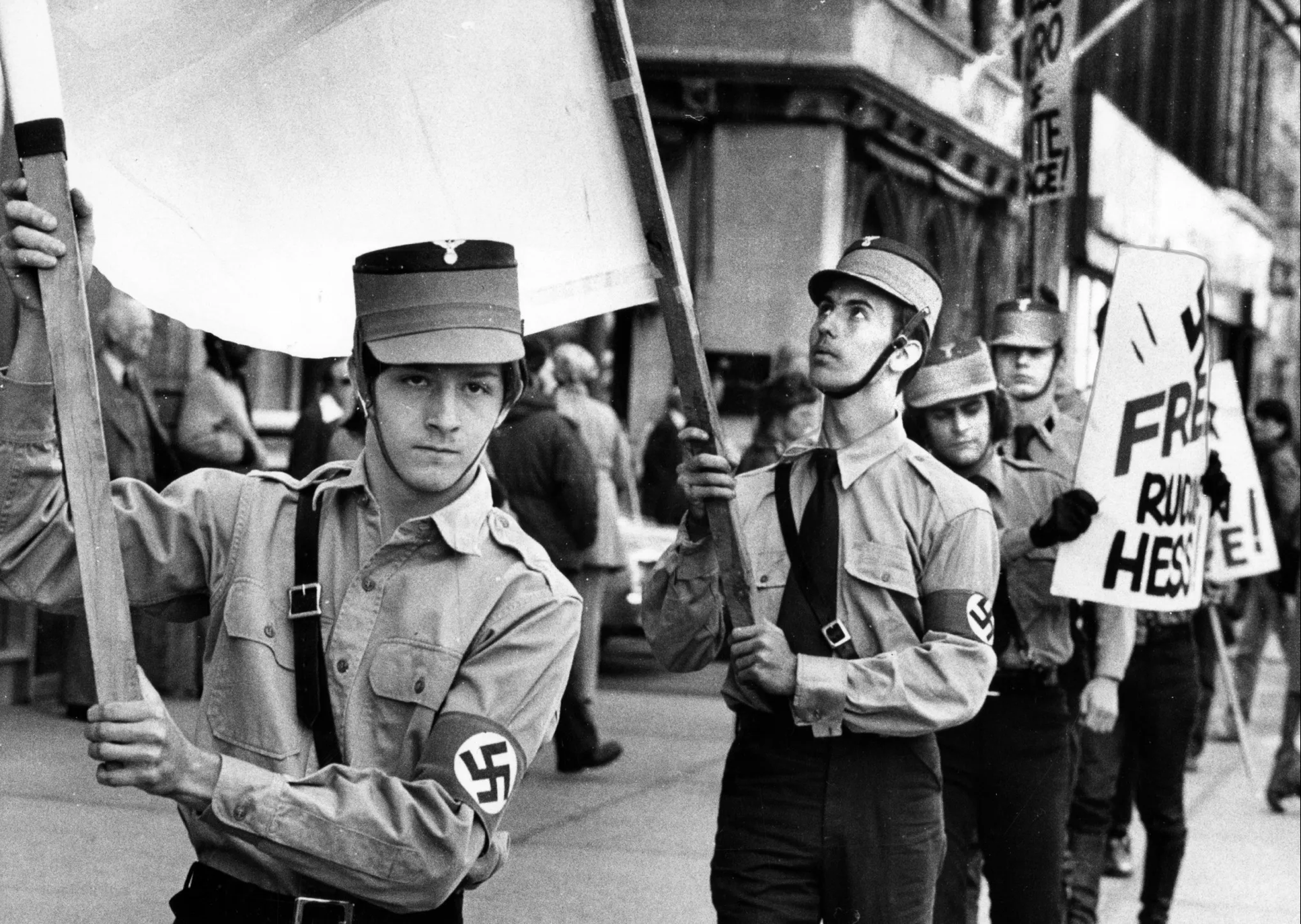
While police hold back onlookers, 12 members of the National Socialist Party of America protest the continued imprisonment of Rudolph Hess, a deputy under Adolf Hitler, on May 9, 1977. (Chicago Tribune)


Aug 23, 2025 6:39 PM
Updated Aug 24, 2025 12:28 AM
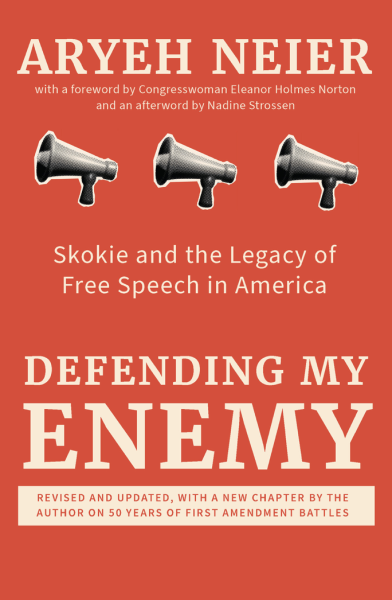
Defending My Enemy: Skokie and the Legacy of Free Speech In America by Aryeh Neier, with a New Foreword by Congresswoman Eleanor Holmes Norton and a New Afterword by Nadine Strossen (The New Press (2025))
The backbone of the Trump administration’s blizzard of chaotic, cruel, and corrupt attacks on our democracy is one of the most turbulent, disruptive, and consequential assaults on freedom of speech in American history.
On the very first day of his second term, Donald Trump had the audacity to sign a deceptive Executive Order entitled Restoring Freedom of Speech and Ending Federal Censorship, declaring that it was the policy of the United States to “secure the right of the American people to engage in constitutionally protected speech” and “ensure that no Federal Government officer, employee, or agent engages in or facilitates any conduct that would unconstitutionally abridge the free speech of any American citizen.”
Aside from being outrageously hypocritical, Trump’s EO was constitutionally flawed on its face. Every resident in the United States - citizen and non-citizen - enjoys the First Amendment’s protection of freedom of speech, freedom of the press, freedom of assembly, and the right to petition the government for redress of grievances.
But then Trump immediately violated his own EO. He and his obedient underlings have enlisted the full force of the federal government’s overwhelming criminal, civil, administrative, immigration, and national security authority to illegally crush protest, dissent, and free speech. On an unprecedented scale, directly and indirectly, Trump is violating the First Amendment rights of every person in the United States to express and receive information and ideas free of government censorship. He is going after the Voice of America, the Smithsonian Museum, the Associated Press, NPR, PBS, ABC, CBS, the Library of Congress, local public libraries, foreign and domestic students, immigrants, colleges and universities, elected officials, law firms, and judges. “Worse than McCarthyism” is what the preeminent historian Ellen Schrecker calls Trump’s attacks on universities.
Related stories
And by silencing all of these voices, he is denying the constitutional right of every American to hear what those voices have to say.
The United States is in a constitutional crisis. It is imperative that we vigorously defend our rights. The reissuance of the seminal book Defending My Enemy: Skokie and the Legacy of Free Speech in America could not have come at a better time to remind us of the importance of defending the freedom upon which all others depend – freedom of speech.
Yelling Fire in a Crowded Theater and Nazis Marching in Skokie
In many debates over free speech, you’ll hear two familiar statements: “You don’t have the right to yell fire in a crowded theater” and “the Nazis had no right to march in Skokie.”
Both statements are often little more than cocktail party banter, and both are wrong. But they do reveal the dilemma at the heart of the First Amendment. Why do we protect free speech? Is speech still protected if it causes harm or the risk of harm? Should the government be able to censor hateful speech before it actually causes any harm? Can political officials, with their own shifting agendas, be trusted to decide what is and is not protected speech? Why should the speech of Nazis be protected at all? If they were in power, wouldn’t they censor our speech? But can we punish Nazi speech without setting a dangerous precedent that could be used to censor the speech we approve of?
The debate over Nazis marching in Skokie is brought into these conversations to test the outer limits of free speech in America. Before that it was Communists (or Bolsheviks or Anarchists or Socialists or whoever was the focus of patriotic and propagandistic attacks at the time). Today, it’s Hamas. Tomorrow, it could be someone or something else. To deepen these conversations, we are fortunate that The New Press has decided to reissue Defending My Enemy: Skokie and the Legacy of Free Speech in America by Aryeh Neier, first published in 1979. At that time he was the national executive director of the American Civil Liberties Union, which represented the Nazis in the Skokie controversy. Defending My Enemy was a brave book when it was published, and almost 50 years later it remains an indispensable book to help us navigate today’s convulsive debates over free speech on American campuses and throughout our society. This edition is enhanced by a new foreword by Congresswoman Eleanor Holmes Norton, a new afterword by Nadine Strossen, president of the ACLU from 1991 to 2008, and an extensive new chapter by Neier himself offering his views on the contemporary challenges facing free speech in America.
Neier’s eloquent explanation of why the ACLU would defend the right of Nazis to march in Skokie, a predominantly Jewish city, builds on the tradition of robust protection for free speech that developed over the twentieth century, beginning in 1919, when Supreme Court Justice Oliver Wendell Holmes, Jr. wrote about yelling fire in a theater. He didn’t say you can’t ever do it; if there’s really a fire, then that is exactly what you should do. (And he did not say the theater had to be crowded.) What he actually wrote, in his 1919 opinion in Schenck v. United States, was that the “most stringent protection of free speech would not protect a man in falsely shouting fire in a theatre and causing a panic.”
So the first thing you need to tell that know-it-all at the cocktail party is that Justice Holmes would only deny free speech protection if two conditions both existed: 1) there is no fire and 2) the speaker actually caused a panic. If there really is a fire, then warning people is exactly what you should do. If there was no fire but no panic ensued, then no harm, no foul.
Holmes soon realized that he needed to clarify his views on free speech. Six months later, he and his protégé, Justice Louis Brandeis, issued an influential dissent in Abrams v United States. In that case, a group of Jewish anarchists had distributed two flyers in New York City denouncing President Woodrow Wilson as a hypocrite and a coward for sending American troops to Russia to help suppress the Bolshevik Revolution. The pamphlets declared, among other things, “Workers of the World! Awake! Rise! Put down your enemy and mine!" and "Yes! friends, there is only one enemy of the workers of the world and that is CAPITALISM."
The defendants were convicted under the Sedition Act of 1918 for conspiring with Germany to incite opposition to the US military operations in World War I. Five were sentenced to three to twenty years in prison. Several were deported to their native Russia after they served their time.
In a 7-2 decision, the Supreme Court upheld all the convictions, citing Holmes’ recent decision in Schenck. But Holmes and Brandeis dissented, asserting that the defendants did not pose a “clear and present danger” to the United Sates and were instead convicted "not for what the indictment alleges but for the creed that they avow." Holmes wrote one of the most compelling pleas for freedom of speech that is as relevant today as it was over a hundred years ago:
Persecution for the expression of opinions seems to me perfectly logical. If you have no doubt of your premises or your power, and want a certain result with all your heart, you naturally express your wishes in law, and sweep away all opposition... But when men have realized that time has upset many fighting faiths, they may come to believe even more than they believe the very foundations of their own conduct that the ultimate good desired is better reached by free trade in ideas — that the best test of truth is the power of the thought to get itself accepted in the competition of the market, and that truth is the only ground upon which their wishes safely can be carried out.
Holmes and Brandeis would be vindicated fifty years later in the case of Brandenburg v. Ohio. Clarence Brandenburg, a Ku Klux Klan (KKK) leader was convicted of violating Ohio's criminal syndicalism statute, which prohibited "advocat[ing] ... the duty, necessity, or propriety of crime, sabotage, violence, or unlawful methods of terrorism as a means of accomplishing industrial or political reform" and "voluntarily assembl[ing] with any society, group or assemblage of persons formed to teach or advocate the doctrines of criminal syndicalism.” At a 1964 KKK rally in Hamilton County, Ohio, Brandenburg spoke to several men wearing robes and hoods, some carrying firearms. He called for "revengeance" [sic] against "black peoples," "Jews," and their supporters. He also claimed that "our President, our Congress, our Supreme Court, continues to suppress the white, Caucasian race.” He announced plans for a march on Congress to take place on the Fourth of July. In another speech at the same rally, he urged that African Americans be expelled to Africa and Jewish Americans to Israel.
Without dissent, the Supreme Court overturned Brandenburg’s conviction. It held that “the constitutional guarantees of free speech and free press do not permit a State to forbid or proscribe advocacy of the use of force or of law violation except where such advocacy is directed to inciting or producing imminent lawless action and is likely to incite or produce such action.”
We learn in the new foreword to Defending My Enemy that Congresswoman Norton was part of the legal team that defended Brandenburg. She asks: “As an African American woman and civil rights activist who grew up during segregation and engaged in protests for my fundamental freedoms, why would I defend people who advocated against my rights?” Her answer: “Principle.”
Neier gives the very same answer for defending the Nazis.
Defending Myself by Defending My Enemy
Aryeh Neier was born in 1937 in Berlin, a city then under Nazi control. His parents were Polish Jews who had moved to Germany after World War I. His father Wolf (to whom he dedicates his book) taught Hebrew at the Berlin Jewish Community center. His family escaped to England in 1939, only days before the outbreak of World War II. Neier would later learn that almost everyone in his family was murdered by the Nazis. He makes very clear that he is describing his background “to suggest why I am unwilling to put anything, even love of free speech, ahead of detestation of the Nazi.” But he is equally clear that he could not bring himself to advocate for freedom of speech in Skokie “if I did not believe that the chances are best for preventing a repetition of the Holocaust in a society where every incursion on freedom is resisted.” He acknowledges that “freedom has its risks.” but “suppression of freedom, I believe, is a sure prescription for disaster.”
Neier does an excellent job describing how the Weimar Republic abandoned its moral authority and ushered in the rise of Adolph Hitler by suppressing free speech; the rise of white supremacy in America; the development of the American Nazi movement; the details of what happened in Skokie; the admirable role played by the ACLU; the misguided backlash it received; the consistent vindication it has secured in the courts; and the ongoing challenges we face in upholding the First Amendment in the face of inflammatory and politically motivated calls to punish and suppress the free speech of the enemy du jour.
As Neier explains, Frank Collin joined the American Nazi Party in 1965. Despite his vigorous denials, Neier believes it likely that his father Max (who changed his name from Cohn to Collin in 1946) was a Jew who survived imprisonment for three months in the Dachau concentration camp. Frank was apparently estranged from his father by the time of the Skokie controversy, and his mother was reared as a Catholic.
In early 1977, Collin sent letters to a dozen Chicago suburbs seeking permits to hold demonstrations in their public parks to promote white power. Unlike most of the cities, Skokie took the bait and advised the Nazi leader he would have to post $350,000 in insurance as a condition of securing a permit. Collin replied by telling the city that he planned to hold a demonstration without a permit in front of the village hall on Sunday, May 1. Four days before the scheduled event, Skokie filed a petition in the county court seeking to enjoin the Nazi gathering.
Collin was already represented at that time by David Goldberger, legal director of the Illinois ACLU, in a separate challenge to the Chicago Park District, which was requiring a $250,000 insurance bond to hold demonstrations at Marquette Park. Without hesitation, Goldberger, an experienced First Amendment lawyer and himself a Jew, agreed to represent Collin in the Skokie case.
On April 28, a county judge enjoined the Nazi demonstration on Sunday, May 1, finding that the Nazis, by displaying the swastika and distributing their “repulsive” pamphlets, would “incite or promote hatred against persons of the Jewish faith or ancestry or hatred against persons of any faith or ancestry, race or religion.” The next day the Illinois Appellate Court denied Goldberger’s request to stay the injunction. Late that afternoon, Collin told the press that since the judge had only enjoined the May 1 event, he was going to march on April 30. That morning, without Goldberger being present, Skokie’s lawyers convinced a different county judge to extend the injunction to April 30 “or any time thereafter pending further order of this Court.”
On May 2 and 3, Skokie adopted three ordinances: one requiring a $350,000 public liability insurance bond; a second, making it a crime to disseminate any “markings and clothing of symbolic significance” that “promotes and incites hatred against persons by reason of their race, national origin, or religion;” and a third, prohibiting anyone from engaging in any public demonstration “as a member or on behalf of any political party while wearing a military uniform.”
The Illinois courts were slow-walking Goldberger’s efforts to stay the injunction, so on June 14 he secured an emergency order from the US Supreme Court directing the state courts to expedite a decision.
Meanwhile, after Skokie denied a new permit application Collin had filed for a Fourth of July demonstration, Goldberger filed a separate lawsuit in federal court seeking to invalidate the three Skokie ordinances. Collin didn’t go ahead on July 4, but on July 12, the Illinois Appellate Court modified the injunction to allow the Nazi march to go forward but without displaying the swastika. In September, the case was argued in the Illinois Supreme Court.
On January 27, 1978, in a historic 6-1 decision, the Illinois Supreme Court ruled entirely in favor of the Nazis’ right to march and to wear uniforms bearing the swastika emblem. While “offensive to the principles of a free nation or the memories it recalls may be,” the swastika is “symbolic political speech intended to convey to the public the beliefs of those who display it.” Given “the heavy presumption against the constitutional validity of a prior restraint,” the fact that the swastika is “abhorrent to the Jewish citizens of Skokie” does not justify enjoining the Nazi’s speech.
Shortly thereafter, in the federal case, US District Judge Bernard M. Decker issued a fifty-five page decision declaring all three Skokie ordinances unconstitutional. He found that the insurance requirement imposed “a virtually insuperable obstacle to the free exercise of First Amendment rights.” He found that the other two ordinances were vague and overbroad, and improperly imposed an unconstitutional prior restraint on speech. He also found that the prohibition on wearing military-style uniforms violated the First Amendment, which “embraces the freedom to advocate even that the government ought to be violently overthrown, let alone that it out to be controlled by civilians.” Finally, he held that political speech could not be subjected to the “community standards” of “morality and decency” which were applicable to explicit sexual material.
In his powerful decision, Judge Decker recalled one of Justice Holmes’s most trenchant defenses for robust protection of free speech:
If there is any principle of the Constitution that more imperatively calls for attachment than any other it is the principle of free thought - not free thought for those who agree with us but freedom for the thought we hate.
The decision was a complete vindication for the ACLU and for Neier”s vision of the First Amendment. On May 22, 1978, the Seventh Circuit Court of Appeals quickly affirmed Judge Decker’s decision, and less than a month later the Supreme Court, on a vote of 7-2, denied Skokie’s request for a stay.
In a little-known postscript, having squeezed as much publicity out of the situation as possible, Collin cancelled the Nazis’ march in Skokie. Instead, about twenty Nazis held a brief demonstration in Chicago. The next day in Skokie, a larger group of several hundred, exercising their First Amendment rights, gathered in front of the village hall and held a peaceful memorial service for the victims of the Holocaust.
The First Amendment couldn’t have, then and now, a better defender than Neier. His personal story is compelling and his professional credentials are impeccable. We would completely understand if someone who escaped Nazi Germany and had lost much of his family in the Holocaust would want to silence Nazism by any means necessary. Instead, Neier became executive director of the ACLU, after which he co-founded Human Rights Watch, served as president of the Open Society Institute, and wrote seven books and over three hundred articles and op-eds on civil and human rights. Throughout his remarkable career he learned and advocated that in a society of laws, rights won on behalf of Brandenburg and the Nazis “are of direct value to civil rights demonstrators and war opponents.” And the reverse is also true. “Deny free speech to Frank Collin in Skokie today and people with contrary views will lose some of their freedom.” When Neier takes pride in saying he has been “defending my enemies my entire career,” his meaning is very clear. He doesn’t defend what they say; he defends their right to say it.
In his new chapter, completed in January 2025, Neier marshals all of his insights on free speech to condemn the efforts of the Trump administration to deport foreign students such as Mahmoud Khalil for organizing pro-Palestinian protests and to cancel federal funding to universities such a Columbia for allegedly failing to protect students from antisemitism. Neier fears that the definition of antisemitism is being stretched beyond illegal discrimination of Jews for being Jews to encompass constitutionally protected criticism of Israeli government policies. “The blatant violation of constitutional norms in the administration’s attempt to punish a leading academic institution for tolerating freedom of speech on controversial issues warrants outspoken denunciation.”
In her timely new Afterword, Nadine Strossen, herself the daughter of a Holocaust survivor, emphasizes that the importance of Defending My Enemy lies in how it is “both timeless and timely.” She firmly agrees with Neier that “tolerance of free speech even for intolerant views is actually not paradoxical, because in the long run such tolerance is more likely to protect civil liberties and minority groups than the censorial alternative.” In making her persuasive case that the antidote to hate speech is more speech, not censorship, Strossen points out in the 2009 the Holocaust Museum and Education Center opened in Skokie. She expresses confidence that the museum embodies the core message of Neier’s book that “we must not only defend free speech for the enemies of human rights; we must also use our own free speech to promote all human rights for all people.”
As a member of a vulnerable community, Neier wants “restraints on power.” The restraints that matter most include “restraints that prohibit those in power from interfering with my right to speak, my right to publish, or my right to gather with others who also feel threatened.”
“Those in power must not be allowed to prevent us from assembling and joining our voices together so we can speak louder and make sure that we are heard.” From personal experience, Neier has learned the valuable lesson that to “defend myself, I must restrain power with freedom, even if the temporary beneficiaries are the enemies of freedom.” This is truly a lesson we all must learn – and relearn – in order to ensure the protection of a democratic society.
Comments

Powered by RoundtableAn AI/DeFi-powered Enterprise Media Operating System. Learn more at Roundtable.io.© Roundtable 2026. By using this site you agree to the Terms of Use and Privacy Policy