


Jul 3, 2026 8:24 PM
Updated Jul 4, 2026 12:51 AM
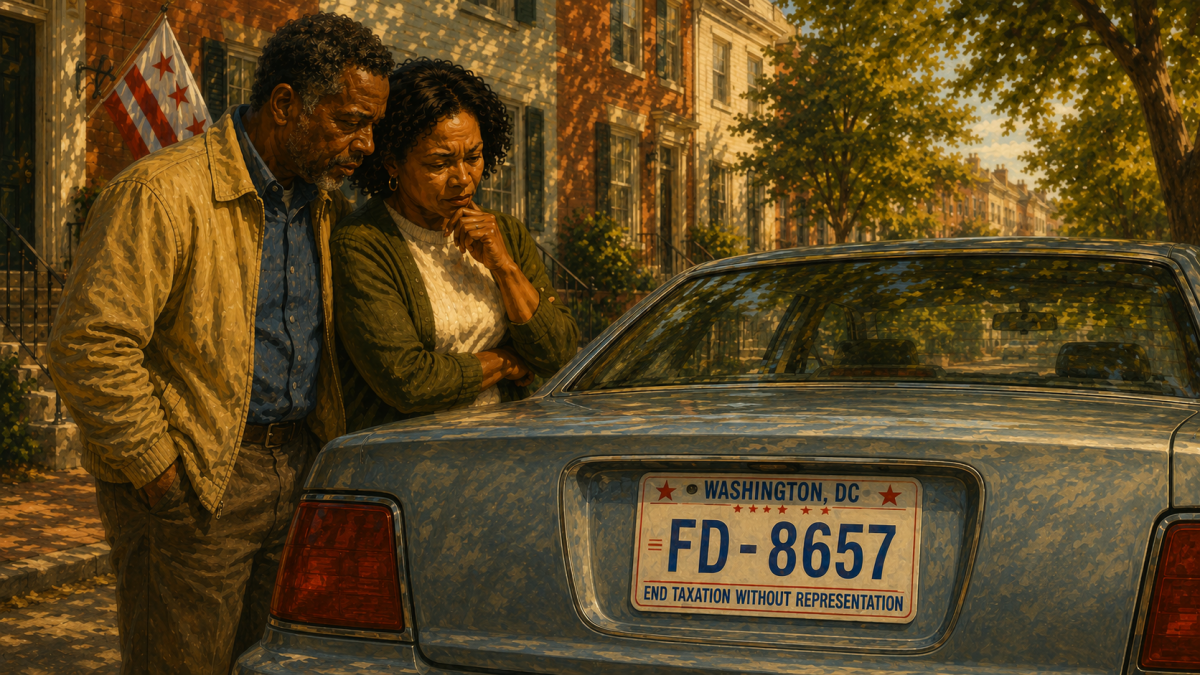
The residents of the nation’s capital fulfill the obligations of citizenship without receiving the full political rights enjoyed by Americans in every state.
With the United States commemorating its 250th birthday this weekend, the one Revolutionary War-era slogan that resonates most for me is “No taxation without representation.”
That’s because I live in Washington, D.C.
You may remember from grade school that that famous slogan gained currency in the 1760s in response to Great Britain’s attempt to tax the colonists without affording them representation in the British Parliament. Founding Father Samuel Adams, now probably best known for having a beer named after him, was furious. “If taxes are laid upon us in any shape without ever having a legal representative where they are laid,” he asked, “are we not reduced from the character of free subjects to the miserable state of tributary slaves?”
Now, I would not go as far to say that I have been reduced to the miserable state of a tributary slave—which even back in Adams’ day was a bit over the top—but I can say that, as a longtime resident of our nation’s capital, Washingtonians—American citizens who pay federal taxes and serve in the military—do not have full voting representation in Congress nor the power to stop Congress from meddling in our local affairs. Some activists in D.C.’s ongoing struggle for self-governance call the District “the last colony.”
Related stories
D.C. voices have been silenced
The roots of D.C. residents’ disenfranchisement go back to the early days of the nation. Article 1 of the U.S. Constitution includes the District Clause, which empowered Congress to establish a federal capital district no larger than 10 miles square where it would “exercise exclusive legislation in all cases whatsoever.” The rationale? As defined by James Madison in Federalist No. 43, the national seat of government should not depend on any state government for protection or authority. But Madison also wrote that the citizens in the federal district “will have had their voice in the election of the government which is to exercise authority over them.”
It was not to be. The framers of the Constitution left out a way for the district’s future residents to have representation. The Constitution allocated seats in Congress and Electoral College votes to states, but the District was not a state. After President George Washington chose a site on the Potomac River for a permanent capital, the District of Columbia Organic Act of 1801 granted Congress the exclusive jurisdiction over the territory carved from Maryland and Virginia, taking away the voting rights of the residents who had been living there previously.
Not only were the residents of the capital deprived of representation in Congress, they also could not vote for president until Congress approved the 23rd Amendment in 1960, which granted D.C. the same number of electoral votes as the least populous state, and states ratified it the following year. They also were not able to elect a nonvoting delegate to the U.S. House of Representatives until 1970, when Congress passed District of Columbia Delegate Act. And they were allowed to elect their own mayor and city council for the first time since 1874 when Congress passed the Home Rule Act in 1973. For 100 years, Congress and commissioners appointed by the president directly governed the city.
None of those gains would have happened without constant pressure from residents, which intensified during the civil rights era of the 1950s and 1960s. In 1979, Washingtonians nearly achieved what they wanted when both houses of Congress passed the D.C. Voting Rights Amendment, which would have granted Washington the same status as a state, with voting representation in both the House and the Senate. Unfortunately, only 16 states ratified the measure, well short of the 38 needed to take effect.
More recent efforts to achieve statehood have also failed. The House passed H.R. 51 in 2020 to make the District a state with two senators and a House member, but it died in the Republican-led Senate. A year later, a national poll found that 54 percent of likely voters said D.C. should be a state and the House again passed the bill. But once again it languished in the Senate, never coming to a vote.
D.C. residents are second-class citizens
Today nearly 700,000 people live in Washington, D.C., more than the populations of Vermont and Wyoming. Despite their size, each of those states has two senators and one representative in Congress. By contrast, D.C. has no senators and only one delegate in the House. D.C. Del. Eleanor Holmes Norton, who is retiring at the end of this term after 35 years in Congress, can introduce legislation and participate in House committees, but she cannot vote.
Regardless, Congress keeps its thumb on the city. At the same time the Home Rule Act gave Washingtonians the right to have a mayor and 13-person city council, it granted Congress and the executive branch broad authority over the city’s budget and the right to review and nullify any of the council’s legislation. For example:
- Congress blocked D.C. from establishing a regulated recreational marijuana market after voters approved an initiative in 2014. As a result, possession is legal, but Congress has prevented the District from creating the kind of regulated stores that exist in many states.
- In 2023, Congress overturned the D.C. Council’s revised criminal code.
- In 2025, the House voted to repeal police-accountability and noncitizen local-voting laws.
- In February, the House voted to reverse the D.C. Council’s decision to reject of some of Donald Trump’s tax policies, which some states did, potentially costing the city about $600 million through 2029.
- In March, a House committee advanced a bill that would prohibit D.C. from using traffic cameras to catch and fine reckless drivers, even though many of the districts they represent use them.
The District’s status also has prevented it from receiving its fair share of federal funding. When Congress passed a coronavirus relief package in March 2020, for example, the District lost out on millions of dollars in federal aid because Congress considers it a U.S. territory, not a state.
The president’s control over local affairs extends to deploying the D.C. National Guard. Unlike the governor of a state, D.C.’s mayor cannot mobilize the troops without the approval of the federal government while the president can deploy them at will. In June 2020, in the aftermath of the murder of George Floyd by Minneapolis police officers, President Trump deployed D.C. National Guard troops to suppress a peaceful Black Lives Matter rally. Conversely, after Trump incited a mob to storm the U.S. Capitol on January 6, 2021, to stop Congress from certifying Joe Biden as president, he refused to activate the guard to secure the Capitol. Help would have likely arrived sooner if the District’s mayor had authority over the guard.
Last August, Trump went so far as to take over the D.C. police department, albeit briefly. It was the first time a president invoked a Home Rule Act provision permitting such an action in the event of a public safety emergency. But there was no emergency. Violent crime in D.C. was at a 30-year low, according to official statistics. Under the Home Rule Act, the emergency police authority is limited to 30 days unless Congress acts. Congress did not extend it and it expired a month later.
At the same time Trump took over the D.C. police, he deployed the D.C. National Guard on the streets of D.C. and directed the Defense Department to send National Guard troops from willing states to the capital. “I’m announcing a historic action to rescue our nation’s capital from crime, bloodshed, bedlam and squalor and worse,” Trump said. “This is Liberation Day in D.C., and we’re going to take our capital back.” Troops came in from Mississippi, Ohio, South Carolina, West Virginia and other states. They are still here with nothing to do but hang around Metro stations, the National Mall, and upscale neighborhoods like mine.
Republicans stand in the way
One obvious reason Congress has consistently failed to grant the residents of Washington, D.C., the full political rights U.S. citizens in states enjoy is partisanship. If D.C. became a state, Democrats would most certainly gain two senators and one representative, and Republicans are adamantly opposed to that happening. If D.C. were a GOP stronghold, Republicans in Congress would likely be all for D.C. statehood.
Race also has played a significant role. Historically, D.C. has been a majority Black town.
On August 4, 1965, the very day Congress passed the Voting Rights Act, Rev. Martin Luther King Jr. braved Nazi picketers and bomb threats to address Black Washingtonians. “You don’t have freedom in Washington,” King said, “because you can’t vote [except in national elections]. If you don’t know why they don’t want you to vote, I’ll tell you. It’s because the District of Columbia is 55 to 60 percent Negro, and they know you will elect some Negroes to high public office.” King explained that “they” were Southern members of Congress who were blocking home rule legislation and urged the crowd to launch an “all-out nonviolent movement for home rule.”
Very few Republicans have supported D.C. statehood, but some have supported giving D.C. residents voting representation in Congress, most notably Richard Nixon. “It should offend the democratic sense of this nation that the citizens of its capital,” Nixon said, “. . . have no voice in Congress.” Nixon signed the law creating D.C.’s nonvoting House delegate in 1970, describing it as only a first step and reiterating that “voting representation for the District of Columbia is my goal.”
Thanks for reading Money Trail. This post is public, so please share it with your friends.
The District of Columbia Republican Party is an outlier. It fully understands the implications of taxation without representation. “The District of Columbia must either become a state or its residents must be exempt from federal income taxes,” it argued in its 2020 platform. “. . . Without voting representation, we demand NO TAXATION.”
As patriotic as it is, that argument continues to fall on deaf ears in Congress. H.R. 51, the Washington, D.C. Admission Act, and its companion bill in the Senate are still in play, but they are going nowhere. Given how difficult it is for this Congress to agree on anything, and given if it miraculously does agree on something (like the overwhelmingly bipartisan housing bill), Trump will likely torpedo it, the prospects for D.C. statehood legislation this session are dim.
The House bill, which D.C. Del. Norton reintroduced in January, has more than 200 cosponsors and has been referred to the House committees with jurisdiction over the legislation. As of today, it has not received a committee hearing or House floor vote. Maryland Sen. Chris Van Hollen reintroduced the bill in the Senate in January. It currently has 43 Democratic and independent cosponsors and has been referred to the Senate Committee on Homeland Security and Governmental Affairs. It is still sitting there, collecting dust.
So, when the National Park Service launches more than 850,000 fireworks (mostly from China) over the National Mall on July 4—120 times more than the 7,000 fireworks it set off last year—and sprays soot and heavy metal pollution into the air, I will be watching at a safe distance, but I won’t be celebrating.
Comments

Powered by RoundtableAn AI/DeFi-powered Enterprise Media Operating System. Learn more at Roundtable.io.© Roundtable 2026. By using this site you agree to the Terms of Use and Privacy Policy