
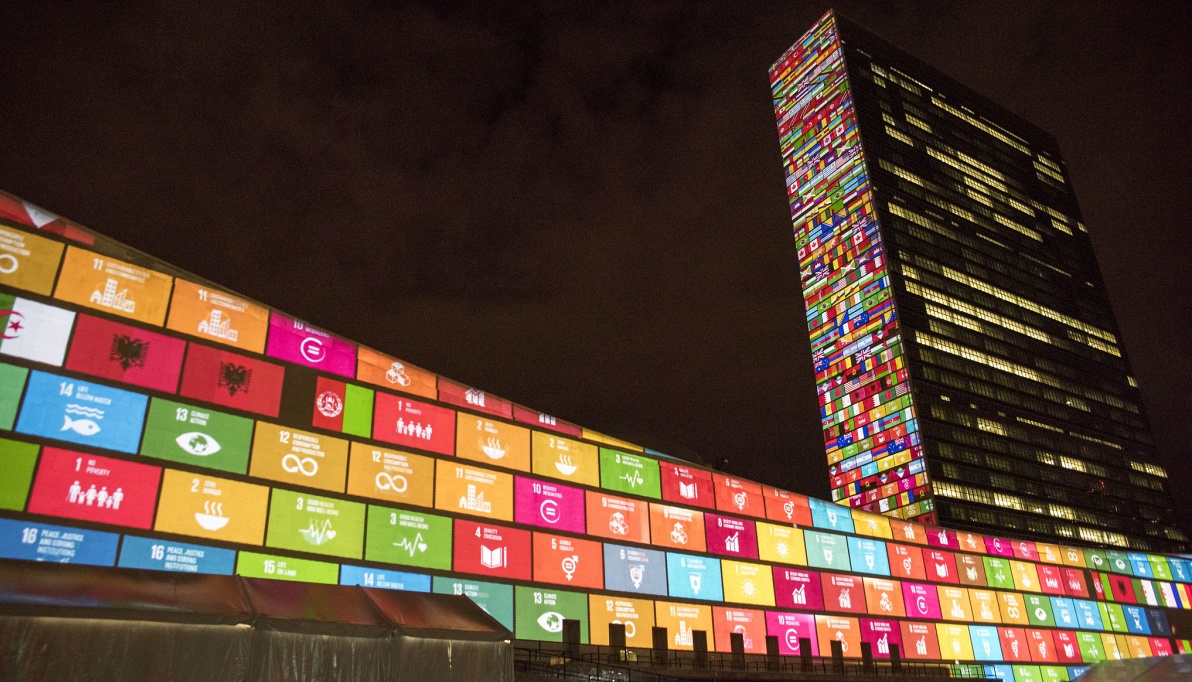
Projections on Sustainable Development Goals and 70th Anniversary of the United Nations • Flickr • Attribution-NonCommercial-NoDerivs (CC BY-NC-ND 2.0)


Oct 22, 2023 1:00 PM
The United Nations Universal Declaration of Human Rights states in Article 19, “Everyone has the right to freedom of opinion and expression.”
Buried in the avalanche of horrific news this week—of war, ethnic cleansing, earthquakes, political dysfunction and a possible pending start to genocide, was the October 17th surprise announcement of the Westminster Declaration by 138 international artists, journalists, activists and academics. Their statements, based out of a conference held in June of 2023 is pointing us toward the very real threat posed to the world order and indeed, democracy itself, by the “censorship industrial complex”.
In fact, the timing of this release was quite prescient as we are seeing this censorship play out in real time in the heated emotional debate about the current Israel-Hamas war, Just the day before the announcement, The Intercept reported about NYU law student Ryna Workman losing both a job offer and a her position as student body President for a newsletter expressing “solidarity with Palestinians.” That same day J Street, the supposed “pro-Israel, pro peace” lobby, threatened to withhold endorsements from Congressional members after promoting a resolution calling for support in the war on Gaza, or else. A Democratic staffer, quoted anonymously, put it this way, “Those of us staffers who have Palestinian family—or are Palestinian themselves—are totally abandoned here.”
How did we get here? Writer and founder of Environmental Progress, Michael Shellenberger, testified in March 2023 to the House Select Committee on the Weaponization of the Federal Government like this:
“The censorship industrial complex combines established methods of psychological manipulation, some developed by the U.S. Military during the Global War on Terror, with highly sophisticated tools from computer science, including artificial intelligence.The complex’s leaders are driven by the fear that the Internet and social media platforms empower populist, alternative, and fringe personalities and views, which they regard as destabilizing. Federal government officials, agencies, and contractors have gone from fighting ISIS recruiters and Russian bots to censoring and deplatforming ordinary Americans and disfavored public figures. Importantly, the bar for bringing in military-grade government monitoring and speech-countering techniques has moved from ‘countering terrorism’ to ‘countering extremism’ to countering simple misinformation. The government no longer needs a predicate of calling you a terrorist or extremist to deploy government resources to counter your political activity. The only predicate it needs is simply the assertion that the opinion you expressed on social media is wrong.”
Related stories
The signatories of the declaration themselves, which include U.S.-born political dissidents Glenn Greenwald, Edward Snowden and Australian born Julian Assange, point out that the United Nations Universal Declaration of Human Rights, drafted in 1948 and now in its 75th anniversary year, states in Article 19, “Everyone has the right to freedom of opinion and expression.”
This right is at stake—here in the United States, most certainly in authoritarian regimes and conflict zones, but most especially in the digital world where we cannot even see the way that the censors operate. From the Westminster declaration, these include: “filtering, labelling, manipulation of search engines” as well as, “deplatforming and flagging”. Content moderation should worry us all, as should the expansion of these powers off social media platforms and into the end-to-end encrypted messaging apps like WhatsApp, Signal and Telegram. The signatories warn us that is what is coming next if we do not act to protect free speech.
As a democracy and peace activist, I cannot fathom how quickly we got here. As someone who has paid a very heavy personal price for standing up to the State (in the form of stalking, harassment and bullying in real time—not online), I knowingly sacrificed my own personal safety for that of the collective in November 2020. The information war now being waged is a much more private struggle and the potential for the “administration of evil”, in the words of Phillip Zimbardo, is-in my estimation—exceedingly high.
Here’s what I’ve done personally—out of necessity, but it has also preserved me from the thought police now policing our digital spaces. Though this list isn’t comprehensive, in the context of today’s culture, it has proven to be quite radical.
- I shut down all my social media, even LinkedIn.
- I changed my own personal media diet completely. I no longer trust that mainstream media sources are unbiased.
- I support my grassroots investigative journalists. Without entities like this publication, The Intercept, the PBS NewsHour and Democracy Now!, I’d be lost.
- I am constantly finding new affinity groups and activating, with as many people and causes as will have me as possible.
As these 138 individuals across party lines, geopolitical boundaries and academic disciplines tell us, the war for our intellectual freedom as humanity is ON. I know whose side I am on and hint: it is NOT with the censorship State.
Join us! We need you, no matter what your political persuasion, opinion or cause. This is the beauty of true democracy—freedom of speech. In my dreams, I sometimes return to Sproul Plaza and watch the debates I used to go see for fun on my lunch hour. When I wake from this, I always realize how lucky I was to be a student at a University of Berkeley campus not yet tainted by the nefarious intentions of the digital surveillance state.
Comments

Powered by RoundtableAn AI/DeFi-powered Enterprise Media Operating System. Learn more at Roundtable.io.© Roundtable 2026. By using this site you agree to the Terms of Use and Privacy Policy