
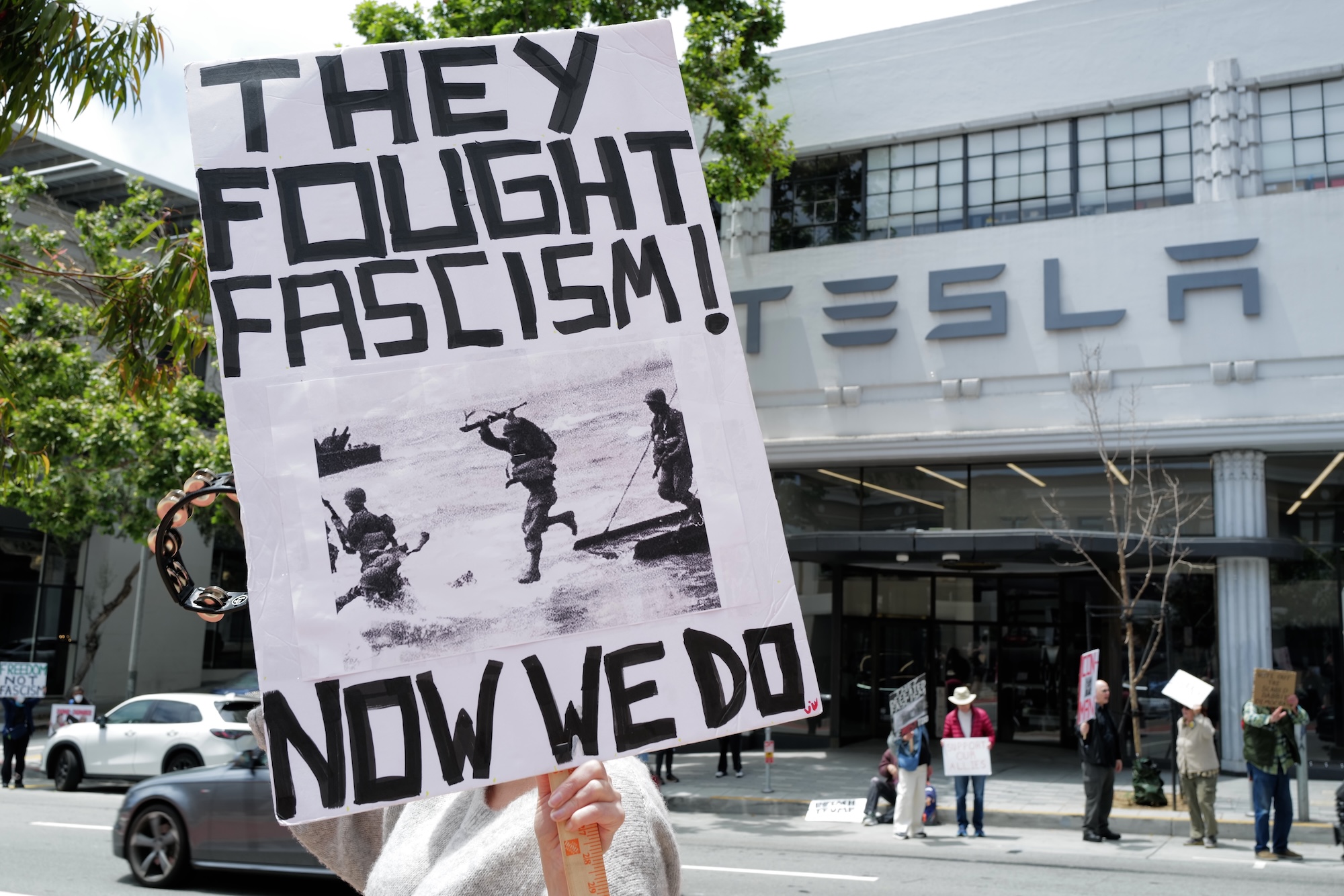
A protester at Tesla Takedown holds a sign reminding that Fascism is an ever present danger that must be resisted at all costs.


Jul 2, 2025 4:44 PM
From Istanbul and Budapest to Aleppo and Khartoum, authoritarians are attacking their most independent cities.
I was scheduled to visit Ukraine this week, but didn’t have to make the trip. Because the same war I would have observed there had already arrived in my hometown of Los Angeles.
World War III is well underway. Contrary to popular belief, this war is not a global contest between hegemons, or even between alliances of nations.
World War III consists of near-constant assaults by violent and authoritarian national governments on cities, usually their own, for the crime of governing themselves differently than autocrats might like. Such attacks are a feature of dozens of armed conflicts around the globe.
To Americans, the Trump administration’s lawless attacks on Los Angeles might seem shocking. We are not accustomed to seeing the federal government ignore the law to send thousands of troops to police Americans. We’ve never heard a president authorize roving bands of masked and unidentified federal stormtroopers to arrest anyone who looks like an immigrant. Nor have we experienced federal administrations seeking to imprison elected local leaders who are their political opponents.
Related stories
But if you look around the planet, the Battle of Los Angeles appears familiar.
World War III’s hottest spot may be Turkey, where the autocratic President Recep Tayyip Erdoğan has been sacking local governments. In recent years, he has removed members of opposition parties as part of a larger war against democracy. Last fall, he replaced the elected mayors of Batman, Mardin, and Halfeti, all in Kurdish-majority regions, with his own cronies.
This spring, the war came to Istanbul, with the arrests of the popular mayor Ekrem Imamoglu,senior staff of the Istanbul Metropolitan Municipality, leaders of several city districts, some city contractors, and thousands of residents who protested the actions in the street.
Imamoglu is accused of corruption, but Turks see those charges as political. Imamoglu’s real crime was defeating Erdoğan’s party in three municipal elections and governing so well that he was leading Erdoğan in presidential polls. The decapitation of Istanbul’s leadership has disrupted local management and service, with the city “effectively rendered inoperable,” according to senior lawmaker Gokhan Gunaydin.
In this, Turkey embodies a global dynamic. National governments fail to resolve their people’s problems, big and small. To remain in power, they turn to authoritarianism, increase their power through fear, and sow political and violent conflict domestically. And they ignore the work of governance—maintaining infrastructure, running trains, delivering healthcare—which increasingly falls to local leaders.
You might think that national regimes would thank localities that step up and take on governance responsibilities. But it’s a mean world, and national authoritarians tend to attack their most successful and independent cities—from Istanbul to Los Angeles, Chicago, and New York City.
An essential piece of the now-deposed Syrian dictatorship’s civil war was its destruction of Aleppo, previously the country’s most populous, wealthy, and intellectually and culturally distinguished city. Aleppo’s relative prosperity was a threat to the Assad regime.
Then there’s Russia’s war in Ukraine, which Vladimir Putin insists belongs to him. Ukraine’s democratic gains, and its vastly improved local governance, provoked Putin. In the war, the Russian regime has been most destructive in successful Russian-speaking cities in Ukraine’s east, most notably Mariupol, a major steel producer, port city, and center of culture and education.
Do the people of besieged cities have any chance of defeating the authoritarian nation-states that scapegoat and oppress them?
Ethiopia’s government, in its civil war with the Tigray region, has focused violence on the city of Mekelle, which was an independent-minded and rapidly growing cultural and economic center (and a 19th century capital). The Myanmar junta has repeatedly bombed its gloriously beautiful second city Mandalay, the former capital of the Burmese monarchy. Israel’s authoritarian government, in laying waste to Palestinian communities, has killed local officials and destroyed even successful local governments in Gaza and also in Lebanon.
Even in countries that are not at war, conflicts between authoritarian regimes and self-governing cities are ugly, and have the feel of war.
Hungary’s strongman ruler Viktor Orbán frequently targets the government and economy of his country’s capital city, Budapest. Orban’s assaults are mostly financial—including a June 4 decree that lowers the local business taxes for Orbán allies—a tax cut that would destroy the local budget. The national government has also increased the “solidarity tax” that Budapest pays to fund poorer municipalities and has violated court rulings to seize money from city accounts.
Effectively, Hungary is bankrupting Budapest, much as Trump has threatened to bankrupt Los Angeles and other U.S. cities by blocking federal funds. Orbán, said Budapest Mayor Gergely Karacsony, “want[s] to push the city to the brink of an abyss. The political intention to paralyze the capital’s operations is obvious.”
Authoritarian nation-states are more frequently detaining local leaders, often under the pretext of fighting corruption. Allies of India’s authoritarian-nationalist leader, Narendra Modi, a champion of local governance when he was a state governor, last year revoked the autonomy of Muslim-majority Jammu and Kashmir and dissolved its local assembly. Modi’s allies also jailed and then forced out Delhi’s longtime chief minister, Arvind Kejriwal, a linchpin of an opposition alliance that includes other city leaders.
“We have to save this country from dictatorship,” Kejriwal said after his detention last year.
Indonesia’s president, Prabowo Subianto, has accelerated a practice of replacing local leaders with military officials. Prabowo is also proposing to end local elections altogether and is preventing his country’s future capital, Nusantara, from having its own local government.
For some regimes, destroying local self-governance is not enough. China, after dismantling Hong Kong’s self-rule, is hunting Hong Kong officials and activists wherever they have fled. (China also has spent decades systematically destroying self-governing local communities in Tibet and Xinjiang.) Nation-states have fueled overseas civil wars that destroy cities; the worst example is the Sudanese capital of Khartoum, now a ruin via a civil war involving Egypt, Saudi Arabia, the United Arab Emirates, Ethiopia, Eritrea, South Sudan, Russia, China, and Turkey.
In the U.S., the World War rages not just in California. Florida’s authoritarian governor has removed local officials, and Texas’ right-wing government routinely cancels the democratic decision-making of its cities. Not to mention the MAGA-inspired assassination of locally elected state representatives in Minnesota.
Do the people of besieged cities have any chance of defeating the authoritarian nation-states that scapegoat and oppress them?
Yes. But it won’t be easy. It would require the residents of besieged localities, via technology-enabled collaborations and mutual aid, to transform their hometowns into stronger, higher-capacity city-states.
Before that can happen, the people protesting the mayor’s jailing in Istanbul, dodging bombs in Mandalay, or battling secret federal police in L.A. must make common cause.
Comments

Powered by RoundtableAn AI/DeFi-powered Enterprise Media Operating System. Learn more at Roundtable.io.© Roundtable 2026. By using this site you agree to the Terms of Use and Privacy Policy