
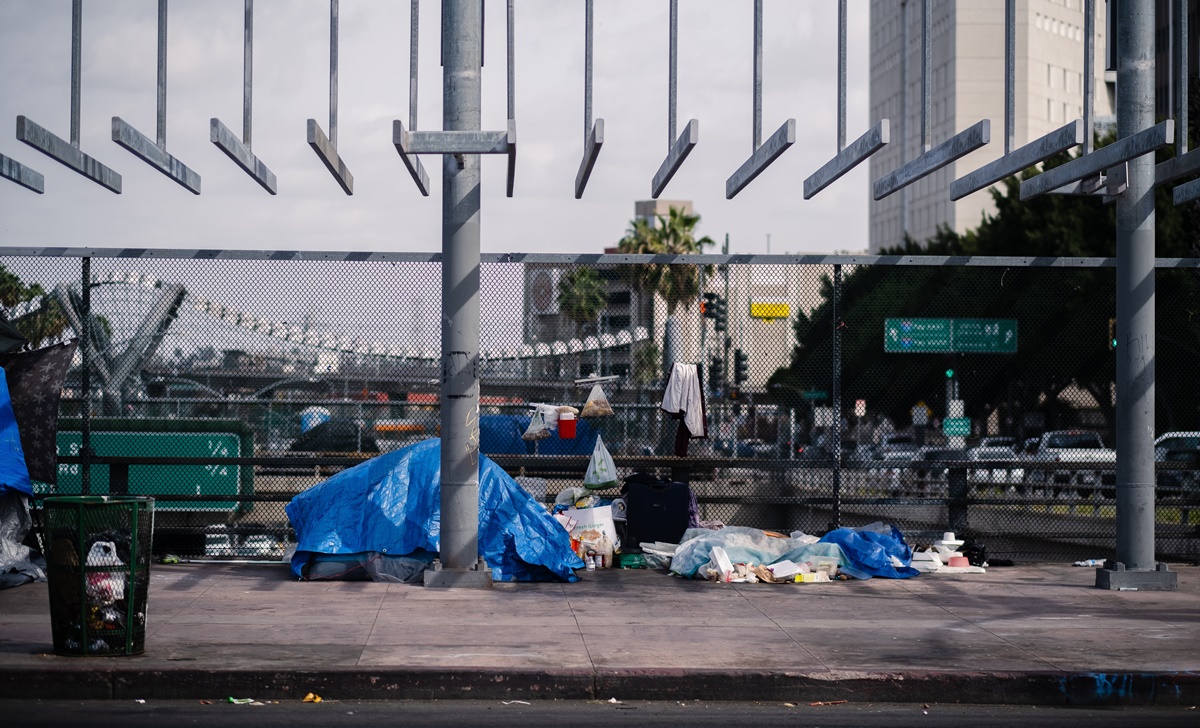
Photo of Downtown Los Angeles by Levi Meir Clancy


Nov 19, 2022 2:00 PM
Elected officials must be able to identify and then address the underlying causes of houselessness and growing poverty before they offer remedies
When they are sworn in, their campaign consultants’ carefully crafted negative ads and grandiose promises to solve houselessness and street crime will be forgotten.
As for growing poverty, mounting climate disasters, rampant white collar crime, and possible nuclear war, the gurus apparently advised the candidates to ignore these real world issues. This is almost understandable because there is not much that local officials could undertake on these major issues.
This is why I am pessimistic about elected officials taking the lead on substantive issues, but optimistic about solutions welling up from community groups directly dealing with houselessness, climate change, infrastructure, mass transit, gentrification and mansionization, urban forest, bicycle infrastructure, and related issues.
Why pessimism?
Neither Rick Caruso nor Karen Bass identified the basic causes of the urban housing crisis. In this regard, they are not that different from other candidates in the election. They delivered their lines well, but to provide answers to LA’s highest priority issue, houselessness, elected officials must be able to identify and then address underlying causes. They can’t just brush away symptoms, like the houseless encampments that the LAPD “sweeps” away, to curry short-term favor with fed-up constituents.
Related stories
This is what is missing from the City Hall’s approach to the worsening housing crisis.
Note: Since the writing of this article, Karen Bass was announced the winner of the mayoral race.
National Policies
Mayor Eric Garcetti’s recent epiphany that the causes of LA’s housing crisis are national in scope is only partially correct. True, there are at least three nationwide policies responsible for the increase in houselessness , but the other causes are strictly local.
- Federal public housing programs have been continuously eliminated since the early 1970s, beginning with the Nixon administration. At present the only remaining Federal government low-priced housing program is Section 8, through which rents in some private-sector rentals are reduced for lucky low-income tenants. In Los Angeles the waiting list for Section 8 rentals has 365,000 people. These applicants hope to win a lottery for 30,000 Section 8 vouchers. Nevertheless 20 – 30 percent of these winners will forfeit their vouchers when they fail to find an available Section 8 rental. As a result, only 7% of those eligible for Section 8 vouchers will manage to secure a subsidized rental.
- California shut down its 400 local redevelopment agencies in 2011. These agencies had been required to spend 20 percent of their budgets on subsidized low-cost housing. Their abolition ended the second remaining source of public housing funding.
- Controlling for inflation, wage levels have barely moved since the late 1960s. Since then economic inequality and housing costs have steadily risen. Nationally, “The top one-thousandth of the income ranking now gets about the same total income as the entire bottom 40 percent of the U.S. population.” This is why an increasing percentage of the American population, including Angelenos, are priced out of housing. The gap between stagnant wages and increased housing costs forces many people into overcrowded living conditions, cheaper housing markets, and houselessness.
Local causes of the housing crisis
In contrast to these three macro causes, there are many local causes and remedies that the Mayor, the City Council, and the Housing and Planning Departments steer clear of in deference to powerful real estate interests.
- In L.A. over 27,000 low-priced housing units have been lost through Ellis Act evictions. Tenant buy-outs also resulted in thousands of additional evictions. Once emptied, developers build luxury apartments at these site, usually through discretionary zoning waivers that legalize them. In Los Angeles this gentrification process is easily observed in many neighborhoods, like DTLA and Hollywood. As a result, the supply of existing low-priced housing continues to shrink despite a building boom.
- Compared to other major cities, like New York, Los Angeles has weak rent control. LA’s Rent Stabilization Ordinance (RSO) only applies to apartments built before 1978. Furthermore, in Los Angeles RSO apartments have vacancy decontrol. The only limit on rent increases is market conditions. As a result, rents of older apartments have increased faster than wages, and the number of rent stabilized apartments has continuously declined.
- Los Angeles does NOT have an inclusionary zoning If it did, new apartment buildings would automatically include inspected low-priced apartments. Instead, Los Angeles has two voluntary density bonus ordinances. The most common one, Transit Oriented Communities Guidelines (TOC), allows developers to exceed height and density rules in exchange for pledges to include low-priced housing in their new buildings. But no City ever physically inspects these residential projects to verify that promised low income units exist and are rented to vetted low-income tenants.
- Between 9,000 to 20,000 houses and apartments in Los Angeles are rented to visitors through AirBnB and other short-term rental businesses. This misuse of existing housing further reduces the supply of available affordable units.
- Large real estate companies buy apartments and houses as speculative investments, and then keep them off the market. The Vacancy Report identified 93,000 such vacant residential units in Los Angeles, twice the number of houseless people.
Until incumbent officials and their new colleagues deal with the causes of the housing crisis, houselessness will get worse in Los Angeles. This is because the nationwide policies and practices mentioned above, such as the end of HUD and CRA public housing, supplemented by evictions, weak rent control, and density bonus ordinances, are adopted at the behest of real estate speculators. The unpleasant side effects are demolitions and the replacement of former low-priced housing with expensive apartments. Not to worry though because City Hall accepts these outcomes as the “price of progress.” In other words, in LA growing houselessness is an acceptable tradeoff when City Hall pulls out the stops for real estate speculators.
Comments

Powered by RoundtableAn AI/DeFi-powered Enterprise Media Operating System. Learn more at Roundtable.io.© Roundtable 2026. By using this site you agree to the Terms of Use and Privacy Policy