



Killer Digs?
Nov 26, 2024 7:51 PM
Updated Nov 26, 2024 10:45 PM
Trucking warehouse planned for toxic site by Eastside school sparks outcry
For decades, businesses in Eastside and Northeast L.A. that polluted the air, soil, and water could operate without accountability for the consequences. Historical evidence shows some even set up shop in the area precisely for that reason.
But a fight now erupting over a proposed Xebec trucking warehouse on a highly contaminated site in Lincoln Heights shows that times are changing. Along with skilled coalition leaders raising awareness and activating residents in English and Spanish, a new generation of progressive elected officials, led by a local a school board member, is key to the shift.
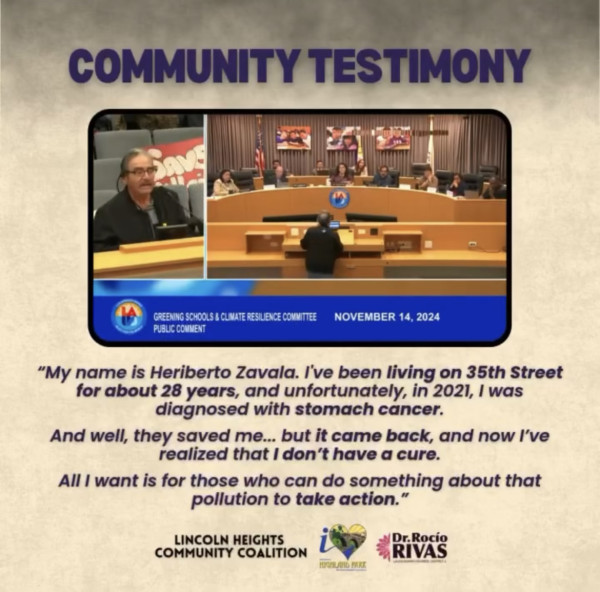
“A proposed 60,000-square-foot diesel trucking distribution center across from Hillside Elementary puts the health and safety of our children and community at risk,” announced Dr. Rocío Rivas, L.A. Unified’s Board Member for the 2nd District, in a bilingual message posted to social media on November 22. Rivas is leading a press conference near the school on Tuesday, November 26, at 4 pm that includes Hillside parents, neighbors, and community allies to highlight grave pollution dangers from the proposed project, at 3505 Pasadena Ave.
Rivas’ posting and an email alert from her staff to community members describes cancer-causing compounds, including trichloroethylene (TCE), that taint the site due to dry-cleaning chemicals dumped there for years by a previous company, Welch’s Uniform & Laundry. At a nearby site, the now-defunct metallics company American Caster Corp. also dumped chemicals into the sewer and stashed at least 252 barrels of toxic sludge, many of which leaked into the soil, in an underground cave discovered in 1984. In a rare case of accountability for egregious endangerment of the public, some officials with American Caster went to prison over the toxic dumping.
Related stories
TCE is one of the same deadly compounds implicated in the massive contamination of Eastside communities, including part of Boyle Heights and unincorporated East L.A., by the Exide battery-smelting company. For 90 years, including four decades operating on a temporary permit, the smelter polluted and deposited poisonous fallout including lead, chromium, and arsenic, onto neighborhoods surrounding its plant at 2700 S. Indiana St. in Vernon. At one ground well used to draw drinking water in East L.A., in the swath of toxicity inflicted by Exide, levels of TCE are 28 times the amount deemed safe and acceptable under federal standards.
The Exide hotspot now joins more than 1,000 locations nationwide of the most heinous environmental dumping and notorious corporate wrongdoing as a federal Superfund site. For a decade, L.A. County Supervisor Hilda Solis has led the fight to demand resources to address the thousands of homes and yards contaminated by Exide and the thousands of lives and life expectancies degraded and shortened due to decades of exposure.
In Lincoln Heights, digging and building at the site targeted by Xebec for a trucking warehouse would send similar carcinogens into the air. Hundreds of children and educators at the adjacent school would be most endangered. Also in harm’s way from the airborne toxins would be thousands of residents in the surrounding neighborhoods of Cypress Park, Montecito Heights, and Mount Washington. As Rivas concluded in her message to rally neighbors and allies, “Let’s fight for the safety and future of our community.”
New generation of progressive leader
Rivas, parent of a son in an Eastside junior-high public school, has both personal and professional devotion to safeguarding students’ health and stopping preventable pollution hazards at the source. Mentored by trailblazing public-school champion and social-justice leader Jackie Goldberg, Rivas carries a PhD from Columbia University and deep understanding of the disparities, including funding, nutrition, healthcare, and environmental dangers, that hinder student learning.
In 2022, Rivas won her first campaign for elected office. She inspired strong support from local parents fighting charter schools, the unions representing teachers and school professionals, and East Area Progressive Democrats (EAPD). With a skilled army of grassroots volunteers, she defeated a candidate who spent five times more money with backing by most local incumbent politicians. Adversaries of Rivas included all four of the officials caught on leaked audio in 2022 manipulating redistricting to deprive Black Angelenos of representation on City Council.
As it turns out, the Councilmember representing the site of the proposed massive trucking warehouse, at 3505 Pasadena Ave. in Lincoln Heights, is Eunisses Hernández. She defeated a politician, Gil Cedillo, heard on the recordings making crude comments about other groups of Angelenos while disparaging several Northeast L.A. communities as “white” and pushing to exclude them from his redrawn district.
Cedillo’s complaints echoed stereotypes of Anglo constituents as more insistent on responsiveness and follow-up by public officials over quality of life concerns and Latinos as more indulgent of indifference and even neglect of problems by officials and their staff. Such was the mindset of the candidate heard on the leaked audio whom Hernández defeated.
Hernández, like Rivas, came into office vowing to use her oversight power to challenge pollution that threatened residents of communities she represented. But as City Councilmember, Hernández possesses a direct and dispositive say over the land-use decision-making affecting Xebec. Getting her to use that power in full to stop the project is one aim of the community groundswell opposing the trucking warehouse.
It isn’t just cancer-causing chemicals in the soil that makes the proposed Xebec site such a pollution flashpoint. As EAPD wrote in its letter to Councilmember Hernández and to L.A. City Planning, “this monstrous ‘Beast in the Northeast’ project will … snarl traffic, worsen vehicle congestion, and degrade transit safety for these neighborhoods in ways that violate the terms of the mobility plan enacted into law by Angelenos in March 2024 with voters’ overwhelming approval of Measure HLA.”
The letter explained that people and communities around the Xebec site already endure heavy air-quality contamination that ranks in the very lowest decile, or bottom 10 percent, of state pollution indices. “To treat their health and wellbeing as expendable by ignoring the available evidence and compounding the damage and dangers to them,” the letter added, “is wrong.”
There are other uses for the site, EAPD points out, that do not portend harm to students, residents, and stakeholders or make future generations casualties of a bad planning decision now.
Eastside and Northeast L.A. residents are among the most park-deprived communities of L.A. County. Elected officials representing L.A. have more progress to make to address this woeful scarcity of accessible local greenspace, the result of disinvestment and past decisions that placed warehouses and diesel vehicles ahead of the voices and priorities of Eastside and Northeast L.A. residents.
Turning point for environmental justice
The fight over the trucking warehouse at 3505 Pasadena Ave. is one concrete way to redress that grievous, long-term injustice.
The committed leadership of School Board Member Rocío Rivas and critical stance by L.A. Councilmember Eunisses Hernández give the community a fighting chance to stop Xebec before it gets its way. They also signify a stark break from the past, when officials like José Huizar routinely surrendered to developers, often in spite of pollution concerns raised by public agencies and local residents.
Huizar served on School Board for 4 years starting in 2001 and as Councilmember for 15 years until 2020. He sold out residents of Eastside and Northeast L.A. in a long-running scheme that included staff people and involved bribery, gambling, escort services, extortion, hundreds of thousands of dollars in cash squirreled away in Huizar’s home, fraud, and tax evasion. Huizar eventually pleaded guilty to racketeering crimes and reported to federal prison October 7 for a term of 13 years.
The shadow of his selling out and corrupted service hangs over Eastside and Northeast L.A. like its own toxic cloud. But penetrating that haze and dispersing it is a bright new force of nature. A movement of the people, it carries the clear voices of residents in at least two languages backed up by informed, impassioned elected officials eager to act in the public interest. For neighborhoods where this phrase has extra meaning, it feels like a breath of fresh air that makes further inspiration possible—and perhaps lasting change.
Comments

Powered by RoundtableAn AI/DeFi-powered Enterprise Media Operating System. Learn more at Roundtable.io.© Roundtable 2026. By using this site you agree to the Terms of Use and Privacy Policy