


Dec 27, 2024 8:27 PM
How did it happen that despite such extensive community support, the DWP in late November removed the sculptures from the telephone poles and returned them to Lori Powers?
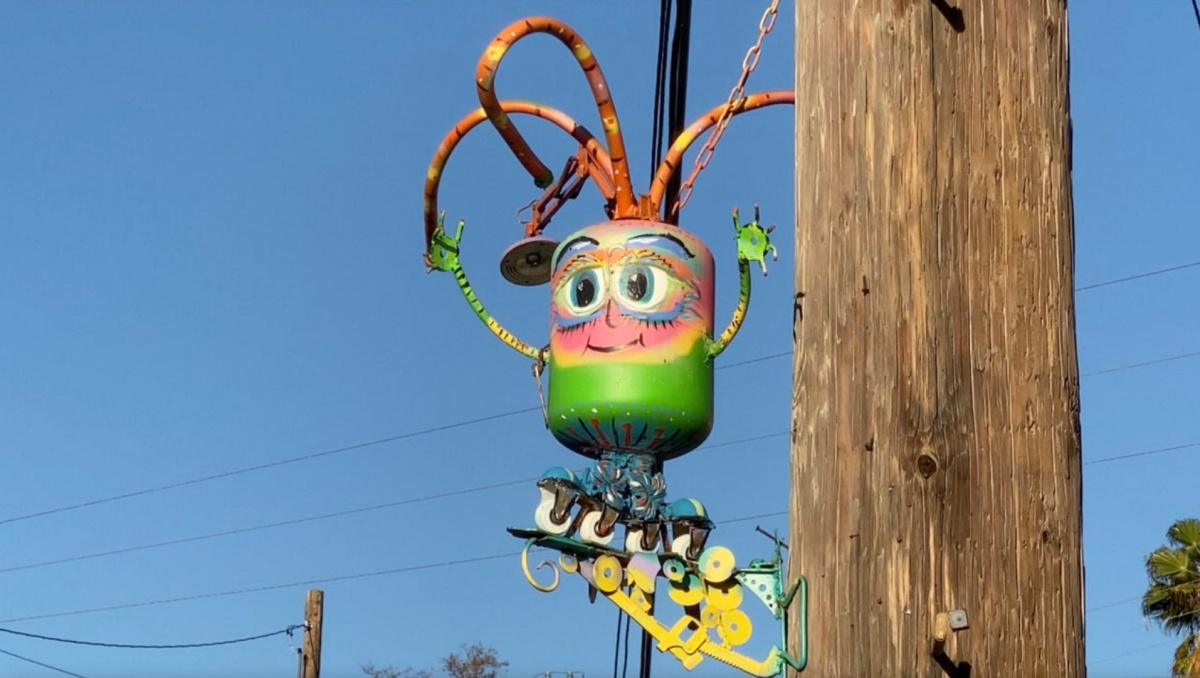
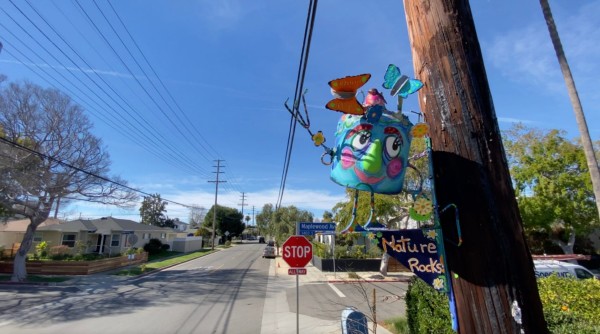
Two years ago, in a piece for Truthdig when it reemerged from its hiatus, I wrote about how the Los Angeles neighborhood of Mar Vista had been artistically enchanted with the addition of 22 whimsical public sculptures on telephone poles. These had been placed by Lori Powers, an imaginative guerilla artist whose works on the two major East-West neighborhood thoroughfares had generated wonder and delight for many hundreds of local residents and visitors. They didn’t stop the growing gentrification, but at least they made the Mar Vista area unique, an artistic flash point in a city that needed it badly.
My earlier article described Lori’s background and creative origins, her techniques and processes, and her powerful desire to use her works to bring some joy to her community. For about eight years, she proceeded without any formal permits from city authorities. She staked out her sites and set up her ladder and attached her colorful prefabricated sculptures.
When that directive became public, several things occurred. The most important was the outpouring of community support for these artworks to stay where they were.
Then it all ended—at least for now. There had been a very few objections to her art, as I noted. These were, I argued, ostensibly about safety issues on the telephone poles but suggested a deeper and more inexplicable hostility toward the artworks. Those objections, apparently, were sufficient to get the Los Angeles Department of Water and Power (DWP) involved, causing that agency to issue a directive to its staff to remove all of Lori’s works.
Related stories
When that directive became public, several things occurred. The most important was the outpouring of community support for these artworks to stay where they were. Many hundreds of Mar Vista community residents signed petitions and attended meetings, organized by Lori and her son Max.
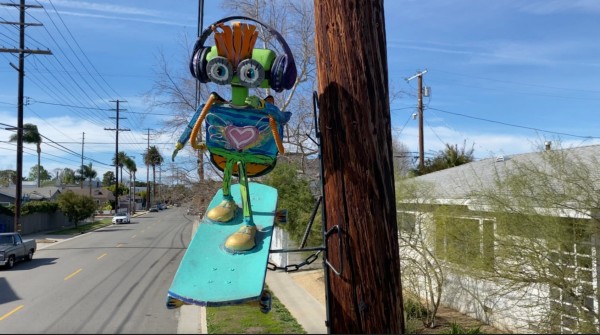
Soon, this generated local media attention, including from the Los Angeles Times and from various radio and television outlets. LA Times columnist Robin Abcarian, a resident of nearby Venice, visited some of the local works and was present when the DWP made an initial, unsuccessful attempt to remove Lori’s pieces from the poles. She wrote a marvelously supportive column about Lori’s public artistic efforts and the community’s passionate commitment to retain them.
I participated extensively in all of this, drawing on my longtime experience as a political activist and public speaker. A “save the art” meeting was held at the Mar Vista Community Council, where many residents, including myself, spoke. We obtained unanimous support from that entity, even though its actions are largely advisory and without any real political consequence.
We held several planning and strategy meetings at Lori’s home and discussed our options to save the artworks. These efforts were identical to the organizing that has occurred for decades in communities throughout the country. Passion and hope abounded among the participants.
We also obtained enormous help from former Councilwoman Ruth Galanter, whose wise political strategic and tactical advice was extraordinarily valuable. We also contacted the office of the present Councilwoman, Traci Park. Lori, I, and others spent considerable time with her staff, who showed their support. Traci Park likewise regularly expressed her commitment to these artworks .
So, why didn’t all of this work? How did it happen that despite such extensive community support, the DWP in late November removed the sculptures from the telephone poles and returned them to Lori Powers?
One major reason is the current DWP and the deeper character of this bureaucratic enterprise in a large city like Los Angeles—a story that is increasingly emblematic of local governments through the nation. This city agency is the largest municipal utility in the United States. It supplies over four million gallons of water per day to more than four million residents and businesses and more than 800 megawatts of electric generating capacity. The agency has over 11,000 employees and an administration led by professional engineers and people with substantial experience and training in management and public administration.
In recent years, the DWP has been rocked with numerous scandals that have been widely reported locally, regionally, and nationally.
In recent years, the DWP has been rocked with numerous scandals that have been widely reported locally, regionally, and nationally. Widespread and pervasive corruption has been central to these scandals. A severely botched rollout of a new billing system left many consumers angry and frustrated. Overtime pay abuses strained tight city budgets, while other services were neglected and curtailed.
Above all, a major kickback scheme was unearthed, ensnaring several high profile players, including prominent lawyers, with some sent off to prison and others subject to California State Bar disciplinary charges. The former head of the DWP was sentenced to prison for accepting bribes. Serious allegations of retaliation against whistleblowers were levelled. A major lawsuit alleging sexual harassment was filed, adding to the burgeoning cloud hanging over the agency in the public’s view.
The newly appointed DWP head, Janisse Quiñones, is now paid a salary of $750,000, substantially larger than that of the Mayor and the Police Chief. No one doubts her professional qualifications as an engineer and her experience in the field. Yet Los Angeles continues to have a severe budget crisis and to most laypeople, this salary appears excessive.
Amidst all of this, those of us committed to saving Lori Powers’ artworks in Mar Vista wondered why the DWP would bother with an issue so fundamentally small relative to the other problems that the agency has had to address. Throughout our organizing efforts, many of us sought an answer to this question. Some of us attempted to phone members of the DWP and a few got little more than evasions and bureaucratic double talk.
I also tried to phone the DWP. I had searched its website and found the following beneath the biography of Janisse Quiñones’ biographical information:
“Do you have a question, compliment, or complaint? An issue that hasn’t been resolved?”
With decades of experience in grappling with large bureaucracies, including the University of California and elsewhere, I saw this as rhetorical nonsense.
Those words were comparable to the language of the Department bureaucrats who spoke at the Mar Vista Community Council. They harped on safety issues, even though for over seven years, no safety issues had occurred even during some of the most severe storms in modern Southern California history.
Still, I tried, with utterly no success. I made numerous calls to the DWP, pressing number after number and getting nowhere. Finally, I gave up after reaching only low-level functionaries who took my name with promises to have my calls returned. Those replies were lies.
It is revealing and distressing that the Department of Water and Power in Los Angeles is seemingly not susceptible to political pressure, either from community groups or even local elected officials. I recall, not so long ago, that when Councilpersons demanded action or restraint from city agencies, they took such demands seriously.
DWP appears to be an empire of its own, indifferent to the people who ostensibly are elected by the people. They, the elected officials, indicated that they could do no more. Councilwoman Park conceded as much despite her strong efforts.
The DWP has forgotten that they are actually subordinate to the people. Although those on the left don’t especially like the term, DWP has operationally assumed the role of a “deep state” within Los Angeles. Just as Bernie Sanders has demanded a shake-up of the federal Defense Department, so too do the residents of Los Angeles need a fundamental shake-up of the DWP, with real mechanisms of accountability and genuine responsiveness to authentic community concerns.
The struggle to place Lori’s artworks in public spaces in Mar Vista is not over.
The struggle to place Lori’s artworks in public spaces in Mar Vista is not over. She has begun the laborious process of seeking approval to place them on the parkways, the narrow spaces between the sidewalks and the street throughout the neighborhood. These works can be mounted on poles and will again be visible to pedestrians and motorists. They require, apparently, an engineer’s approval and then the property owner’s consent, which should be easy enough. When she completes this process, and even expands her efforts, Mar Vista will emerge again as a modest bulwark against the creeping disgrace of gentrification.
Why should all of this matter in an era of impending mass deportations, threats to Medicare, Social Security, international horror and genocide, and even more terror on the horizon with Trumpian fascism. It’s a good question; I’ve begun writing (and acting) on some of these issues myself. And I’ll continue. But I’m also reminded of the compelling and haunting verses from the iconic labor and women’s poem and song:
As we come marching, marching, we battle, too, for men—
For they are women's children and we mother them again.
Our days shall not be sweated from birth until life closes—
Hearts starve as well as bodies: Give us Bread but give us Roses.
As we come marching, marching, unnumbered women dead
Go crying through our singing their ancient song of Bread;
Small art and love and beauty their trudging spirits knew—
Yes, it is Bread we fight for—but we fight for Roses, too.
Let’s never lose sight of all our goals in the never ending struggle for human dignity, justice, and fulfillment.
Photos from Paul Von Blum's photo essay on Truthdig.
Comments

Powered by RoundtableAn AI/DeFi-powered Enterprise Media Operating System. Learn more at Roundtable.io.© Roundtable 2026. By using this site you agree to the Terms of Use and Privacy Policy