


Jul 28, 2020 8:00 AM
Updated Feb 10, 2022 10:59 PM
Johnny Townsend: “40 people were arrested” no longer means forty people were committing crimes. It literally only means they were arrested. Most or perhaps all of those arrested might be innocent.
Speakers and writers often apologize for “preaching to the choir.” It’s seen as futile or, worse, an exercise at rationalizing and self-justification. But directing our arguments to a group already on “the right side” also helps readers and listeners withstand the gaslighting they receive from other sources. Just as importantly, it acknowledges a basic fact about choirs—not all choir members are on the same page of the hymnal or know how to read music very well.
As a Mormon, I sang every week during Sacrament meeting. Sitting in the pews with our families, we were supposed to follow the chorister’s lead, but hardly anyone did. For a while, I also sang in the congregational choir led by the bishop’s wife. As a missionary, I sang every morning during Devotional. After I left the Church, I sang in the New Orleans Gay Men’s Chorus. One year, we even sang with the opera chorus in a production of Aida. People came to these choruses with differing abilities, some able to sight read, some with perfect pitch, some understanding music theory and some not.
Preaching to the Choir
I didn’t transition from right-wing Republican Mormon to Democratic Socialist simply by walking out of a Church tribunal with my excommunication verdict. What I did leave with was an open mind. Even so, unlearning the lies I’d been taught all my life, and learning new ideas previously kept from me, took a long while, mostly because there was so much to learn.
The first several times I heard someone insist it was impossible for any white person in America not to be racist, I resisted such an uncomfortable concept. But I couldn’t unhear it, and slowly, over many years, I came to understand they were right. They were preaching to folks who already wanted racial justice, but even people who support racial equity aren’t all on the same page. We need a music director to guide us or the words overlap, the sound isn’t crisp, and no one can understand what we’re saying.
Related stories
“40 people were arrested” no longer means forty people were committing crimes. It literally only means they were arrested. Most or perhaps all of those arrested might be innocent.
I wasn’t a proponent of universal healthcare until I actually heard about it. Only after realizing it was possible, had in fact been practiced in other countries for decades, did I even notice that section in the hymnal existed. I now know several hymns on the topic, some focusing on the need to fully cover dental, vision, and mental healthcare as well. The principles seem obvious now, but we aren’t born knowing them.
I could laugh when I read the instructions on the side of a box of Corn Flakes in Italy: “Pour in bowl. Add milk. Do not boil.” For an Italian, boiling something that at first resembles pasta is the obvious course of action. We can’t assume anything. Everything we know we learned somewhere along the way.
I had no reason to advocate for tuition-free college and vocational training till a preacher asked us to sing a hymn about it. With no children of my own, it didn’t occur to me that taxpayer-funded childcare and pre-k education were important gospel principles. Thank god for a preacher who gave good sermons on them.
I’ve long pushed to increase spending for public transportation while many of my fellow choir members with cars haven’t given it much thought. They need tenors like me to help them read this hymn’s music. Even I needed the alto who helped me understand that we not only need more public transportation but that it must also be fare-free. We both needed the choir director to help us sing in harmony. And we wouldn’t even have tackled that difficult hymn in the first place if the pastor hadn’t assigned it for an upcoming holiday.
It took a while for me to understand the importance of a woman’s right to choose. It’s a basic tenet of the left, but I was not on the same page as the pastor or others in the choir for several years, because I didn’t forget overnight everything I was taught in my previous religion. Even after joining the new choir, I still needed to hear my new preacher every week, especially because I was no longer browbeaten into doing whatever I was told. I was expected to study and act on only what I believed was true. No more “God said it, I believe it, that settles it for me.”
As a fully out gay man, I didn’t understand trans folks until I saw The Crying Game. “I get it now,” I thought as I walked out of the theater. Of course, I’ve heard more sermons since then, sung more hymns, and continued learning more of the doctrine. There are entire universities dedicated to theology. I’m not going to learn everything with only a few homilies a week.
I understand the importance of parables now, that it’s easier sometimes to understand a principle or culture if we read or watch a story about them. “Eastern European Jewish culture was lost during the Holocaust” doesn’t reach me on an emotional or intellectual level the way reading In My Father’s Court helps me understand just what was lost. But I can’t read every book, learn every relevant principle in the space of six months or even six years. I need to keep singing in the choir and listening to sermons. It’s even important for me to hear the same topics over and over so I don’t forget what I’ve already learned. I was once able to sing The Shema perfectly, but I’ve lost some of my ability because I don’t practice it much anymore.
Just as a good Bible class or Torah study can help us get past superficialities, a good minister or priestess can help us learn to ask the right questions.
A true believer in conservation since I was a child, I still needed to hear a few sermons on solar, wind, and wave energy, pointing out both their pros and their cons. The religion I follow now is Truth and Compassion, and while some principles may be eternal, our understanding of them is subject to shifting paradigms as we conduct more research. Hydroelectric dams used to sound like a good idea. Not so much anymore. Closing off certain streets to vehicular traffic sounds good for now, as does a modern Conservation Corps to build green energy infrastructure, but I do want to hear more sermons on the subject in the coming months and years. No topic should ever be considered too sacred to discuss publicly, no orthodoxy incontestable. Even as a Mormon, I was taught that we learn “line upon line, precept on precept.” I still believe that.

In the public “debate” about climate change, news teams make every effort to present “both sides” equally, despite the preponderance of evidence on one side. Odd that this same effort to appear objective is often missing in the coverage of other matters.
Tear Gas and Flash Bangs
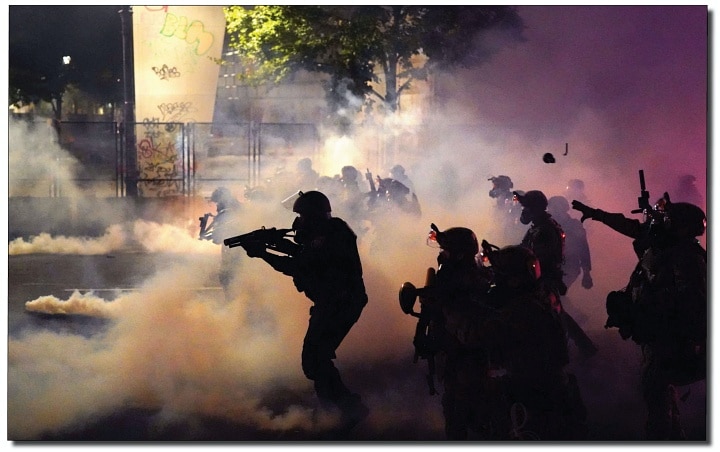
But I wasn’t always able to see through the propaganda of “the media” until others showed me how. When a news report airs about riots breaking out during a protest, I watch the video coverage more carefully. Yes, I see tear gas and flash bangs going off, I see people running or fighting the police, but now I question if officers throwing the tear gas and flash bangs are what turned the peaceful protest into the chaos I see onscreen. I no longer accept the news anchor’s version of events unquestioningly.
“40 people were arrested” no longer means forty people were committing crimes. It literally only means they were arrested. Most or perhaps all of those arrested might be innocent.
When a police chief says, “We have to make sure people and property aren’t being hurt,” I no longer see that as justification for brutality. I think, “An easy way for you to achieve that, Chief, would be to stop abusing people so that they feel they have no choice but to protest.” When police chiefs say they can’t ban the use of tear gas because they need that option to avoid using excessive force for crowd control, I recognize the spin they’re giving to justify their abuse, since tear gas is excessive force. Can someone use excessive force to avoid using excessive force?
I’ve seen officers breaking windows. I’ve seen people later identified as white supremacists or other provocateurs destroying property.
When I hear news anchors reporting on broken windows or other vandalism, I no longer assume that protesters caused the damage. I’ve seen officers breaking windows. I’ve seen people later identified as white supremacists or other provocateurs destroying property. I don’t discount the possibility that protesters may have generated some of the destruction, but I recognize that when a news anchor says, “Police report widespread damage to businesses,” I’m only hearing one side of the story.
Since these past weeks of protest have been organized in direct response to documented police brutality, broadcasting only police assessment of an event is to support an undeniable conflict of interest. Of course police will deflect any personal responsibility. Would you hold a trial where only the prosecutor and the witnesses she calls get to speak? Why were no protesters interviewed for the news segment? There were clearly plenty of people to ask.
“Three officers were injured by explosive devices.” OK, but who threw those devices? Did an officer deploy them too close to his fellow officers? Did he simply cut himself when he deployed it, causing a minor, self-inflicted injury not caused in any way by protesters? Maybe everything being reported is true, but it’s definitely not a given, and I recognize how much is implied without being explicitly stated, so that reporters and anchors can pretend impartiality.
The Pope is not infallible. Neither is any preacher I might be singing for. I’m not only free to question the latest sermon I hear from the choir seats—I’m obligated to. And I’m just a chorus member, after all, not a composer. I’m only trying to sing my small part, and I can’t do it effectively without continued guidance.
Defunding the police or military weren’t even on my radar until a few months ago. I’d always thought in terms of small reforms. But now those more sweeping options seem inevitable. When I studied Abraham’s attempt to sacrifice Isaac on the altar, I always focused on his dedication to God. Then a rabbi pointed out that Isaac is never shown talking to his father again, and I began to see the story as also conveying something about the human cost of following orders blindly. The test of one’s faith isn’t to do whatever we’re told even if we disagree. It’s to question any order that compels us to hurt others for any reason.
As a missionary, I taught “investigators” eight lessons in a specific order before they were allowed to be baptized. If someone asked a difficult question, we responded with, “We can answer that question later. First, we need to lay the groundwork so you’ll understand the context.” Kind of like the classic joke explaining why you can’t just tell someone outright their cat died. First, you tell a long story about how it slipped out the door while you were house sitting and climbed up on the roof. It fell while you were trying to rescue it. You brought it to the veterinary clinic, and the vet worked tirelessly to save the cat. After a drawn-out prelude, you can then finally explain that their beloved pet is dead. With the overly extensive background, they’re now more prepared to accept the unpleasant news.
As part of the choir, I benefit greatly hearing from the preacher and other choir members. I can learn about Universal Basic Income and re-enfranchising felons who have served their time and legalizing marijuana and polyamory and physician-assisted death. As a Mormon, I was always told to stick to the basics, never to question “the mysteries,” but in this new religion, learning and growth never end.
Singing with the choir demands a commitment of both time and energy, but I truly enjoy singing, contributing my small portion to a grand, “joyful noise.” One of the best perks of singing about grace and love is getting to hear the pastor week after week. She’s not wasting her breath.
Please, keep preaching to the choir.
Comments

Powered by RoundtableAn AI/DeFi-powered Enterprise Media Operating System. Learn more at Roundtable.io.© Roundtable 2026. By using this site you agree to the Terms of Use and Privacy Policy