
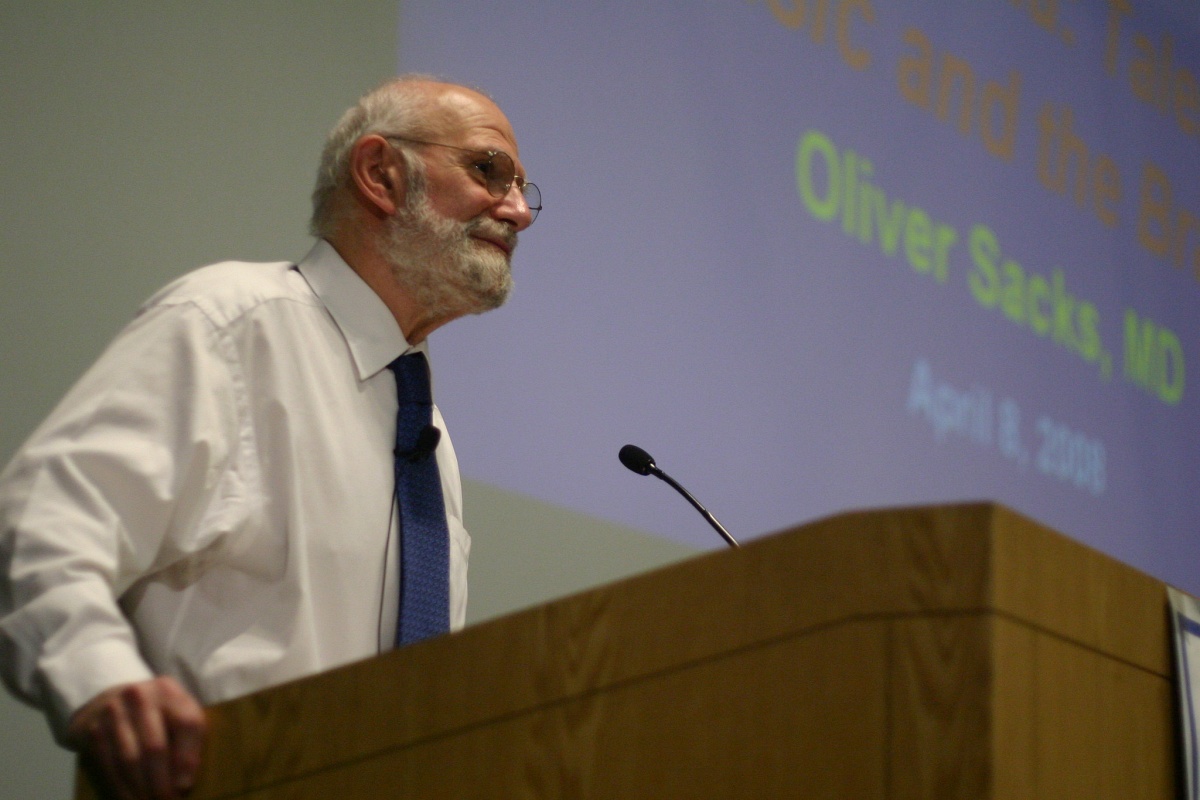
Angela Radulescu • CC BY-NC-SA 2.0 • Flickr


Dec 15, 2025 9:35 PM
Updated Dec 16, 2025 1:39 AM
Through his care, his patients realized that they had hidden gifts—for music, painting, writing—that could restore to them a sense of wholeness.
Editor of The New Yorker David Remnick begins a recent introduction to British-born Oliver Sacks this way: “The neurologist Oliver Sacks’s early books, including ‘Awakenings’ and ‘The Man Who Mistook His Wife for a Hat,’ established his reputation as [a] unique literary voice and the avatar of a new medical outlook that considered a patient’s life story and sense of self as being crucial to the treatment of a range of ailments.” But Remnick’s words are just an introduction to Rachel Aviv’s "rich and nuanced piece" for this year’s magazine December 8th issue.
Before looking at the introduction of Remnick and the essay by Aviv, I had seen many episodes of NBC’s well-reviewed “Brilliant Minds,” which Peacock also streamed, and which was based on Sack’s life and medical work, overwhelmingly in New York. (NBC began the series in 2024 with 13 episodes in 2024-25 and 10 episodes [so far] in 2025.) In The New Yorker pieces by Remnick and Aviv, as well as in the NBC episodes, it is clearly evident that Sacks is gay, and that is important to his identity. But as Remnick writes, he “remained closeted until he was eighty.”
About gayness I have very limited knowledge. The Wikipedia entry on “Biology and sexual orientation” seems well done to me. And I am inclined to accept its statement that “biological theories for explaining the causes of sexual orientation are favored by scientists.” Even though I was raised Catholic, received only Catholic formal education, and that church still considers sexual activities by gays as sinful, I am more inclined toward the late Pope Francis’s response: "If a person is gay and seeks God and has good will, who am I to judge?"
In addition, as important as gayness was to Sacks (1933-2015), the Indian-born economist Amartya Sen was certainly correct when he noted that all humans have multiple identities and share common numerous human qualities. Sacks was not just gay. He was also a brilliant neurologist and writer, and so much more, as well as a man who faced death bravely when he died at age 82 of terminal-cancer complications.
Related stories
Yet, as Aviv points out, Sacks was a complicated and often troubled man—he saw a psychiatrist “for half a century.” Sacks’ books and essays were taken to be true revelations about his patients, but his writings were sometimes misleading. Nevertheless, Aviv adds that his “early case studies also tended to revolve around secrets, but wonderful ones. Through his care, his patients realized that they had hidden gifts—for music, painting, writing—that could restore to them a sense of wholeness.” And she quotes a Sacks’ friend as stating, “His genius was to see . . . to the dignity of the person.”
Empathy was one of Sacks’ most notable qualities—Barack Obama once wrote that empathy “is at the heart of my moral code, and it is how I understand the Golden Rule—not simply as a call to sympathy or charity, but as something more demanding, a call to stand in somebody else's shoes and see through their eyes.” Aviv writes that Sacks described empathy as being “enabled to ‘feel’—that is, to imagine, with all the powers of my head and heart—how it felt to be another human being.” And she adds that he “established empathy as a quality every good doctor should possess, enshrining the ideal through his stories.”
Earlier I mentioned that Sacks “faced death bravely when he died at age 82 of terminal-cancer complications.” Just months earlier, in a New York Times essay he wrote,
It is up to me now to choose how to live out the months that remain to me. I have to live in the richest, deepest, most productive way I can. . . . I have been lucky enough to live past 80 . . . . I want and hope in the time that remains to deepen my friendships, to say farewell to those I love, to write more, to travel if I have the strength, to achieve new levels of understanding and insight. . . . I still care deeply about the Middle East, about global warming, about growing inequality. . . . I cannot pretend I am without fear. But my predominant feeling is one of gratitude. I have loved and been loved; I have been given much and I have given something in return; I have read and traveled and thought and written. I have had an intercourse with the world, the special intercourse of writers and readers. Above all, I have been a sentient being, a thinking animal, on this beautiful planet, and that in itself has been an enormous privilege and adventure.
All of the above reflections on Sacks seem more important than ever. More important because tolerance toward gays like Sacks is presently under attack. A mid-2025 Time magazine article was entitled “How Gay Marriage Is Under Threat in the Trump Era,” and it indicated that “a flurry of executive orders targeting the LGBTQ community casts a big shadow over the future of gay marriage.”
Although (as indicated earlier), “I have very limited knowledge” of gayness, but having been married almost 60 years, I do know about love in such a state. And I know that it can grow and be nourished in that situation. And I know that it is better to love someone on a daily basis—even if it be someone of the same gender—than to have no partner to receive that affection.
Comments

Powered by RoundtableAn AI/DeFi-powered Enterprise Media Operating System. Learn more at Roundtable.io.© Roundtable 2026. By using this site you agree to the Terms of Use and Privacy Policy