


Jun 22, 2020 8:00 AM
Updated Feb 10, 2022 10:31 PM
Black Lives LGBTQ Intersectionality - Patrisse Cullors of Black Lives Matter discusses being a queer black woman who is unapologetic
Patrisse Cullors says her political art is about survival.
“If your community is under attack, whether that’s the queer community, the black community, the trans community, or women, our response is survival,” says Cullors, who identifies as queer and co-founded Black Lives Matter in 2013.
“When we talk about race, when we talk about gender, or when we talk about politics, we’re talking about it because we’re talking about how we are going to survive a place that is oppressing us because of these things, because of who we are, because of our identities.”
Cullors’ newest performance art piece is “A Prayer for the Runner.” It’s described as a “public act of mourning,” centered on a prayer she co-wrote with Damon Turner, inspired by the “modern-day lynching” of Ahmaud Arbery.
Related stories
Cullors will perform the piece live Saturday at noon during a virtual event. It will be followed by a discussion with Melina Abdullah, founder of Black Lives Matter’s Los Angeles chapter. The event is part of a series of events at the Fowler Museum at UCLA for LGBTQ Pride Month.
Patrisse Cullors Black Lives Matter
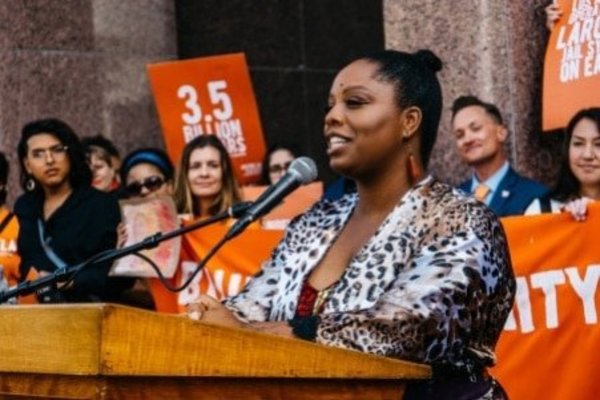
In this undated photo, Patrisse Cullors, at the podium, speaks during a rally supporting Measure R, which voters overwhelmingly approved in March 2020. The measure gives the Los Angeles County Civilian Oversight Commission the power to investigate, research, and create a Comprehensive Public Safety Reinvestment Plan to reduce jail population and provide alternatives to incarceration. Photo: Patrisse Cullors.
Cullors loves when political activism and art intersect.
“I feel like my work is part of the legacy of queer arts, but also the legacy of the black arts movement,” Cullors told Q Voice News last year. “I’m excited about that intersection.”
In an interview with Q Voice News, Cullors, 36, talks about what Pride means to her and the intersectionality of being black and queer.
Here are some excerpts.
“Pride means so many things,” Cullors says. “I came out at 15 years old. It was a time when sodomy laws still existed in California, when gay marriage hadn’t been passed, where me and my girlfriend were being harassed on the street for being publicly out and queer.
“It felt really important for me as a black queer woman to remind people that I was unafraid and unapologetic,” she says.
Advertisement
“Pride is something deeply personal, but it’s also very political. My pride has everything to do with the community where I come from,” Cullors says.
“I’m from Los Angeles. I’m born and raised here. I’m born and raised in a suburb, outside of the inner city, in Van Nuys,” she says. “Pride also is my Southern roots. My family on one side is Creole from Louisiana. The other side is from Oklahoma. My pride is in being someone who identifies as pansexual and queer.
Accepting the “black weirdo”
Click here to continue reading at Q Voice News
Comments

Powered by RoundtableAn AI/DeFi-powered Enterprise Media Operating System. Learn more at Roundtable.io.© Roundtable 2026. By using this site you agree to the Terms of Use and Privacy Policy