


Mar 6, 2024 6:59 PM
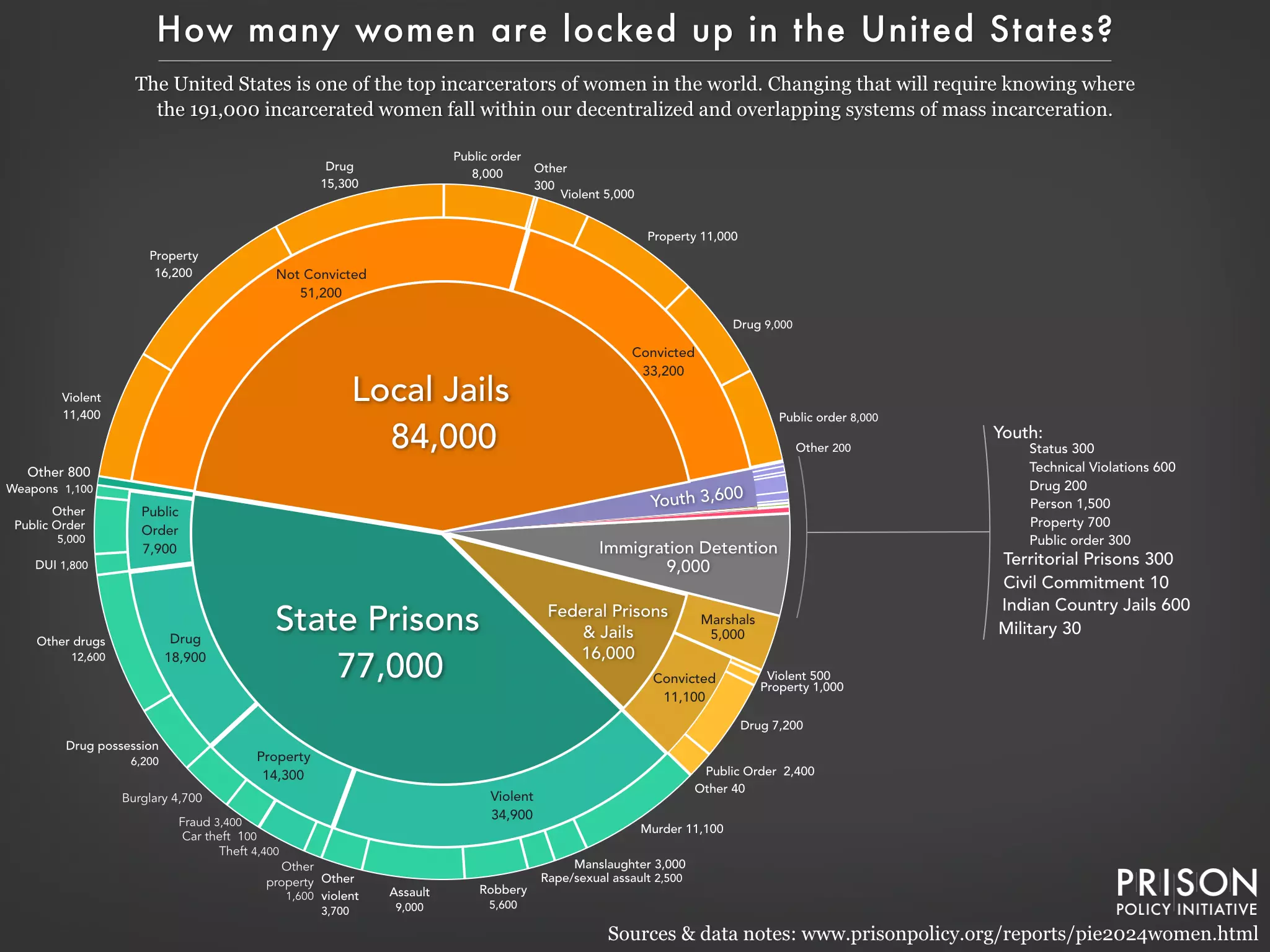
This report provides a detailed view of the 190,600 women and girls incarcerated in the United States and how they fit into the even broader picture of correctional control.
With growing public attention to the problem of mass incarceration, people want to know about women’s experiences with incarceration. How many women are held in prisons, jails, and other correctional facilities in the United States? Why are they there? How are their experiences different from men’s? These are important questions, but finding the answers requires not only disentangling the country’s decentralized and overlapping criminal legal systems, but also unearthing the frustratingly limited data that’s broken down by gender.
This report provides a detailed view of the 190,600 women and girls incarcerated in the United States and how they fit into the even broader picture of correctional control. We pull together data from a number of government agencies and break down the number of women and girls held by each correctional system, by specific offense, in 446 state prisons, 27 federal prisons, 3,116 local jails, 1,323 juvenile correctional facilities, 80 Indian country jails, and 80 immigration detention facilities, as well as in military prisons, civil commitment centers, and prisons in the U.S. territories. We also go beyond the numbers, including rare self-reported data from a national survey of people in prison to offer new insights about incarcerated women’s backgrounds, families, health, and experiences in prison. This report answers the questions of why and where women are locked up — and much more:
Most notably, and in stark contrast to the total incarcerated population, where the state prison systems hold twice as many people as are held in jails, more incarcerated women are held in jails than in state prisons. As we will explain, the outsized role of jails has serious consequences for incarcerated women and their families.
Women’s incarceration has grown at twice the pace of men’s incarceration in recent decades, and has disproportionately been located in local jails. The data needed to explain exactly what happened, when, and why do not yet exist, not least because the data on women has long been obscured by the larger scale of men’s incarceration. Frustratingly, even as this report is updated using many of the same data sources from year to year, it is not a direct tool for tracking changes in women’s incarceration over time because we are forced to rely on the limited sources available, which are neither updated regularly nor always compatible across years.
Related stories
Particularly in light of the scarcity of gender-specific data, the disaggregated numbers presented here are an important step to ensuring that women are not left behind in the effort to end mass incarceration.
Jails loom large in women’s incarceration
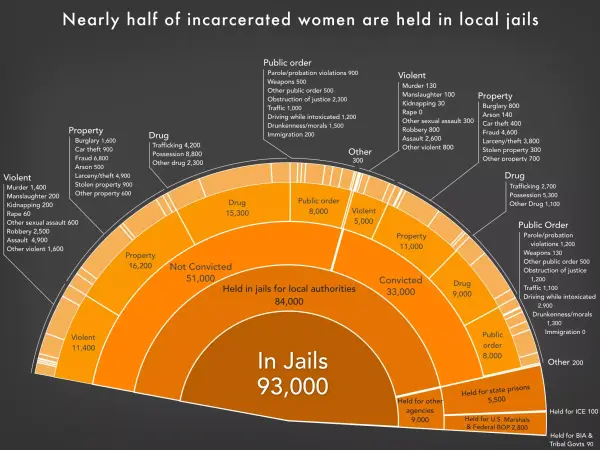
A staggering number of women who are incarcerated are not even convicted: more than a quarter of women who are behind bars have not yet had a trial. Moreover, 60% of women in jails under local control have not been convicted of a crime and are awaiting trial.
Aside from women under local authority (or jurisdiction), state and federal agencies also pay local jails to house nearly 9,000 additional women. For example, ICE and the U.S. Marshals Service, which have fewer dedicated facilities for their detainees, contract with local jails to hold roughly 2,900 women. So, the number of women physically held in jails is even higher:
Women disproportionately stuck in jails: Causes and effects
Avoiding pretrial detention is particularly challenging for women. The number of unconvicted women stuck in jail is surely not because courts are considering women to be a flight risk, particularly when they are generally the primary caregivers of children. The far more likely answer is that incarcerated women, who have lower incomes than incarcerated men, have an even harder time affording money bail. When the typical bail amounts to a full year’s income for women, it’s no wonder that women are stuck in jail awaiting trial.
Even once convicted, the system funnels women into jails: About one-third (32%) of convicted incarcerated women are held in jails, compared to about 13% of all people incarcerated with a conviction. This reflects the different distribution of offense types and criminal histories between convicted men and women. Women are proportionally more likely to be serving a sentence of incarceration for a property or drug offense and less likely to be incarcerated for a violent offense when compared to men. These differences mean that women are more likely to be sentenced to a term in jail, where people typically serve shorter sentences of up to one year.
So, what does it mean that large numbers of women are held in jail — for them, and for their families? First, while stays in jail are generally shorter than in stays in prison, jails can be especially deadly for women. Women have a higher mortality rate than men in jails, dying of drug and alcohol intoxication at twice the rate of men. And the number of deaths by suicide among women in jails increased by almost 65% between the periods of 2000-2004 and 2015-2019. Women are more likely than men to enter jail with a medical problem or a serious mental illness and while incarcerated, women are more likely to suffer from mental health problems and experience serious psychological distress. Being locked up doesn’t help: Research shows that incarceration can cause lasting damage to mental health.
Compounding the problem is the fact that jails are particularly poorly positioned to provide proper health care. In fact, local jails tend to offer fewer services and programs overall than prisons do, and because most programs are designed for the larger male population, women may not even have access to programming that’s available to men in the same jail. (However, this is certainly not to say that prisons are always better at meeting women’s needs, as we will discuss further.)
Jails also make it harder to stay in touch with family than prisons do. Jail phone calls are often at least three times as expensive as calls from prison, and other forms of communication are more restricted — some jails don’t even allow real letters, limiting mail to postcards. Increasingly, both prisons and jails are doing away with real mail altogether and contracting with private companies that scan and then destroy postal mail, delivering shoddy scanned copies to the recipients. These barriers to authentic communication are especially troubling given that 80% of women in jails are mothers, and most of them are primary caretakers of their children. Thus children are particularly susceptible to the domino effect of burdens placed on incarcerated women.
Ending mass incarceration requires looking at all offenses — and all women
The numbers revealed by this report enable a national conversation about policies that impact women incarcerated by different government agencies and in different types of facilities. These figures also serve as the foundation for reforming the policies that lead to incarcerating women in the first place.
Too often, the conversation about criminal justice reform starts and stops with the question of “non-violent” drug and property offenses. While drug and property offenses make up more than half of the offenses for which women are incarcerated, the pie chart reveals that all offenses — including the violent offenses that account for over a quarter of all incarcerated women — must be considered in the effort to reduce the number of incarcerated women in this country. This fact underscores the need for reform discussions to focus not just on the easier choices but on the policy changes that will have the most impact. Particularly in light of the fact that many survivors of domestic and sexual abuse have been incarcerated for violent crimes that occurred in response to gendered violence and abuse, exclusions from reforms based on entire offense categories make even less sense.
Furthermore, even among women, incarceration is not indiscriminate and reforms should address the disparities related to LBTQ+ status, race, and ethnicity as well. A 2017 study revealed that one-third of incarcerated women identify as lesbian or bisexual, compared to less than 10% of men. The same study found that lesbian and bisexual women are likely to receive longer sentences than their heterosexual peers, and more likely to be put into solitary confinement.
And although the data do not exist to break down the “whole pie” by race or ethnicity, we know that Black and American Indian or Alaska Native women are consistently overrepresented in state and federal prisons: Women in prison are 48% white, 17% Black, 19% Hispanic, 2.5% American Indian or Alaska Native, 0.7% Asian, and 13% “other.” While we are a long way from having data on intersectional impacts of sexuality and race or ethnicity on women’s likelihood of incarceration, it is clear that Black and lesbian or bisexual women and girls are disproportionately subject to incarceration.
Mass incarceration targets girls, too
Nearly 7,000 young women and girls are caught up in various systems of confinement, very often for minor and even non-criminal offenses. About half are held in facilities for the juvenile justice system, and almost as many are unaccompanied migrant children in facilities operated by the Office of Refugee Resettlement (ORR). While children held by ORR are not held for any criminal or delinquent offense, most are held in shelters or even juvenile placement facilities under detention-like conditions. And a not-insignificant number of confined girls are actually held in adult prisons and jails. Like their adult counterparts, confined girls often report identities that are marginalized in the U.S. along lines of race, gender, and sexual orientation.
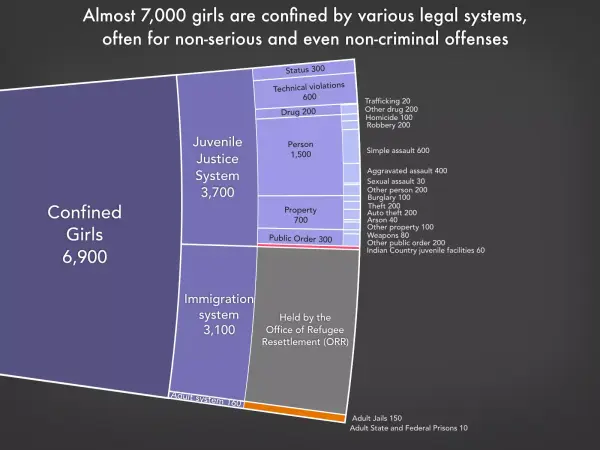
For nearly 1 in 4 girls (23%) confined by the juvenile justice system, the most serious charge levelled against them is a non-criminal “technical” violation of probation (16%) or a status offense (7%), such as “running away, truancy, and incorrigibility.” These are behaviors that would not warrant confinement except for these girls’ status as probationers or as minors. By comparison, boys are held for these technical violations and status offenses at half the rate of girls. The use of confinement in response to status offenses is particularly troubling because those behaviors tend to be simply responses to abuse.
Girls of color and those who identify as LBTQ+ are disproportionately confined by the juvenile justice system. Black girls account for 32% of all girls in juvenile facilities, despite making up just 14% of girls under 18 nationwide; similarly, 3.5% of girls in juvenile facilities are American Indian or Alaska Natives, compared to less than 1% of girls nationwide. And while LBTQ+ women are overrepresented in the adult correctional systems, a staggering 40% of girls in the juvenile justice system are lesbian, bisexual, or questioning and gender non-conforming. The comparable statistic for boys is just under 14%.
While society and the criminal legal systems subject all girls to stricter codes of conduct than is expected of their male peers, Black girls in particular shoulder an added burden of adultification — being perceived as older, more culpable, and more responsible than their peers — which leads to greater contact with and harsher consequences within the juvenile justice system. In fact, about 160 girls aged 17 or younger are locked up in adult prisons and jails, the result of laws that allow the transfer of youth from juvenile to adult criminal courts. In 2021, 133 girls were “waived” to criminal courts from the juvenile system — about 6% of all cases “waived.” More than one-third (37%) of those girls were Black.
Prison is no answer for marginalized, traumatized women
About half of confined women and girls are held in state and federal prisons. In general, women in prison are serving longer sentences than those in jails, and they are often located far from their families and friends. In many geographically large states there is just one facility for women, making visits difficult for children and other loved ones located hundreds of miles away. But this is just one of the many challenges facing women in prison, as we found in our 2022 analysis of a rich dataset published by the Bureau of Justice Statistics, the 2016 Survey of Prison Inmates.
The data from the survey offer a rare in-depth look at the backgrounds and experiences of people in prison, relying on responses from incarcerated people themselves, rather than the administrative data that’s easier to collect from prison systems. In our analysis, we focused on people held in state prisons, who make up a much larger piece of the “whole pie” than those in federal prisons. Among our findings, and those of the Bureau of Justice Statistics, we see that in state prisons nationwide:
- Women report childhood disadvantages at alarming rates: 12% report homelessness before they turned 18; 19% were in foster care at some point; and 43% came from families that received welfare or other public assistance. Almost half (45%) had been arrested by age 18.
- Women are more likely than men to enter prison having already received a high school diploma or equivalent credential, but still over half (53%) did not finish high school.
- Over a quarter of women (26%) experienced homelessness in the year before the arrest that led to their incarceration — a higher rate than among men (16%).
- Women are more likely to be jobless (53%) than to be employed in the month before their arrest.
- Women are more likely to be written up for a prison rule violation in the past year (58%), particularly for “minor” rule violations.
- Women report disabilities (50%) and physical and mental health problems at higher rates than men. Over half (58%) of women met the criteria for a substance use disorder the year before they went to prison, and over three-quarters (76%) had some indication of a past or current mental health problem — both significantly higher rates than among men. Yet just 47% had received treatment for a substance use disorder and just 43% had received professional mental health care since they went to prison.
- Women are more likely to be parents of minor children (58%), more likely to be single parents, and more likely to have been living with their children prior to their imprisonment — making it more likely that incarceration would uproot their children and lead to termination of parental rights, permanently breaking up their families.
- About 4% of women (over 3,000) were pregnant when they went to prison, and more than two-thirds (68%) of these women had no health insurance at the time. Yet only half had received any kind of prenatal care in prison apart from an obstetric exam.
- Additionally, another government survey shows that while incarcerated, women are 3 times as likely as men to be sexually victimized by prison or jail staff.
These statistics confirm much of what we know about incarcerated women from previous research: By almost any measure, women in prison are worse off than men, both leading up to and during their incarceration. Furthermore, the underlying causes of women’s criminal behavior are distinct from men’s and show that they would be better served in treatment programs in their communities than by criminal legal system punishments.
The tentacles of mass incarceration have a long reach
Even the “whole pie” of incarceration in the chart above represents just one small portion (17%) of the women under any form of correctional control, which includes 808,700 women on probation or parole. Again, this is in stark contrast to the total correctional population (mostly men), where one-third (34%) of all people under correctional control are in prisons and jails.
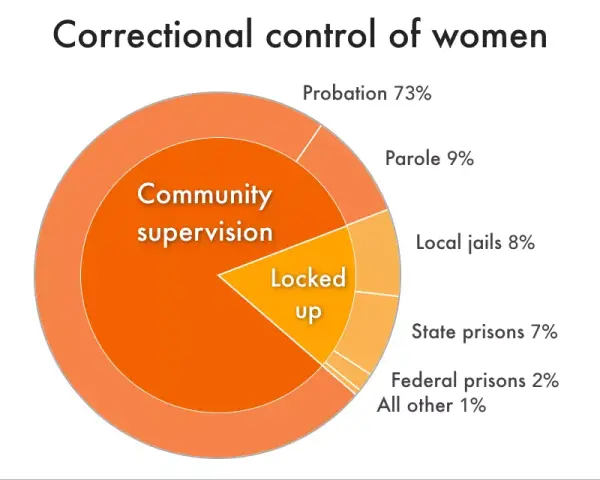
Nearly three-quarters of women (73%) under the control of any U.S. correctional system are on probation. Probation is often billed as an alternative to incarceration, but instead it is frequently set with unrealistic conditions that undermine its goal of keeping people from being locked up. For example, probation often comes with steep fees, which, like bail, women are in the worst position to afford. Failing to pay these probation fees is often a non-criminal “technical” violation of probation. Childcare duties further complicate the common probation requirement to meet regularly with probation officers, especially for women with no extra money to spend on childcare or reliable transportation across town. And probation violations — even for these innocuous and understandable reasons — can land women in jail or prison who were never sentenced to incarceration. In fact, our analysis of the 2016 Survey of Prison Inmates found that one-third (33%) of women in state prisons were on probation at the time of their arrest, which underscores how this “alternative to incarceration” often simply delays incarceration.
In the wake of the 2022 Supreme Court decision to overturn Roe v. Wade, restrictive pretrial, probation, and parole conditions can also create barriers to accessing reproductive health care. Restrictions on travel are “standard conditions” of supervision in many places, requiring approval from a probation or parole officer to make specific trips. With many states now restricting access to and criminalizing abortion, seeking abortion or other reproductive care may be difficult or impossible for many of the hundreds of thousands of women on probation or parole in those states.
Reentry is another critical point at which women are too often left behind. Almost 2.5 million women and girls are released from prisons and jails every year, but fewer post-release programs are available to them — partly because so many women are confined to jails, which are not meant to be used for long-term incarceration. Additionally, many women with criminal records face barriers to employment in female-dominated occupations, such as nursing and elder care. It is little surprise, therefore, that formerly incarcerated women — especially women of color — are also more likely to be unemployed and/or homeless than formerly incarcerated men, making reentry and compliance with probation or parole even more difficult. All of these issues make women particularly vulnerable to being incarcerated not because they commit crimes, but because they run afoul of one of the burdensome obligations of their community supervision.
Like probation before it, electronic monitoring is touted as an “alternative” to incarceration, but it is being used to expand the scope of correctional control rather than reduce the number of people behind bars. The rapid expansion of electronic monitoring in the pretrial context has created “an entirely new path to incarceration via ‘technical violations.’” And ICE’s “Alternatives to Detention” and “Intensive Supervision Appearance Program,” which both rely almost entirely on electronic monitoring, now subject hundreds of thousands more people to constant surveillance and the threat of detention or deportation than just a few years ago. Unlike probation, electronic monitoring is so constrictive that it amounts to a form of “e-carceration.” Unfortunately, the available data are not broken down by sex or gender identity, but with nearly half a million people on electronic monitoring across the criminal legal and immigration systems in 2022, it’s safe to assume that many, many women are confined by this form of mass incarceration as well.
The need for more data
The picture of women’s incarceration is far from complete, and many questions remain about mass incarceration’s unique impact on women. This report offers the critical estimate that a quarter of all incarcerated women are unconvicted. But — since the federal government hasn’t collected the key underlying data in 20 years — is that number growing? And how do the harms of that unnecessary incarceration intersect with women’s disproportionate caregiving to impact families? Beyond these big picture questions, there are a plethora of detailed data points that are not reported for women by any government agencies. In addition to the many data holes and limitations mentioned throughout this report, we’re missing other basic data, such as the simple number of women incarcerated in U.S. territories or involuntarily committed to state psychiatric hospitals because of justice system involvement.
As public awareness has grown about the differences between gender identity and sex assigned at birth, there has been a growing interest in the question of how transgender and nonbinary individuals experience incarceration. Unfortunately, government surveys that break down data between “male” and “female” categories often include trans men among “females” and trans women among “males,” relying on housing assignments as a proxy for gender. This further muddies the picture of women’s incarceration.
While more data are needed, the data in this report lend focus and perspective to the policy reforms needed to end mass incarceration without leaving women behind.
Reposted from Prison Policy Initiative
Comments

Powered by RoundtableAn AI/DeFi-powered Enterprise Media Operating System. Learn more at Roundtable.io.© Roundtable 2026. By using this site you agree to the Terms of Use and Privacy Policy