
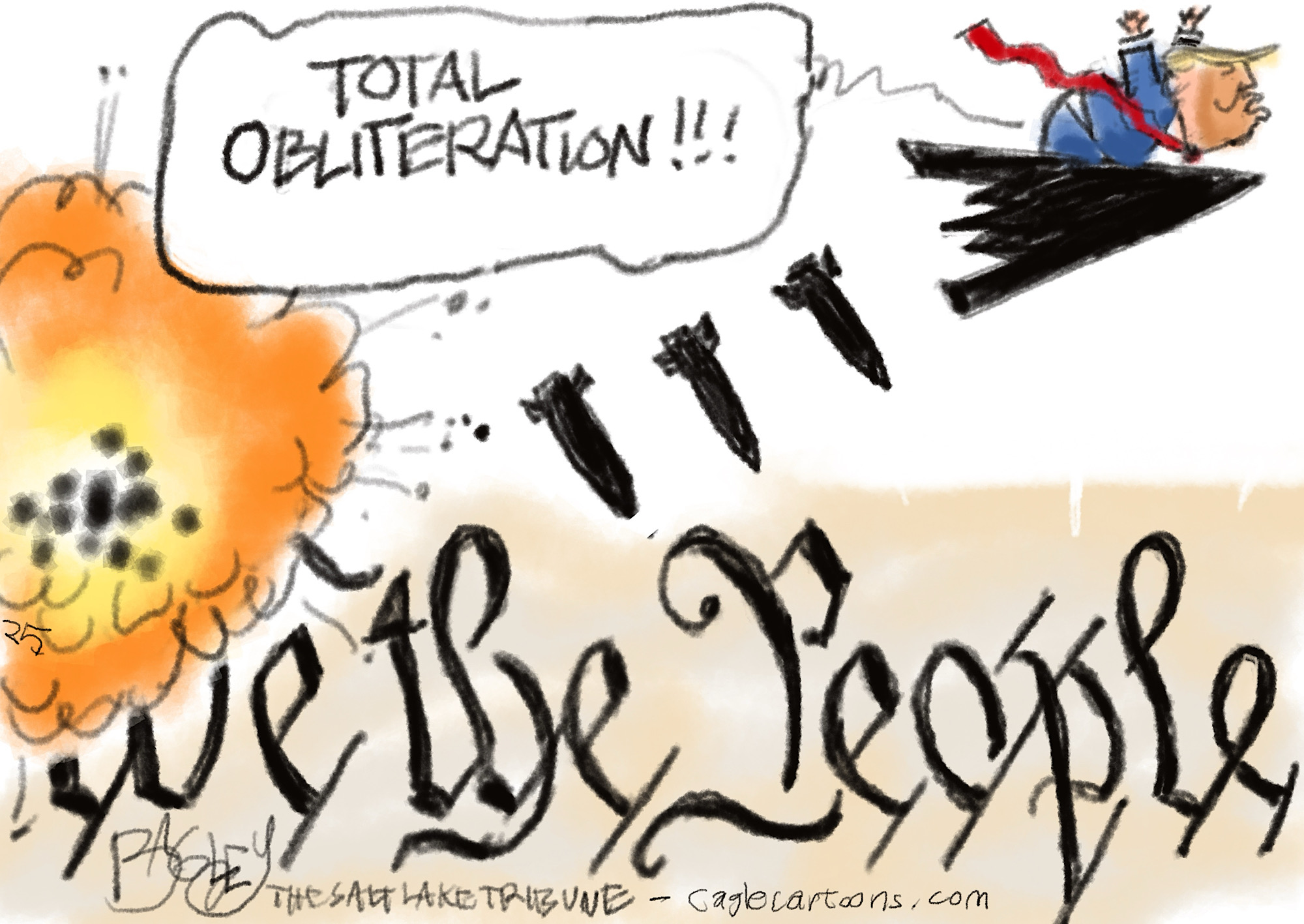


If the president can alter the meaning of a Constitutional amendment just by signing his name then he can alter any other part or simply declare that it’s no longer in force.
Aug 13, 2025 3:25 PM
Updated Aug 14, 2025 8:12 PM
If the president can alter the meaning of a Constitutional amendment just by signing his name then he can alter any other part or simply declare that it’s no longer in force.
Have you ever wondered what a Constitutional crisis would look like? Look around. We’re having one right now, right here in the USA.
The Constitution has the force of law, but it’s not a body of statute law like the US Code. It’s a set of guidelines the founders put together to tell the people actually running the country what their functions are. It lays out the roles of the legislative, executive, and judicial branches of the government, separating their functions so that no one of them can dominate either of the other two.
A crisis could come in many forms, but the one we’re having right now is fairly straightforward: people in the three branches of the government have stopped doing what the Constitutiton says they should do, and they’ve started doing pretty much whatever they feel like doing. Amending the Constitution by unilateral presidential executive order is a good example of what I mean.
The Constitution includes twenty-seven amendments. Each one came into force in the same way. Either two thirds of both houses of Congress, or the legislatures of two thirds of the states, determine the need for an amendment. Either the Congress or a convention drafts a new amendment, and it’s then ratified by the voters of three fourths of the states. Article V spells out this process.
Related stories
In other words, amendments become part of the Constitution as a result of votes cast by elected representatives in the Congress, in the state legislatures, in special conventions, and by all eligible voters. It’s a cumbersome process for a good reason: the founders didn’t want the document converted from an owner’s manual into a body of statute law by frivolous modifications arising from the heat of the moment.
The Constitution offers no other method of changing its effect. However, that hasn't kept the president from seeking to amend it with executive orders. One of his first acts, on January 20, 2025, was to sign an order titled “Protecting the Meaning and Value of American Citizenship.” The order targets just one specific group of people: American-born children of parents who are in the country illegally.
The president’s order states,
“...the Fourteenth Amendment has never been interpreted to extend citizenship universally to everyone born within the United States. The Fourteenth Amendment has always excluded from birthright citizenship persons who were born in the United States but not ‘subject to the jurisdiction thereof.’”
The relevant clause in the Fourteenth Amendment states:
“All persons born or naturalized in the United States, and subject to the jurisdiction thereof, are citizens of the United States and of the State wherein they reside.”
We’ll pass over the order’s first claim, that the Fourteenth Amendment “has never been interpreted to extend citizenship universally,” because it requires the president to prove a negative. The second claim is where the order creates its target category, stating that people in the country illegally are not subject to its jurisdiction, and therefore their children are exempt from birthright status. The order’s effect depends on the meaning of “subject to the jurisdiction thereof.”
What does that mean?
Since January, 2025, over a hundred thousand people — over five hundred every day — have been taken by agents of ICE and hustled out of the country without due process, a a right protected by both the Fifth and the Fourteenth Amendments. It seems obvious that being seized by agents of the country and summarily expelled without appeal to the protections guaranteed to all of us in those two amendments is about as “subject to the jurisdiction” as it’s possible to be. If that’s not what “subject to the jurisdiction” means, it’s not clear what it does mean.
As it happens, about half of the people in this country illegally came in through established ports of entry in full compliance with law, and just didn’t leave when their visas ran out. By its own logic, the order includes them. They are in the country illegally, but they are not the ones being kidnaped and whisked away by ICE.
The inconvenient truth is that, except for indigenous peoples, every American is the descendant of an immigrant from somewhere. We are a country of immigrants, made by immigrants and for immigrants. No executive order can undo that fundamental fact about who we are.
Interestingly, moreover, there is no specific language in the Constitution granting presidential authority for executive orders. Article II Section 3 states only, “...he shall take care that the laws be faithfully executed.” In his executive orders, the president is not trying to make sure that existing laws are faithfully executed. He’s creating new laws, and then sending his agents out to make sure they’re faithfully executed.
In other words, the president is seeking to alter the Constitution by usurping functions expressly allocated to Congress. However, the current Congress so far has done nothing to check the torrent of de facto legislation pouring from the White House.
Likewise, the function of the Supreme Court is to interpret the Constitution, and to rule on the constitutionality of actions by the president and the Congress. Instead, the Court has simply abdicated its responsibility and validated the president’s freedom to do whatever he wants.
If the president can alter the meaning of a Constitutional amendment just by signing his name, and face no challenge from either the Congress or the Supreme Court, there’s no apparent reason why he can’t alter any other part of that document, or simply declare that it’s no longer in force.
And if that’s true, then we’ve already passed from rule of law to rule by presidential whim, and we’re now living in a territory once occupied by the United States of America, a territory now occupied by a usurper who wants to become the sole arbiter of what’s legal and what’s not, who matters and who doesn’t, who’s American and who’s not.
That’s what a Constitutional crisis looks like.
Comments

Powered by RoundtableAn AI/DeFi-powered Enterprise Media Operating System. Learn more at Roundtable.io.© Roundtable 2026. By using this site you agree to the Terms of Use and Privacy Policy