


Trump's Unitary Executive Abuse
Feb 28, 2025 6:30 AM
Is the Unitary Executive theory behind the Trump/Musk takeover constitutional?
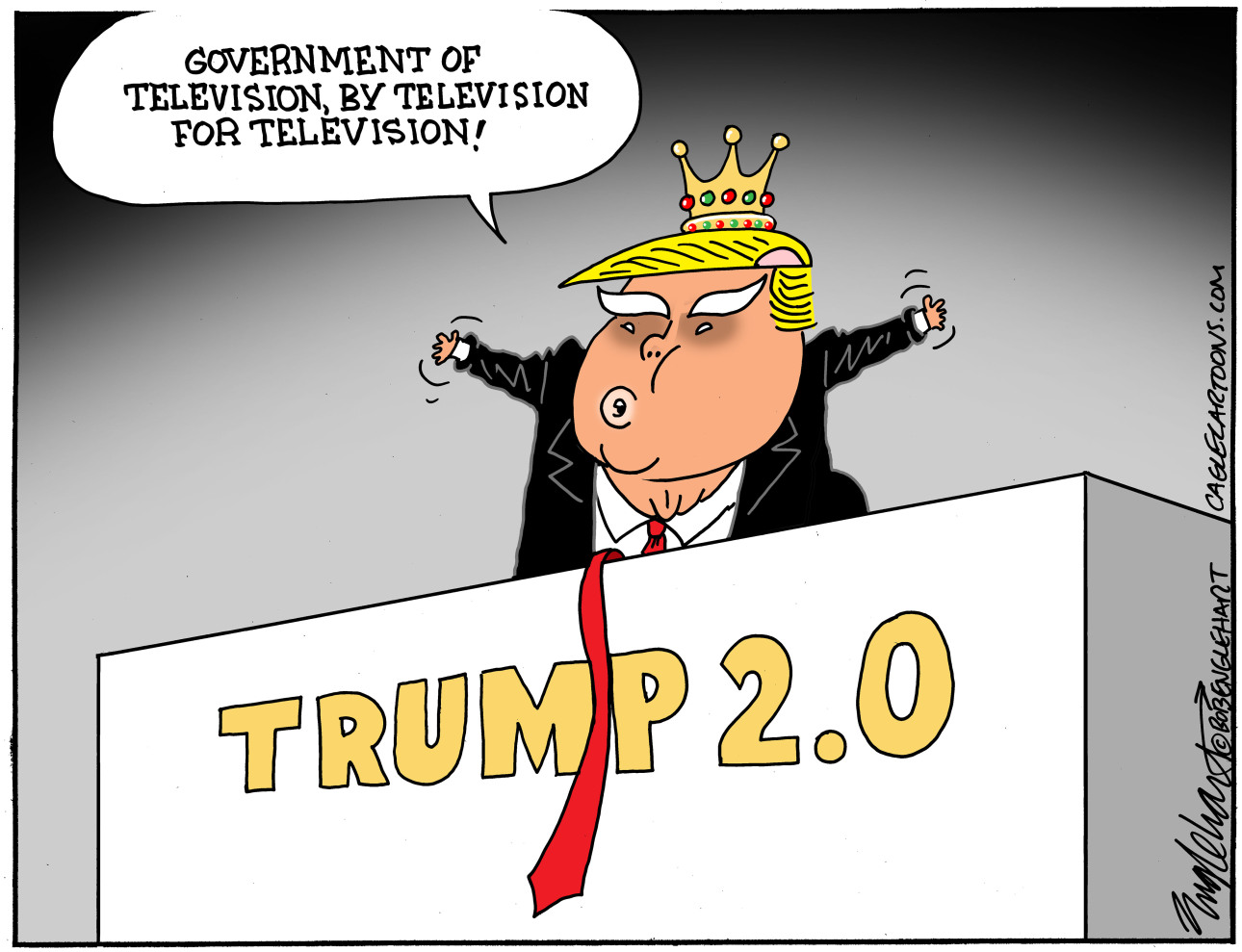
On February 18, 2025, Trump issued an executive order in which he declared that only he and the Attorney General “shall provide authoritative interpretations of the law for the executive branch.” Just before that, Trump posted on TruthSocial: “He who saves his country does not violate any law.”
Though the Executive Order doesn’t explicitly say so, it means that according to Trump, Supreme Court rulings are no longer to be considered “authoritative interpretations of the law” in relation to the executive branch.
No president—not even GW Bush—has seized power like Trump is doing, not since the famous 1803 SCOTUS ruling in Marbury v. Madison, which established the principle of judicial review and the supremacy of the Supreme Court to decide what is and is not the law (whether in relation to the executive branch or otherwise).
* (See note below about the animosity between President Jefferson and Chief Justice Marshall.)
Related stories
Without getting into the nuances here, let me just say THERE IS NO OTHER WAY A DEMOCRACY CAN FUNCTION without the principle of judicial review and the supremacy of an independent Supreme Court. There HAS TO BE a check on presidential power, or it is not a democracy. There has to be separation of powers and checks and balances.
The Unitary Executive Doctrine
All of Trump’s actions since retaking office have been a direct outgrowth of the unitary executive theory that George W. Bush adopted and tested during his two terms.
In 2005, I wrote an article about this doctrine titled: “Scholar says Bush has used obscure doctrine to extend power 95 times” (The Raw Story, September 23, 2005). (I am unable to get this link to work.)
A few months later, I wrote an article titled, "The Unitary Executive: Is The Doctrine Behind the Bush Presidency Consistent with a Democratic State?” (FindLaw’s Writ, January 9, 2006). (Link still active.) (Internal article links are no longer active.)
(Please note that these articles and my book mentioned below were published under my former legal name: Jennifer Van Bergen.)
My articles broke the news on this and were the first public warnings about this theory. (The topic was picked up by Charlie Savage, a journalist for The Boston Globe who won the 2007 Pulitzer Prize for National Reporting for his reporting on President George W. Bush’s use of signing statements.) (His 2007 book “Takeover: The Return of the Imperial Presidency” followed my 2004 book “The Twilight of Democracy: The Bush Plan for America."
In the 2006 article, I wrote:
“The unitary executive doctrine arises out of a theory called ‘departmentalism,’ or ‘coordinate construction.’ According to legal scholars Christopher Yoo, Steven Calabresi, and Anthony Colangelo, the coordinate construction approach “holds that all three branches of the federal government have the power and duty to interpret the Constitution.” According to this theory, the president may (and indeed, must) interpret laws, equally as much as the courts.”
This view came about after Nixon’s downfall, espoused by those unhappy with how he was treated for what they believed were his legitimate actions.
But although there have been those who have pushed this unitary executive view ever since, history does not favor it. It is simply unsustainable.
Cass Sunstein just pointed out in a NYTimes OpEd here: “In its most extreme version, the unitary executive theory is a form of invented history, a modern creation that threatens to change, and in important ways to undermine, the operations of the national government.”
I don’t think SCOTUS will go so far as to overrule Marbury v. Madison or to say that they themselves may not interpret or limit Trump’s authority. For them to do so would be to say SCOTUS itself is nothing more than an appendage of the president. We shall see.
* (Re. Chief Justice John Marshall’s ruling in Marbury v. Madison, President Thomas Jefferson was NOT pleased.). Not long after it, Jefferson proposed impeaching him! Jefferson furthermore, especially during his second term, pushed the limits of presidential power so far that New Englanders were talking of secession!
Comments

Powered by RoundtableAn AI/DeFi-powered Enterprise Media Operating System. Learn more at Roundtable.io.© Roundtable 2026. By using this site you agree to the Terms of Use and Privacy Policy