


Dec 9, 2025 7:16 PM
Updated Dec 11, 2025 3:39 AM
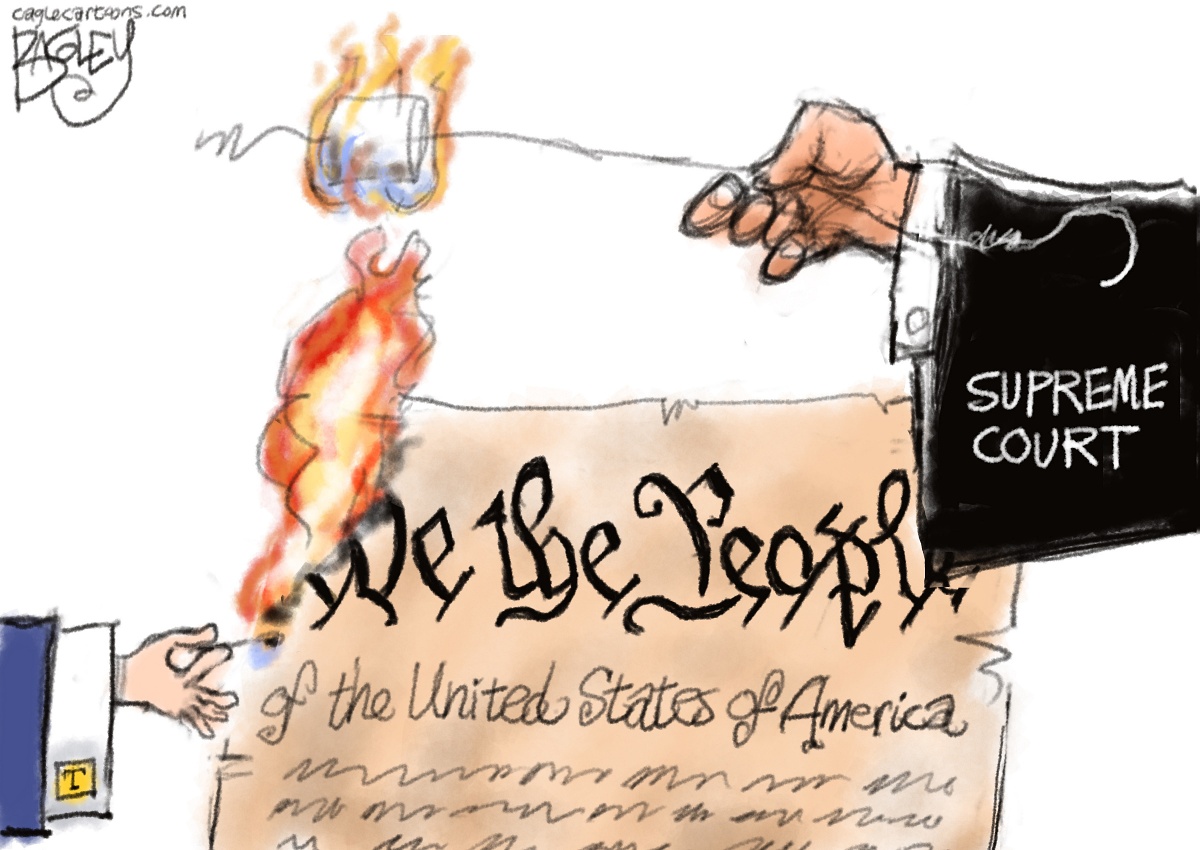
Whatever happens, the Roberts Court will forever be remembered as the handmaiden of Donald Trump’s imperial presidency.
Stephen Rodhe: Whatever happens, the Roberts Court will forever be remembered as the handmaiden of Donald Trump’s imperial presidency. More Videos
The United States is experiencing a constitutional crisis. The federal government is not functioning as it was designed by the Founders. The U.S. Constitution, as written and interpreted over the last 237 years, intentionally established a separation of powers and checks and balances. No less than five of the 29 Federalist Papers written by James Madison argued that keeping the three branches separate was essential to the preservation of liberty. “The accumulation of all powers, legislative, executive, and judiciary, in the same hands, whether of one, a few, or many…may justly be pronounced the very definition of tyranny.”[1]
In his Farewell Address, George Washington warned us about the “love of power and proneness to abuse it which predominates in the human heart” and spoke of the “necessity of reciprocal checks of political power, by dividing and distributing it into different depositories and constituting each the guardian…against invasions by the others.”[2] Of such checks and balances he concluded, “To preserve them must be as necessary as to institute them.”[3]
Today, not only are all three branches of the federal government under the control of a single political party; they are acting in service to a single individual, President Donald J. Trump. The Founders’ worst fears have become a reality, not simply because power is consolidated rather than separated, but because that power is being weaponized to retaliate against the opposing political party and other perceived foes. This is what Trump vowed he would do. On March 4, 2024, in a campaign appearance at the Conservative Political Action Conference, Trump announced, “In 2016, I declared: I am your voice. Today, I add: I am your warrior. I am your justice. And for those who have been wronged and betrayed: I am your retribution.”[4] His words, undoubtedly for the purpose of political influence, took on biblical, and even, apparently, messianic proportions: “Vengeance is mine, I will repay, says the Lord.” (Romans 12:19).
Related stories
In the most sweeping unilateral exercise of presidential authority in American history, Trump has, in less than a year, commandeered the entire federal government using the departments of Justice, Homeland Security, War (the new name he gave the Department of Defense), Treasury, and Education, as well as the IRS, Office of Management and Budget (OMB), Immigration and Customs Enforcement (ICE), the newly created Department of Government Efficiency (DOGE), and other departments and agencies in order to fire thousands of federal workers,[5] including inspectors general[6] and the commissioners of several independent administrative agencies.[7] Moreover, under these auspices, he has also terminated research grants to universities;[8] penalized law firms;[9] deported lawful permanent residents;[10]arrested and detained American citizens;[11] initiated the revocation of foreign students’ visas for protest activities;[12] invoked the Alien Enemies Act of 1798;[13] attacked Iran without congressional authority;[14] destroyed several boats in international waters in the Caribbean Sea and Pacific Ocean—killing at least 61 civilians;[15] arrested and detained journalists;[16] dismantled the Corporation for Public Broadcasting;[17] retaliated against the news media;[18] defunded the Voice of America[19] and the Smithsonian Museum;[20] terminated USAID;[21] shut down the Department of Education;[22] unilaterally imposed unprecedented tariffs without congressional authorization;[23] pardoned January 6 insurrectionists;[24] indicted former FBI director James Comey,[25] New York State Attorney General Letitia James,[26] and former National Security Advisor John Bolton;[27] deployed National Guard and active-duty soldiers to major Democrat-led cities, including Washington D.C., Los Angeles, Chicago, Portland (Oregon), and Memphis—and threatened to do so in Baltimore, New York City, New Orleans, Oakland, San Francisco, and St. Louis;[28] threatened to invoke the Insurrection Act;[29] and authorized the designation as “domestic terror networks” of the Open Society, Act Blue, Indivisible, the Coalition for Humane Immigrant Rights of Los Angeles, Jewish Voice for Peace, If Not Now, and other nonprofit organizations.[30]
In the face of all this, instead of imposing the checks and balances on Trump required by the Constitution, the other two branches have provided him help and support. Congress has either meekly stood by as Trump ignores his duty to “take Care that the Laws be faithfully executed”[31] or compliantly enacted his political agenda, which has already included permanent tax cuts, steep cuts to Medicaid, adding $150 billion to the military budget, and allocating $100 billion to ICE, thereby increasing the federal deficit by at least $2.4 billion over the next 10 years, according to the Congressional Budget Office.[32]
Meanwhile, although scores of federal trial and appellate courts have issued hundreds of temporary restraining orders, preliminary injunctions, and final judgments intended to curb Trump’s abuse of power, the conservative majority on the U.S. Supreme Court has used its emergency docket, dubbed the “shadow docket,” to create a law-free zone enabling Trump to implement executive orders—orders already found unconstitutional by lower courts—that immediately disrupt the status quo while appeals are pending.
Critics call it the “shadow docket” because the Supreme Court makes these important decisions without considering legal briefs on the merits from the parties or amici, without conducting oral arguments, and without issuing comprehensive majority (and sometimes dissenting) opinions explaining the justices’ reasoning, citing relevant facts and legal precedents. According to one analysis:
The growing reliance on the shadow docket has drawn criticism from legal experts about the lack of time and process the Supreme Court spends on what can be incredibly consequential decisions. Since Trump took office again in January, his administration has asked the Supreme Court 23 times to block lower court rules on an emergency basis. The court has granted the government’s emergency requests in 17. It rejected the government in two cases, while three other cases were resolved without decisions, and one request is pending.[33]
When the conservative majority granted Trump’s request to stay a temporary injunction that had prevented his administration from using the Alien Enemies Act to deport Venezuelan nationals to El Salvador,[34] Justice Ketanji Brown Jackson condemned the rush to judgment in a fiery dissent. “At least when the Court went off base in the past, it left a record so posterity could see how it went wrong,” she wrote, referring to the infamous 1944 decision in Korematsu v. United States, where the Court upheld the internment of Japanese Americans.[35] Justice Jackson added:
With more and more of our most significant rulings taking place in the shadows of our emergency docket, today’s Court leaves less and less of a trace. But make no mistake: We are just as wrong now as we have been in the past, with similarly devastating consequences. It just seems we are now less willing to face it.
Unitary Executive Theory Unbound
The legal pretext used by the architects of Donald Trump’s second term to justify his radical transformation of the federal government is an extreme version of the Unitary Executive Theory, which has been the darling of a few influential conservative law professors and judges since it emerged during the Reagan era.
The Unitary Executive Theory places the president at the apex of power in the federal government, in full and absolute control of all federal departments and agencies, none of which, regardless of their special expertise, are independent of the president's singular authority. The theory renders unconstitutional any act of Congress that limits what a president does, and it is the duty of the U.S. Supreme Court to strike down any attempt by Congress to encroach on the president’s vast power.[36]“Supporters of the theory argue that the original intent of our country’s founders requires presidential control, including a power to remove federal officials from their posts for political reasons.”[37]
Critics of the Unitary Executive Theory point out that Section 3 of Article II of the Constitution provides that the president may “recommend” for Congress's “consideration” such “measures as he shall judge necessary and expedient” and “shall take Care that the Laws be faithfully executed” (known as the “take care” provision). Section 2 of Article II provides that upon taking office, the president shall swear to “faithfully execute the Office of President of the United States, and will to the best of my Ability, preserve, protect and defend the Constitution of the United States.” Thus, the critics conclude that the Constitution envisions a president who is not alone in being in charge of the entire federal government but is, instead, in a collaborative relationship with Congress. The president may “recommend” laws to Congress, which may or may not enact them, but in all events the president is obligated to “take Care” that the laws Congress decides to pass are “faithfully executed.” Or, said more generally, “Opponents of the theory rely on functional considerations and our practice of dispersing power more widely.”[38]
Even leading conservative legal analyst Jack Goldsmith, a professor at Harvard Law School, who believes that some of Trump’s actions “are lawful exercises of a president’s massive constitutional and statutory power that are designed to exemplify the robustness of his presidential control,” is deeply concerned that “much of what he is doing either exceeds the Supreme Court’s current conceptions of the limits of presidential power or at least are very aggressive and contested assertions of presidential power.”[39]
According to Goldsmith, “Trump’s gambit to fire career civil servants rests on a conception of Article II that goes beyond the Supreme Court’s already-generous removal precedents. There are other examples of Article II overreach, and…several of Trump’s actions violate other provisions of the Constitution, such as the birthright citizenship order.”[40]
“This is a strategy, obviously, that is designed to project power and to demonstrate a president who is in charge and fulfilling his campaign promises,” Goldsmith writes. It seeks “to maximize disruption of the federal government, which is a key policy goal of the Trump administration,” and “aims to maximize fear—among the executive branch employees that Trump would like to quit; among those who stay in government but do not support the president’s actions; and among those in the country, and the world, whom Trump wants to intimidate to achieve his ends.”[41]
As Goldsmith sees it, the “lawfulness of the actions ultimately rests on the validity of an absolutist conception of unitary executive power that Trump 2.0 embraces and exemplifies,” based on four related tenets: 1) the Constitution vests all of the executive power in the president, 2) all subordinate executive branch officials are removable at will by the president, 3) the president’s Article II duty to “take Care that the Laws be faithfully executed” entails an exclusive presidential power to decide which laws to enforce or not to enforce, and 4) the president can thus direct and control all subordinate executive officials.[42]
Goldsmith argues that the Supreme Court has not yet accepted all four of these tenets. It has embraced the first in many decisions, most recently Trump v. United States, in which the Court granted Trump absolute immunity for crimes committed while carrying out his official duties.[43] The Court said, “[T]he Constitution vests the entirety of the executive power in the President,” and “unlike anyone else, the President is a branch of government.”[44] In addition, the Court has acknowledged the second tenet, with two important—but what Goldsmith calls “possibly shaky”—exceptions: “one for multimember expert agencies that do not wield substantial executive power, and one for inferior officers with limited duties and no policymaking or administrative authority.” Many of the people in government that Trump wants to remove “are probably protected right now by this second exception,” according to Goldsmith. He notes that in Trump the Court for the first time embraced a version of the third tenet, but “the scope of its ruling is impossible to discern, and an exclusive power to decide which laws to enforce is in unexamined tension with other decisions.” Since the Court has tied the president’s power to control all subordinate executive officials (Tenet No. 4) to his removal power (Tenet No. 3) and to the “take care” duty of Article II, Goldsmith believes “the extent of that presidential power in the weeds remains uncertain.”[45]
By Goldsmith's count there are at least five “unitarians” on the Supreme Court: Chief Justice John Roberts and justices Clarence Thomas, Samuel Alito, Neil Gorsuch, and Brett Kavanaugh. (He is “less sure” about Justice Amy Coney Barrett). These justices “have spoken and reasoned in ways that suggest they might accept all four tenets of the pure unitary executive, in theory.”[46] The question is “whether they will go there in reality, when the reality is a president who doesn’t care about legal limits or about the non-legal norms that have kept the modern behemothic executive in check and thus legitimated its power.”[47] Goldsmith calls this “one of the most important questions in Trump 2.0” because “every judicial decision about executive power rests on implicit assumptions about how that power will be used and the credibility and trustworthiness of the administration wielding it.”[48]
Past Supreme Court Decisions Rejected Unitary Executive Theory
An early test of the scope of presidential power came in 1838 in the case of Kendall v. United States.[49]The federal government argued that the postmaster general was “subject to the direction and control of the President of the United States” growing out of his constitutional obligation to “take care that the laws be faithfully executed.”[50] Instead, the Supreme Court held that this “doctrine cannot receive the sanction of this Court.” It “would be vesting in the President a dispensing power which has no countenance for its support in any part of the Constitution, and is asserting a principle which, if carried out in its results to all cases falling within it, would be clothing the President with a power to control the legislation of Congress and paralyze the administration of justice.”[51] Almost a hundred years later, the Court reinforced Kendall in Humphrey’s Executor v. United States.[52] In 1925, William E. Humphrey was appointed as a commissioner of the Federal Trade Commission (FTC) by President Calvin Coolidge. He was reappointed in 1931 by President Herbert Hoover to a second seven-year term, which was set to expire in 1938, but President Franklin D. Roosevelt fired him in 1933.[53]
Humphrey’s strident opposition to most of the FTC’s antitrust enforcement drew Roosevelt’s ire. Despite the fact that when Congress passed the Federal Trade Commission Act of 1914, it prohibited the president from firing an FTC commissioner for any reason other than “inefficiency, neglect of duty, or malfeasance in office,”[54]Roosevelt fired him over policy disagreements.[55] Five months later, Humphrey died of a stroke. Upon his termination, the FTC stopped paying his salary, so his executor sued the federal government.[56]
On May 27, 1935, the Supreme Court issued a unanimous decision in favor of Humphrey’s estate, holding that Congress’s restrictions on the president’s removal of FTC commissioners did not violate the Constitution. In an opinion by Justice George Sutherland, the Court distinguished between executive officers and quasi-legislative or quasi-judicial officers. The Court concluded that Congress had intended to create an independent, non-partisan agency “free from ‘political domination or control’” by providing tenure protection to “limit the executive power of removal to the causes enumerated.”[57] The FTC was a non-partisan body “which shall be independent of executive authority, except in its selection and free to exercise its judgment without the leave or hindrance of ... any department of the government.”[58] The Court limited the president’s inherent supervisory power to “purely executive officers.”[59]
In 1988, a challenge to the appointments of independent counsels in the case of Morrison v. Olson gave proponents a chance to convince the Court to adopt the Unitary Executive Theory.[60] In response to the Watergate affair and other scandals, Congress passed the Ethics in Government Act of 1978 (EGA), which empowered a special division of the U.S. Court of Appeals for the District of Columbia Circuit to appoint an independent counsel to investigate federal officials so long as the attorney general determined there was sufficient evidence to warrant the investigation. Unlike other federal law enforcement officers, independent counsels under the EGA were not subject to removal at the order of the president. Instead, the attorney general could remove independent counsel only if there was “good cause” or if counsel had become mentally or physically unable to perform the job.[61]
In Morrison, the Reagan administration argued that the independent counsel system violated the principle of separation of powers by interfering with the president’s powers to enforce the law and hire and fire executive officials. However, in an opinion by Chief Justice William Rehnquist, the Supreme Court upheld the constitutionality of the EGA by a hefty 7–1 margin, without the participation of Justice Anthony Kennedy, who recused himself.
The Court held that the independent counsel system did not unduly interfere with the president’s ability to carry out the laws or remove executive officers. The Chief Justice noted that Congress was not trying to enhance its own powers through the EGA. Further, since the Appointments Clause of the Constitution authorizes Congress to allow courts to appoint inferior officers (“but the Congress may by Law vest the Appointment of such inferior Officers, as they think proper, in the President alone, in the Courts of Law, or in the Heads of Departments”), this was not a case of judges assuming executive powers.[62]
The lone dissenter, Justice Antonin Scalia, wrote a lengthy opinion aggressively advancing the Unitary Executive Theory. He argued that the majority’s approach amounted to an arbitrary determination that the independent counsel system did not interfere “too much” with the powers the Constitution had given to the president alone.[63] Scalia argued that Congress did not have the power to allow judges to appoint a special counsel nor the authority to restrict the president from firing that person at will. He warned that because independent counsels were not accountable to the president, their powers could easily be abused.[64] Scalia advanced a strong defense of the Unitary Executive Theory, but no other justice joined in his dissent, not even conservatives such as Chief Justice Rehnquist or Justice Sandra Day O’Connor.
Nevertheless, 12 years later the tide began to turn. On June 29, 2020, in a closely divided 5-4 decision, the Supreme Court held in Seila Law LLC v. Consumer Financial Protection Bureau that the structure of the Consumer Financial Protection Bureau (CFPB), with a single director who could be removed from office only “for cause,” violated the president’s authority.[65]
During a CFPB investigation of Seila Law LLC—which provided debt relief services—the law firm refused to produce documents in response to a civil investigative demand and challenged the constitutionality of the CFPB. The U.S. District Court for the Central District of California upheld the constitutionality of the CFPB, and the Ninth Circuit Court of Appeals affirmed, citing Humphrey's Executor and Morrison as controlling. However, the Supreme Court reversed. Chief Justice Roberts wrote the majority opinion, in which justices Thomas, Alito, Gorsuch, and Kavanaugh joined. Thomas wrote a partial concurrence, joined by Gorsuch, expressing his view that Humphrey's Executor should be overturned and all “for cause” termination requirements should be found unconstitutional.[66]
In the majority opinion, the Court described two exceptions to the president’s general power to remove officers at will—exceptions that were obviously tailored to avoid overturning Humphrey’s Executor and its progeny. To address Humphrey’s Executor, the majority agreed that the president's removal power could be constrained by Congress if the officer were a member of an agency that shares similar characteristics to the FTC. To address Morrison, the majority held that Congress could limit the president’s authority to fire “inferior officers with limited duties and no policymaking” role.[67] The Court upheld the president’s authority where an independent agency is led by a single director and vested with significant executive power.
Justice Elena Kagan wrote a strong dissent, joined by Justices Ruth Bader Ginsburg, Stephen Breyer, and Sonia Sotomayor. Kagan challenged the majority’s key assumption by noting as follows: “Nowhere does the text [of the Constitution] say anything about the president's power to remove subordinate officials at will.”[68] She also disputed the majority’s characterization of Article II’s “Take Care” Clause as conferring power to the president. Kagan wrote that to the extent the clause gives presidents any power—instead of merely conferring a duty upon them—it is only the power to ensure that “the laws are faithfully executed.”[69]
From Theory to Unilateral Executive Action
It is not apparent whether Trump ever heard of the Unitary Executive Theory before he ran for president, but he has eagerly embraced it since then. On January 27, 2025, he fired Gwynne Wilcox, a Democrat, the first Black woman to serve on the National Labor Relations Board and the first Black woman to chair that agency.[70] On February 10, he fired Cathy Harris, a Democratic member of the Merit Systems Protection Board (MSPB). Congress has established by law that officials such as Wilcox and Harris could not be fired except “for inefficiency, neglect of duty, or malfeasance in office.”[71]Trump cited no such grounds. Both women sued and won preliminary injunctions from federal judges.
On February 18, 2025, Trump issued a sweeping presidential directive, triumphantly based on the Unitary Executive Theory, entitled “Ensuring Accountability for All Agencies.”[72] He invoked his “authority as President” to declare that “it shall be the policy of the executive branch to ensure Presidential supervision and control of the entire executive branch.”[73] He claimed that previous administrations have allowed what he pejoratively called “so-called ‘independent regulatory agencies’” to “operate with minimal Presidential supervision.” He asserted that these agencies “currently exercise substantial executive authority without sufficient accountability to the President, and through him, to the American people,” and he complained that they “have been permitted to promulgate significant regulations without review by the President.”[74]
Consequently, he announced that henceforth all federal agencies “must be supervised and controlled” by the president and that all proposed and final significant regulatory actions must be submitted for review to the Office of Information and Regulatory Affairs within the White House before publication in the Federal Register.[75] Furthermore, Trump’s directive mandated that the “President and the Attorney General, subject to the President’s supervision and control, shall provide authoritative interpretations of law for the executive branch,” which shall be “controlling on all employees in the conduct of their official duties.”[76] No employee of the executive branch acting in their official capacity “may advance an interpretation of the law as the position of the United States that contravenes the President or the Attorney General’s opinion on a matter of law, including but not limited to the issuance of regulations, guidance, and positions advanced in litigation, unless authorized to do so by the President or in writing by the Attorney General.”[77]
On May 22, by a vote of 6-3, the Supreme Court granted the Trump administration’s request for an emergency stay of the injunctions granted to both Wilcox and Harris.[78] The majority issued only a terse two-page unsigned order, with very little explanation. It neither cited nor distinguished Humphrey’s Executor. It conceded that the “President is prohibited by statute from removing these officers except for cause, and no qualifying cause was given,” citing Section 153(a) of Title 29 (permitting removal only for “neglect of duty or malfeasance in office”) and Section 1202(d) of Title 5 in the United States Code (permitting removal only for “inefficiency, neglect of duty, or malfeasance in office”).[79] Nonetheless, in the very next sentence, the majority granted the stay, simply declaring, without further explanation, that because “the Constitution vests the executive power in the President, see Art. II, §1, cl. 1, he may remove without cause executive officers who exercise that power on his behalf, subject to narrow exceptions recognized by our precedents,” citing Seila Law LLC.[80]
Curiously, the majority admitted that it was not deciding “whether the NLRB or MSPB falls within such a recognized exception” since “that question is better left for resolution after full briefing and argument.” Without explanation, the majority also simply declared, “the Government faces greater risk of harm from an order allowing a removed officer to continue exercising the executive power than a wrongfully removed officer faces from being unable to perform her statutory duty.”81 Also, without explanation, the majority declared that a “stay is appropriate to avoid the disruptive effect of the repeated removal and reinstatement of officers during the pendency of this litigation,” ignoring the fact that it was Trump’s directive, not the injunction, that had disrupted the status quo.[82]
The three dissenters had a lot more to say. In a scathing eight-page dissent written by Justice Kagan, joined by justices Sotomayor and Jackson, the dissenters pointed out that Humphrey’s Executor “has stood as a precedent of this Court” but “not just any precedent.”[83] Humphrey’s Executor “undergirds a significant feature of American governance: bipartisan administrative bodies carrying out expertise-based functions with a measure of independence from presidential control.”[84] She explained that Congress created the NLRB and the MSPB, and many other agencies, including the Federal Communications Commission and the FTC, based on the vision “that in certain spheres of government, a group of knowledgeable people from both parties—none of whom a President could remove without cause—would make decisions likely to advance the long-term public good.”[85] She reminded the majority that in Humphrey’s Executor a unanimous Court rejected the argument that the “removal restriction enacted for the FTC interferes with ‘the executive power,’ and it held that Congress has authority, in creating such ‘quasi- legislative or quasi-judicial’ bodies, to ‘forbid their [members’] removal except for cause.’”[86] She also noted that Humphrey’s Executor was reaffirmed in Wiener v. United States.[87] Kagan not only accused Trump of taking “the law into his own hands” but also asserted that now “this Court effectively blesses those deeds.”[88] Humphrey’s Executor “remains good law, and it forecloses both the President’s firings and the Court’s decision to award emergency relief.”[89]
To support her view that the “emergency docket, while fit for some things, should not be used to overrule or revise existing law,” Kagan cited her conservative colleague, Justice Barrett.[90] Four years ago, Barrett expressed concern that the Court considers emergency applications “on a short fuse without benefit of full briefing and oral argument” and resolves them “without fully (or at all) stating our reasons.”[91] Kagan also distinguished between granting an emergency stay to vindicate established legal rights—rights that the courts below have disregarded—and issuing an order that actually changes the law and takes away established legal rights. Furthermore, she noted that the majority did not even find that the Trump administration was likely to prevail on that issue, which is an indispensable prerequisite to granting an emergency stay: “Our normal (invariable?) practice is to grant a stay pending appeal only when we decide the applicant is likely to succeed on the merits.”[92] Such an omission should have been fatal to the emergency stay application.
As far as balancing the equities is concerned, Kagan pointed out that what matters is not that “Wilcox and Harris would love to keep serving in their nifty jobs” but “that Congress provided for them to serve their full terms, protected from a President’s desire to substitute his political allies.”[93] The majority “distorts and overstates the interest in preventing Wilcox and Harris from continuing in office,” Kagan wrote.[94] That is not the entire government’s interest but only that of Trump. “Congress, after all, is also part of the Government, and (as just noted) its equities lie in preserving the legislation it has enacted to limit removals.”[95] Since Humphrey’s Executor was decided, 14 different presidents, Republican and Democrat, have lived with Congress’s restrictions on firing members of independent agencies. “No doubt many would have preferred it otherwise. But can it really be said all this time, that the president has a crying need to discharge independent agency members right away—before this Court (surely next Term) decides the fate of Humphrey’s on the merits?”[96]
Finally, Kagan noted that the majority justified its emergency stay on the grounds that such a stay would “avoid the disruptive effect of the repeated removal and reinstatement of officers during the pendency of this litigation.”[97] However, she pointed out the obvious fact that when this case came to the Court, “Wilcox and Harris had been reinstated to their positions, by the combined rulings of the district and appellate courts.”[98] So, by re-removing them, “the majority’s order itself causes disruption—except, of course, if that order presumes or implies that they will be re-removed next Term anyway.”[99]
Shortly thereafter, the Supreme Court went even further and used the emergency docket to bless the elimination of an entire federal department created by Congress. On July 14, 2025, in McMahon v. New York, the Supreme Court, again in a 6-3 vote, granted Trump’s request for an emergency stay of a preliminary injunction that had prevented him from abolishing the Department of Education (“the Department”).[100] Remarkably, the order resulting in the complete elimination of an entire federal department created by Congress was four sentences long. It read in full as follows:
The application for stay presented to JUSTICE JACKSON and by her referred to the Court is granted. The May 22, 2025 preliminary injunction entered by the United States District Court for the District of Massachusetts, case No. 1:25–cv–10601, is stayed pending the disposition of the appeal in the United States Court of Appeals for the First Circuit and disposition of a petition for a writ of certiorari, if such a writ is timely sought. Should certiorari be denied, this stay shall terminate automatically. In the event certiorari is granted, the stay shall terminate upon the sending down of the judgment of this Court.[101]
No findings. No reasoning. No case citations.
In stark contrast, Justice Sotomayor issued a comprehensive 19-page dissent, joined by justices Kagan and Jackson. As Congress mandated, she began, “the Department plays a vital role in this Nation’s education system, safeguarding equal access to learning and channeling billions of dollars to schools and students across the country each year. Only Congress has the power to abolish the Department.” The executive’s task, she noted, is to “take Care that the Laws be faithfully executed.”
Yet, “by executive fiat, the President ordered the Secretary of Education to ‘take all necessary steps to facilitate the closure of the Department.” Consistent with that Executive Order, Secretary of Education Linda McMahon “gutted the Department’s work force, firing over 50 percent of its staff overnight.”[102]In McMahon’s own words, the mass termination served as “the first step on the road to a total shutdown” of the Department.[103]
“When the Executive publicly announces its intent to break the law,” Sotomayor wrote, “and then executes on that promise, it is the Judiciary’s duty to check that lawlessness, not expedite it.”[104] She pointed out that “[t]wo lower courts rose to the occasion, preliminarily enjoining the mass firings while the litigation remains ongoing. Rather than maintain the status quo, however, this Court now intervenes, lifting the injunction and permitting the Government to proceed with dismantling the Department.” She called that decision “indefensible” because it hands “the Executive the power to repeal statutes by firing all those necessary to carry them out.”[105]
“The majority is either willfully blind to the implications of its ruling or naive, but either way the threat to our Constitution’s separation of powers is grave.”[106] Until now, Sotomayor pointed out, “Presidents have recognized they lack the unilateral authority to eradicate a Department that Congress has tasked with fulfilling statutory duties.”[107] Since Congress created the Department, “only Congress can abolish it. The President, too, may not refuse to carry out statutorily mandated functions assigned to the Department, for he must ‘take Care that the Laws be faithfully executed.’ Art. II, §3.”[108]
Sotomayor pointed out that even short-term delays in funding can force school districts “to make cuts…to staff and programs, disrupting services for students and families.”[109] Indeed by the time they filed suit, several States had already experienced delays related to federal reimbursements. Officials at schools and universities likewise attested that they rely on timely certifications from the Department to enroll students on federal financial aid. Following the reduction in force, “academic institutions have been or will be forced to turn away whole swaths of prospective students.”[110] The Government submitted no evidence to rebut the factual record compiled by the plaintiffs. Nor did it argue that the executive could singlehandedly abolish the Department. Instead, it claimed the mass termination fell within the president’s authority to “streamlin[e]” the Department.
She went on to note that the district court had expressly found that “the record abundantly reveals that Defendants’ true intention is to effectively dismantle the Department without an authorizing statute,” [111] and that the terminations would prevent the Department from “carry[ing] out its statutory functions.”[112] Likewise, the First Circuit denied the Government’s request to stay the preliminary injunction because the Government did not “even attempt to engage with the District Court’s record based findings, including the extent of the reduction in force, the intent behind both it and the transfer of functions to shut down the Department,” or “the disabling impact of those actions on the Department’s ability to carry out statutorily assigned functions.” The First Circuit agreed that the plaintiffs faced serious irreparable harms from the “Department’s inability to provide its statutorily mandated services.”[113]
“The Founders of this Nation entrusted the lawmaking power to the Congress alone,” Sotomayor wrote, citing the seminal decision in Youngstown Sheet & Tube Co. v. Sawyer.[114] “‘There is no provision in the Constitution that authorizes the President to enact, to amend, or to repeal statutes.’”[115] While the Government claimed it simply intended to “‘cut bureaucratic bloat,’” Sotomayor demonstrated how the “record unambiguously refutes that account.”[116]
Furthermore, Sotomayor found that the Government’s contention that the plaintiffs failed to demonstrate an “‘“actual or imminent”’” harm was “belied by both the record and common sense.”[117] Dismantling those services “has jeopardized funding streams and required schools to divert resources to fill the gaps, causing concrete monetary damages and operational harm to plaintiffs.”[118]While the Government will, no doubt, “suffer pocketbook harms from having to pay employees that it sought to fire as the litigation proceeds, the harm to this Nation’s education system and individual students is of a far greater magnitude.”[119] Lifting the District Court’s injunction “will unleash untold harm, delaying or denying educational opportunities and leaving students to suffer from discrimination, sexual assault, and other civil rights violations without the federal resources Congress intended.”[120]
Sotomayor concluded that the “President must take care that the laws are faithfully executed, not set out to dismantle them.”[121] While that “basic rule undergirds our Constitution’s separation of powers,” the majority “rewards clear defiance of that core principle with emergency relief.”[122] She could not “condone such abuse of our equitable authority,” and thus she and her two colleagues respectfully dissented.[123]
Emboldened, Trump continued to fire Democratic commissioners of other independent agencies without cause, and the conservative majority obligingly continued to use emergency stays to bless these partisan purges. In May 2025, Trump fired Mary Boyle, Alexander Hoehn-Saric, and Richard Trumka Jr., the three Democratic commissioners on the Consumer Product Safety Commission (CPSC). Boyle sued and won a preliminary injunction reinstating her but on July 23, 2025, the 6-member majority again granted Trump’s request for a stay. This time the Court conceded that emergency orders “are not conclusive as to the merits,” but nonetheless held that the application was “squarely controlled” by the emergency order in Trump v. Wilcox.[124]
Yet again the three dissenters pointed out that the Court was using “its emergency docket to destroy the independence of an independent agency,” which Congress had established to ensure “‘a classic independent agency—a multi-member, bipartisan commission’” whose members serve staggered terms and cannot be removed except for good reason.[125] As the dissent explained, in Congress’s view “that structure would better enable the CPSC to achieve its mission—ensuring the safety of consumer products, from toys to appliances—than would a single-party agency under the full control of a single President.”[126] By allowing the president “to remove Commissioners for no reason other than their party affiliation, the majority has negated Congress’s choice of agency bipartisanship and independence.”[127]
Then, on September 22, 2025, by a now-familiar 6-3 vote, in a one paragraph order the Court once again stayed a preliminary injunction that had reinstated Rebecca Kelly Slaughter, a Democratic commissioner at the FTC, whom Trump had fired without cause in March 2025. (Trump had also fired Avaro Bedoya, another Democratic FTC commissioner, but she decided to resign). The Court scheduled Slaughter’s case for the December 2025 argument session. By specifically defining the key issue as whether Congress’s removal protections for members of the FTC violate the separation of powers and, if so, whether Humphrey’s Executor “should be overruled,” the conservative majority left little doubt where it was headed.[128]
Once again, in Trump v. Slaughter, the three dissenters, justices Kagan, Sotomayor, and Jackson, pointed out that the “majority, stay order by stay order, has handed full control of all those agencies to the President. He may now remove—so says the majority, though Congress said differently—any member he wishes, for any reason or no reason at all” thereby extinguishing “the agencies’ bipartisanship and independence.”[129] The dissenters added that the “emergency docket should never be used, as it has been this year, to permit what our own precedent bars. Still more, it should not be used, as it also has been, to transfer government authority from Congress to the President, and thus to reshape the Nation’s separation of powers.”[130]
In August 2025, Trump fired Lisa Cook, a Democratic member of the Federal Reserve, “for cause,” citing allegations of mortgage fraud as the basis for her removal. The Federal Reserve Act provides that members of the Board of Governors shall serve 14-year terms “unless sooner removed for cause by the President.”[131] Cook won a preliminary injunction and the Court of Appeals for D.C. Circuit denied the government’s request for a stay by a 2-1 vote. However, this time, instead of granting an emergency stay, on October 1, the Supreme Court deferred the government’s request pending oral argument in January 2026.[132]
A Brief Detour?
Is the Unitary Executive Theory now firmly established as the prevailing jurisprudence under which the Supreme Court will cast aside the doctrine of separation of powers, weaken checks and balances, neuter the role of Congress to limit the Executive Branch, and afford the president unbounded control over the entire federal government? Or is the six-member conservative majority on the Supreme Court simply giving Trump a short honeymoon to temporarily impose his authoritarian vision on America, which they will end once they decide the multiple court challenges on the merits of those cases during the 2025-2026 term? Or will shifting majorities emerge on the Court to give half a loaf to Trump and half to the rule of law?
Less than a month after returning to the White House, Trump embraced the imperial decree attributed to French Emperor Napoleon Bonaparte: “He who saves his Country does not violate any Law.”[133]Barely three months into Trump’s second term, Celina Stewart, CEO, and Dianna Wynn, president, of the League of Women Voters, declared that “our country is in a constitutional crisis.” They decried how the “foundational principles that have sustained our democracy—checks and balances, the rule of law, free and fair elections—checks are under direct and sustained threat.” Calling it an “extraordinary moment,” in which “we cannot proceed with business as usual,” they implored all Americans, regardless of who they voted for in 2024, “to come together, stand united, and fight back to save our democracy. We cannot afford to fail the generations to come.”[134]
Whatever happens, the Roberts Court will forever be remembered as the handmaiden of Donald Trump’s imperial presidency. Last year, it invented absolute criminal immunity to protect candidate Trump. This year it abused the emergency docket to allow President Trump to ignore Congress and radically disrupt or dismantle important federal institutions in the face of the text and history of the Constitution and well-established Supreme Court precedents.
If the six Justices who are so enamored with originalism and who pride themselves on their fidelity to the Founders had clearly seen in Trump what George Washington called the “love of power and proneness to abuse it,” they would have spoken with a unanimous voice, ensuring that the Court serves the United States as an indispensable “guardian” upholding the “necessity of reciprocal checks of political power.”[135] There is still time for the Court to resume that crucial role in the American democracy.
[1] The Federalist No. 47, 1.
[2] Washington’s Farewell Address to the People of the United States, 15 [hereinafter Washington's Farewell Address].
[3] Id.
[31] U.S. Const. art. II, §3.
[32] One Big Beautiful Bill Act, H.R. 1, 119th Congress (2025), available at https://www.cbo.gov/publication/61486.
[34] Trump v. J.G.G., No. 24A931, 604 U. S. ____ (2025), available at
[35] Id., at 2 (Jackson, J. , dissenting) (citing Korematsu v. United States, 323 U.S. 214 (1944)).
[36] David M. Driesen, The Unitary Executive Theory in Comparative Context, 72 Hastings L.J. 1 (2020).
[37] See Steven G. Calabresi & Kevin H. Rhodes, The Structural Constitution: Unitary Executive, Plural Judiciary, 105 Harv. L. Rev. 1153, 1158 (1992) (noting that “unitary executive theorists” claim that the president must have ‘direct control’ over all executive officers;) cf. id. at 1166 (discussing some differences in the nature of the required control among supporters of the theory). See also Steven G. Calabresi & Saikrishna B. Prakash, The President’s Power to Execute the Laws, 104 Yale L.J. 541, 550 (1994) (stating that the Constitution’s text and history support the unitary executive theory); Saikrishna Bangalore Prakash, Note, Hail to the Chief Administrator: The Framers and the President’s Administrative Powers, 102 Yale L.J. 991, 991-94 (1993) (arguing that the Framers intent supports the unitary executive theory); cf. Steven G. Calabresi & Christopher S. Yoo, The Unitary Executive: Presidential Power from Washington to Bush 37-38 (2008) (arguing that the history of presidential support for the unitary executive theory over time supports it).
[38] See, e.g., Peter L. Strauss, Overseer, or “The Decider”? The President in Administrative Law, 75 Geo. Wash. L. Rev. 696, 759 (2007) (arguing that the president oversees government agencies, but that the Constitution does not require the president to have the power to decide all issues himself); M. Elizabeth Magill, Beyond Powers and Branches in Separation of Powers Law, 150 U. Pa. L. Rev. 603, 651, 653 n.125 (2001) (describing fragmentation of power within branches of government as “our ASSURANCE against threatening concentrations of government power”). See generally Aziz Huq & Tom Ginsburg, How to Lose a Constitutional Democracy, 65 UCLA L. Rev. 78 (2018).
[39] https://executivefunctions.substack.com/p/maximum-executive-power-and-the-fate [hereinafter Goldsmith].
[40] Id.
[41] Id.
[42] Id.
[43] Trump v. United States, No. 23–939, slip op. (S. Ct. July 1, 2024), available athttps://www.supremecourt.gov/opinions/23pdf/23-939_e2pg.pdf.
[44] Id. at 20.
[45] Goldsmith, supra note 15.
[46] Id.
[47] Id.
[48] Id.
[49] Kendall v. US, 37 U.S. 524, 525 (1838).
[50] Id. at 524.
[51] Id. at 525.
[52] Humphrey’s Executor v. United States, 295 U.S. 602 (1935).
[53] Id. at 618.
[54] Id. at 602.
[55] Id. at 619.
[56] Id. at 618.
[57] Id. at 625.
[58] Id.
[59] Id. at 628.
[60] Morrison v. Olson, 487 U.S. 654 (1988).
[61] Id., passim.
[62] Id. at 70 citing U.S. Const. art. II, § 2, cl. 2.
[63] Id. at 697-98 (Scalia, J., dissenting).
[64] Id. at 715 (Scalia, J., dissenting).
[65] Seila Law LLC v. Consumer Fin. Prot. Bureau, 591 U.S. 197 (2020).
[66] Id. at 2-3 (Op. of Roberts, C.J.).
[67] Id. at 16.
[68] Id. at 8-9 (Kagan, J., dissenting).
[69] Id. at 12.
[73] Id.
[74] Id.
[75] Id.
[76] Id.
[77] Id.
[78] Trump v. Wilcox, No. 24A966, 605 U.S. ___ (2025), available at
[79] Id. at 1.
[80] Id.
[81] Id.
[82] Id.
[83] Id. at 1 (Kagan, J., dissenting).
[84] Id.
[85] Id.
[86] Id.
[87] Id. at 1-2 (citing Wiener v. United States, 357 U. S. 349 (1958)).
[88] Id. at 2.
[89] Id.
[90] Id.
[91] Id. (citing Does 1–3 v. Mills, 595 U. S. __, slip op., at 1 (2021) (Barrett, J., concurring in denial of application for injunctive relief )).
[92] Id. at 5.
[93] Id.
[94] Id. at 6.
[95] Id.
[96] Id. at 7.
[97] Id., n.*, at 7 (citing Trump v. Wilcox, No. 24A966, 605 U.S. ___, 2 (2025)).
[98] Id., n.* at 7.
[99] Id.
[100] McMahon v. New York, No. 24A1203, 606 U. S. ____ (2025), available at https://www.supremecourt.gov/opinions/24pdf/24a1203_new_6j37.pdf.
[101] Id. at 1.
[102] Id. at 2 (Sotomayor, J., dissenting).
[103] Id.
[104] Id.
[105] Id.
[106] Id. at 2.
[107] Id. at 5.
[108] Id. at 12.
[109] Id. at 9.
[110] Id. at 10.
[111] Id.
[112] Id. (internal citation omitted).
[113] Id. at 11 (internal citations omitted).
[114] Id. at l2 (citing Youngstown Sheet & Tube Co. v. Sawyer, 343 U. S. 579, 589 (1952)).
[115] Id. at l2 (citing Clinton v. City of New York, 524 U. S. 417, 438 (1998)).
[116] Id. at l2.
[117] Id. at 14-15 (internal citations omitted).
[118] Id. at 15.
[119] Id. at 16.
[120] at 19.
[121] Id.
[122] Id.
[123] Id.
[124] Trump v Boyle, No. 25A11, 606 U. S. ____ (2025), available at
[125] Id. at 1 (Kagan, J., dissenting, joined by Sotomayor, J. and Jackson, J.).
[126] Id.
[127] Id. at 2.
[128] Trump v. Slaughter, No. 25A264 (25-332), 606 U. S. ____ (2025), available at https://www.supremecourt.gov/opinions/24pdf/25a264_o759.pdf.
[129] Id. at 2 (Kagan, J., dissenting, joined by Sotomayor, J. and Jackson, J.)
[130] Id. at 3.
[131] 12 U.S.C. §242.
[132] Trump v. Cook, No. 25A312, Order in Pending Case (Oct. 1, 2025), available at
[133] https://www.snopes.com/fact-check/trump-quotes-napoleon/. See also “Maxime 97” in Honoré de Balzac, Maximes et pensées de Napoléon Maximes et pensées de Napoléon (1838). This “maxime,” Celui qui sauve sa patrie ne viole aucune loi,” was published 17 years after Napoleon’s death in exile.
[135] Washington's Farewell Address, supra note 2.
Comments

Powered by RoundtableAn AI/DeFi-powered Enterprise Media Operating System. Learn more at Roundtable.io.© Roundtable 2026. By using this site you agree to the Terms of Use and Privacy Policy