


Taking Book Banning to Court
Nov 20, 2023 8:00 AM
Updated Nov 21, 2023 3:03 AM
New Lawsuit Asserts Florida School Board Unlawfully Restricts Access to Books on Race, Racism and LGBTQ Identities
Across the country, parents, authors, book publishers, and organizations dedicated to the freedom to read are fighting back against the unprecedented and highly organized movement to ban books from classrooms and school libraries. Now, in a first-of-its-kind legal challenge to unlawful censorship, a group including the free expression organization PEN America, the publisher Penguin Random House, the authors of some of the targeted books, and some parents of children affected by the book bans have sued a school district in Florida for violating the First Amendment.
Escambia County School District and School Board are accused of removing and restricting access to books that discuss race, racism, and LGBTQ identities, against the recommendations of the district’s own review committee responsible for evaluating book challenges.
The lawsuit was filed on May 17 in federal court in Pensacola, Florida. The plaintiffs are represented by the law firm of Ballard Spahr LLP and the non-profit organization Protect Democracy.
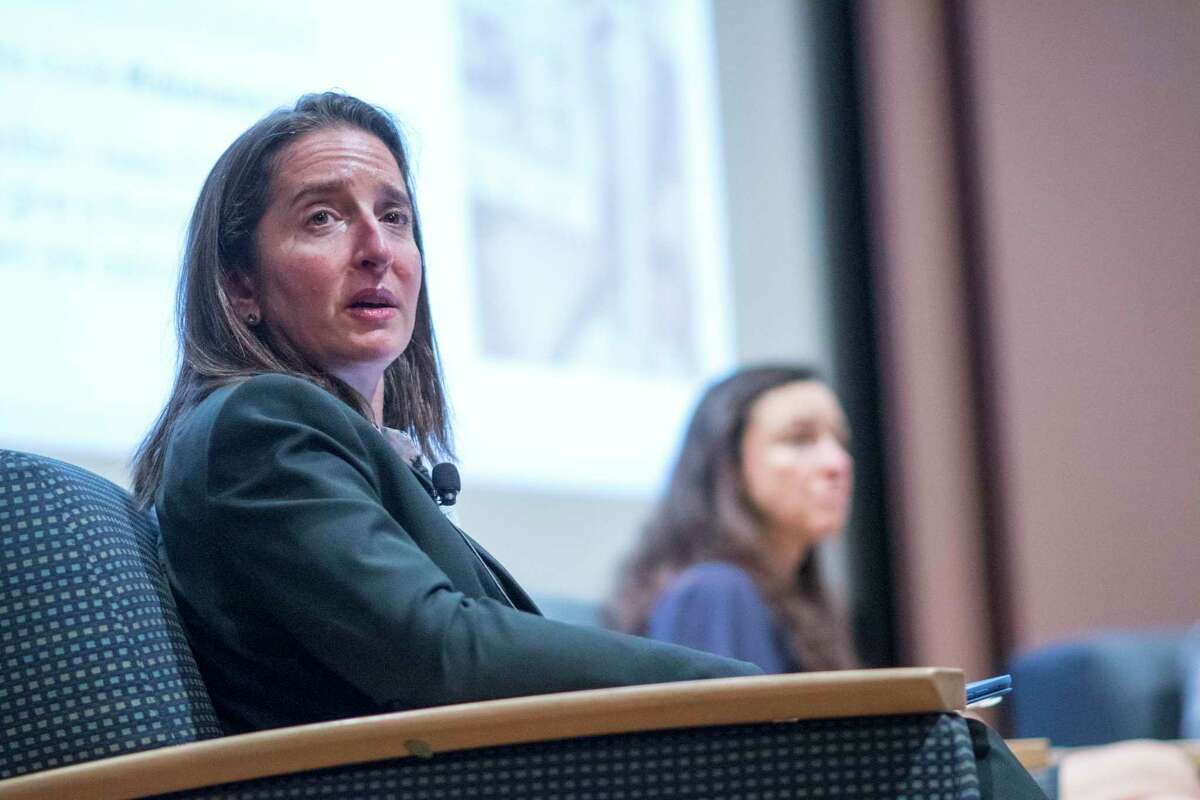
I recently interviewed, by email, Lynn Oberlander, the lead attorney in the case. A graduate of Yale University and Columbia Law School, she has served for almost 25 years as general counsel of leading digital media companies as well as The New Yorker magazine, and she has held senior in-house roles at Univision, Forbes, and NBC. Since 1998, Ms. Oberlander has taught Media Law and Media Ethics at the New School and is a frequent speaker and author on media law topics, including freedom of expression, national security and espionage, news gathering and encryption, access, defamation, copyright, and ethics.
Related stories
Rohde: Tell us about the plaintiffs you are representing and some of the books that Escambia County has targeted.
Oberlander: We’re representing PEN America, Penguin Random House, and a number of authors whose books have been challenged and have been either removed from school libraries within the school district or moved into restricted access pending review. Our plaintiff authors include Sarah Brannen, George M. Johnson, David Levithan, Kyle Lukoff, and Ashley Hope Pérez. In addition – and importantly – our plaintiffs include seven parents of ten children within the Escambia school district, who are suing on behalf of themselves and their children. The parents allege that both they and their children want the children to be able to read and access the removed and restricted books and to be exposed to the stories and viewpoints within them.
A substantial number of the removed and restricted books deal with issues or have characters who are of color or LGBTQ, and have been targeted because they contain disfavored viewpoints. Among the challenged books are The Kite Runner by Khaled Hosseini, Milo Imagines the World by Matt de La Pena, Two Boys Kissing by Plaintiff David Levithan, Too Bright to See by Plaintiff Lukoff, Beloved by Toni Morrison, and Slaughterhouse-Five by Kurt Vonnegut. These are just a very few of the titles that have been challenged.
Rohde: What actions has Escambia County taken to remove or restrict these books that you allege violate the First Amendment?
Oberlander: Since May 2022, when the current wave of book restrictions began in Escambia County, challenges have been filed for over 200 books, including many award-winning classics and books that have been on the shelves for years, and the School Board has voted to remove (or “ban” in common parlance) 10 books, including The Bluest Eye, Lucky, The Nowhere Girls, And Tango Makes Three, When Aidan Became a Brother, All Boys Aren’t Blue, The Perks of Being a Wallflower, New Kid, Drama, and Push (the source for the 2009 movie Precious). In addition, while awaiting “review,” the school board has placed over 150 books on restricted access, which means that the books were removed from the shelves and placed in a special area of the library. To access the books, the students, including kindergarteners, have to go to a librarian, ask for specific access to a restricted book, and have the librarian check to see if they have parental permission.
For each of the ten books that have already been removed from the school district, the School Board overrode the decision of its appointed district review committee, and it is clear that these books have been removed or restricted based on the viewpoints they express, which is unconstitutional, and not for legitimate pedagogical reasons.
For example, the School Board ordered the removal of the 2005 children’s book, And Tango Makes Three by Peter Parnell and Justin Richardson, which tells the true story of two male penguins in the Central Park Zoo who incubated an egg together. The book has been available in the school district and elsewhere for years, but in 2022, a school teacher named Vicki Baggett decided it should be banned because it promoted “LGBTQ agenda using penguins”. Although the district review committee that reviewed the book voted to retain the book. as it was educationally appropriate for the recommended grade levels, the School Board overrode that decision and removed the book.
Ms. Baggett has been a leader in the removal efforts in the District, and ultimately filed over 100 book challenges. All of the removed books so far have been based on her challenges, and in each case, the School Board overrode the recommendation of its appointed committee of experts, the district review committee.
We’ve brought three claims in our suit: The first, brought on behalf of the authors, PEN America, and Penguin Random House, argues that the School Board’s actions constitute impermissible viewpoint discrimination under the First Amendment; the second alleges that the Board’s actions violate the parents’ and students’ right to receive information under the First Amendment; and the third, brought on behalf of the authors, PEN, and the parents and students, asserts that discriminatory animus has motivated the removals and restrictions, and violates the Equal Protection clause.
Rohde: Under the law, do parents have any role to play in the education of their children and in the selection of books used in classrooms and school libraries?
Oberlander: Absolutely. Parents have a significant role to play in both the education of their children and in the selection of books used in classrooms and school libraries. And elected school boards are generally the voice of the parents and represent local views. But the Supreme Court has repeatedly ruled that those rights are not absolute, that students have rights to receive information, and that there are constitutional constraints on what school boards can do.
This is not the first time that our nation has been convulsed by book bans and book restrictions. There was a previous wave in the late 1970s, for example, and at that time the Supreme Court stepped in and issued its only decision thus far that directly took on public school book bans. In Board of Education v. Pico (1982), the Court was faced with a similar dilemma: nine books had been banned from school libraries in the Island Trees school district in New York.
The Justices issued a fractured opinion, with no one position commanding a majority. The Court’s plurality decision recognized the important role that local school boards play in determining the educational priorities of their communities, but found that school boards could not order books removed from the shelves to deprive students of “access to ideas” with which the board members disagreed. As Justice William Brennan concluded, “In brief, we hold that local school boards may not remove books from school library shelves simply because they dislike the ideas contained in those books and seek by their removal to ‘prescribe what shall be orthodox in politics, nationalism, religion, or other matters of opinion.’”
And a majority of Justices accepted that school boards could not remove books from a library in a “narrowly partisan or political manner.” (Justice William Rehnquist, dissenting) (quoting plurality opinion on this issue and “cheerfully conced[ing] the point”).
But this is precisely what is going on in Escambia County and other districts around the country: Books are being challenged and removed because the books express views that some find distasteful. The book removals and restrictions upon which we focused, for example, are disproportionately books that are by or about people of color, or people who are LGBTQ. And the viewpoint discrimination is obvious: the challenge forms, which are the forms on which the objectors explain their objections, variously argue that the books are “LGBTQ indoctrination” or “woke indoctrination”.
For example, one of the books that has been challenged and is currently subject to “restricted access” is the award-winning Uncle Bobby’s Wedding by Plaintiff Sarah Brannen. The book features a child who attends her uncle’s wedding to his boyfriend. There is a picture of the men holding hands, but there is neither sex nor anything age-inappropriate in the book. Nevertheless, the challenge form asserted that the book “contains alternate sexual ideologies” and was prohibited under Florida’s Don’t Say Gay law. Although the law in question does not apply to school libraries, the book has been restricted pending review merely because it recognizes the existence of LGBTQ people and same sex relationships.
Similarly, the challenge form for New Kid, a graphic novel by Jerry Craft that tells the story of a 12-year old Black student who experiences culture shock when he enrolls in a private school, asserts that the book involved “race-baiting”, reflected “anti-whiteness” and promoted a “woke agenda.” The School Board voted to remove New Kid from elementary school libraries, again overruling the district review committee, which had voted to retain the book.
At the high school level, the School Board has removed classics like Toni Morrison’s The Bluest Eye, and Saphire’s Push, both over the district review committee’s recommendation. The upper level books are often challenged on the grounds that they contain descriptions of sexual assault or sexual activity, but we think it is pretty obvious that that is being used as a pretext.
Rohde: Escambia County has recently moved to dismiss your lawsuit. What arguments are the defendants making to challenge the merits of your case, and what has the Supreme Court previously said which you believe supports your claims?
Oberlander: In its Motion to Dismiss, the School Board threw up a whole host of defenses, ranging from arguing that the Complaint was a prohibited “shotgun pleading,” whch made lots of allegations without a legal basis, to arguing that the plaintiffs don’t have standing and that recent legislative enactments in Florida have rendered the claims moot.
The most aggressive claim that Defendant made is perhaps the argument that none of the plaintiffs, including the parents of the students and the authors of the books, have any right to object to any actions of the School Board because the removal and restriction of library books constitutes unreviewable “Government Speech.” The School Board has grossly overstated this doctrine and its applicability to challenges to book restrictions. Every court that has reviewed similar actions has found that there are constitutional limits to book removals, though they have differed as to what those limits are.
The Supreme Court made it very clear in Tinker v Des Moines Ind. Community Sch. Dist. (1969) that “First Amendment rights, applied in light of the special characteristics of the school environment, are available to teachers and students. It can hardly be argued that either students or teachers shed their constitutional rights to freedom of speech or expression at the schoolhouse gate. This has been the unmistakable holding of this Court for almost 50 years.”
The Court acknowledged that Boards of Education “have, of course, important, delicate, and highly discretionary functions, but none that they may not perform within the limits of the Bill of Rights. That they are educating the young for citizenship is reason for scrupulous protection of Constitutional freedoms of the individual, if we are not to strangle the free mind at its source and teach youth to discount important principles of our government as mere platitudes,’" quoting West Virginia Board of Education v. Barnette (1943).
“In our system,” the Court explained, “students may not be regarded as closed-circuit recipients of only that which the State chooses to communicate. They may not be confined to the expression of those sentiments that are officially approved.” Indeed, “vigilant protection of constitutional freedoms is nowhere more vital than in the community of American schools.”
I should note that we were supported by two excellent amicus briefs: One, brought by 24 First Amendment scholars, discussed the government speech theory, and the other, filed by the Florida NAACP and Equality Florida, argued that book removals and restrictions deny students access to perspectives about race, racism and LGBTQ identities and disproportionately harm black and LGBTQ students and their families.
Rohde: PEN recently issued a report revealing that in the 2022–23 school year, from July 1, 2022, to June 31, 2023, 3,362 books were banned or restricted in US public school classrooms and libraries, denying students access to 1,557 unique book titles. More than 40 percent of all book bans occurred in school districts in Florida. Across 33 school districts nationwide, PEN recorded 1,406 book ban cases in Florida, 625 bans in Texas, 333 bans in Missouri, 281 bans in Utah, and 186 bans in Pennsylvania.
Do you believe this nation-wide movement poses a threat to our democracy? And what impact do you hope to achieve if your lawsuit is successful?
Oberlander: We absolutely believe it poses a threat to our democracy. In Pico, the plurality “acknowledged that public schools are vitally important ‘in the preparation of individuals for participation as citizens,’ and as vehicles for "inculcating fundamental values necessary to the maintenance of a democratic political system." And the public school library is central to encouraging students’ intellectual development. “‘[S]tudents must always remain free to inquire, to study and to evaluate, to gain new maturity and understanding. The school library is the principal locus of such freedom,’” (quoting Keyishian v. Board of Regents (1967)).
Public school libraries are designed to help foster educated citizens in part by exposing students to a broad range of views. Removing and restricting access to books because someone doesn’t like the message (or presumed message) limits the viewpoints available and runs counter to the ideal of a library as a marketplace of ideas. It weakens public education as well, and seems designed to inculcate a type of group-think that is profoundly anti-American and antithetical to the First Amendment.
We’re very pleased that around the country, defenders of the First Amendment are successfully fighting back. Another case is pending in Florida against the Escambia School Board, Lake County School Boards and Florida officials, challenging the removal of And Tango Makes Three, and also challenging a Florida statute that proscribes books concerning sexual orientation from school classrooms (Parnell v. School Board of Lake County, Florida).
In March, a federal court in Texas enjoined a local public library board from removing and restricting books to minors that some found objectionable, including various LGBTQ and Critical Race Theory-themed books, including children’s books with cartoon nudity such as In the Night Kitchen. (Little v. Llano County). In July, a federal court enjoined an Arkansas law requiring censorship of certain non-obscene books in a public library (Fayetteville Public Library v. Crawford County). And in September, a federal court enjoined a Texas law requiring booksellers who sell to schools to rate books as “sexually relevant” or “sexually explicit” and prohibiting the sale to schools of non-obscene books that are “sexually explicit” (Book People, Inc. v. Wong).
As to the impact we are seeking, in the immediate sense we’d like the removed and restricted books to be returned to circulation in the Escambia County school libraries, where they will be available for students to find, read, and engage with the ideas they contain.
In the larger sense, we hope that our lawsuit will remind School Boards that their actions are constrained by the Constitution and that they cannot remove or restrict books for non-pedagogical, political reasons. To repeat, we hope to ensure that those in charge of our children’s education understand that students do not “shed their constitutional rights to freedom of speech or expression at the schoolhouse gate.”
Comments

Powered by RoundtableAn AI/DeFi-powered Enterprise Media Operating System. Learn more at Roundtable.io.© Roundtable 2026. By using this site you agree to the Terms of Use and Privacy Policy