
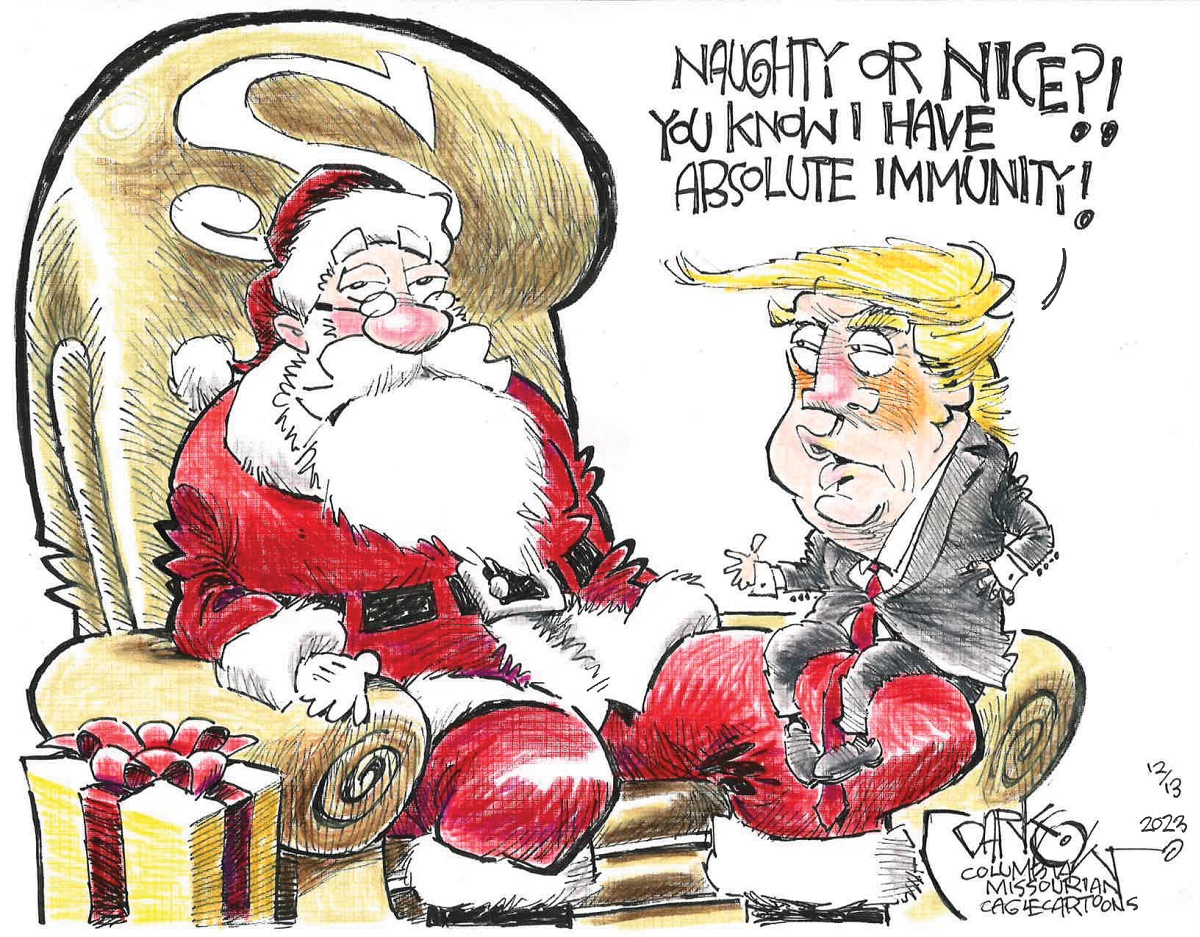
Cagle Cartoon: John Darkow


Jack Smith Should Ask
Mar 10, 2024 4:30 PM
By staying Trump’s trial, the Supreme Court risks destroying accountability to the voters in the 2024 elections, even if it ultimately concludes that former President is not immune from criminal prosecution.
Last week, the Supreme Court not only decided to take up former President Trump’s claim of absolute immunity, it also prevented his trial from proceeding. Interfering with Trump’s trial creates a risk that voters deciding whether to support the former president may go to the polls ignorant of the most important facts about him. Many of them may not know whether Trump criminally conspired to overturn the 2020 presidential election results. By staying Trump’s trial, the Supreme Court risks destroying accountability to the voters in the 2024 elections, even if it ultimately concludes that former President is not immune from criminal prosecution. There is no good reason for the Court to take that risk, even if the Justices feel obliged to rule on the merits of the immunity claim.
If the trial proceeds and the Court subsequently determines that Trump is immune, the Court can stop proceeding then and void any verdict.
Normally, claims that a conviction may prove improper do not generate stays (or pre-trial review), precisely because a stay interferes with orderly, prompt trials. And there has never been a case where the need for an orderly, prompt trial is greater. If the trial proceeds and the Court subsequently determines that Trump is immune, the Court can stop proceeding then and void any verdict.
The main reason that courts nevertheless stay trials to review immunity claims is absent here. Immunity claims in the past have only applied to officials engaged in federal service. Immunity protects officeholders from having to participate in a trial, because it distracts them from performing their official duties. But President Trump has no official duties, because he is no longer president. The usual rationale for the extraordinary remedy of a pre-trial stay is absent here.
Related stories
The other reason for a stay is also absent here. The Court stays proceedings lest fear of the burden of trials deter officials from fearlessly carrying out their duties. But this fear rationale cannot apply to President Trump. He has already completed his term of office, undaunted by fears of criminal prosecution. And the immunity he seeks does not yet exist. If the Court decides to create such an immunity, it will be appropriate to stay proceedings in the future when an immunity claim is presented. But there is no need to stay former President Trump’s trial, since fears of the burdens of trial cannot influence how he performs his duties, as he does not currently occupy an office.
Perhaps sensing the weakness of the traditional rationales for a stay in this case, President Trump’s lawyers argued that a trial distracts him from campaigning for the presidency. This novel argument does not hold water. Accepting this idea would mean that accused criminal candidates who committed their crimes while out of office would face the burdens of criminal prosecution during a campaign, but those who committed crimes while in office could delay trials, hardly a recipe for fair elections or responsible government. Furthermore, the timing may not work. Delaying trial might force Trump to defend at the most important moment of the presidential election.
Jack Smith, the Special Counsel, did argue that the public has an interest in a speedy trial in this case. But he did not point out that the policies that support a stay in most immunity cases do not support a stay in this case. He should ask the Supreme Court to lift the stay because a stay is unnecessary to meet any legitimate need.
This would give the Court a chance to demonstrate that it takes equity and fairness seriously and is not simply protecting the leading Republican candidate from trial on serious charges quite germane to his qualifications to become President again. A pre-trial stay is an extraordinary remedy, to be granted only when equity and fairness clearly favor it. Equity and fairness do not favor it here.
Lifting the stay would also take pressure off the Court, allowing it to take the time it needs to carefully consider the immunity issue without immunizing Trump from accountability solely through its delay. President Trump probably appointed Brett Kavanaugh to the bench precisely because Justice Kavanaugh is on record as favoring presidential immunity from criminal prosecution. But if the Court is approaching this case with an open mind and not with the intent to let Trump off the hook, it will lift the stay.
Comments

Powered by RoundtableAn AI/DeFi-powered Enterprise Media Operating System. Learn more at Roundtable.io.© Roundtable 2026. By using this site you agree to the Terms of Use and Privacy Policy